Jinggangshan: China's Red Tourism Cradle
Jinggangshan, birthplace of China's Red Army: what red tourism means, Huangyangjie, the Martyrs' Cemetery, waterfalls, and getting there from Nanchang.
By Hello Nanchang · Last updated
Jinggangshan, Ji'an, Jiangxi Province, China · Allow 2 days; best in spring (azaleas, Apr–May) or as a summer cool-escape
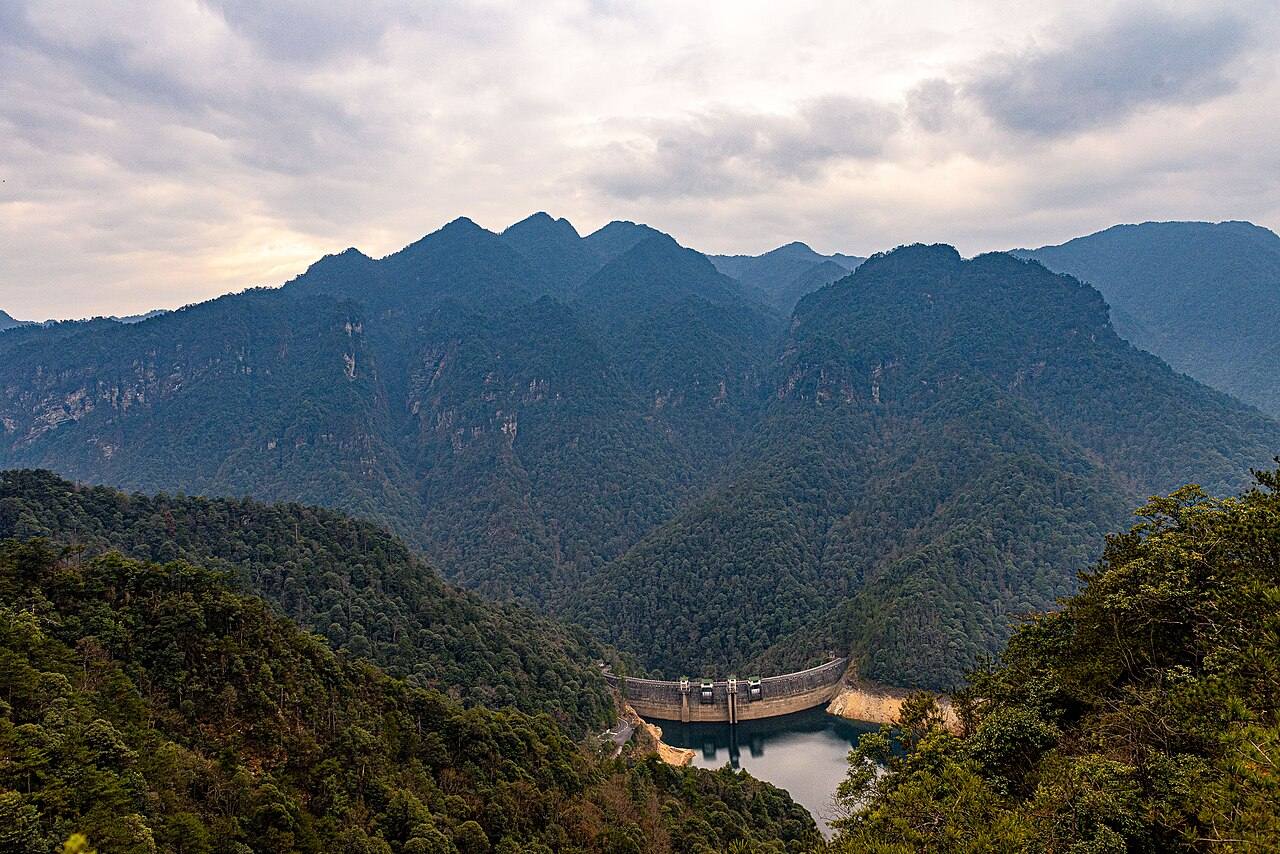
Come up onto Huangyangjie on a clear morning and the valleys below have filled with cloud overnight — a white floor of it, breaking slowly against the ridges. Behind you, a company outing in rented Red Army caps is arranging itself for a group photo under a granite stele. A guide with a loudhailer is telling the mortar story for the fourth time this hour. Somebody's grandmother is selling cucumbers out of a bucket.
That is Jinggangshan (井冈山) in a single frame: a serious mountain and a nation's founding story, sold at the same gate. It sits on the Jiangxi–Hunan border, roughly three hours south of Nanchang by train, more than eighty per cent of it under forest — and it is at once one of the most visited places in the province and one of the least visited by foreigners, who tend to assume it's a political theme park. It isn't. It's a cool, green, inexpensive mountain town with an unusually well-funded set of museums bolted on, and the story those museums tell is gripping whatever you make of what grew out of it.
Two days does it properly: one for the ridges and waterfalls, one for the town and the history. Here's how the mountain works — tickets, shuttle lines, what to eat, what to skip.
What "red tourism" actually is
Jinggangshan means "well ridge mountains," and for most Chinese visitors the name carries the weight that Gettysburg or Valley Forge carries in the United States. The short, neutral version: in October 1927, in the wreckage of that year's failed uprisings, Mao Zedong led a small force up into these hills and set up what is described as the Communist Party's first rural revolutionary base. The following spring, troops under Zhu De — survivors of the Nanchang revolt that August — joined him. The Red Army — forerunner of today's People's Liberation Army — is dated from that meeting, which is why the mountain is nicknamed the "Cradle of the Chinese Revolution."
Red tourism (红色旅游) is the enormous domestic travel category built on sites like this one: part history lesson, part pilgrimage, part patriotic day out. In practice you'll share the mountain with school groups in matching caps, corporate cohorts doing a "Red Army day," and busloads of retirees who waited a long time to come. Uniform rental is a small industry here — grey-blue tunic, red-star cap, canvas satchel — and the photographs are taken very seriously. You need no particular political view to find it interesting; treat it as a window into how a very large country tells its own origin story, and as the reason a remote mountain has immaculate roads, clean toilets and better museum lighting than most provincial capitals get. Nobody will ask what you think.
The part the brochures undersell: the scenery stands up on its own. Sub-tropical forest, stacked waterfalls, bamboo running up the slopes in green sheets, and a summer climate cool enough that Jinggangshan appears on China's official lists of hot-weather escapes. Come for the walking and treat the history as a bonus, or the other way round. Both trips work.
Getting there from Nanchang
Two sensible routes, and the better one depends on the timetable rather than on distance.
- Option A — direct train to Jinggangshan Station (井冈山站). There are direct services most days from Nanchang and Nanchang West, taking roughly 3 to 3.5 hours; recent timetables have shown around eight or nine trains a day between the two cities, a mix of faster D-class and slower conventional services, so check what's actually running on your date. Second class on the fast trains has been in the region of ¥120. Simplest option, one seat all the way.
- Option B — high-speed to Ji'an West (吉安西), then a bus. This one surprises people: the Nanchang–Ganzhou high-speed line puts Ji'an West about an hour from Nanchang West — the quickest runs have been around 55 minutes, the slower ones nearer an hour and a half — with dozens of departures spread across the day. From Ji'an West a tourist coach (locally the 601 line) runs up to Ciping via Ji'an's central bus station and the airport; allow about 1.5 to 2 hours and budget in the region of ¥35. Door to door it comes out similar to the direct train, but you get a far wider choice of departure times.
Whichever you pick, the mountain does not start at the station. Jinggangshan Station sits about 35 km from Ciping (茨坪), the small town at the centre of the scenic area where the hotels, the visitor centre and the shuttle terminus are. A local bus runs the link for a few yuan — locals quote around ¥8 — roughly every twenty minutes through the day, and a taxi has been running about ¥70. Allow 40 minutes to an hour on winding road, and don't book a train that gets you in after dark on your first night.
There is also Jinggangshan Airport (JGS), out in Tai'he county with flights to Beijing, Shanghai, Guangzhou and a few other cities. It's about 88 km from Ciping — an airport coach leaves the Ciping visitor centre a few times each morning, and a taxi has been quoted around ¥260. Use it if you're arriving from far away; from Nanchang, take the train.
Book rail on 12306.cn or an English-language reseller, and carry the passport you booked with — it's your ticket at the gate. Check which Nanchang station you're leaving from: the city has several, and Nanchang West is not walking distance from Nanchang station. Our Nanchang stations and airport guide untangles which is which, and getting around Jiangxi by train covers the wider network.
Tickets, shuttle lines and how the mountain works
Jinggangshan isn't one gate with one path behind it — it's more than twenty sites scattered across the ridges, run on a "one ticket" system: a single gate ticket, valid five days, admitting you to the lot. Buy once, then move around on the official sightseeing buses.
- Gate ticket. Recent quotes run roughly ¥150 to ¥190 per adult depending on season and what's bundled in, with the low rate through the winter months. Students and seniors get reductions with ID. Both the price and the bundling have moved more than once lately — treat this as a planning figure and confirm at the visitor centre.
- Sightseeing bus pass. Bought separately, listed by the scenic area at ¥80 per person, valid five days. Not optional in any practical sense: the sites are kilometres apart on mountain road.
- Longtan ropeway. Roughly ¥50 one way, ¥70 return — worth it climbing back out of the waterfall valley.
- Dujuanshan (Azalea Mountain) ropeway. A separate, longer cableway, about ¥150–160 return and not covered by the gate ticket. In azalea season it's the best money you'll spend here.
Budget roughly ¥250 a head for gate ticket plus bus pass, before ropeways. Buses leave the Ciping terminus from around 7:30am, roughly every half hour until early evening. Three lines cover almost everything:
- A line — terminus → Xiaojing (小井) → Longtan (龙潭) → Bamboo Garden (百竹园) → Huangyangjie (黄洋界). The big one; this is your mountain day.
- B line — terminus → Dajing (大井) → Shuikou (水口).
- C line — terminus → the Main Peak (主峰), for Wuzhifeng.
Two habits make the difference. Buy your gate ticket and bus pass the evening you arrive, not at 7:30 the next morning with everyone else. And on your mountain day, ride the A line to the far end first — do Huangyangjie before the coaches land, then work back down through the Bamboo Garden, Longtan and Xiaojing. Save the walkable Ciping sites (museum, Mao's residence, the cemetery) for the other day, when you need no bus at all. For the full hour-by-hour version, including the Nanchang days either side, see our Jiangxi red tourism itinerary.
The red sites — and the stories behind them
Most of the memorial museums are free; China dropped admission at patriotic-education sites some years ago. Reservation rules have flip-flopped — the Jinggangshan Revolutionary Museum dropped advance booking for individual visitors in 2024, so you can walk in with ID, while other sites have kept real-name registration. Carry your passport and assume the rule may have changed again by the time you arrive.
Huangyangjie (黄洋界) — a pass at about 1,343 m, roughly 17 km northwest of Ciping and the mountain's postcard image. On 30 August 1928 the garrison here — two companies, well under a battalion — held off four Nationalist regiments. The detail everyone comes for is the mortar: one repaired gun, three shells, and the mountain damp had ruined the first two. The third landed on the enemy command post. Convinced the Red Army's main force had come back, the attackers pulled out overnight. Mao, on his way back to the mountain with that force, heard the news and wrote the poem Xijiangyue: Jinggangshan, whose line about "the roar of guns on Huangyangjie" is still on the school syllabus. Read the monument while you're up there: the tall stele carries Zhu De's calligraphy on the front and Mao's own hand — "a single spark can start a prairie fire" — on the back, and the low horizontal one carries the poem.
From the pass you can also pick up the grain-carrying trail (挑粮小道), the stone path the base's supplies came up: about 3.1 km with roughly 700 m of climb from the village of Yuantou below, still walked by training groups in Red Army kit. The story attached to it is the one every Chinese schoolchild knows. Zhu De, then in his forties and commanding the army, insisted on carrying loads alongside the twenty-year-olds; when his men hid his shoulder pole to make him rest, he found another and wrote on it in brush characters, Zhu De's carrying pole — not to be taken. Sentimental, perhaps. You feel the point of it about ten minutes into the climb.
Jinggangshan Revolutionary Martyrs' Cemetery (井冈山革命烈士陵园) — on the north hill in Ciping, up a long flight of steps, and the most affecting thing on the mountain. In the two years and four months of the Jinggangshan struggle, something close to 48,000 people died — an average of around sixty a day. The wall of the memorial hall carries the names of 15,744 of them. In the centre of that hall stands a plain block of white marble with nothing carved on it at all: the monument to the thirty-thousand-odd who died without leaving a name. You do not need to share anyone's politics to stand in front of a blank stone and understand exactly what it means.
Jinggangshan Revolutionary Museum (井冈山革命博物馆) — 5 Hongjun South Road in Ciping, free, generally open Tuesday to Sunday from 9am with last entry in the late afternoon, closed Mondays outside public holidays. It lays out 1927–28 in order, with English on the main panels and a scale relief of the whole base area that finally makes the geography click. Ninety minutes. Do it before you go up the mountain, not after.
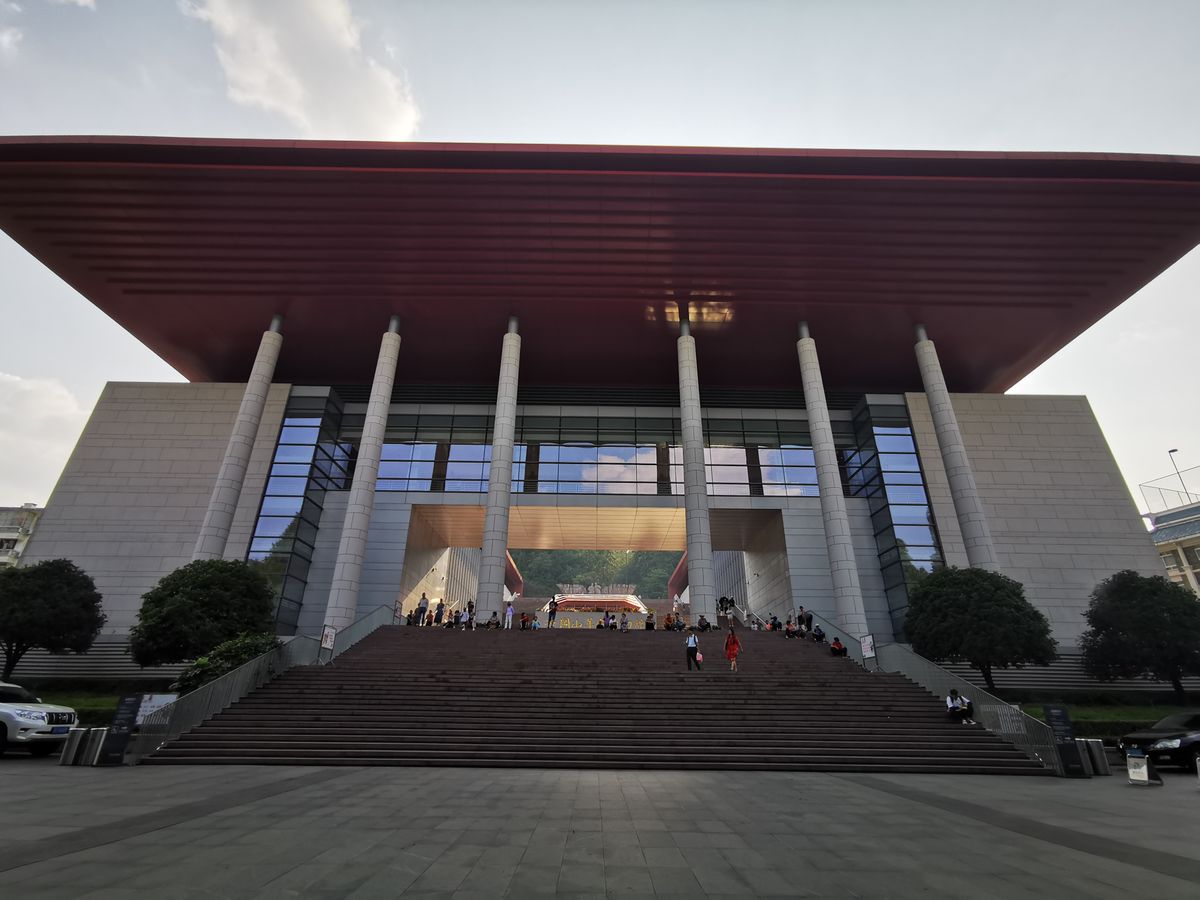
The Revolutionary Museum in Ciping — free, air-conditioned, and the ninety minutes that make everything else on the mountain legible. Photo: Liuxingy / Wikimedia Commons (CC BY-SA 4.0).
Dajing (大井), on the B line — the site locals call the White House (白屋), for the colour of its walls. It was a forty-four-room house, and Nationalist troops burned it in January 1929. What survived the fire: one scorched wall, two evergreens behind the building, and a large flat stone on the lawn out front where Mao used to sit and read. When the house was rebuilt in 1960 the surviving burnt wall was set into the new one — deliberately, as a scar you're meant to notice. The stone is still on the lawn. Of all the restored sites here, this is the one that feels least like a museum.
Xiaojing (小井), also on the A line — the Red Army's first proper field hospital, a plain two-storey timber building of thirty-odd rooms known as the Red Light Hospital. In January 1929 the Nationalists raided the village and took more than 130 wounded men who could not be moved. They were interrogated for the whereabouts of the main force, told them nothing, and were killed. Most of them are unnamed on the grave marker behind the hospital. It takes ten minutes to walk round and it is the quietest ten minutes you'll spend here.
The green side: waterfalls, bamboo and the ¥100 peak
If the history isn't your reason for coming, the landscape holds the trip up on its own.
Longtan (龙潭) — Five Dragon Pools and Eighteen Waterfalls. A steep, wet, ferny valley about 9 km from Ciping where the water comes down in stages through sub-tropical forest. The sensible way to do it is down on foot and up by ropeway: reckon on about an hour of steps going down, past pool after pool, with the noise building the lower you go. Spray on the stairs makes them slick — proper shoes, and mind the handrails. It's the single best two hours on the mountain for anyone who came for scenery rather than for 1928.
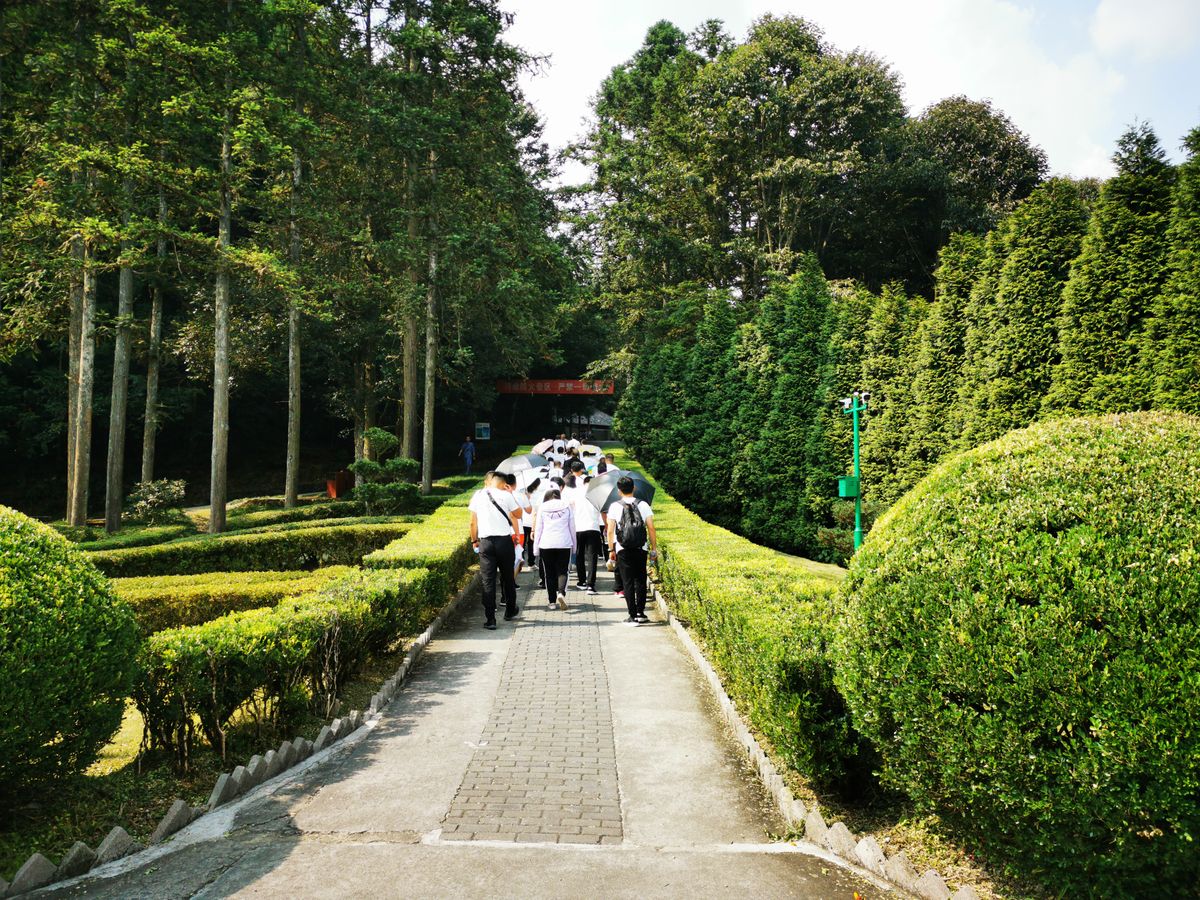
The way in to Longtan — the valley itself is about an hour of steps down past pool after pool, with the ropeway back up. Photo: Liuxingy / Wikimedia Commons (CC BY-SA 4.0).
Wuzhifeng (五指峰) — "Five-Finger Peak." The ridge on the back of China's old fourth-series ¥100 note, reached on the C line at the Main Peak stop. If you still have one of those notes in a drawer at home, bring it — holding it up against the skyline is the obligatory photograph, and admittedly a good one. Even without the note, the terrace gives you the best long view of the range.
Dujuanshan (杜鹃山), also called Bijiashan (笔架山) — the azalea ridge. Thirteen peaks lined up south of Ciping like a Chinese brush rest, which is where the second name comes from. The draw is the ten-li azalea corridor: twenty-six species of wild rhododendron along a cliff walkway with five viewing platforms, peaking mid-April to mid-May. Access is by a 5.2 km cableway — around twenty-five minutes each way, with no walking route up — and it costs extra, roughly ¥150–160 return. In bloom it is the best thing on the mountain. Out of season, skip it and spend the money on lunch.
Bamboo Garden (百竹园). A collection of well over a hundred bamboo species on the A line, twenty minutes' stroll, pleasant rather than essential — but the light through a bamboo stand on a grey morning is the photograph you'll actually keep.
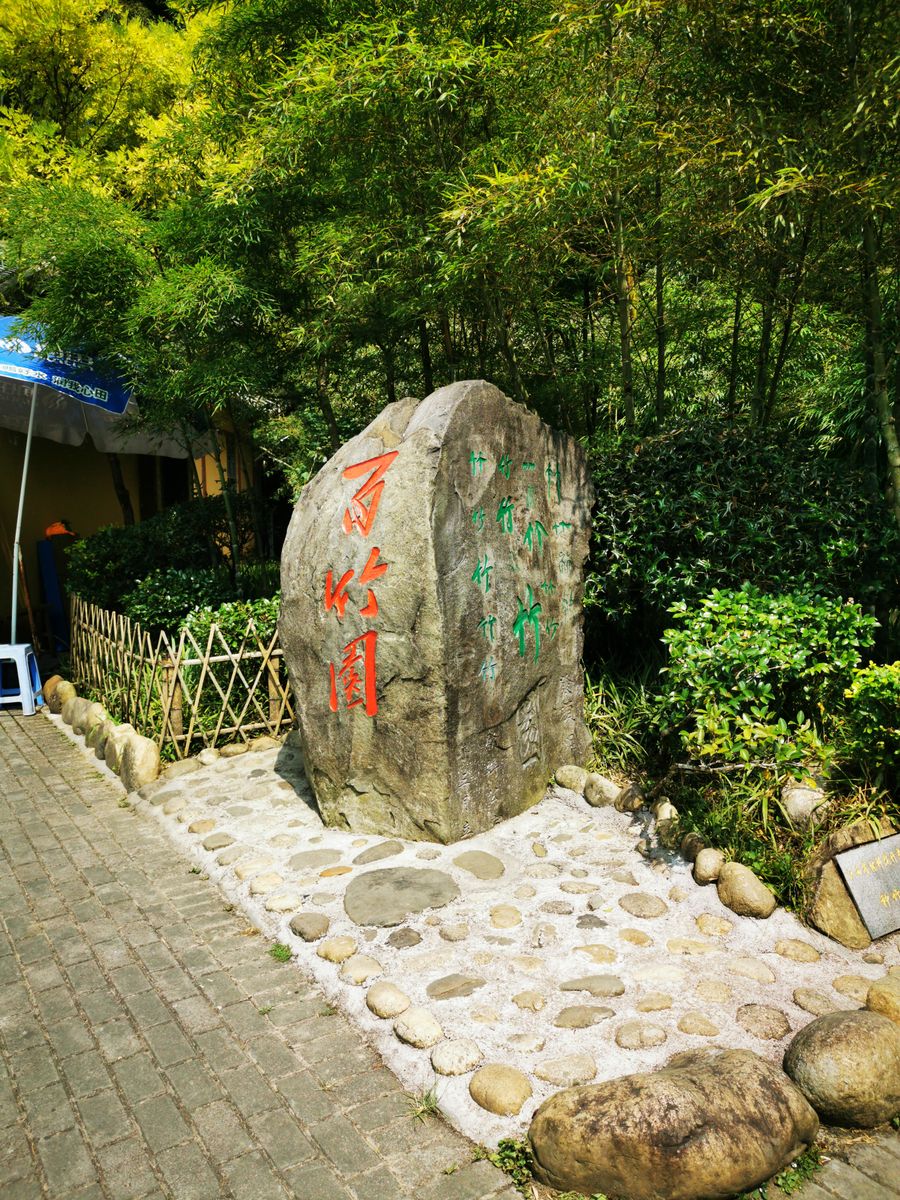
The Bamboo Garden on the A line — a twenty-minute stop, and welcome shade when the afternoon sun is full on the mountain. Photo: Liuxingy / Wikimedia Commons (CC BY-SA 4.0).
What to eat on the mountain
Jinggangshan cooks in the Luling (庐陵) style of surrounding Ji'an: smoky, salty, chilli-forward, heavy on things gathered off the hillside. It is not subtle and it is very good. A home-style table for two at a family restaurant in Ciping runs around ¥40–60 a head; hotel dining rooms and set "Red Army meals" cost more.
- Smoked bamboo shoots with pork belly (烟笋炒肉) — the dish to order if you order one thing. Spring shoots dried over a wood fire, rehydrated and stir-fried with fatty pork, garlic and chilli; chewy, smoky, deeply savoury. Lunch or dinner. Comes spicy — say shǎo là (少辣, less chilli) if you need it dialled back. Roughly ¥40–60 a plate, easily shared. Yes, a first-timer pick.
- Red rice and pumpkin soup (红米饭南瓜汤) — the "Red Army meal": coarse unhulled red rice, steamed plain, with a thin sweet pumpkin soup alongside. It comes from a marching song, and it is deliberately austere — this is history on a plate rather than dinner. Usually sold as part of a set. Not spicy, safe for anyone, and worth ordering once for the point it makes.
- The "three stones" (三石) — shíjī (石鸡), a mountain frog, braised or stir-fried; shí'ěr (石耳), a black fungus that grows on rock faces, usually steamed with chicken; shíyú (石鱼), tiny stream fish fried into an omelette or dropped into soup. Dinner dishes, and the frog and fungus are the expensive end of any Jinggangshan menu — a stone-frog dish can run past ¥100. The stone-fish omelette is the easy entry point; the frog is for the adventurous.
- Bamboo-tube rice (竹筒饭) — rice, sometimes with cured pork, packed into a green bamboo section and roasted until the tube chars and the grain picks up the smell of the wood. Snack or lunch, sold around the sights and along Ciping's pedestrian street, usually well under ¥20. Fun, cheap, excellent with children.
- Lianhua blood duck (莲花血鸭) — from the county next door: duck chopped on the bone and stir-fried hard with chilli, the sauce bound with its own blood so it clings dark and glossy. Dinner. Strong, salty, properly hot. More local than first-timer — order it if you already like Hunan or Jiangxi cooking.
Two honest notes. We're deliberately not naming individual restaurants: Ciping's line-up turns over fast, and a name verified today may be a phone shop by the time you read this — ask your guesthouse where they eat, and you'll usually end up a hundred metres away at half the tour-group price. Second, dog meat (狗肉) is traditional in parts of this region and does appear on menus. Worth knowing the characters if that matters to you.
Ciping after dark, and where to stay
Ciping sits at about 820 m, which is why July evenings here are pleasant while Nanchang is unbearable. It's a small, tidy, slightly unreal mountain town — planned, planted and built almost entirely around visitors — and half an hour walks you across it.
Yicui Lake Park (挹翠湖公园) occupies the middle: a lake with a nine-turn bridge and a tea pavilion, lit at night, free and open. At the southern end, Nanshan Park (南山公园) climbs to a torch monument on a terrace — go up at dusk for the view over the town roofs to the main peak. At the northern end there's a sculpture garden with nineteen larger-than-life figures of the base's early leadership. The pedestrian street handles the rest: bamboo-tube rice, dried mushrooms, sour-jujube sweets, and Red Army caps in every size.
There's also a large outdoor stage show, Jinggangshan, at the Red Army Theatre in the new town — running most evenings in season since 2008, around seventy minutes, seating tiered by military rank. It's near the railway station rather than in town, the schedule pauses in winter and for maintenance, and prices move, so check locally rather than assuming.
Stay in Ciping. It's inside the scenic area, walkable, and it's where the shuttle terminus is; sleeping down by the station saves money and costs you an hour each way. Simple hotels and guesthouses have started around ¥260 a night outside peak periods, with more comfortable mountain-view rooms from roughly ¥500. In azalea season and over public holidays the town genuinely sells out — book well ahead and expect peak rates.
When to go — and what to skip
- Spring (April–May) — the prime window, and the only time Dujuanshan makes sense. Azaleas peak mid-April to mid-May. Also the busiest; book everything.
- Summer (June–August) — the cool-escape season. While Nanchang sits in the high thirties, Ciping is genuinely comfortable. Families everywhere, and afternoon thunderstorms.
- Autumn — clear, dry, quiet. The best walking of the year and the easiest to get a room.
- Winter — cold, often fogged in, sometimes frosted or lightly snowed. Atmospheric, low season rates, and the cloud sea at Huangyangjie is more likely — but the mountain feels shut.
What to skip. Don't attempt Jinggangshan as a day trip from Nanchang — three hours each way plus an hour from the station buys you about four hours on the mountain. Don't pay for the Dujuanshan ropeway outside azalea season unless the weather is exceptional. Don't expect English away from the main museum; trail and restaurant signage is Chinese only and a translation app earns its keep. Don't count on a foreign card anywhere — set up Alipay or WeChat Pay before you fly. And be realistic about crowds: in the first week of May or October the memorial sites can feel like a station concourse. Go midweek if you possibly can.
Practical info
- Getting there: direct train from Nanchang to Jinggangshan Station (~3–3.5 hrs), or high-speed to Ji'an West (about an hour) plus the 601 coach (~1.5–2 hrs). Station to Ciping is ~35 km, 40–60 minutes by local bus or taxi.
- How long: two days and one night minimum; three days if you want the Main Peak and Dujuanshan as well.
- Tickets: one gate ticket (recently ~¥150–190 by season, valid five days) plus the ¥80 sightseeing bus pass; ropeways extra. Museums and memorial sites are free. Confirm current prices on arrival.
- Pay & language: Alipay / WeChat Pay everywhere, foreign cards nowhere. Passport for museum registration. English on major museum panels only.
- Bring: layers, rain shell, grippy shoes for the Longtan steps, and cash-free payment sorted before you leave the city.
- Good for: history-minded travellers, summer heat-escapers, walkers, photographers, anyone curious about how modern China narrates itself. Less good for: tight schedules, mobility-limited visitors (a lot of steps), and anyone expecting bilingual hand-holding.
Common questions
Is Jinggangshan worth it if I'm not interested in Communist history? Yes, but be honest about the ratio: roughly half of what's here is memorial. The other half — Longtan's waterfalls, the bamboo, the azalea ridge, the cool summer air — would justify a mountain break anywhere. If you have only one mountain day in Jiangxi and no interest in the history at all, Wugongshan's grasslands or Sanqingshan's granite peaks will suit you better.
How many days do I need, and can I do it as a day trip? Two days and one night covers the essentials; three lets you add the Main Peak, Dujuanshan and a slower morning in the Ciping museums. A day trip from Nanchang isn't realistic — it's about four hours door to door each way. Stay the night in Ciping.
Do I need to book tickets in advance? Not the gate ticket or the bus pass — buy both at the Ciping visitor centre. Do book your train and your room ahead, especially in spring and over public holidays. Museum reservation rules change; carry your passport and check the official channel a few days before.
Is it difficult for non-Chinese speakers? Manageable, not effortless. The main museum has English panels; almost nothing else does. Buses are numbered and colour-coded, hotel staff are used to arranging taxis, and a translation app plus a screenshot of 茨坪 gets you a long way.
Fitting it into a trip
Jinggangshan pairs naturally with Nanchang — that's where the 1927 story starts and where your train comes from either way. For the two of them as a planned route with the timings worked out (which museum on which day, when to catch which train, how to dodge the Monday closures), we've laid it out day by day in our Jiangxi red tourism itinerary. For the city itself, start with the Nanchang travel guide; for where the mountain sits in the province, browse all our Jiangxi destinations or the 5–7 day Jiangxi loop.
Want it built around your dates, your pace and how much history you actually want? Plan your Jiangxi trip with us and we'll do the timetable wrangling.
Cover photo: "Wuzhi Peak, Jinggangshan" by N509FZ (CC BY-SA 4.0) via Wikimedia Commons. In-article photos: "井冈山革命博物馆 01", "井冈山龙潭景区 01" and "井冈山百竹园 01" by Liuxingy (CC BY-SA 4.0) via Wikimedia Commons.
Last verified: 2026-08 — train times, fares, gate-ticket prices, ropeway and shuttle fees, museum reservation rules and opening hours all change often. Please double-check official sources before you travel.
You Might Also Like
- Lushan (Mount Lu): China's Summer Escape
- Nanchang Travel Guide: Jiangxi's Capital
- Poyang Lake Nature Reserve: See the Cranes
Explore Nanchang & Jiangxi itineraries · Plan a custom trip with us