Nanchang Countryside: Villages & Day Trips
A deep, seasonal guide to the countryside around Nanchang: old villages, tea and fruit farms, Junshan Lake crab and cool Meiling — how and when to go.
By Hello Nanchang · Last updated
Countryside around Nanchang — Anyi, Xinjian, Jinxian & Nanchang counties
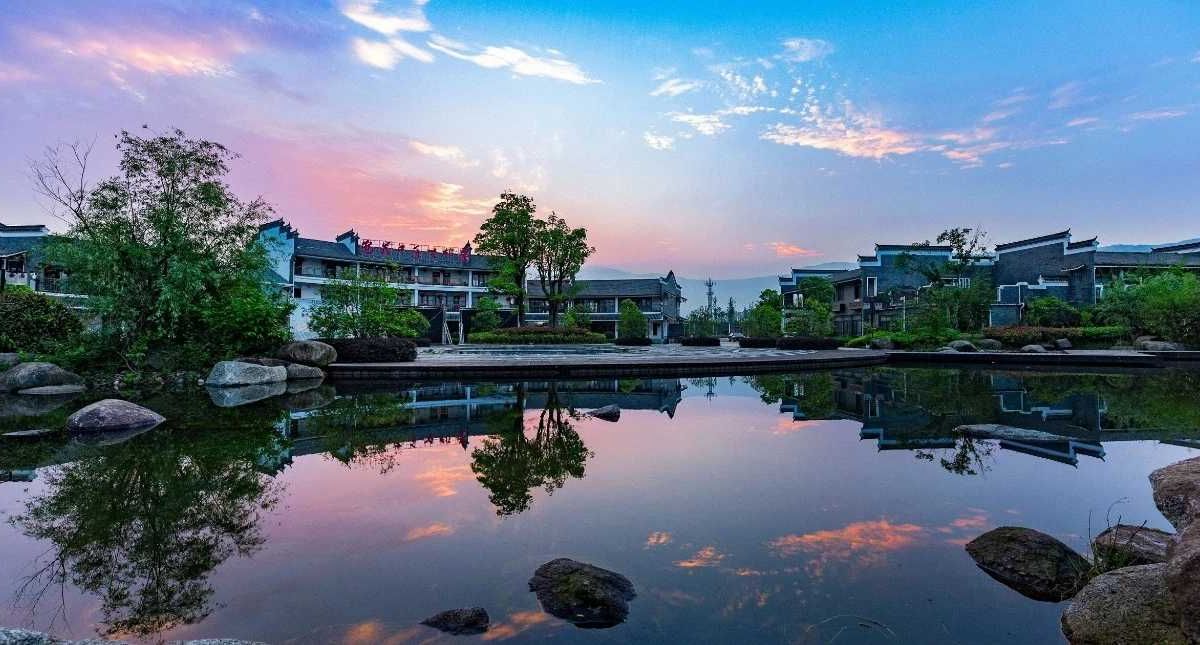
Drive twenty minutes past Nanchang's ring road and the city just stops. The malls thin out, the paddies open up, and the flat green of central Jiangxi rolls to the horizon in every direction — camphor trees over stone lanes, tea terraces on low hills, a lake so wide you lose the far shore. Most visitors treat Nanchang as a one-night stop between fast trains, do Tengwang Pavilion and a bowl of rice noodles, and move on. They miss the better half of the trip: the ring of villages, farms and forest hills that sits inside an hour of Bayi Square, and rewards you differently in every season.
This is your guide to that ring — the real, verifiable places, told deeply enough that you can actually go do each one. It's the countryside the original day-trip lists skip past: Anyi's thousand-year-old Ming and Qing villages, the tea gardens and fruit farms of the southern counties, autumn crab on Junshan Lake, and the cool green hills of Meiling when the city turns into a furnace. No fixed dates here — everything is framed by season, so it holds up whenever you happen to be in town.
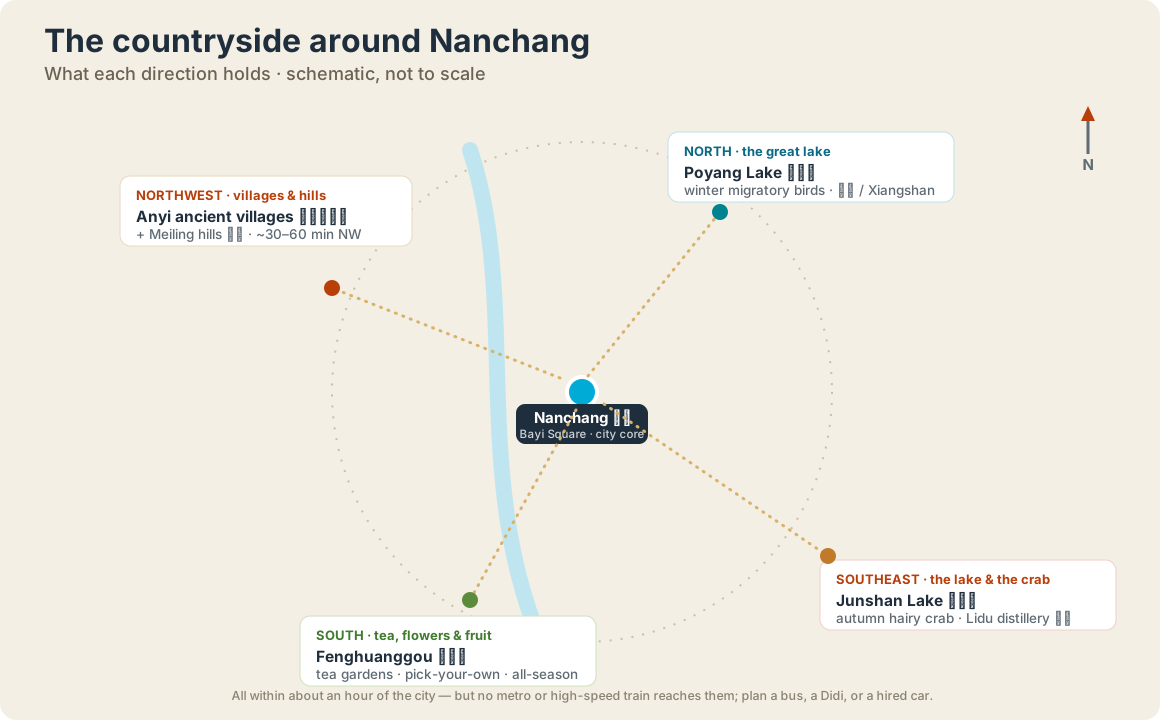 The lay of the land: what each direction out of Nanchang holds — all within about an hour of the city.
Why bother — and how the land lies
Here's the honest pitch: Nanchang itself is an underrated but compact city — you can see its headline sights in a day and a half. The countryside is where a longer stay earns its keep. It's cheap (most of these places cost between nothing and ¥50 to enter), it's genuinely local rather than packaged, and because Jiangxi's foreign-tourist numbers are low, you'll often have a whole Ming courtyard or a tea slope more or less to yourself.
The one thing to get straight before you plan anything: no metro line and no high-speed train reaches these rural sights. The subway stays inside the built-up city; the HSR is for bigger destinations further out (Jingdezhen, Lushan, Wuyuan). A suburban commuter-rail plan for the "Greater Nanchang" region — including a line toward Anyi — has been floated, but it isn't running, so don't count on it. Countryside days here mean a bus, a Didi, or a hired car. More on that below; it shapes how you plan.
Roughly, the interesting country falls into four directions:
- Northwest — the ancient villages & the hills. Anyi County (安义县) and its Ming/Qing village cluster; Meiling (梅岭), the forest-park ridge that's Nanchang's summer air-conditioning. History and nature.
- South — tea, flowers & fruit. Nanchang County (南昌县) around Fenghuanggou (凤凰沟), a sprawling tea-and-silk eco-park that's good in every season and best for families.
- Southeast — the lake & the crab. Jinxian County (进贤县) and Junshan Lake (军山湖), Nanchang's answer to the famous hairy-crab lakes, at its best in autumn. Jinxian is also home to a surprising bit of liquor history.
- All around — the farms. Pick-your-own orchards scattered through every county, with something ripe in almost every month.
If you want the big countryside trip — postcard whitewashed villages and terraced gold on a scale Nanchang's own fields can't match — that's Wuyuan (婺源), in northeast Jiangxi, and it's a proper overnight by train, not a Nanchang day-trip. What follows is the closer, quieter layer you can do and be home for dinner.
The ancient villages: Anyi (安义古村群)
Start here, because it's the single best half-day of the lot. About 55–60 km northwest of central Nanchang, tucked against the foot of the Meiling hills, the Anyi Ancient Villages cluster (安义古村群) is three old villages sitting in a loose triangle, each maybe 300 metres from the next, joined by stone-paved lanes: Luotian (罗田村), Shuinan (水南村) and Jingtai (京台村). Together they've stood, in one form or another, for more than a thousand years — Jingtai's roots reach back to the early Tang, Luotian to the late 800s, Shuinan to the early Ming — and the cluster is billed, fairly, as a "thousand-year village." It's a national 4A scenic area and a listed historic-and-cultural village, which in plain terms means it's protected and reasonably well kept, not a rebuilt film set.
What survives is the point: more than a hundred Ming and Qing dwellings, granite streets worn smooth, ancestral halls, an old opera stage, a village school, and the carving — stone, wood and brick — that Jiangxi merchants poured their money into when this was a prosperous trade corridor. Walk slowly and you'll find a window carved with a hundred bats (the "Hundred Blessings" screen, 百福图), each in a different pose, a small joke in wood four centuries old.
The one building not to miss is the Shidafudi mansion (世大夫第) in Luotian — a Qing-era scholar-official's compound of eleven linked halls and a warren of skylit courtyards, with an intact underground drainage system that still handles the rain. And near the entrance stands a Tang-dynasty camphor tree, more than a thousand years old, broad enough that you'll want the photo. There's a Song-style tea-whisking experience, a clutch of craft workshops, a Jiangxi-merchant (赣商) museum, and, on and off through the year, folk performances — dragon and lion dance, opera, a periodic craft market. These are programming that changes, so treat them as "if it's on, enjoy it" rather than a reason to time your trip.
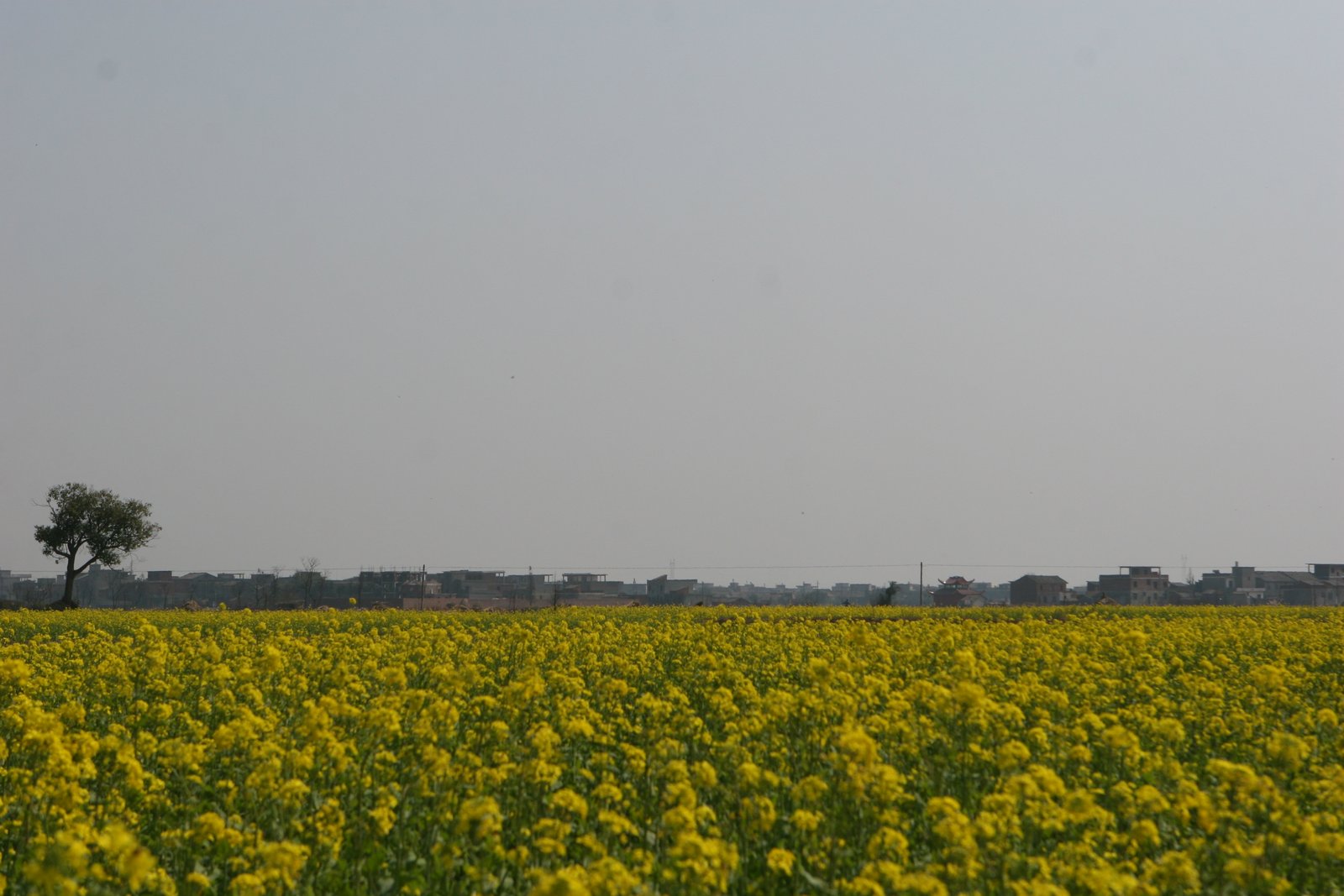 In spring the fields around the Anyi villages and across the county turn gold with rapeseed — go in the first hour after the gate opens, for the low light and the quiet before the tour groups. Photo: 张元柏 / Wikimedia Commons (CC BY-SA 3.0).
Doing it right
- The walk: do the three villages in order — Luotian → Shuinan → Jingtai (or the reverse). An unhurried loop is about three hours; make it a full day if you stop for tea, lunch and the workshops. An electric shuttle cart runs from the main gate to Luotian if you'd rather not walk the whole way.
- Tickets: entry is around ¥40 for an adult at last check — but note it's been listed higher in the past, so treat that as a guide and check the current price at the gate or on a listing app before you go. A shuttle-cart fee (roughly ¥15) is usually separate; combo cart-plus-ticket packages have existed. Kids, students, seniors and Anyi residents typically get half price.
- Hours: roughly 8:30am–5pm (some listings say 8am–5:30pm). Buy tickets at the gatehouse by the entrance. Confirm current hours before setting out.
The rapeseed — a spring bonus, not the whole show
In spring, the fields around the villages and the wider county turn gold with rapeseed (油菜花). Bloom peaks in March and tapers into April — a month-range, not a fixed date, and it shifts a week or two with the weather each year. The signature shot is the grey-tiled old houses framed by a sea of yellow. Anyi runs a "Golden Flower" tourism festival in the flowering weeks, but the dates change annually, so don't build a trip around the festival — build it around the bloom and check the year's schedule if the festival matters to you.
One craft tip that never goes stale: go early. Get to the fields before mid-morning, ideally within the first hour or two after the gate opens. The low side-light sets the gold glowing and backlights the petals, and you'll be walking the lanes before the tour groups roll in from the city. By eleven the light is flat and the courtyards are busy. (And to be clear: these are flat, rolling fields, not the dramatic terraces you may have seen photos of — those terraces are Wuyuan's, not Anyi's.)
Eat like the county does
Anyi's food is worth planning a meal around. The signature is Anyi rice noodles (安义米粉 / 宗山米粉) — hand-made, springy, a Jiangxi intangible-heritage product with roots back to the Northern Song; order them tossed or in soup. Pair them with crock-simmered "ash chicken" soup (瓦灰鸡汤), made from the local free-range grey-feathered bird and slow-cooked in a clay pot, or salted-vegetable steamed pork (盐菜压肉), the county's take on the classic 扣肉. In late spring, look for Anyi loquats (安义枇杷) — thin-skinned, juicy and prized locally, and said to have once been sent to the imperial court as tribute.
On-site, the Tang Camphor restaurant (唐樟餐厅) by the old tree does the hand-pulled noodles and ash-chicken soup for groups; there's village barbecue too. Beyond that, ask locally rather than trust a random storefront — small village kitchens come and go.
Farms, tea & flowers: the southern counties
South of the city, the countryside is softer and more cultivated — this is where you go to pick fruit, walk through tea, and let kids run. The anchor is Fenghuanggou (凤凰沟), a national 4A eco-agriculture park in Huangma, Nanchang County, about 35 km south of downtown. It's a genuinely all-season spot, which is rare, and it packs three things into one sprawling site.
- A sea of tea. Some 2,150 mu of tea gardens climb the low slopes, laid out with flowers interplanted among the rows. In spring you can join the picking and processing and taste the fresh first-flush tea; the rest of the year it's simply a lovely green walk.
- Silk, from the source. There's a real mulberry-and-silkworm complex here — a fruit-mulberry orchard, a Jiangxi mulberry-variety garden, and a Silk Culture Museum (蚕桑丝绸文化博览馆). Jiangxi was a historic silk region, and the park leans into that "birthplace of silk" story; it's a good rainy-hour stop.
- Fruit to pick. Strawberries, mulberries and bayberries in their seasons, right on site.
Fenghuanggou markets itself on a four-season identity — cherry blossom and rapeseed in spring (roughly February–April), lotus in summer, pink muhly grass in autumn (around September–November), ginkgo and foliage into winter. Bloom dates move each year, so check current reports before a flower-specific trip. A practical, honest note on tickets: they're low-cost but genuinely variable. What's known: recent listings have shown everything from free entry to around ¥50, and extra fees can appear during flower-season festivals. What's uncertain: which of those applies on the day you turn up. So check a current listing (Ctrip / Meituan) or the official notice before you go. Hours are roughly 8am–5:30pm on weekdays, a little longer on holidays.
The pick-your-own calendar
Fruit-picking is the countryside's most reliable family activity because something is almost always ripe. Use this as a rough month-range guide — peaks shift a couple of weeks with the weather and the variety, and small farms open and close year to year, so call ahead (or have your guesthouse call) to confirm a specific farm is picking that week:
- Strawberries (草莓) — December to May, best in winter and early spring; the marquee cold-season draw. Roughly ¥30–40 a jin. Anyi County has the best-known strawberry greenhouses.
- Mulberries (桑葚) & loquats (枇杷) — May–June.
- Blueberries (蓝莓) — May–July.
- Bayberries / yangmei (杨梅) — June–July.
- Peaches (桃) & watermelon (西瓜) — June–August.
- Grapes (葡萄) — July–September.
- Kiwi (猕猴桃) — August–October; Jinxian County's Meizhuang town (梅庄镇) runs one of Jiangxi's biggest kiwi bases.
- Citrus / mandarins (柑橘) — October–December.
Prices at the gate are typically a small per-person fee plus per-jin for what you carry out — a few yuan to ¥120 for a premium blueberry farm — all approximate and worth confirming on arrival.
The lake & the crab: Junshan Lake (军山湖)
Come autumn, Nanchang's food-lovers point their cars southeast to Jinxian County and a big, clean lake on the southern shore of Poyang Lake called Junshan Lake (军山湖) — historically the poetic "Sun-Moon Lake" (日月湖). Its still, shallow, grass-fed water is prized crab country, and the Junshan Lake hairy crab (军山湖大闸蟹) is a protected National Geographical Indication product, regularly talked up among China's best. Locals sell it on four traits — big, fat, fresh, sweet — with a blue-black shell, white belly and golden claws, and pitch it, cheerfully, as the good-value alternative to pricier Yangcheng Lake crab.
The season runs, roughly, late September through November into early December, and there's a simple local rule of thumb worth knowing: females first, males later. October is for the females, prized for their roe (蟹黄); November — mid-November is often cited as the fattest window — is for the males, heavier with creamy 蟹膏. (It follows the old "九雌十雄" saying, which counts lunar months landing around October and November.)
You eat it at its source. Rustic, family-run farmhouse restaurants (农家乐) cluster in Sanyangji township (三阳集乡) and along the Junshan Lake stretch of the Changwan Road — many of them literally in villagers' own houses, where you pick live crabs from the tank. Service is basic and loud; the crab is the point. Prices are by weight and move with the market — a large crab of a few liang might run around ¥40, but confirm the price before you order. There's a Junshan Lake Crab Festival most autumns too (recent editions have opened between late October and mid-November), but the date shifts with the harvest every year, so check the year's Jinxian announcement rather than banking on a fixed weekend.
The lake is about an hour's drive southeast of the city. And a real-world warning that applies to all these remote food spots: Didi coverage for the return leg from a lakeside village can be thin. Arrange your ride back with the same driver, or come with a hired car.
A liquor-history detour worth the stop
While you're out in Jinxian, and if you like your day-trips with a story, there's an unexpected one at Lidu town (李渡镇): the Lidu Distillery Workshop Site (李渡烧酒作坊遗址), the earliest, most complete ancient baijiu distillery ever excavated in China. Dug up in 2002 inside the working Lidu liquor company, it revealed Yuan-dynasty fermentation cellars, kilns and drains — physical proof for the old claim, made by the great Ming naturalist Li Shizhen, that distilled spirits began in the Yuan. It's a national heritage site and a 4A scenic area, and admission has been free in recent years (it once charged ¥50) — though tours can tie to the distillery's schedule, so confirm the current policy and whether you need to book. Fastest way there: high-speed train to Jinxian South, then local bus 20 into Lidu.
Nature & hills: Meiling (梅岭)
When Nanchang turns into the "furnace" it's famous for, the move locals make is to gain altitude. Meiling (梅岭) is a ridge of bamboo, granite and tea terraces about 29 km northwest of the city — a 30–40-minute drive — topping out at Xiyao Lake (洗药湖) around 841 metres, the highest ground in Nanchang and commonly 8–10°C cooler than the streets below. It isn't one gated park but a mountain road strung with small paid pockets, with much of the ridge free to roam; and it holds Nanchang's oldest story, the cinnabar wells of Hongya Danjing (洪崖丹井), from which the city's old name Hongdu (洪都) descends. One naming trap: your map app will label the area Wanli (湾里), after the district that was abolished in 2019 and folded into Xinjian. Same place.
It's the one direction out of the city that earns a page of its own, so it has one. Our full Meiling guide has the cableway, the signed trail network by distance and grade, the summer rafting run, the streamside canopies Nanchang families spend July sitting in, the Panlong Peak city viewpoints, what each pocket costs and when to go.
If you want more of the same country
The northwest hills have a few more cards if Meiling hooks you. Guaishiling (怪石岭), an eco-park of rock formations by Xixia Reservoir about 25 km north, is engineered family fun — a ridge "little Great Wall" walk, a long glass water-slide and a skywalk, entry around ¥45–50 (add-ons often separate). And for something quieter and genuinely special, Xiangshan Forest Park (象山森林公园) on the Poyang Lake shore hosts a huge heron and egret colony — hundreds of thousands of birds and more than ten heron and egret species (little egret, grey heron, pond heron, cattle egret, night heron and more) — with free entry, best from roughly March to September, at dawn, with binoculars and bug spray. Both are car-first.
When to go: the countryside by season
The whole ring works year-round, but each season has its headline act. Here's the honest "what's good when," so you can match the trip to the calendar rather than the other way round.
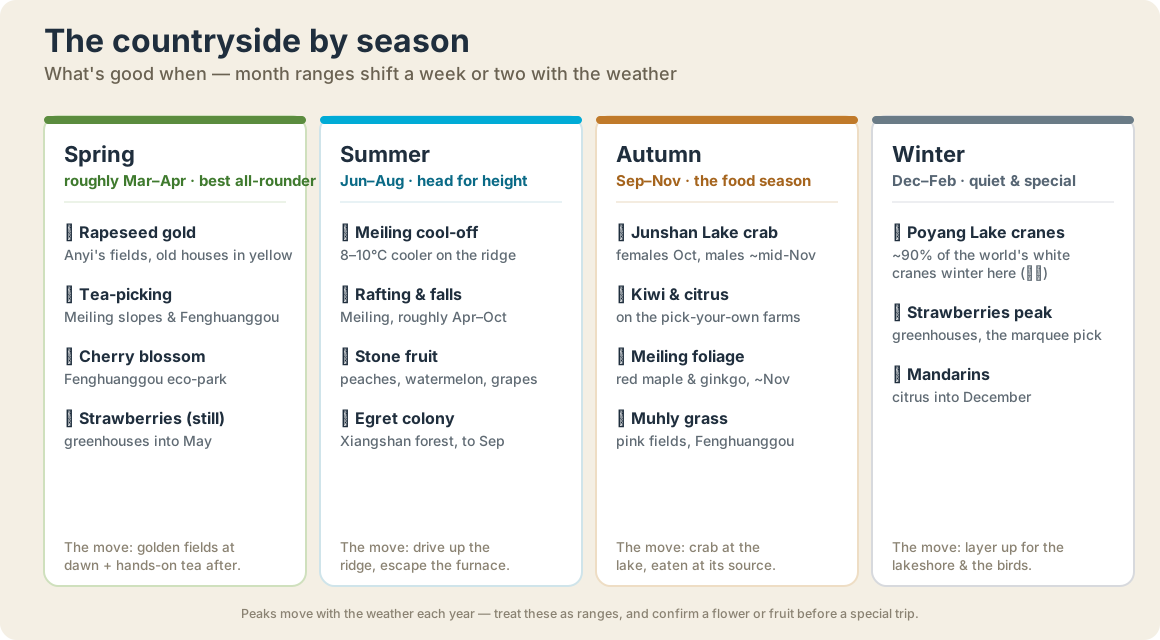 What's good when — match the trip to the calendar rather than the other way round.
- Spring (roughly March–April): the best all-rounder. Rapeseed peaks around Anyi in March into April; cherry blossom and rapeseed light up Fenghuanggou; and it's tea-picking season on the Meiling slopes and at Fenghuanggou's gardens. This is the moment to pair a golden-fields morning at Anyi with an afternoon of hands-on tea.
- Summer (June–August): hot and humid in the city — so head for height. Meiling is the season's whole point, 8–10°C cooler on the ridge, with rafting running and waterfalls full. Fruit-picking peaks too: peaches, watermelon, early grapes.
- Autumn (September–November): the food season. Junshan Lake crab comes on from late September, females best in October and males fattest around mid-November. Grapes give way to kiwi and then citrus on the farms. And Meiling turns — red maples and thousand-year ginkgo, usually peaking in November (the exact week moves with the first cold snap).
- Winter (December–February): quieter, and two draws stand out. Strawberry greenhouses are in full swing (the marquee cold-season pick), and out on Poyang Lake, the migratory birds arrive — almost the whole world population of Siberian cranes winters on this one lake system from roughly November to March, prime mid-December to February. The Wucheng bird town (吴城候鸟小镇) is the reserve's own base, but a great many of the birds now feed on farmland closer to Nanchang. Wear serious layers for the exposed lakeshore.
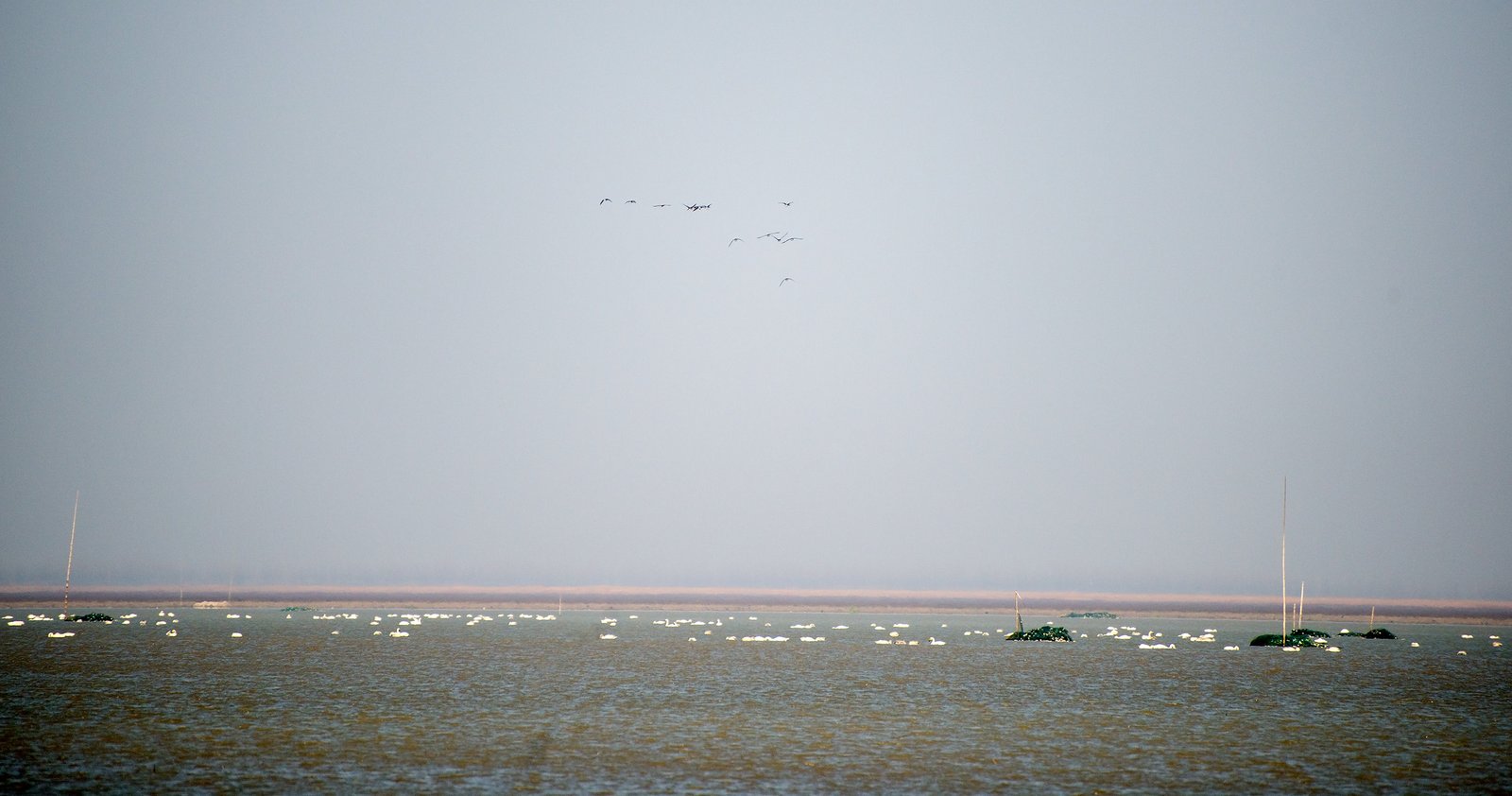 Winter brings the birds: Poyang Lake, on Nanchang's doorstep, hosts almost the whole world population of Siberian cranes from roughly November to March. Photo: liuzr99 / Wikimedia Commons (CC BY-SA 2.0).
Getting there: no metro, so plan the ride
This is the section that makes or breaks a countryside day, so read it before you commit. To repeat the headline: no metro, no high-speed train reaches any of these sights. You have three real options.
1. A hired car with a driver — the easy button (and the one most foreign visitors should pick)
Here's the crucial thing the "just rent a car" advice usually gets wrong: a foreign licence plus an International Driving Permit is not valid to drive in mainland China. To self-drive legally you'd need a Chinese licence or a temporary Chinese driving permit (available since 2019 — no test, but you need a notarised Chinese translation of your home licence and a valid visa). For most short-stay visitors that's more hassle than it's worth. The clean workaround is to hire a car with a driver — through Didi's chauffeur options, your hotel, or a day-trip operator. It's affordable, it removes the licence problem entirely, and — the real win — it solves the return leg from remote spots where ride-hailing is thin. For a full day visiting one or two of these sights, this is usually the most relaxing choice.
2. Didi / taxi — flexible, door-to-door
For the nearer districts, a Didi (滴滴) runs door-to-door in roughly 40–60 minutes for around ¥60–100 one way — that's a working estimate for the closer country; fares swing with distance, traffic and surge, so check the app for a live quote. The farther sights cost more: Anyi and the Poyang Lake shore are 60–90 minutes and can run well over ¥100–150 one way. Didi is the default app; city taxis are metered. The catch, again, is coming back: from a lakeside crab village or deep in Meiling, a return Didi can be slow or nonexistent. Ask your outbound driver to wait or come back, agree a round-trip price up front, or plan a hired car for those spots.
3. Public bus — cheapest, slowest, most patience required
Buses exist and they're cheap, but they're piecemeal — expect a long-distance coach or city bus plus a local hop at the far end. A few concrete ones:
- Anyi Ancient Villages: city bus 181 from Nanchang Railway Station east square runs to the scenic area, around ¥15, well over an hour each way (first buses from Nanchang roughly 7am, last returns from the village around 5pm). A tourist coach (~¥30) also runs on some days — check the latest schedule.
- Fenghuanggou: Metro Line 3 to Zhenxing Avenue (振兴大道) station, then bus 128 or C64 to the gate.
- Meiling: bus 219 toward Wanli, then transfer to a local route (510 and others) for the scattered spots; some routes connect to Metro Lines 1 and 2 at Ditie Dasha (地铁大厦) station.
Bus numbers, fares and timetables get reshuffled, so don't memorise them — search your destination in Amap (高德) or Baidu Maps the day before and it'll tell you the current route and the departure station. Nanchang has several long-distance stations (Xufang 徐坊, Changnan 昌南, Hongcheng 洪城, Qingshan 青山, plus the county stations); which one you use depends entirely on direction, so let the app decide.
Practical tips & rough costs
The countryside runs on slightly different rules than the city. Get these right and the day is smooth.
- Carry cash. Alipay (支付宝) and WeChat Pay (微信支付) work almost everywhere, and both now let foreign visitors link a Visa/Mastercard in-app — set that up before you travel. But rural stalls, village farms, small car parks, pay-toilets and older vendors may prefer or only take cash, and the signal can drop. Keep ¥100–300 in small notes for a countryside day. Physical RMB is legal tender and can't be refused.
- English is essentially zero once you leave central Nanchang. Signs and menus are Chinese-only and rural staff rarely speak English. Load an offline translation app (Baidu or Google Translate with the camera function), and — genuinely the most useful trick — save your destination's Chinese name to show your driver: 安义古村群景区, 凤凰沟景区, 军山湖. Screenshot the address too.
- Toilets are basic. Expect public squat toilets at rural sites and farms, often with no paper or soap. Carry your own tissue and hand sanitiser; pay-toilets may want a coin.
- Dress for the specific trip. Sun protection and water for open farms and summer Meiling; warm layers for the exposed, windy Poyang Lake shore in winter; comfortable, mud-ready shoes for pick-your-own fields and lakeshore boardwalks.
- Data is non-negotiable. A local SIM, eSIM or roaming plan is essentially required — you'll need it to run Didi, maps and pay apps out where there's no wifi.
- Rough all-in cost: a couple doing a full countryside day by hired car, with entry fees and a farmhouse lunch, will spend far less than the equivalent day near a first-tier city — figure a modest few hundred yuan total, most of it the car and the meal, not the tickets.
Two days, done right
To make this concrete, here are two ways to actually string it together — one for any time of year, one for the season it's built for.
A good all-season day: villages + hills (northwest)
- Leave the city by 8am by hired car or Didi, straight to the Anyi Ancient Villages — you want the early, group-free hour in the lanes (in spring, that's also the golden-light window for the rapeseed).
- Walk the three villages — Luotian, Shuinan, Jingtai — over about three hours, saving Shidafudi and the Tang camphor for unhurried stops.
- Lunch on Anyi rice noodles and ash-chicken soup at the Tang Camphor restaurant or a village kitchen.
- Detour to Meiling on the way back — it's on the same side of the city. Drive the ridge, do the short Shenlong Pool walk or the Lion Peak climb if you've legs left, and catch the cooler air and the view before dropping back to town for dinner.
The autumn crab pilgrimage (southeast)
- Mid-morning start — this is a lunch mission, so no need to rush. Hired car southeast to Junshan Lake, about an hour.
- Pick your crabs live at a Sanyangji farmhouse restaurant and let them steam them whole; October for roe, November for the fatter males. Confirm the by-weight price before they cook.
- Walk the lakeshore to earn the next course, then, if you've time and curiosity, swing by the free Lidu distillery site for the "birthplace of Chinese baijiu" story on the way home.
- Keep your driver — the return ride-hail from the lake villages is the weak link; don't get stranded with a full belly.
If you'd rather not orchestrate the cars, translation and timing yourself, we can build any of this into a Nanchang trip for you — see Plan With Us, or browse our Nanchang itineraries to slot a countryside day around the city's own sights like Tengwang Pavilion. And if these fields leave you wanting the grander version, Wuyuan is the overnight step up.
FAQ
Can you reach Nanchang's countryside by metro or high-speed rail?
No. The metro stays inside the built-up city and the HSR serves bigger destinations further out. Every rural sight around Nanchang — Anyi, Fenghuanggou, Junshan Lake, Meiling — needs a bus, a Didi, or a hired car. For most visitors, a hired car with a driver is the easiest option, partly because a foreign licence isn't valid to self-drive in China.
When do the rapeseed fields bloom near Nanchang?
Rapeseed around Anyi County peaks in March and tapers into April — a range that shifts a week or two each year with the weather. Go in the first hour or two after the gate opens for the best light and the fewest crowds. For a bigger, terraced version of the same landscape, that's Wuyuan, a longer trip northeast.
When is hairy-crab season at Junshan Lake?
Roughly late September through November into early December. Local wisdom: females, prized for their roe, are best in October; males, fatter with creamy paste, peak around mid-November. Eat it at the source in the farmhouse restaurants around Sanyangji, and confirm the by-weight price before ordering.
Is Meiling worth the trip from Nanchang?
In summer, absolutely — the ridge runs 8–10°C cooler than the city and is the classic local escape from the heat, with waterfalls, a steep peak climb and seasonal rafting. It's also lovely in autumn for red maples and ginkgo. Note your map may label it "Wanli"; it's the same place, now part of Xinjian District.
Do I need cash for a countryside day?
Yes — carry ¥100–300 in small notes even though Alipay and WeChat Pay work in most places. Rural stalls, village farms, small car parks and pay-toilets may only take cash, and the signal can drop. Also load an offline translation app and save your destination's Chinese name to show your driver.
Last verified: 2026-07 — transit times, prices and hours change; please double-check official sources before you travel.
You Might Also Like
- Lushan (Mount Lu): China's Summer Escape
- Nanchang Travel Guide: Jiangxi's Capital
- Poyang Lake Nature Reserve: See the Cranes
Explore Nanchang & Jiangxi itineraries · Plan a custom trip with us