Longhushan (Mount Longhu): Taoism & Rafts
Longhushan near Yingtan, a cradle of Taoism: Danxia red cliffs, a bamboo-raft drift past 2,600-year-old cliff coffins, and how to get there from Nanchang.
By Hello Nanchang · Last updated
Longhushan, Yingtan, Jiangxi Province, China · 1–2 days; best in spring & autumn; raft drift runs in daytime
The bamboo raft sits about six inches above the Luxi River, which means the water is basically at your elbow and the cliffs go up from there. Your boatman poles, the raft swings, and a wall of rust-red sandstone slides past close enough to see the lichen on it. Then he points his pole at a black slot in the rock, forty metres up a face with no ledge, no path, no obvious way for anything to get there — and inside it, unmistakably, is a wooden coffin. It has been sitting in that hole since roughly the time Confucius was alive.
That single moment is why Longhushan (龙虎山, "Dragon-Tiger Mountain") is the best half-hour-from-Nanchang trip in Jiangxi. It is a UNESCO World Heritage site, a Global Geopark and a 5A scenic area, but the honest pitch is simpler: it is the one place in the province where a jaw-dropping landscape, a 1,900-year-old religion and a genuine archaeological mystery all sit within a few kilometres of each other — and a bullet train gets you there in about the time it takes to drink a coffee.
Why Longhushan is worth the trip
Jiangxi has taller mountains and prettier villages. What Longhushan has is variety inside one gate. In a single day you can float a river, climb a viewpoint, watch a stunt performance on a cliff, and then walk the flagstone street of a temple town where the same family held a hereditary religious title for sixty-odd generations. Three things carry the place:
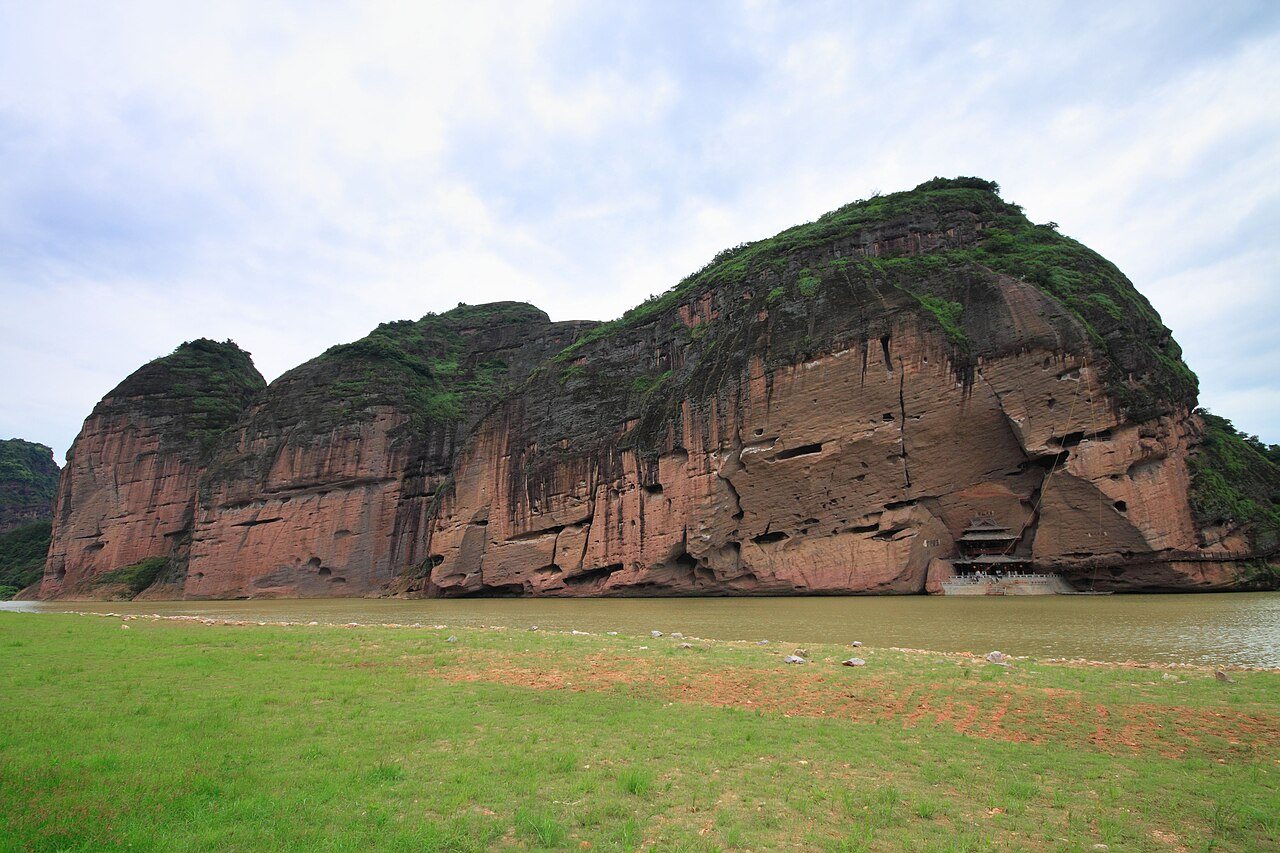
- Danxia landform (丹霞地貌) — red-cliff scenery. "Danxia" is rust-red sandstone weathered into cliffs, pillars and rounded domes. Longhushan's is some of China's finest — it was inscribed with the other China Danxia sites on the UNESCO list — and gliding through it at water level on a raft is the classic way to see it.
- A cradle of Taoism. Zhang Daoling (张道陵), founder of the Way of the Celestial Masters — the first organised form of China's home-grown religion — is said to have worked here in the Eastern Han dynasty, nearly 1,900 years ago. His successors held the title for sixty-odd hereditary generations and ran it from the town upstream (see below).
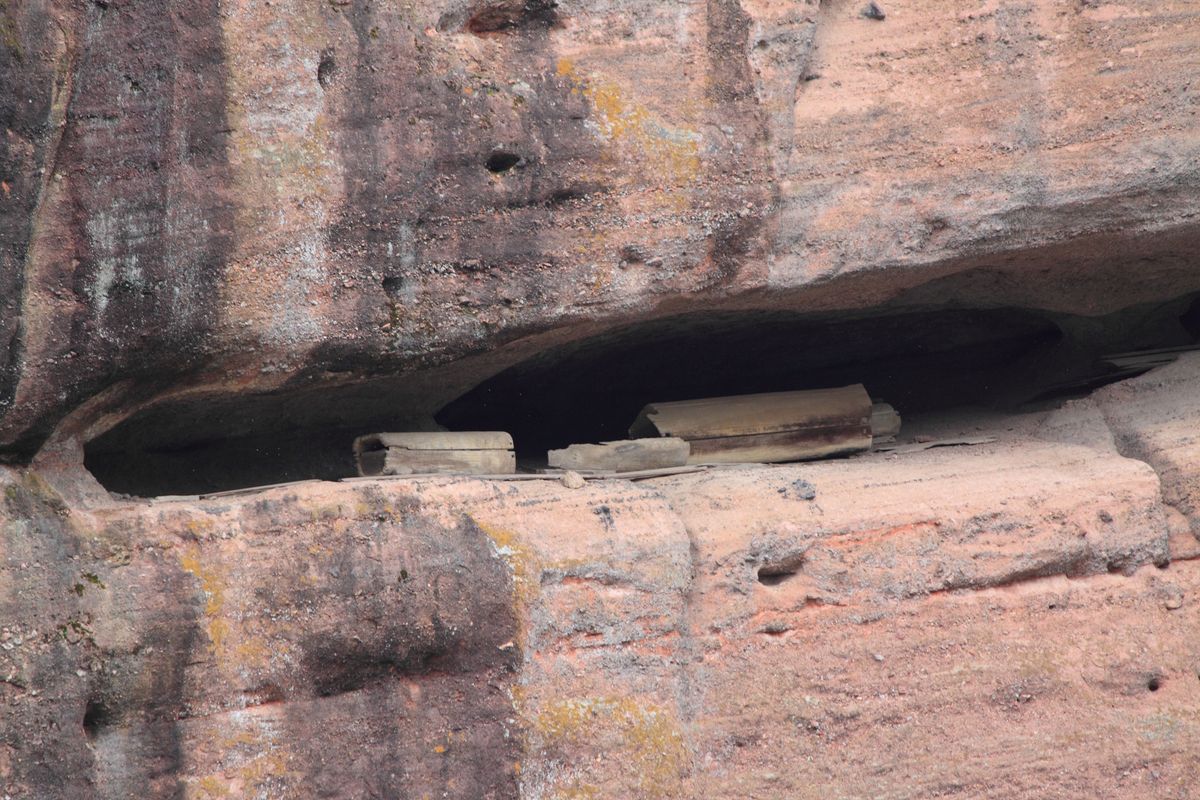
- The cliff coffins (崖墓悬棺). High above the Luxi River sit wooden coffins of the ancient Yue people, some around 2,600 years old. How they were hoisted onto sheer rock with Bronze-Age technology is still argued over — and the park stages a regular re-enactment that raises a replica up the cliff to show one theory.
The Danxia rock that gives Longhushan its colour — iron-rich sandstone weathered into domes and walls. It photographs best in low, warm light, which is another argument for an early raft. · Photo: Zhangzhugang / CC BY-SA 4.0 via Wikimedia Commons
An elixir, a dragon, and 108 demons let out of a shed
Two stories give the place its weight, and knowing them changes what you're looking at.
The first is Zhang Daoling's. Sometime in the second century he came to these hills, set up a furnace, and — the way the tradition tells it — spent years making an elixir of immortality. When it finally worked, a dragon and a tiger showed up. Whatever you make of that, the organisation he founded outlasted him by a very long way: his descendants inherited the title of Celestial Master and, from the Song dynasty onward, ran Chinese Taoism's most powerful institution from the small riverside town of Shangqing, a few kilometres upstream. The current line is counted in the sixty-somethings.
The second story is fiction, and it's the reason Chinese visitors grin when they arrive. Water Margin (水浒传), one of China's four great classical novels, opens right here. In chapter one, a Song court official named Marshal Hong is sent to Longhushan to beg the Celestial Master to stop a plague. He fails to find him, sulks around the Shangqing Palace complex, and bullies the monks into unsealing a hall they have kept shut for generations — the Demon-Suppressing Hall. Out come thirty-six heavenly stars and seventy-two earthly ones: the 108 outlaws whose careers fill the next hundred chapters. The novel's entire cast is, technically, a workplace accident that happened at this address.
And here is the part that pushes it past trivia. In 2014 archaeologists began excavating the site of that palace — the Great Shangqing Palace (大上清宫), just east of Shangqing town. What came out was the largest, highest-ranking Taoist palace complex ever excavated in China: a site of more than 300,000 square metres, twenty-nine building foundations including the Jade Emperor and Sanqing halls, and over ten thousand artefacts spanning the Song to the Qing. It was named one of China's top ten archaeological discoveries of 2017 and later listed as a national key protected site. The ruins are now open under a protective structure and are covered by most through-tickets. Standing in a hall foundation that a fourteenth-century novelist chose as the door his demons came out of is a strange and good feeling.
Getting there from Nanchang
This is one of the easiest day trips in the province. Longhushan sits about 20 km south of the city of Yingtan (鹰潭), on the busy Shanghai–Kunming high-speed corridor.
- Train to Yingtan North (鹰潭北 / Yingtanbei). Services from Nanchang West are frequent — close to fifty a day — and the fastest run around 35 minutes; second class is about ¥77. ⚠ There are two Yingtan stations. High-speed trains overwhelmingly use Yingtan North; the older Yingtan (鹰潭) station in town is a different place. Check which one is printed on your ticket. For which Nanchang station you leave from and how to reach it, see our Nanchang airport and train stations guide, and our guide to getting around Jiangxi by train.
- Station to the park. A K2 tourist bus is the standard answer: it runs from the Yingtan stations out to the Longhushan visitor centre for a few yuan, roughly every half hour through the day. Reckon on about 40–50 minutes from Yingtan North; if your bus goes via the old Yingtan station you may need to change there. Timetables and route numbers on this corridor get reshuffled, so confirm at the station information desk rather than trusting a screenshot.
- Taxi or Didi. Straight from Yingtan North to the visitor centre is roughly a 30-minute drive and saves the transfer. Have your hotel or the driver confirm the fare before you set off — meters and app pricing both exist here.
Book trains on 12306.cn or through an English-friendly reseller, and carry your passport: it is your ticket ID at the gate. If you're arriving in China specifically for a short Jiangxi loop, check the visa-free transit rules first.
Tickets, and what your money actually buys
Longhushan is spread over a big area with several separate zones, so the pricing works like most large Chinese parks: one through-ticket covers the gate plus the internal shuttle buses, and the bamboo raft is bundled in or bolted on. Rates move with season and package, so treat these as the shape of it rather than the invoice:
- The all-in package — gate + sightseeing bus + bamboo raft, normally valid for two days — is generally quoted somewhere in the ¥220–260 range in high season. This is what most visitors buy.
- Gate + shuttle without the raft is cheaper; concession versions of it have been listed around ¥90. Worth it only if you're specifically not going on the water.
- The raft on its own is usually ¥75–100 per person if bought separately.
- The sightseeing bus is not optional in practice. The zones are kilometres apart and there is no sensible way to walk between them.
- Concessions follow China's usual bands — free for small children, reduced for minors, full-time students and older visitors — but the exact age and height cut-offs are re-announced every year, so bring ID if you think you qualify.
- Tianmenshan (天门山), a separate valley in the wider scenic area, is typically not included in the standard ticket. Don't plan around it unless you've bought it.
The park generally runs around 8:00 to about 17:00–17:30, with last admission earlier and slightly different summer and winter hours; the raft only runs in daylight. Buy online the night before if you can — the gate uses ID/passport scanning and the ticket windows are the slowest part of the day.
A full day at Longhushan, in order
The park's own signage points everyone in the same direction at the same time. This order works with the shuttle network and gets you onto the water before the queues build.
- Arrive at the visitor centre by 8:30–9:00. Collect your ticket, and while you're there the on-site geology and Taoism museums are a genuinely useful ten minutes of context, not filler.
- Shuttle to the Xianshuiyan (仙水岩) zone — the heart of the park and the stretch of river the coffins overlook.
- Get on the raft early. The Luxi River drift is the single best thing here and it is much better with fewer boats around. Sit on the side your boatman points at; the coffin faces are all on one bank.
- Time the raft to land you near a coffin-hoisting show (see below) — most people watch from the Taohuazhou (桃花洲) side of the river.
- Walk up Elephant Trunk Hill (象鼻山) for the classic overhead view of the cliffs and the river bend — the stone arch really does look like a trunk in the water. Steps, but short ones.
- Detour to the "mosquito-free village" (无蚊村), a small riverside settlement locals insist no mosquito bothers. The explanations vary; the lane of old houses and river views in the middle of a busy park is real either way.
- Shuttle to Zhengyiguan (正一观), the temple on the spot where Zhang Daoling is said to have set up his furnace. Then continue to the Great Shangqing Palace ruins (大上清宫).
- Finish in Shangqing Ancient Town (上清古镇) in the late afternoon, when the day-trip coaches have gone and the street belongs to residents again. Eat here.
That's a full, brisk day — roughly 8 hours inside the gate. If you only have half a day, do the raft and Xianshuiyan and skip everything upstream.
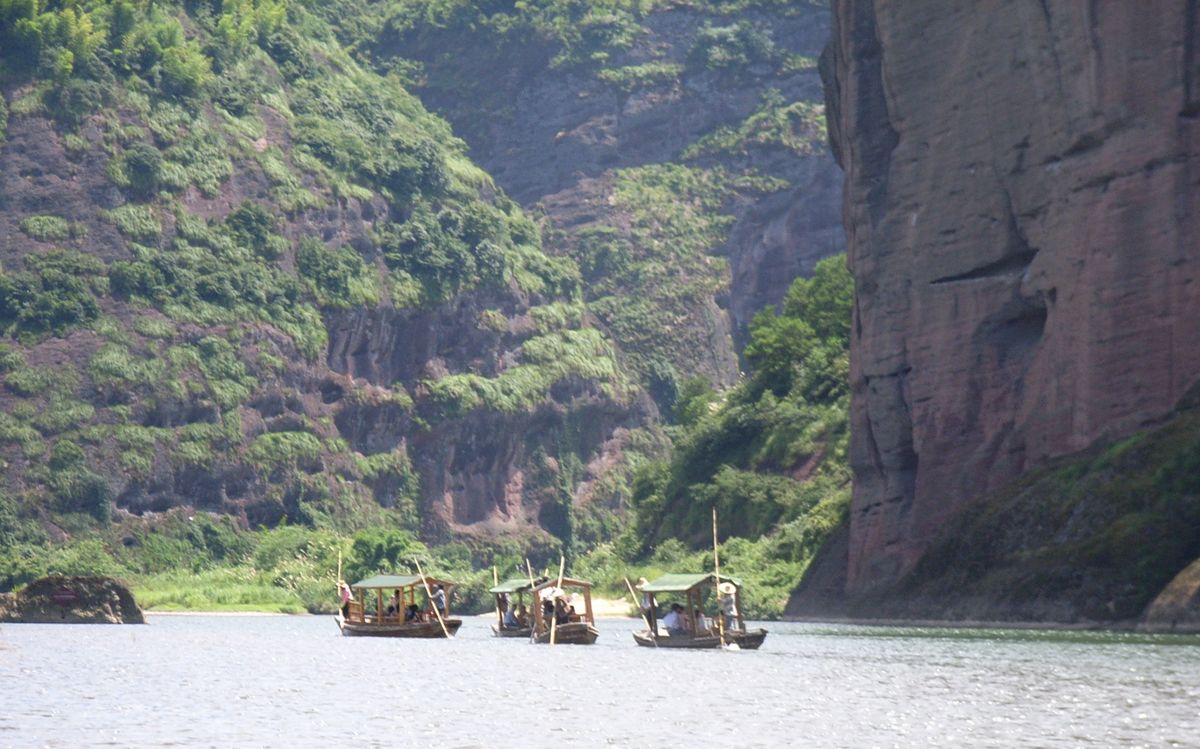
The Luxi River drift, the reason most people come. Rafts seat a handful of passengers on low benches; you sit at water level the whole way. · Photo: User:Neon / CC BY-SA 3.0 via Wikimedia Commons
The raft, and the coffin-hoisting show
The bamboo-raft drift (筏游泸溪河) runs downstream between the upper river landings and the Xianshuiyan piers, past the best of the Danxia and directly below the coffin caves. Plan on somewhere between 45 minutes and an hour and a half on the water — listings quote different stretches and lengths, and the water level moves the timing around. It is unhurried, low to the water and completely exposed to the sun. There is no shade. Bring a hat, and keep your phone on a strap.
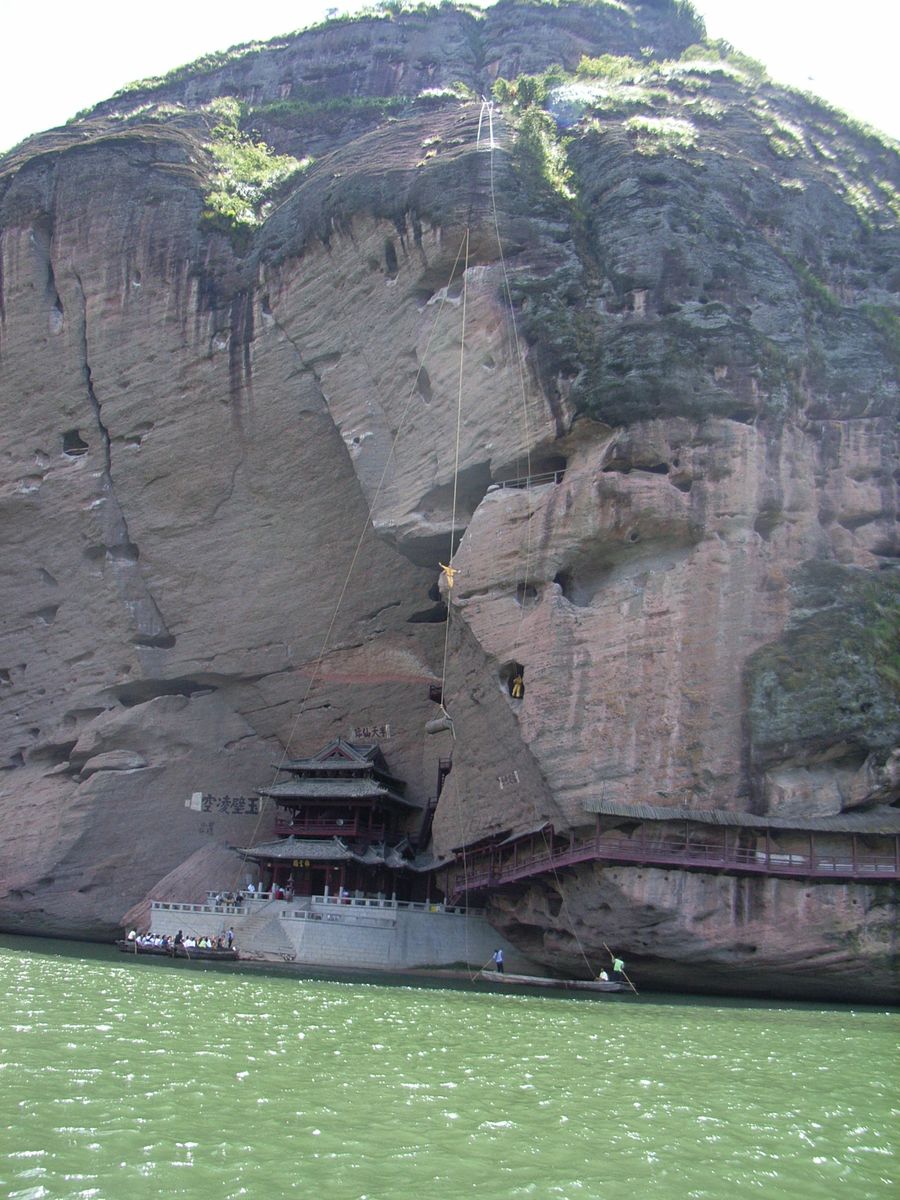
The coffin-hoisting performance (升棺表演) is the park's signature set piece, and it's better than it sounds. Performers descend the cliff on ropes from the top, swing across to a cave mouth, and haul a replica coffin up the rock face using a winch-and-rope method archaeologists think may be close to how the Yue actually did it. It's staged on the cliff around Feiyun Pavilion (飞云阁), and you watch from the far bank or from a raft that pauses below.
Show times shift with the season and the crowd. In busy months schedules are commonly quoted at roughly 10:00, 12:00, 14:00 and 16:00; in quiet months there may only be a morning and an afternoon slot, and bad weather cancels it outright. The board at the visitor centre on the day is the only schedule that counts — check it before you plan your raft. Arrive 20–30 minutes early for a front view.
Admission to the show is normally covered by your park ticket. The whole thing lasts around fifteen minutes and it is worth arranging your day around.
The real thing: Yue-people cliff coffins in a natural cave high above the river. Bring a zoom lens or binoculars — from the raft they're further away than they look. · Photo: User:Neon / CC BY-SA 3.0 via Wikimedia Commons
Shangqing Ancient Town and the Celestial Masters' Mansion
Shangqing (上清古镇) is a single long street of grey brick and dark timber along the Luxi River, and it has been the administrative seat of a religion for most of a thousand years. The traveller-diarist Xu Xiake passed through in the Ming dynasty and noted, dryly, that the street was "very long." It still is.
The anchor is the Celestial Masters' Mansion (嗣汉天师府) — the hereditary residence and office of the Zhang line. It covers around 50,000 square metres with several hundred rooms, laid out on a bagua (eight-trigram) plan, with red walls, glazed tile and old trees shading the courtyards. Chinese guidebooks pair it with the Confucius Mansion in Qufu — "Confucius in the north, Zhang the Celestial Master in the south" — and the old couplet attached to it calls the mansion "the unmatched place of the southern land, the first family west of the river." It is a working religious site, not a museum set: expect incense, resident Taoists in blue robes, and people who are actually here to pray.
Give the mansion 45–60 minutes and the street another hour. Most through-tickets cover the Shangqing zone including the mansion and the Great Shangqing Palace ruins, but some packages price the mansion separately — confirm what yours includes at the gate rather than at the door.
What to eat at Longhushan
Skip the food court by the visitor centre and eat in Shangqing, where the restaurants are family-run and the local specialities are actually local. Nobody here speaks much English; point, or use a translation app. The town's own trio is tofu, river fish and chestnut chicken.
- Shangqing tofu (上清豆腐) — the dish the town is known for, made with local soybeans and spring water, served white and quivering, usually braised with chilli and scallion or done in a clay pot. Lunch or dinner. Say 少辣 (shǎo là) for mild — Jiangxi's default heat is real. Roughly ¥20–40 a dish. Easy first-timer pick.
- Luxi River fish (泸溪河鱼) — freshwater fish out of the river you just floated, steamed or braised with pickled chilli. Dinner. Priced by weight, so budget ¥60–120 for a whole one to share. Delicious, but bony — not the dish to order if you're eating in a hurry.
- Tianshi chestnut chicken (天师板栗烧土鸡) — free-range chicken braised slowly with chestnuts until the sauce goes sticky and slightly sweet. A shared main, ¥80–150 depending on the bird. The crowd-pleaser of the three.
- Shangqing rice noodles (上清米粉) — the everyday breakfast and quick lunch, tossed or fried, ¥8–15. Same family as the rice noodles you'll have eaten in Nanchang, cooked a little plainer.
- Taoist temple food (道家斋菜) and the Bagua banquet (天师八卦宴) — a full set banquet with dishes arranged by the eight trigrams. It's a genuine local tradition and a genuine production: it has to be ordered in advance through a Shangqing restaurant or your guesthouse, and it's priced per table, not per head. Plan-ahead special, not a walk-in.
We're not naming individual restaurants here because the strip turns over. The reliable filter is the old one: at 12:30, walk the street and go into the one with the most local families in it.
After dark: the Luxi River light show
Dreaming of Longhushan (寻梦龙虎山) is a large outdoor production staged near the visitor centre, part walking promenade and part boat ride, with 3D projection thrown onto the Luxi River cliffs and a plot loosely built around Taoist ideas. It is unapologetically theatrical and, for most foreign visitors, surprisingly enjoyable — the cliffs make an unbeatable screen.
Practicalities, all of which move: the first performance usually starts around 8pm, with later slots (9pm, 10pm) released only when the earlier one sells out; times shift seasonally and the show can be cancelled by weather. Combined park-plus-show tickets have commonly been quoted around ¥350 for adults with cheaper concession versions. Check the current schedule when you buy.
Be honest with yourself about the last train. If you're day-tripping from Nanchang, the show and the return journey do not fit together comfortably. It's a reason to stay the night, not a reason to sprint.
How long to stay, and where
Because the train is so quick, plenty of people do Longhushan as a long day trip from Nanchang: early train out, raft and Xianshuiyan, Shangqing in the afternoon, back for a late dinner. It works, and it's the right call if your Jiangxi time is tight.
Give it one night if you want Shangqing without clock-watching, an unhurried morning raft, or the evening show. Three sensible bases:
- Shangqing Ancient Town — the atmospheric choice. Small hotels, guesthouses and Taoist-themed stays inside the old street, walking distance to the Celestial Masters' Mansion, and quiet once the coaches leave.
- By the visitor centre — standard hotels and family homestays near the main gate. Least charming, best for being first onto the raft.
- Yingtan city — ordinary business hotels near the stations. Choose this only if you're moving on early the next morning.
Best time to visit
- Spring and autumn are the sweet spots: mild, clearer air, and the red rock at its most photogenic. Spring adds green hills and blossom along the river.
- Summer is hot, humid and busy. The morning raft is genuinely refreshing; the middle of the day on an unshaded clifftop is not. Water travel here is at its best roughly April to October.
- Winter is cool, quiet and cheap, with shorter hours and a thinner show schedule.
- Whatever the season, a dry low-mist day is what you want. Heavy rain flattens the colour of the Danxia and can stop the raft and the cliff show.
- Avoid the first three days of the May and October national holidays if you possibly can — the raft queue is the bottleneck, and it is a long one.
What to skip, and other honest notes
- Don't try to add Tianmenshan onto a one-day visit. Different ticket, different valley, and you'll rush the parts you came for.
- The coffins are far away. They're the highlight, but they are small dark shapes at forty metres. A zoom lens or a cheap pair of binoculars transforms the experience; a phone camera will not.
- Sun, not scenery, is what ruins people's day here. The raft, Elephant Trunk Hill and the Shangqing street are all exposed. Hat, sunscreen, more water than you think.
- Arrive digitally prepared. English signage is patchy, English-speaking staff are rare, and the Shangqing restaurants and snack counters take Alipay or WeChat Pay and essentially nothing else — no foreign cards. Set up payment and an offline translation app before you leave Nanchang.
- If you have to choose between Longhushan and Sanqingshan, pick on effort: Longhushan is a low-exertion day of river, culture and one big spectacle. Sanqingshan is a genuine mountain day with hours of stairs and clifftop walkways. They are not substitutes for each other.
Practical info
- Getting there: high-speed train Nanchang → Yingtan North (鹰潭北), about 35–45 min; then K2 tourist bus (~40–50 min, a few yuan) or a taxi/Didi (~30 min) to the Longhushan visitor centre.
- How long: 6–8 hours for a full day inside the park; one night if you want Shangqing or the evening show.
- Tickets: all-in package (gate + shuttle + raft, usually 2-day validity) generally ¥220–260 in high season; raft alone ¥75–100; Tianmenshan not included. Buy online the night before.
- Hours: roughly 8:00–17:00/17:30 with earlier last admission; daylight only for the raft. Confirm seasonal hours.
- Pay & language: Alipay / WeChat Pay everywhere, foreign cards almost nowhere; very little English signage.
- Good for: first-timers, families, culture travellers, anyone who wants a big landscape without a big climb.
- Less good for: people who hate boats or open sun, wheelchair users on the clifftop sections, and anyone hoping for a quiet contemplative temple visit on a national holiday.
Longhushan FAQ
Is Longhushan worth visiting?
Yes — and it's one of the highest-value trips in Jiangxi because it costs you so little travel time. Thirty-five to forty-five minutes on a train buys a UNESCO landscape, a bamboo-raft ride, a 2,600-year-old burial mystery and a living temple town. If you have one spare day in Nanchang, this is the strongest single use of it.
Can you visit Longhushan as a day trip from Nanchang?
Comfortably. Catch a train out around 7:30–8:30am, be at the gate by mid-morning, and you can do the raft, Xianshuiyan and Shangqing before an evening train back. What doesn't fit into a day trip is the evening light show, or a slow afternoon in Shangqing — those need a night.
How much should I budget?
Roughly ¥250–350 per person for the day, all in: train fares both ways, the all-in park package in the ¥220–260 range, and a Shangqing lunch. Add the evening show and it climbs considerably. Prices shift, so confirm before you book.
Do you need to book the bamboo raft in advance?
Not usually — it's normally bundled into the package ticket and you board on a rolling basis. What you should do is go early. From late morning through the afternoon in high season the raft piers are where the whole park queues.
How does Longhushan fit into a longer Jiangxi trip?
It sits on the same eastern high-speed corridor as Sanqingshan, Wuyuan and Jingdezhen, so it slots neatly onto the front or back of the 5-to-7-day Jiangxi loop as a day out of Nanchang. Browse the rest in Destinations.
Quick tips before you go
- Take the train to Yingtan North (鹰潭北), not the old Yingtan station — check your ticket.
- Buy the all-in package if you want the raft, and do the raft first thing.
- Check the coffin-hoisting show board at the visitor centre on arrival and build your day around a slot.
- Set up Alipay or WeChat Pay before you arrive; carry your passport for the train and the gate.
- Hat, sunscreen, water, and binoculars or a zoom lens if you own one.
- Eat in Shangqing, not at the gate — tofu, river fish, chestnut chicken.
Want this built into a longer route with the porcelain kilns, the villages and the peaks? Plan a custom Jiangxi trip with us and we'll sequence it around your dates and your pace.
Images: "Longhushan 9269" and "Longhushan 9273" by Zhangzhugang (CC BY-SA 4.0); "Luxi2" (bamboo raft on the Luxi River) and "Flyingcoffins" (the cliff coffins) by User:Neon (CC BY-SA 3.0) — all via Wikimedia Commons.
Last verified: 2026-08. Train times, fares, ticket and raft prices, bus routes, show schedules and opening hours change often — please double-check official sources before you travel.
Cover photo: Zhangzhugang / CC BY-SA 4.0 via Wikimedia Commons (cropped & resized).
You Might Also Like
- Lushan (Mount Lu): China's Summer Escape
- Nanchang Travel Guide: Jiangxi's Capital
- Poyang Lake Nature Reserve: See the Cranes
Explore Nanchang & Jiangxi itineraries · Plan a custom trip with us