Nanchang Travel Guide: Jiangxi's Capital
Why visit Nanchang — Jiangxi's riverside capital and the gateway to Jingdezhen, Wuyuan, Lushan & Wugongshan. City highlights, how to get there & around.
By Hello Nanchang · Last updated
Nanchang, Jiangxi Province, China · Best visited late September – early November; allow 2 days in the city
By half past six in the morning, a good slice of Nanchang is standing at a counter with a plastic bowl, eating cold rice noodles tossed in chilli oil and washing them down with soup out of a little clay crock. Nobody sits. Nobody photographs it. It costs less than a coffee.
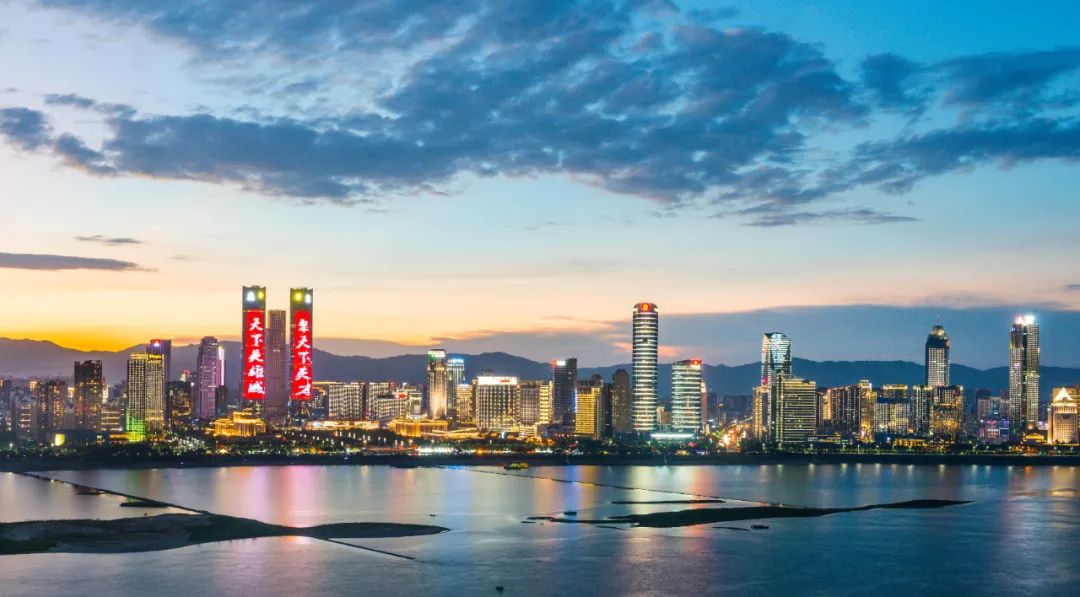
Fourteen hours later the same city does the other thing it is known for: somewhere around eight o'clock — earlier in winter, later in summer — the entire skyline on the far bank of the Gan River switches on at once. Not tower by tower. All of them together, and then animations start rolling across a kilometre of glass like weather.
That's Nanchang in one day: a 2,200-year-old city wearing a 25-year-old skyline. The old half is where you eat and where the history is; the new half is what you look at while you do it. Almost nobody flies here on purpose, which is the whole reason it's still this cheap, this unhurried, and this genuinely curious about you.
Why bother with Nanchang?
The honest pitch: most travellers pass over Nanchang (南昌) on the way between Shanghai and the south, and that is exactly why it's worth a stop. You get a real, working provincial capital of around 6.7 million people, effectively no foreign-tourist crowds, prices well under Shanghai or Hangzhou, and a walkable old core strung along the river. It is also one of modern China's landmark cities: the uprising of 1 August 1927 is treated as the founding moment of the People's Liberation Army, and close to two hundred things in this city are consequently named 八一 ("Bayi," August 1st) — the main square, the main avenue, a bridge, a park, a metro station.
Two days is honestly enough for the city itself. What makes people stay three or four is the second job Nanchang does: it sits in the middle of Jiangxi with fast trains fanning out to porcelain towns, rapeseed villages and four separate mountains. Come for the food and the river; stay because everything else in the province is an hour away.
The character of the place
Nanchang was founded in 202 BC, when the Han general Guan Ying built a walled town here and made it the seat of Yuzhang Commandery (豫章郡) — a name that still turns up on street signs and academies today. The modern name means, roughly, "prosperity of the southern frontier," which was optimistic branding for a garrison in a swamp and has aged reasonably well.
What you notice on the ground is how young it feels. The city runs 55 higher-education institutions and something like 800,000 students, and it shows after dark: night markets that don't thin out until past midnight, milk-tea counters three deep, whole streets of ¥50-a-head stir-fry joints. It has also been one of the fastest-growing big cities in the country by population in recent years — not a sentence most people expect about a place they've never heard of. And it is hot: Nanchang appears on every Chinese list of the country's "furnace" cities, and in July that is not marketing.
How the city is laid out
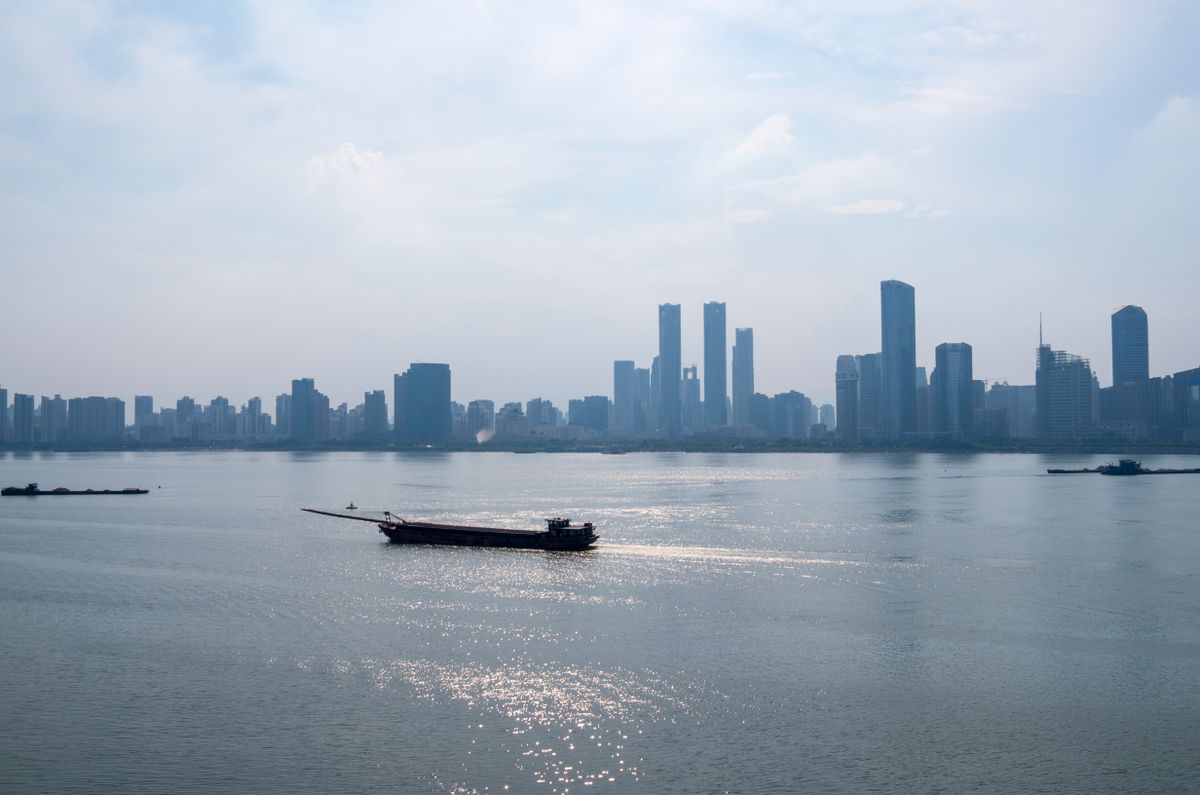 The view that explains the city's geography: the Honggutan CBD on the west bank, seen from the old town side · Photo: Windmemories / CC BY-SA 4.0 via Wikimedia Commons
The Gan River (赣江) runs roughly north through the middle and splits Nanchang cleanly in two. Get that straight and the rest of the map falls into place.
- The east bank — Donghu & Xihu (东湖/西湖), the old city. Dense, lived-in, low-rise, and where you'll spend most of your time on foot: Tengwang Pavilion on the water, Bayi Square in the middle, the lantern lanes of Wanshou Palace, the pagoda and food street at Shengjin Tower, and Hama Jie's night stalls. Metro anchor: Bayi Square (八一广场), the Line 1 / Line 2 interchange.
- The west bank — Honggutan (红谷滩), the new city. A purpose-built CBD of glass towers, wide boulevards and government headquarters that essentially did not exist thirty years ago. This is where you go for the riverside promenade, the Qiushui Square fountains, the Star of Nanchang wheel, the free Jiangxi Provincial Museum and the big malls. Metro anchors: Qiushui Square (秋水广场) on Line 1, Xuefu Ave (E) (学府大道东) on Line 2.
- Qingyunpu (青云谱), south. Suburban and unglamorous, with one very good reason to visit: the classical Jiangnan garden around the Bada Shanren memorial, which has its own Line 3 station.
- Qingshanhu (青山湖) & the High-Tech Zone, east. Lakes and new parks — Aixi Lake, the flooded cypress boardwalks of Fish Tail Park — plus Nanchang East railway station. Metro anchor: Line 4 out to Yuweizhou (鱼尾洲).
- Xinjian (新建), northwest. Changbei Airport, the Meiling forest ridge, and the Haihunhou tomb site out on the Poyang plain.
- Nanchang County (南昌县), south. Where the city runs out into tea gardens, farms and eventually the southern shore of Poyang Lake.
The useful shorthand: sleep and eat on the east bank, cross the river at dusk to look back at it. Line 1 tunnels under the Gan between Tengwangge and Qiushui Square, so swapping banks is one ride with no change.
Three Nanchangers worth knowing before you arrive
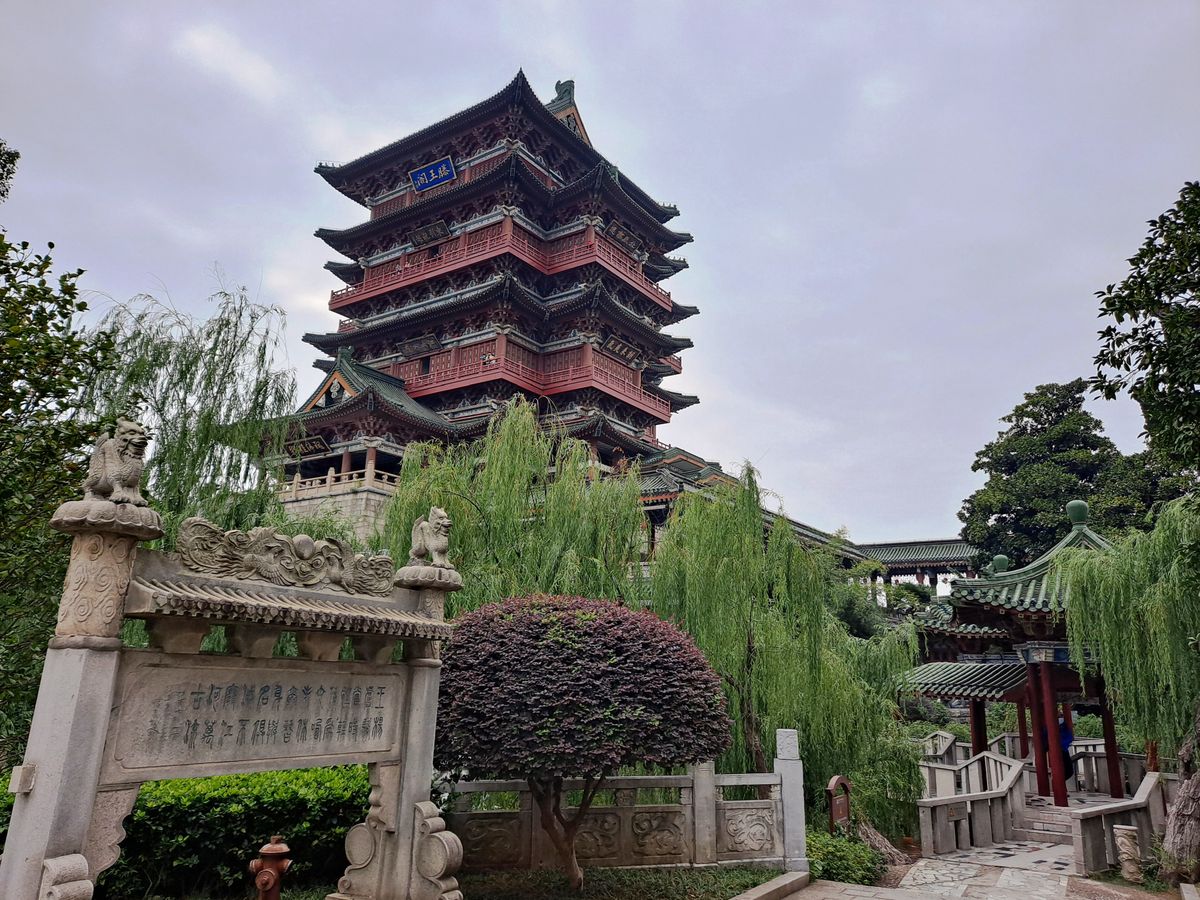 Tengwang Pavilion, first raised in AD 653 and rebuilt more than two dozen times since; the tower you climb today went up in the late 1980s · Photo: 钉钉 / CC BY-SA 4.0 via Wikimedia Commons
Wang Bo (王勃), aged 25. In the autumn of 675 a young poet stopped here on his way south to visit his exiled father, and was invited to a banquet at a riverside tower. The host had quietly arranged for his own son-in-law to produce the commemorative preface; when the brush was politely offered around the room, Wang Bo — who was not supposed to accept — accepted, and wrote the whole thing on the spot. The Preface to the Tengwang Pavilion is still memorised by Chinese schoolchildren, and one of its lines does something no other tourist attraction can claim: "the setting sun flies with a lone wild duck; the autumn waters run one colour with the endless sky." Look across the Gan from the pavilion tonight and you are looking at Qiushui Square — "Autumn Waters Square," built in 2004 and named straight out of that sentence. Wang Bo himself drowned around 676, barely a year after that banquet, when his boat met a storm on the way home from visiting his father — he was about twenty-six. There's a tap-through version of the story if you want it before you go.
Bada Shanren (八大山人), the prince who stopped talking. Zhu Da was born in Nanchang in the 1620s, a member of the Ming imperial clan. When the dynasty fell he shaved his head, entered a monastery, and by some accounts spent years refusing to speak. What came out instead was ink: fish, birds and rocks painted with a violent economy of brushstroke, the birds glaring sideways out of the paper with a look every viewer since has read as pure contempt. His memorial hall sits in a former Taoist temple at Qingyunpu, in one of the prettiest small gardens in the city — and there's a metro station named after him, which is a fine thing for a mute painter to end up with.
The 2am uprising. At two in the morning on 1 August 1927, more than 20,000 troops moved on the garrison here; four hours of street fighting later they held the city. They lost it within days and retreated into the mountains at Jinggangshan — but the date stuck, and it is why the army's emblem carries the characters 八一 and why Bayi Square has a granite spire in the middle of it. The square itself is free and open all hours; the Uprising Memorial Hall sits about 1.5 km west — twenty minutes on foot down Zhongshan Road, or one stop on Line 1 from Bayiguan — and is free but closes Mondays and normally requires an advance real-name reservation with a daily cap, so sort that before you turn up. The wider thread runs through our red-history itinerary.
What to actually do
- Tengwang Pavilion (滕王阁) — the landmark, first raised in AD 653, one of the "Three Great Towers" of southern China. Line 1 to Tengwangge, Exit 2, then about 1.1 km on foot. Day ticket ¥50, no booking needed; the grounds run 08:00 to 18:00 and clear at 18:15 — the "open till 10pm" you see online is the separate evening show, not the daytime climb. Allow one to three hours. Best light late afternoon; from about 5 October to about 6 February a day ticket still reaches sunset — the climb ends at 18:00, a quarter-hour before the grounds clear, and 18:00 is the number sunset has to beat. Our full Tengwang Pavilion story works out the rest.
- Wanshou Palace historical district (万寿宫) — restored grey-tile lanes, red lanterns and small-eats counters, free to wander and sitting directly on top of Wanshougong station on Line 1. Chinese signage routes you out of Exit 1, some English listings say Exit 3; follow the in-station signs. Best at dusk. More on Wanshou Palace.
- Shengjin Tower (绳金塔) — a brick-and-timber pagoda with about a hundred food vendors packed around it, and the easiest place in the city to feel old Nanchang. Shengjinta station, the Lines 3 / 4 interchange, Exit 3. Street free; 1–1.5 hours. More on Shengjin Tower.
- The riverfront after dark — the Qiushui Square musical fountains and the Guinness-record "One River, Two Banks" facade show across the Honggutan skyline. Completely free. Line 1 to Qiushui Square; lights usually run until around 22:30, and the last Line 1 trains leave the termini around then — closer to 23:00 on Fridays, weekends and holidays — but your own station's last train comes earlier, so read the platform board before you settle in. The riverfront in full · the fountain show.
- Jiangxi Provincial Museum — free, genuinely good, and holding a teaser selection of the Haihunhou gold. Closed Mondays; normally needs a free online booking. In the Honggutan Cultural Centre — DiDi is easiest, or Line 1 to Qiushui Square and walk north. Museum guide.
- Haihunhou tomb site museum — out in Xinjian district, built over the unlooted grave of a Han prince who was emperor for twenty-seven days and went into the ground with more gold than any other tomb in China has yielded. A half-day, and the best surprise in the city. Full guide.
- Fish Tail Park (鱼尾洲公园) — a free, award-winning "sponge park" of cypress standing in water; Line 4 to Yuweizhou, Exit 3, then about 8 minutes on foot. Best at golden hour. More · other photo spots.
If you only have one day
- 08:30 — Line 1 to Tengwangge, Exit 2. The pavilion at opening time, before the tour groups and while the river light is still soft.
- 11:00 — one stop to Wanshougong. Surface into the old block and graze your way through lunch on your feet.
- 14:00 — Bayi Square and the Uprising Memorial Hall (booked in advance, and not on a Monday). Twenty minutes on foot between the two, or one stop on Line 1.
- 17:30 — Line 1 under the river to Qiushui Square. Walk the promenade, watch the skyline switch on from the west bank, then head back east for a late dinner and be at the platform before about 21:15.
Two days lets you do this properly, with a museum and a food street added — that's mapped out in 2 days in Nanchang.
What to eat
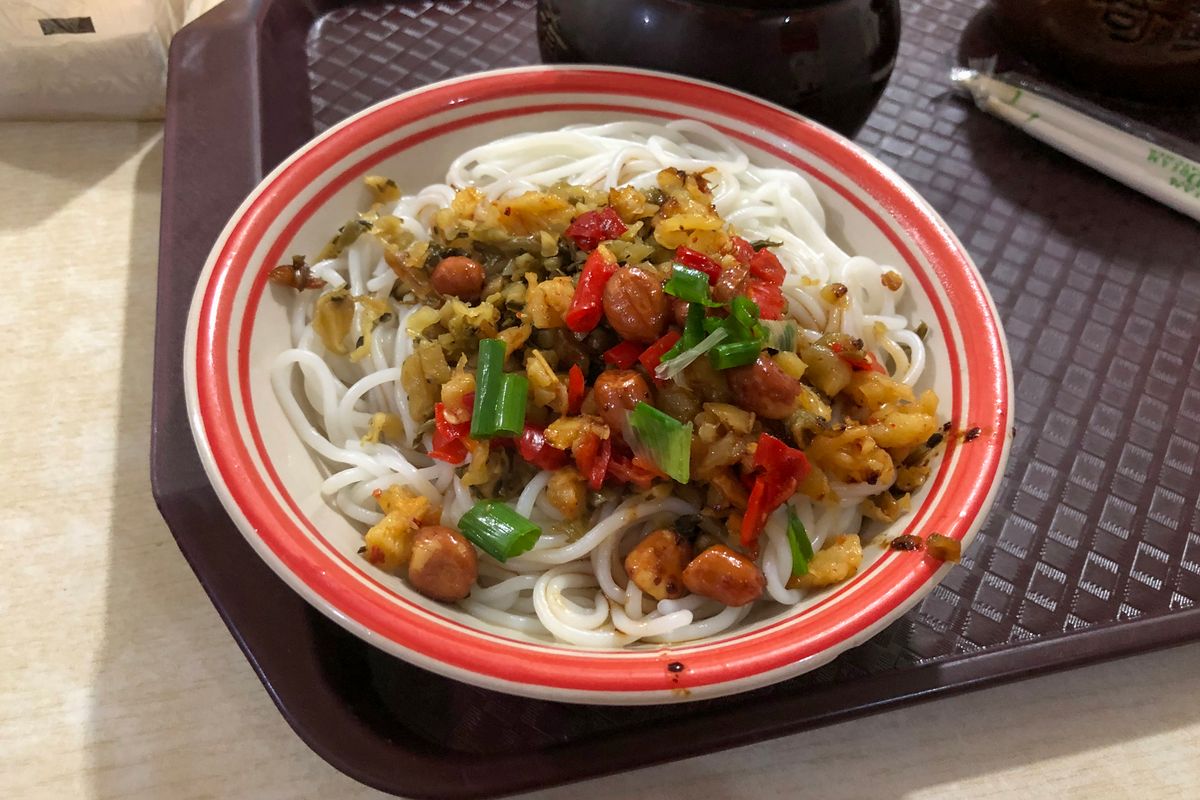 Banfen: cold-tossed rice noodles with chilli oil, soy, pickled radish and peanuts — the city's default breakfast · Photo: N509FZ / CC BY-SA 4.0 via Wikimedia Commons
Jiangxi (Gan) cooking is among the spiciest in China and routinely out-burns its better-known neighbours. It leans fresh, smoky and chilli-forward rather than numbing — fresh chillies treated as a vegetable, tea oil and lard for depth, pickles and cured meat for the backbone.
- Mixed rice noodles (拌粉, bànfěn) — cold rice noodles tossed with chilli oil, soy, pickled radish and peanuts. Breakfast, standing up, ¥6–10, almost always ordered with a soup. The friendliest possible introduction. The full story of the bowl.
- Clay-pot soup (瓦罐汤, wǎguàntāng) — small sealed crocks slow-cooked overnight in a communal urn. Breakfast or any time, roughly ¥5–10, not spicy. Lotus root and pork ribs is the safe first order.
- Lihao with cured pork (藜蒿炒腊肉) — a crunchy wild marsh herb from Poyang Lake stir-fried with smoky cured pork. Best in spring, one of the Ten Great Gan Dishes, and Nanchang's own; locals have a line about it — Poyang Lake's weed is the Nanchang people's treasure. Order this if you order nothing else local.
- Xiaochao (小炒) — point at what's in the chilled display case, watch it hit a screaming wok, eat it four minutes later. Lunch or dinner, about ¥50 a head. Say 微辣 (wēilà, mild). Why it's suddenly a national craze.
- Stir-fried river snails (炒螺蛳) — late-night, sucked straight from the shell, spicy and addictive. Hama Jie (蛤蟆街), a 330-metre lane in the old town near Tengwang Pavilion, is the classic address; most things ¥5–30. Night-market guide.
- White sugar cake (白糖糕) and the rest of the fried-and-steamed breakfast repertoire — cheap, everywhere, and best from a counter with a queue. Street pastries · where locals actually eat.
Two phrases before you sit down: 微辣 (wēilà) for mild, 不要辣 (bú yào là) for no chilli. Say them anyway — "mild" here is still a workout.
More of the city's eating and after-dark options, street by street, in things to do in Nanchang.
Where to stay
- Bayi Square / Donghu (east bank) — the default, and the right call for a first visit. You're on the Line 1 / Line 2 interchange, walkable to Wanshou Palace, the memorial hall and the shopping streets, and a short hop from Tengwang Pavilion. Everything from international chains to cheap business hotels.
- Honggutan (west bank) — newer rooms, bigger river views, quieter streets, the malls and the museum on your doorstep. Better value per star, but you'll commute to the old town for the good eating.
- Near a station — if you're arriving late or leaving at dawn, central Nanchang Railway Station is about 3 km from Bayi Square and on Line 2; Nanchang West is the big high-speed hub about 15 km southwest, also on Line 2 (roughly 45 minutes and about ¥4 into the centre). A room near either beats a 6am taxi.
Getting there, and getting around
Most international visitors arrive in two hops: long-haul into Shanghai, Beijing, Guangzhou, Shenzhen or Hong Kong, then a domestic flight or — usually nicer — a high-speed train. Nanchang Changbei International Airport (KHN) is about 28 km north of the centre and mostly domestic.
Rough fastest high-speed rail times in: Shanghai around 3 hours (most 3–4); Changsha as little as ~1h10 (most 1.5–2); Wuhan around 2 hours; Guangzhou around 3h20 on the quickest services.
Check which station your ticket says. Nanchang has three that matter — central Nanchang Railway Station, the big Nanchang West hub, and Nanchang East (opened end of 2023), which serves the fast line toward Jingdezhen, Wuyuan and Huangshan. They are far apart. All three sit on Metro Line 2. Full breakdown in our airport and stations guide.
- Metro — four lines, roughly 163 km and 122 stations, bilingual signage throughout, fares about ¥2–7. Since June 2025 Line 1 runs all the way to Changbei Airport (Terminal 2) and Line 2 reaches Nanchang East. Tap in with Alipay or WeChat Pay. Line 1 runs roughly 06:00 to 22:30, with last departures commonly stretched to about 23:00 on Fridays, weekends and public holidays. Metro guide.
- From the airport — DiDi or taxi roughly ¥90–120 and 30–45 minutes; the shuttle bus about ¥15 and 45–60 minutes; Line 1 is cheapest but over an hour, because it's a city line rather than an express.
- DiDi — the least stressful door-to-door option with no Chinese. Set it up before you fly.
- Shared bikes (Meituan / Hellobike) — everywhere, roughly ¥1.5 per half hour, and genuinely lovely along the riverside promenade.
- Maps — use Apple Maps: inside mainland China it runs on local AutoNavi (高德) data, is accurate for Nanchang, and downloads offline. Google Maps doesn't work. Amap (高德) itself has the best live transit data, but a mostly-Chinese interface.
Best time to visit
The clear winner is late September to early November: dry, blue, comfortable 15–25°C days, and the best light on the river.
- Spring (Mar–May): mild and green, and the season for lihao and the countryside rapeseed — but it doubles as the rainy season, so pack an umbrella.
- Summer (Jun–Aug): genuinely punishing, 32–37°C and humid. The fountains and night markets are at their best; so is the local instinct to leave town for the mountains.
- Winter (Dec–Feb): cold, damp and largely without indoor heating — bring thermal layers. It's also crane season out on Poyang Lake.
Using Nanchang as a base
This is the city's real superpower, and the reason two-day visitors keep extending. Jingdezhen is about 45 minutes away by fast train from Nanchang East; Jiujiang, for Lushan, is 45 minutes to an hour plus a mountain bus of 1 to 1.5 hours; Wuyuan's villages are around 1h20. Even the city's own countryside — the Ming villages at Anyi, the Meiling ridge, the tea gardens at Fenghuanggou — sits inside an hour: see Nanchang countryside.
For how to shape that into an actual trip, read why Nanchang works as your base, then pick a plan: a weekend, or the full 5-to-7-day Jiangxi loop. The province-wide case, mountain by mountain, is in why visit Jiangxi.
Practical info
- Getting there: Changbei Airport (KHN), 28 km north, Metro Line 1 to Terminal 2. High-speed rail to Nanchang West, Nanchang East or central Nanchang station — all on Line 2.
- How long: two days for the city; three or four if you want a day trip out.
- Costs: most headline sights are free (Bayi Square, the riverfront, the museums, the parks); Tengwang Pavilion is the main paid one at around ¥50. Metro ¥2–7. Street breakfast under ¥15.
- Booking: the Provincial Museum and the Uprising Memorial Hall are free but normally need an advance reservation and both close Mondays. Plan around it.
- Pay & language: Alipay or WeChat Pay for everything — set them up before you arrive. Carry your passport; it's needed for hotels, train tickets and museum entry. English is limited outside hotel desks, so save Chinese place names in your map app. Entry rules, SIM cards and payment set-up are covered in Plan Your Trip, including visa-free entry and transit.
- Good for: food travellers, history readers, photographers, anyone who wants a Chinese city without a tour bus in it. Less good for: nightlife-seekers, spice-averse eaters in a hurry, and anyone who needs everything explained in English.
Worth it?
Yes — with expectations set correctly. Nanchang is not a beautiful city end to end; the charm is concentrated along the river, in the old-town lanes and in the food. Tengwang Pavilion is a modern reconstruction, and knowing the poem behind it matters more than the building. Parts of Wanshou Palace are restoration rather than survival. Nobody here is performing for tourists, which is the point and occasionally the inconvenience. Come for two days, eat everything, watch the skyline light up from the far bank, and then let the trains do the rest.
FAQ
Is Nanchang worth visiting? For two days, genuinely yes: a Tang-dynasty riverside landmark, lantern-lit old lanes, free world-class museums, one of China's best free light shows and some of its spiciest food — with almost no foreign tourists. It's also the most convenient base for the rest of Jiangxi.
How many days do you need in Nanchang? Two covers the city comfortably. Add a third or fourth if you want a day trip to Jingdezhen, Lushan or the countryside, which is what most people end up doing.
What is Nanchang famous for? Tengwang Pavilion and Wang Bo's 675 preface; the 1 August 1927 uprising that founded the People's Liberation Army; the nightly "One River, Two Banks" skyline show; the Haihunhou Han tomb; and fiery Gan cuisine, starting with mixed rice noodles and clay-pot soup.
Where should I stay in Nanchang? Around Bayi Square on the east bank for a first visit — it's the Line 1 / Line 2 interchange and walkable to most of the old town. Honggutan on the west bank for newer rooms and river views; near Nanchang West or the central station if you're on an early train.
When is the best time to visit Nanchang? Late September to early November — dry, clear and 15–25°C. Avoid July and August if you can; the city earns its "furnace" reputation.
Want this built around your dates, pace and spice tolerance? Plan your trip with us. Or browse the rest of the province from the Destinations hub.
Images: "Nanchang Skyline" by Akira CA (CC BY-SA 4.0); "Pavilion of Prince Teng, Nanchang" by 钉钉 (CC BY-SA 4.0); "View of Honggutan New District from Pavilion of Prince Teng" by Windmemories (CC BY-SA 4.0); "Stirred rice noodles in Nanchang" by N509FZ (CC BY-SA 4.0) — all via Wikimedia Commons.
Last verified: 2026-08 — train times, fares, ticket prices, reservation rules and opening hours change often; please double-check official sources before you travel.
You Might Also Like
- Lushan (Mount Lu): China's Summer Escape
- Poyang Lake Nature Reserve: See the Cranes
- Nanchang Countryside: Villages & Day Trips
Explore Nanchang & Jiangxi itineraries · Plan a custom trip with us