Wuyuan Travel Guide: Villages & Rapeseed
Wuyuan, China's most beautiful countryside: Huizhou villages, golden rapeseed terraces and Huangling's sun-drying. When to go and how to reach it.
By Hello Nanchang · Last updated
Wuyuan County, Shangrao, Jiangxi Province, China · Famous for rapeseed blooms mid–late March; Huangling "sun-drying" autumn Sep–Nov; allow 2–3 days
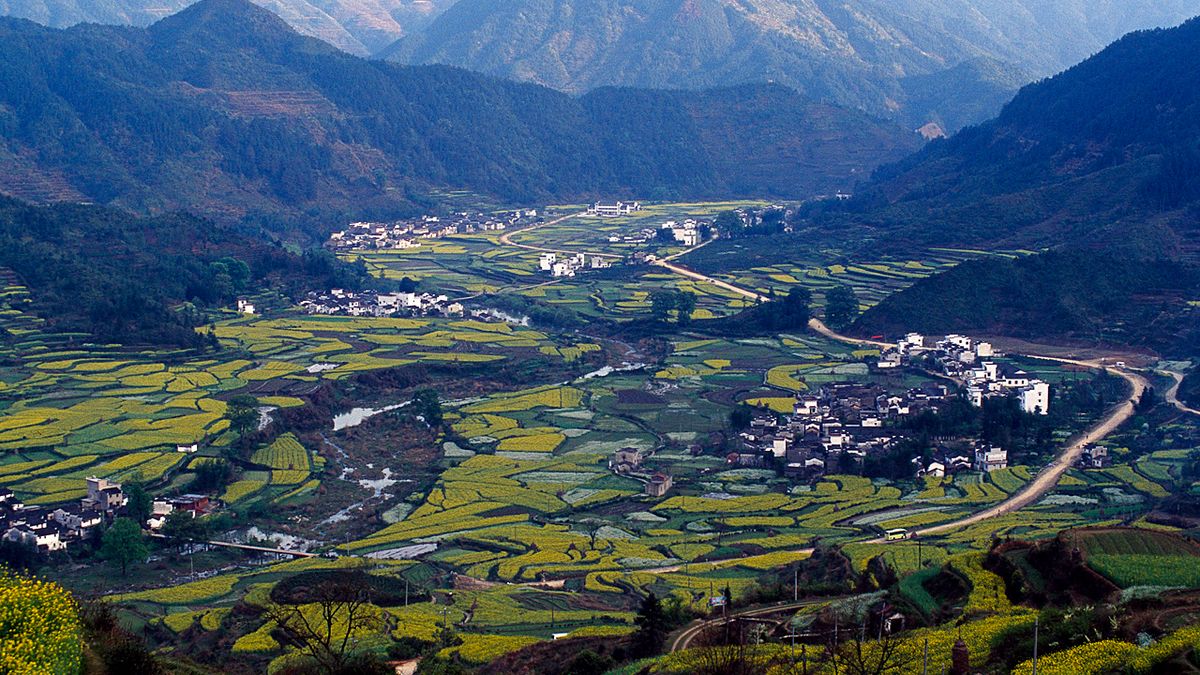
Why Wuyuan?
Wuyuan gets called "the most beautiful countryside in China," and for once the slogan more or less holds up. It's a rural county in the far northeast corner of Jiangxi, tucked up against the Anhui border, and it's wall-to-wall with whitewashed, black-tiled Huizhou-style villages — the same elegant merchant architecture you'll see around Huangshan, but set among tea terraces, camphor trees, stone bridges and rice paddies instead of crowds. For two or three weeks in spring the hillsides erupt into golden rapeseed (canola) flowers, and Wuyuan becomes one of the most photographed places in the country. Come outside that window and you get the same gorgeous villages with a fraction of the people — which, honestly, many travellers prefer.
This is slow travel, not a checklist. You wander old lanes, drink local green tea, eat steamed river fish, and watch farmers dry their harvest on the rooftops. If you've had your fill of big-city China, Wuyuan is the antidote.
How to get there from Nanchang (the key question)
Good news for anyone using Nanchang as a base: the fast trains run straight through, so it's a direct, painless hop with no transfer. One thing worth getting straight, because plenty of guides fudge it: Wuyuan is not a stop on the Nanchang–Jingdezhen–Huangshan line itself. It sits on its own junction some 35km south of that corridor, where the high-speed line running north to Huangshan crosses the line running west to Jingdezhen. That geography is the whole reason it slots so easily between the two.
- Route: Nanchang East (南昌东 / Nanchangdong) → Wuyuan (婺源) by direct high-speed train.
- Which Nanchang station you leave from decides your journey time. From Nanchang East (南昌东) the quickest run is 1 hour 19 minutes, and most of the rest come in under an hour and forty. The same trip from Nanchang West or the central Nanchang station takes 1 hour 50 minutes to over 3 hours — same destination, very different afternoon.
- Frequency: around 20 services a day across all the Nanchang stations, 12 of them out of Nanchang East — first departure 07:23, last 18:44. There's nothing after that, so a slow morning costs you the day.
- Fare: second class is ¥120 on effectively every Nanchang East service, a few yuan either way on the odd one — cheap for the distance, but not pocket change. Fares change; check when you book.
- Check your station: Nanchang has three railway stations and they are nowhere near each other — Nanchang East (南昌东) out in the eastern suburbs, central Nanchang (南昌), and Nanchang West (南昌西). One character on the ticket, an hour of your life. Metro Line 2 links all three, but book the East departures if you can, and leave yourself time to get across town.
- At the far end: Wuyuan's high-speed station (婺源站) sits a few kilometres outside the county town, Ziyang. You don't have to leave the building to keep moving — there's a bus station attached to the rail station; follow the signs from the platform. Direct express buses run to Huangling (stopping at Jiangwan on the way), roughly hourly from mid-morning to late afternoon, for about ¥19. A taxi to Huangling is around 50 minutes, and DiDi works from the station too.
- Coming from elsewhere: the two lines crossing here are what make Wuyuan so easy to fit in. North, on the Hefei–Fuzhou high-speed line, Huangshan North is 23–28 minutes away for about ¥35, with roughly 21 trains a day. West, on the Jiujiang–Quzhou line, Jingdezhen North is 26–32 minutes for about ¥26 — around 29 fast services a day, plus a couple of slow trains at ¥12.5. Hangzhou and Shanghai are reachable too, which is why plenty of people fold Wuyuan into a wider eastern-China loop rather than a Jiangxi one.
Book on 12306.cn (the official railway site) or an English-friendly reseller like Trip.com; your passport is your ticket ID, so bring it to the gate. If you're still working out which Nanchang station is which, our guide to getting around Jiangxi by train lays out the whole network. Because Wuyuan and Jingdezhen are barely half an hour apart, the classic move is to string them together — more on that below.
How Wuyuan is laid out (and the two ticket systems)
This trips a lot of first-timers up, so here's the deal. "Wuyuan" isn't one site — it's a whole county of villages scattered around the county town of Ziyang. Locals and every ticket desk talk in touring lines — east, north and west, and which villages sit on which is the next section. Pick one line per day rather than zig-zagging between them; the driving time is what eats your afternoon. Most of the classic villages are covered by one combo ticket, but the single most famous spot, Huangling, is privately run and sells its own separate ticket. Budget for both if you want the full experience.
- The Wuyuan combo ticket (婺源通票) — around ¥210, valid for about 5 days, covering roughly 14 sights. The standard line-up: Likeng (李坑), Jiangwan (江湾), Wangkou (汪口), Xiaoqi (晓起), Jiangling (江岭), Sixi & Yancun (思溪延村), the Rainbow Bridge at Qinghua (彩虹桥), the Wolonggu gorge at Dazhangshan (卧龙谷), the Lingyan caves (灵岩洞), the old camphor at Yantian (严田古樟), Wengongshan (文公山), Shicheng (石城), the Hundred-Pillar Ancestral Hall at Huangcun (百柱宗祠) and Yuanyang Lake (鸳鸯湖). It pays for itself somewhere around the third or fourth gate. The list does get tweaked and a few sights are sold separately in their own peak weeks, so read the board before you pay.
- Huangling (篁岭) — separate ticket, not in the combo. One combined ticket covers entry and the return cable car: ¥145 in high season — meaning the spring rapeseed weeks and the autumn sun-drying — and ¥120 the rest of the year. There's no cheaper way up that's worth having: the village sits on a ridge, and the cable car is how you reach it. More on Huangling further down.
- Also outside the combo: Likeng (理坑) — a different village from the famous 李坑, same sound, different characters, and a long way north — plus Qingyuan (庆源) out east. Both sell their own tickets. If a driver offers you "Likeng," check which one they mean.
The three touring lines — and which villages sit on each
Nobody tells you this at the station, and it's the most useful thing to know before you plan a day. The villages fan out from Ziyang along three river valleys. Two stops on the same line are usually ten to twenty-five minutes apart; crossing from one line to another can cost you an hour each way. Here's who lives where.
- East line (东线) — the greatest hits, and your first day. Running northeast up the valley from Ziyang: Moon Bay (月亮湾), a crescent islet with a free roadside pull-in, best in early-morning mist; Likeng (李坑), the stream-through-the-middle water village; Wangkou (汪口), whose Yu-clan ancestral hall carries some of the county's finest wood carving; Jiangwan (江湾); Xiaoqi (晓起) under its camphor trees; Jiangling (江岭), the terraced viewpoint, right at the far end; and, on its own ridge above Jiangwan, Huangling (篁岭). Almost everything famous is on this one road.
- North line (北线) — quieter, greener, better in autumn. Up the other valley toward Qinghua and the Dazhangshan hills: Sixi & Yancun (思溪延村), twin Qing merchant villages; the Qinghua Rainbow Bridge (彩虹桥); the Wolonggu gorge (卧龙谷), a cascade walk that earns its keep in July and August; the Lingyan caves (灵岩洞); Shicheng (石城), where old maples stand over the black tiles and fog pools in the valley — photographers rate early November to early December, mid-to-late November best, and they're all set up between about 6:30 and 8:30am (check whether your combo covers it in maple season; some operators sell it separately); and, at the end of a slow road, Likeng (理坑), a village of officials' mansions with barely a coach in sight.
- West line (西线) — a third day, or not at all. Wengongshan (文公山), a quiet hill of cedars said to have been planted by the philosopher Zhu Xi (朱熹) on a twelfth-century visit to sweep his ancestors' graves — twenty-four went in, sixteen still stand, the tallest pushing 39 metres. (Wuyuan is Zhu Xi's ancestral county; the county town, Ziyang 紫阳, carries one of his own studio names.) Then Yuanyang Lake (鸳鸯湖), where mandarin ducks winter in real numbers (roughly November to March; out of season it's a pretty reservoir and little more); the thousand-year camphor at Yantian (严田); and the Hundred-Pillar Ancestral Hall (百柱宗祠) at Huangcun. Fewest visitors, longest drives.
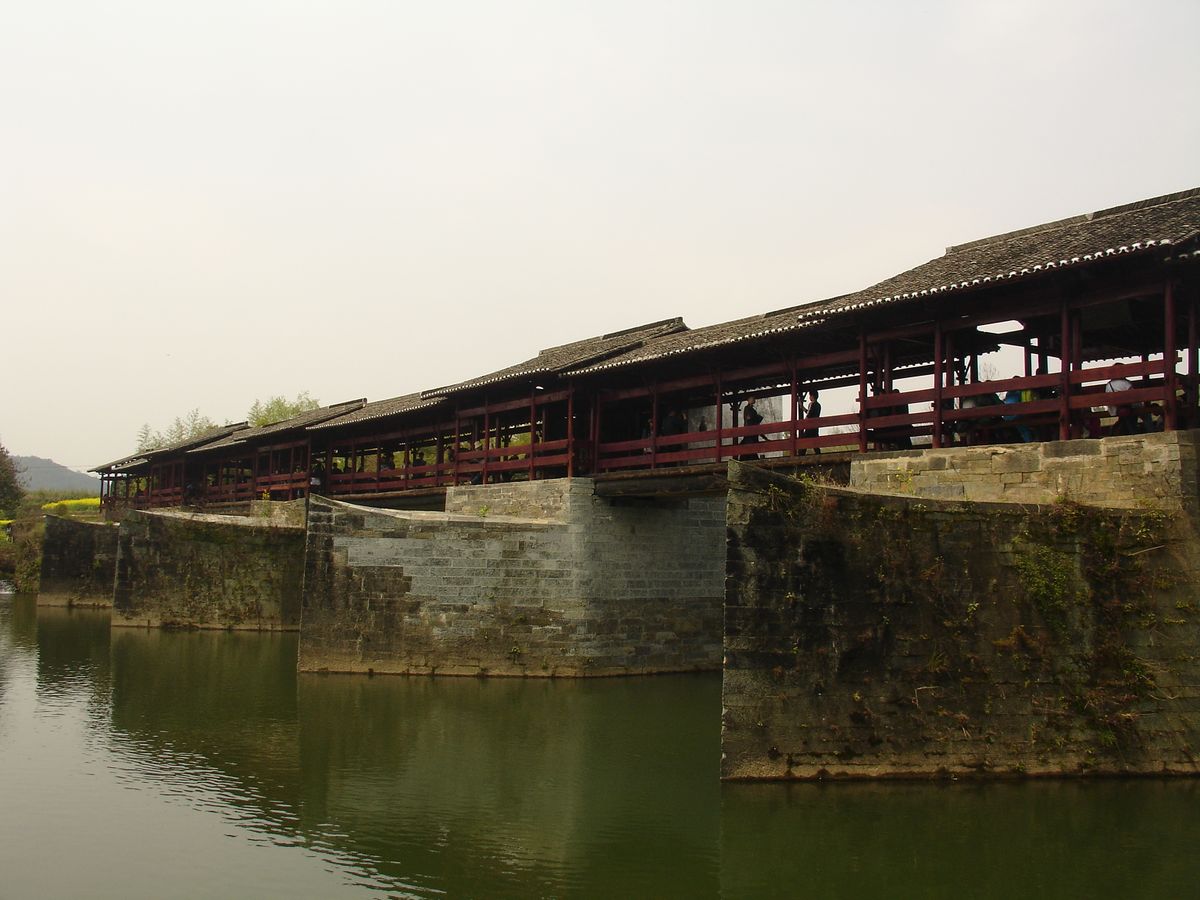
The Rainbow Bridge at Qinghua, on the north line — four squat stone piers cut like boat prows to split the current, with a red-timbered gallery and a tiled roof laid over the top. You walk through it rather than over it. Photo: Simpleyoung / CC BY-SA 3.0 via Wikimedia Commons.
What to see and do
You can't do all of it, and you shouldn't try. Pick a few villages by mood:
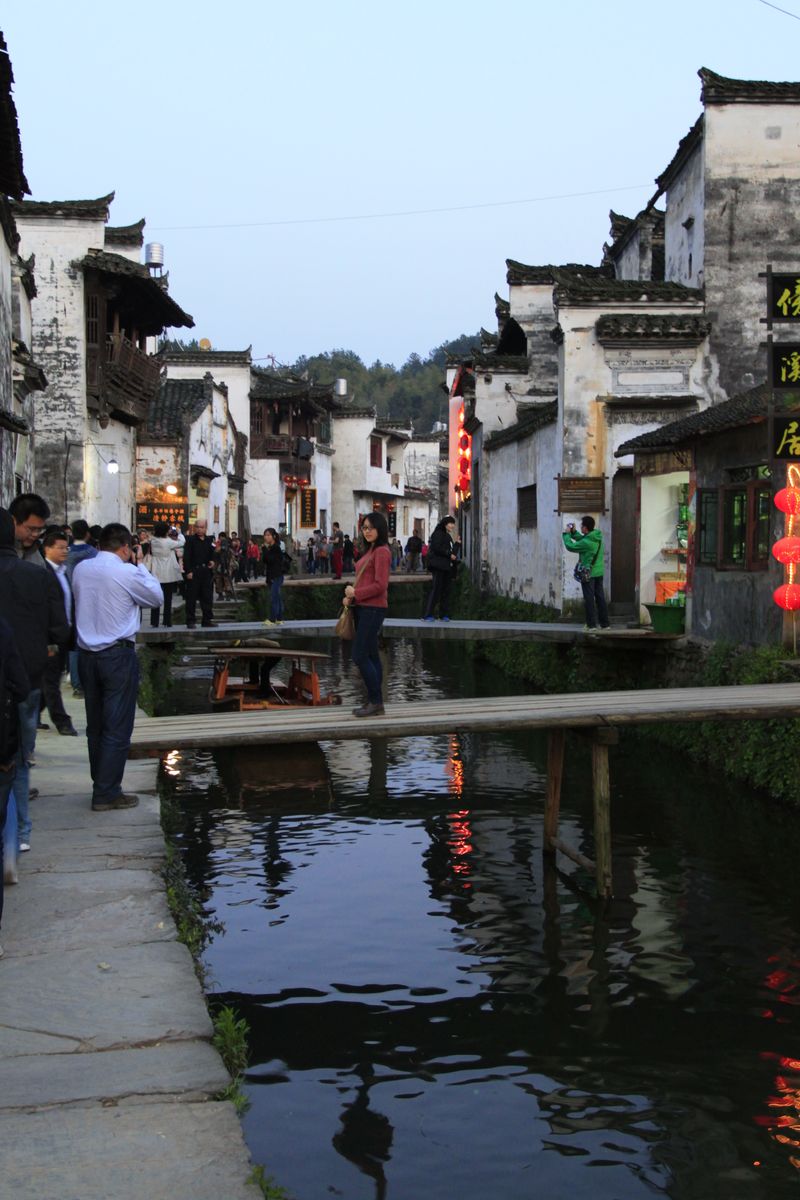
Likeng at dusk: the stream runs straight down the middle of the village, plank bridges cross it every few metres, and by late afternoon somebody is usually posing on one of them while the red lanterns come on. Touristy, and still lovely. Photo: Zhangzhugang / CC BY-SA 4.0 via Wikimedia Commons.
- Huangling (篁岭) — the icon. A restored hilltop village reached by cable car, world-famous for "晒秋" (shàiqiū, "sun-drying autumn"): farmers spread chillies, corn, persimmons and chrysanthemums on round trays across the rooftops, creating those impossibly photogenic patchworks of red and gold. The village clings to a ridge about 500 metres up, which is why the cable car isn't optional, and there's a glass skywalk strung between the slopes if you want the view with a jolt. In spring the terraced rapeseed below it blooms a beat later than the valley floor — often into early or mid-April, when the lowland gold has already gone over. The most curated, polished — and busiest — spot in Wuyuan.
- Likeng (李坑) — a postcard water village of streams, little stone bridges and old shop-houses; touristy but charming, and easy.
- Wangkou (汪口) & Jiangwan (江湾) — handsome historic villages with grand ancestral halls and serious Huizhou wood carving; Jiangwan is the polished "ancestral home" showpiece. The clan is the Xiao-Jiang (萧江), whose hall here is often called the finest south of the Yangtze — Ming-built, burned in the Taiping wars, rebuilt in 1924, pulled down again, and reconstructed a third time in 2003. Jiangwan is also the ancestral village of former Chinese president Jiang Zemin, and one of the county's two top-tier 5A sites (Huangling is the other), which is why it feels more manicured than its neighbours.
- Jiangling (江岭) — the rapeseed-terrace viewpoint in season: tier upon tier of yellow fields wrapping the hills, with white villages tucked in the folds. Off-season it's quiet green terraces.
- Sixi & Yancun (思溪延村) — quieter twin villages, lovely old merchant houses, far fewer crowds. The low-lying rapeseed here is among the first to bloom each spring.
- Xiaoqi (晓起) — upper and lower hamlets shaded by enormous old camphor trees. Ask around and a surprising number of locals will tell you this one, not Huangling, is the prettiest of the lot. It's also the home of Wuyuan's imperial chrysanthemum (皇菊) — see the food section.
- Qinghua Rainbow Bridge (彩虹桥) — a much-photographed Song-dynasty covered wooden bridge over the river at Qinghua.
How Huangling's rooftops got famous
There's a line locals use about Huangling: the village hasn't three feet of level ground. Look at it and you see why — the best part of six hundred years of houses stacked down a 500-metre ridge, lane above lane, roof below roof, terraces dropping away underneath. Lovely to live in, hopeless for drying a harvest. Rice, chillies, corn, persimmons, chrysanthemum all need days of flat sun after they come in, and there wasn't a courtyard in the village big enough for a season's worth.
So the village built outward instead. Wooden racks pushed out from the upstairs windows, round bamboo trays a metre across laid on them, one crop to a tray. Autumn turned the roofscape into a grid of red and orange and gold, and nobody called it scenery — it was just how you got the year into the store cupboard. Then the village nearly lost it: collective relocations in 1993 and 2002 moved most families down the hill, roofs fell in, lanes filled with weeds. From 2009 an outside developer swapped the remaining households into new houses at the foot of the slope and rebuilt the old one as a scenic area; in 2014 a local photographer's picture of the trays went national and the drying racks got themselves voted one of China's "most beautiful symbols"; in 2023 the UN World Tourism Organization named Huangling one of its "Best Tourism Villages". So what you'll photograph is a real farming habit and a staged version of one at the same time. Both are true, and neither spoils the moment you come round the corner and it's all in front of you.
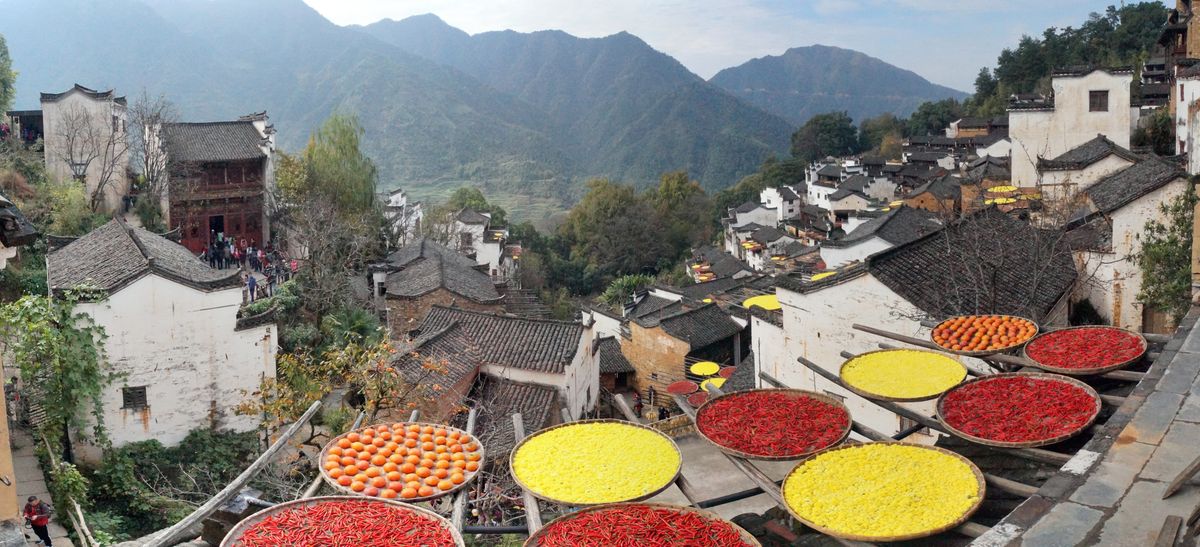
Huangling in autumn, looking down the ridge: trays of chillies, persimmons and gold pushed out on racks above the tiles, with the valley dropping away behind and the ancestral hall on the left already drawing a queue. Photo: Leungcwd / CC BY-SA 4.0 via Wikimedia Commons.
When to go — and the all-important rapeseed window
This is the one section to read twice, because Wuyuan's headline sight is seasonal and the dates move every year with the weather.
- Rapeseed / canola bloom (the famous gold) — roughly mid-March to early April. As a rough guide: the lower plains villages (around Likeng, Yantian, Sixi) come on first, in early-to-mid March; the terraced viewpoints (Jiangling, the slopes at Huangling) peak later, around mid-to-late March; and the high alpine terraces (Huangling's upper "phase 2") can still be golden into mid-April. The fullest, all-at-once peak is usually the second half of March — but it shifts a week or two each year, so check a current local source 1–3 days before you commit rather than trusting any fixed date (including this one).
- Autumn "sun-drying" (晒秋) at Huangling — roughly early September to early December, with the classic red-and-gold rooftop displays at their fullest from about mid-September into November (rice and chillies first, persimmons later). This is the second great season and far less hectic than spring. Late in it, the north line takes over: Shicheng's maples and valley fog are a November thing, and worth the pre-dawn alarm.
- Late spring & summer (May–Aug): lush, green and quiet, with terraced rice instead of flowers — lovely if you just want the villages without the spring crush. Summer is hot, humid and can be wet; this is when the Wolonggu gorge on the north line, all shade and running water, is the smartest thing on the map.
- Winter: cold and bare, but atmospheric (and very cheap); the occasional dusting of snow on black-and-white villages is magic, and the mandarin ducks are in at Yuanyang Lake.
Reality check on the bloom: peak rapeseed season is Wuyuan's one genuinely crowded time. Domestic tour groups and photographers pour in, especially on weekends. If you're coming for the flowers, travel midweek, book your room and your Huangling ticket well ahead, and start each day early.
What to eat in Wuyuan
Come from Nanchang and the first mouthful will surprise you. The capital cooks Gan food — the wok-roaring xiao chao and chilli-slicked rice noodles that make Jiangxi one of the spiciest provinces in China. Wuyuan cooks Hui food (徽菜), inherited from the Huizhou merchants who built these villages: steamed rather than seared, thickened rather than fired, seasoned with white pepper, cured pork and whatever the hills gave up that week. If the chilli has been beating you up all trip, this is the rest stop.
- Paste tofu (糊豆腐) — the dish every Wuyuan table starts with. Tofu crumbled fine and simmered into a thick, savoury porridge with rice flour, dried shrimp, mushroom and a lot of white pepper. Lunch or dinner, first to arrive. Mild — the heat is peppery, not chilli. Roughly ¥38–58 in a scenic-village restaurant, less in the county town. Easiest first-timer order on the menu.
- Rice-flour steamed pork (粉蒸肉) — pork belly rolled in toasted, coarsely ground rice and steamed until the fat goes translucent and the rice has drunk the drippings. Lunch or dinner, no chilli to speak of, about ¥38–58. It's the local habit in miniature: Wuyuan steams almost everything, and a stack of bamboo baskets — pork, beef, taro, pumpkin — feeds three or four people properly. Order a plate of whatever wild greens (野菜) are in season alongside it, stir-fried plain with garlic; water-fern shoots (水蕨菜) in spring are the ones to look for, usually around ¥28.
- Hebao red carp (荷包红鲤鱼) — the county's own scarlet carp, deep-bodied and round enough that the name means "purse fish", farmed in these village ponds for centuries and steamed whole with ginger and spring onion. A dinner dish, delicate rather than spicy, and priced by the fish or by weight — ask the number before you nod. It's the one order that can double your bill.
- Steamed rice cake (蒸汽糕 / 汽糕) — breakfast, and only breakfast. Rice soaked overnight until it turns faintly sour, ground to a slurry, spread thin in a round pan, steamed, then scattered with mushroom, dried shrimp and bean sprouts and cut into squares. Soft, tangy, savoury. From about ¥5 a portion in the county town, ¥10–15 with soy milk in the villages. The pans are away by mid-morning.
The four colours. The county sells itself on its four colours (婺源四色): red is the hebao carp, green is Wuyuan green tea (婺源绿茶), white is the Jiangwan snow pear (江湾雪梨), and black is the one you can't eat — the Longwei inkstone (龙尾砚), quarried in these hills and ranked among China's four great inkstones for a thousand years. The souvenir actually worth bag space, though, is imperial chrysanthemum (婺源皇菊) from Xiaoqi: single dried heads the size of a plum, one to a glass, that open into a whole bloom under boiling water and turn it clear gold. The story locals tell is of a Xiaoqi man, a salt commissioner under the Guangxu emperor, who turned down a retirement gift of gold and asked for palace-garden chrysanthemums instead.
Where to eat, honestly. Inside the ticketed villages — Likeng, Jiangwan, the foot of Huangling — reckon on ¥50–80 a head, menus usually have photographs, and the first three restaurants inside the gate are almost never the best; walk two minutes further in. In Ziyang the same food costs noticeably less, and the breakfast shops are where the ¥5 rice cake lives. The best meal of the trip, though, is usually the one your guesthouse cooks: say in the morning that you'll eat in, because they shop for it. We don't print restaurant names here on purpose — in villages this size the good kitchens change hands faster than any guide keeps up, and your host's pick will beat ours. (Got one that's still good? Send it to us.)
How long to stay
Wuyuan rewards a slower pace than people expect, because the villages are spread out and the joy is in the wandering.
- One night / quick hit: doable — Huangling plus one or two nearby villages — but tight, and you'll feel rushed in flower season.
- Two to three days (recommended): the sweet spot. Mix the headline spots (Huangling, Jiangling) with a couple of quiet villages (Sixi & Yancun, Wangkou), and leave time for tea, lanes and a slow lunch.
A two-day plan that follows the lines
One line per day, and the county stops feeling like a scavenger hunt. This is the version we'd send a friend on.
- Day 1 — the east line. Take an early train out of Nanchang East and you're at Wuyuan station before 09:00. Drop your bag at the guesthouse, then the express bus or a taxi straight up to Huangling — cable car, ridge lane, drying racks, glass walkway, terraces below. Give it three or four hours; it deserves them. Come down mid-afternoon, stop at Jiangwan on the way back (the Huangling bus calls there) for the Xiao-Jiang hall, and finish at Likeng or Wangkou in the late light, once the coaches have gone and the lanterns are on over the stream.
- Day 2 — the north line, with a driver. Book a car through your guesthouse the night before (roughly ¥200–250 for the day). Start at Sixi & Yancun before 09:00, while the merchant courtyards are still empty; on to the Rainbow Bridge at Qinghua mid-morning, lunch nearby. The afternoon depends on the month: Wolonggu for shade and water in summer, the Lingyan caves in rain, Shicheng in late autumn — in which case flip the day, go at dawn for the fog and do the bridge after. Back in Ziyang by early evening; the last train back to Nanchang leaves around 20:30, so a night departure works if you're not staying over.
- Got a third day? In bloom season give it to Jiangling, at the far end of the east line, starting at first light — those terraces face the morning. Otherwise take the west line, or just go back to whichever village you liked best, without a plan.
What it costs
Wuyuan is gentle on the wallet by Chinese-sight standards. Outside peak season, a comfortable independent day — guesthouse, tickets, simple local meals and some local transport — lands somewhere around ¥350–600 per person. Add a private driver, or come in bloom season when in-village rooms spike, and it climbs from there. The two big line items are the tickets (¥210 combo, plus ¥145 for Huangling in high season or ¥120 outside it), not the food: you can eat very well here for ¥50–80 a head.
Getting around the county
The villages are scattered, so plan your transport — this is the bit that catches people out.
- Tourist shuttle buses run between the Wuyuan visitor centre / bus station and the main combo-ticket villages; frequencies thin out off-season, so check the day's timetable.
- Hiring a car with a driver for the day is by far the easiest way to cover several villages on your own schedule — reckon on roughly ¥200–250 for a small van, negotiable, and very reasonable split between a few people. Most guesthouses can arrange one. In bloom season, when the village roads clog up, this is the difference between seeing four villages and seeing two.
- Didi works in and around Ziyang town but gets patchy out in the countryside.
- Maps: use Amap (Gaode); Google Maps is unreliable in mainland China.
Where to stay
Where you sleep shapes the trip more than usual here.
- In a village guesthouse (民宿): the Wuyuan experience. Restored Huizhou courtyard homes in or near villages like Likeng, Sixi or around Jiangling — atmospheric, and you get the villages early and late without the day-trippers.
- Huangling's own hilltop hotels: pricey and book out in season, but staying up top means you see the rooftops and terraces at dawn before the cable car brings the crowds.
- Ziyang (Wuyuan town): the practical base with the most options, restaurants and transport links, if you'd rather have a town at night.
Combining with Jingdezhen, Sanqingshan & the wider loop
Wuyuan really shines as one stop on a northeastern Jiangxi loop rather than an isolated trip. Jingdezhen is half an hour west by train and Sanqingshan (the Taoist granite peak) is in the same Shangrao prefecture, so it links up beautifully:
- Classic combo: Nanchang → Jingdezhen (porcelain) → Wuyuan (villages) → back to Nanchang — every leg a direct train, and none of them over an hour and forty. A superb 3–4 day loop; our Jingdezhen ceramics trip covers the porcelain half day by day.
- Add Sanqingshan for granite peaks and a sea of clouds — Wuyuan and Sanqingshan are both in Shangrao and connect via Shangrao or a direct seasonal bus, making a fuller 5-day nature-and-villages circuit. That's exactly the shape of our 5-to-7-day Jiangxi loop.
- Cross-border bonus: from Wuyuan the Hefei–Fuzhou line runs north into Anhui and puts Huangshan (Yellow Mountain) 23–28 minutes away — about ¥35, some 21 trains a day. It'll be the shortest hop of your whole trip, and it's why Wuyuan sits so naturally between Jingdezhen and the mountain.
Practical info at a glance
- Getting there: direct high-speed train, Nanchang East → Wuyuan, from 1h19m, second class ¥120, 12 departures a day (07:23 to 18:44). The station sits a few kilometres outside Ziyang with a bus station attached; express buses to Huangling about ¥19.
- How long: two to three days. One night only works if Huangling is all you want.
- Tickets: combo around ¥210 (about 5 days, roughly 14 sights), plus Huangling separately — ¥145 in high season, ¥120 the rest of the year, return cable car included.
- Best time: second half of March for rapeseed; mid-September to November for the drying racks; November for Shicheng's fog and maples; summer for green terraces and gorge walks.
- Pay & language: Alipay and WeChat Pay almost everywhere, cash for village stalls; English is rare, so save village names in Chinese on your phone.
- Good for / less good for: photographers, slow travellers, walkers and families with older kids; not for tight schedules, step-free access (cobbles, slopes, high thresholds) or anyone hoping for nightlife. After dinner, Wuyuan goes to bed.
Quick tips
- Coming for the rapeseed? Check a current local bloom update 1–3 days out — the peak moves yearly, and a week early or late changes everything.
- Budget for two tickets: the ¥210 combo (around 14 villages and sights, ~5 days) and Huangling separately — ¥145 in high season, ¥120 outside it, return cable car included.
- Huangling's cable car runs roughly 7:30am–5:30pm; go up early to beat the tour groups.
- In peak spring, book your bed and your Huangling ticket well ahead and travel midweek if you can.
- Sort a day driver through your guesthouse — it's the painless way to village-hop.
- One line per day. Crossing from the east line to the north line and back will cost you a village.
- Carry cash for small village stalls, but Alipay/WeChat Pay work almost everywhere; bring your passport for the train and hotel check-in.
FAQ
When exactly do the rapeseed flowers bloom in Wuyuan? Roughly mid-March to early April, with the fullest county-wide peak usually in the second half of March — but it moves a week or two every year with the winter. The low villages (Likeng, Sixi, Yantian) go first, the terraced viewpoints (Jiangling, the slopes under Huangling) a week or so later, and Huangling's high terraces can still be gold into mid-April. Book flexible rooms and check a current local bloom report one to three days out; no published date, this one included, is worth planning a flight around.
Is Huangling worth buying a separate ticket for? For most first-timers, yes — it's the one place in Wuyuan that delivers a single knockout image, whether that's the autumn drying trays or the terraces in bloom, and the ridge-top lane is lovely early in the day. ¥145 in high season (¥120 outside it), cable car included, is real money on top of the ¥210 combo, though. Skip it in the dead weeks between seasons, or if what you came for is empty lanes — put the money into a driver and spend the day on the north line instead.
Can you visit Wuyuan as a day trip from Nanchang? Physically, yes: the first fast train out of Nanchang East leaves at 07:23 and the last one back leaves Wuyuan around 20:30, so you get a workable thirteen-hour window. Practically, you'll see Huangling and almost nothing else, because the villages are spread across a whole county and the transfers eat the day. If Wuyuan is why you came to Jiangxi, stay the night. If you only have one clear day out of Nanchang, take Jingdezhen instead — 42–60 minutes away, and far better suited to a day.
Wuyuan or Jingdezhen — which should I choose? They're half an hour apart by train, so the honest answer is both. Jingdezhen is a working porcelain city: kilns, workshops, markets, easy from Nanchang in a day. Wuyuan is countryside, and needs two nights to make sense. Three or four days: Nanchang → Jingdezhen → Wuyuan → back. One day: Jingdezhen. One weekend and a camera: Wuyuan.
How many days do you need in Wuyuan, and what does it cost? Two to three days — one line per day, with a third for Jiangling in bloom season or the quiet west line otherwise. Budget roughly ¥350–600 per person per day outside peak season for a guesthouse, tickets, meals and shared transport; a village dinner is about ¥50–80 a head and a day driver about ¥200–250 for the car. Bloom-season rooms cost considerably more, and sell out.
Plan the trip
Wuyuan is the easiest place in Jiangxi to fall for, and the easiest to get slightly wrong — one line too many, one week too early. If you'd rather not gamble on the bloom or the logistics, tell us your dates and we'll build the trip around them. Or keep reading: the 5-to-7-day Jiangxi loop puts Wuyuan in its natural sequence, why visit Jiangxi makes the case for the whole province, and the Destinations hub has every corner of it.
Images: cover, "Wuyuan jiangling" (婺源江岭风光) by YaPEX (CC BY-SA 2.0) — the valley below Jiangling in bloom, rapeseed quilting the fields with whitewashed villages strung along the road; "Wuyuan Qiukou Likeng 20120331-05" by Zhangzhugang (CC BY-SA 4.0); "江西省上饶市婺源县清华彩虹桥" (Qinghua Rainbow Bridge) by Simpleyoung (CC BY-SA 3.0); "Autumn sun drying at Huangling" by Leungcwd (CC BY-SA 4.0) — all via Wikimedia Commons.
Last verified: 2026-08. Rapeseed bloom dates shift every year, and train times, fares, ticket prices, restaurant prices and opening hours change often — please double-check official sources before you travel. Wuyuan's combo ticket in particular is quoted differently by different sellers, and Huangling switches between its high- and low-season rates, so treat the figures here as a budgeting guide rather than a quote.
You Might Also Like
- Lushan (Mount Lu): China's Summer Escape
- Nanchang Travel Guide: Jiangxi's Capital
- Poyang Lake Nature Reserve: See the Cranes
Explore Nanchang & Jiangxi itineraries · Plan a custom trip with us