Haihunhou Museum Nanchang: 27-Day Emperor
Liu He was emperor for 27 days, then a disgraced marquis — and his Nanchang tomb held more Han gold than any on record. How to visit the site museum.
By Hello Nanchang · Last updated
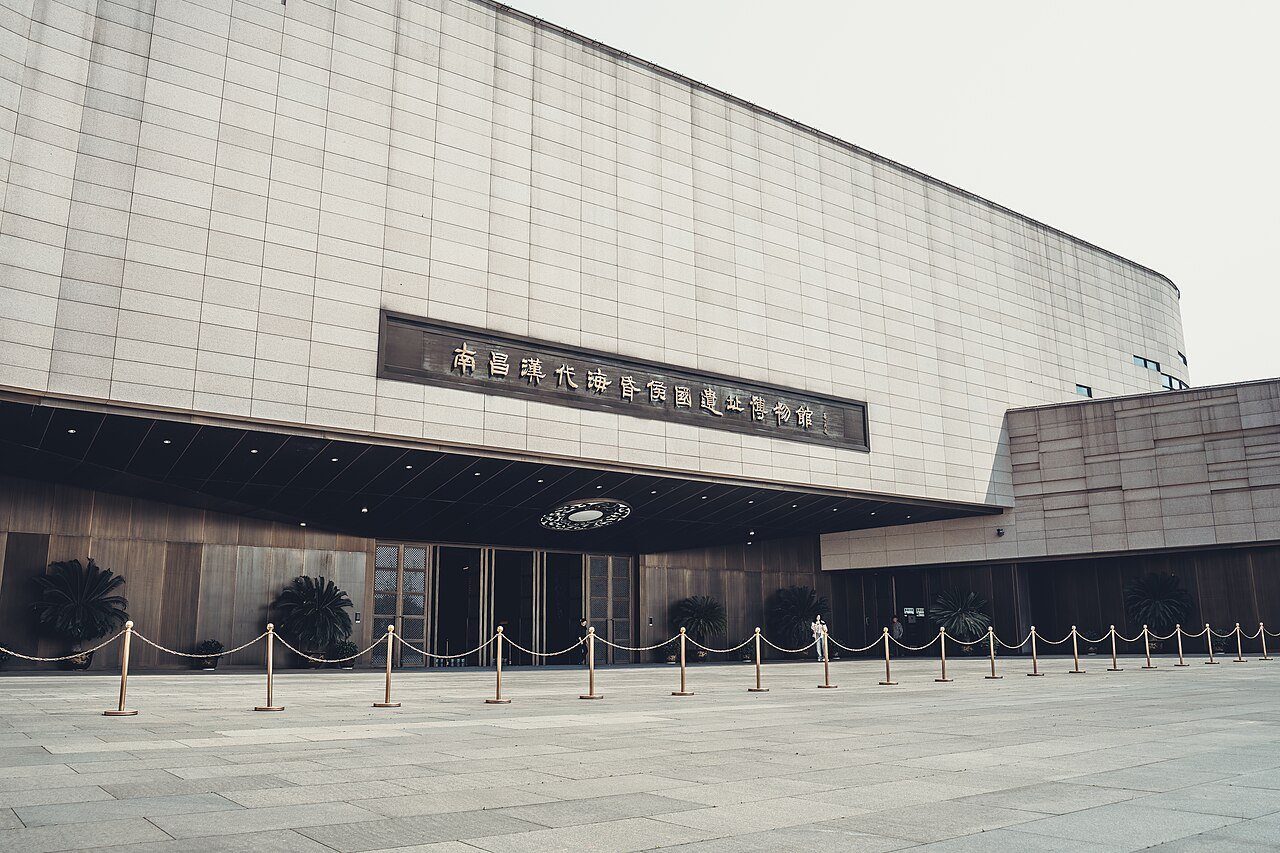
Nanchang Han Dynasty Haihunhou State Site Museum (南昌汉代海昏侯国遗址博物馆), Guanxi Village, Datangping, Xinjian District, Nanchang · Open daily, roughly 9:00 AM – 5:00 PM (last entry around 4:00 PM); confirm current hours and any closed days before you go. Advance real-name reservation required — bring your passport.
The emperor who lasted 27 days — and got the last laugh
Here is the most entertaining résumé in Chinese history. In 74 BC a young prince named Liu He (刘贺) was plucked from a minor kingdom, handed the throne of the Han empire, and deposed twenty-seven days later — fired, the court said, for 1,127 separate misdeeds. That's roughly forty-one scandals a day, which is impressive work even for an emperor. He was packed off in disgrace, eventually exiled to a swampy estate near Poyang Lake and given the consolation title Marquis of Haihun (海昏侯). He died there, more or less forgotten, around the age of thirty-three.
And then, two thousand years later, he won. In 2011 archaeologists opened his tomb — sealed and unlooted since the Han — and found the richest, best-preserved aristocratic burial the dynasty has ever yielded: over ten tonnes of coins, more gold than any Chinese tomb on record, a bronze still, a 2,000-year-old hotpot, and the earliest known portrait of Confucius. The 27-day failure now has a 12-square-kilometre archaeological park and a museum built over his grave, and in death he outshines almost every emperor who outranked him in life. It's hard to picture a more satisfying way to be remembered.
This is the Nanchang Han Dynasty Haihunhou State Site Museum (南昌汉代海昏侯国遗址博物馆), out in Xinjian District, and it's one of the most genuinely surprising half-days in Jiangxi. Not the easy downtown stop — that's the free Jiangxi Provincial Museum, which keeps a teaser selection of the marquis's treasures. This is the real thing: the actual tomb, the actual gold, on the spot where it all came out of the ground.
How to lose a throne in under a month
Liu He had bad timing baked into his bloodline. He was a grandson of Emperor Wu (汉武帝), the towering warrior-emperor — but through a sidelined branch, and he inherited the small kingdom of Changyi as a boy. When the childless Emperor Zhao died young in 74 BC, the all-powerful regent Huo Guang (霍光) went looking for a pliable teenager to install. He picked the eighteen-year-old Liu He.
Liu He was so eager he reportedly ran his escort's horses to death racing to the capital — the most over-eager commute in Chinese history. Then he proceeded to fail spectacularly at being a figurehead. The charge sheet read out at his deposition is wonderfully petty: during the official mourning for the late emperor he secretly bought and ate chicken and pork, dragged along his own "selected maidens," and partied through the night with the 200-odd cronies he'd brought from home. Huo Guang had seen enough. Before the empress dowager, he took Liu He by the hand, untied the imperial seal-cord from his waist, and walked him out of the palace. Twenty-seven days, done.
It's a great farce — but historians now suspect it was also a stitch-up. Liu He's real crime was trying to bring his own people in and claw power back from a regent who decided everything; the 1,127 "misdeeds" were almost certainly padded by the winning side. As Xin Lixiang (信立祥), who led the tomb's research team, has bluntly put it, the official records of Liu He are "in many places not to be believed." If he'd truly been a monster, he'd never have been chosen in the first place. History, as ever, was written by the man who did the firing.
Demoted to commoner, Liu He was quietly re-titled Marquis of Haihun in 63 BC and ordered to live out his days in remote Haihun county, by Poyang Lake in what is now Nanchang's Xinjian District. (Trivia for the curious: nobody fully agrees what "Haihun / 海昏" means — maybe "west of the lake," maybe a sly insult meaning "murky" — though since the county was named two centuries before Liu He ever arrived, the insult theory is fun but doesn't really hold up.) He died in 59 BC, leaving 16 wives, 22 children, and the most valuable buried grudge in China.
The tip-off that saved a fortune
We almost never got to read the rest of the story. In March 2011 a villager in Guanxi Village (观西村) noticed oddly-dressed strangers loitering around a mound called Modunshan (墎墩山), climbed up one morning, saw fresh-dug earth, and called the police. The "strangers" were tomb robbers, and they were close — their shaft had already gone some fifteen metres down. It stopped just short of the burial chamber. A day or two later and 2,000 years of treasure would have vanished into the antiquities market.
Instead, archaeologists got there first, and what followed was a five-year excavation (2011–2016) that Chinese audiences followed like a TV serial. When the inner coffin was finally opened in a lab in 2016, the clincher was small and personal: a jade name-seal, carved with two characters — 刘贺 — resting where the marquis's waist had been. A 2,000-year-old signature on the body of a deposed emperor. Identity confirmed.
What was in the box: a frankly absurd amount of money
Start with the gold. The tomb gave up some 478 gold objects — gold cakes, hoof-shaped ingots, and thin gold plates — totalling somewhere around 115–120 kilograms at well over 95% purity. It is, by a wide margin, the largest haul of gold ever excavated from a single Chinese tomb: more, in one grave, than all previously excavated Western Han gold combined. For a man the empire had officially branded a washout, that is quite a retirement fund.
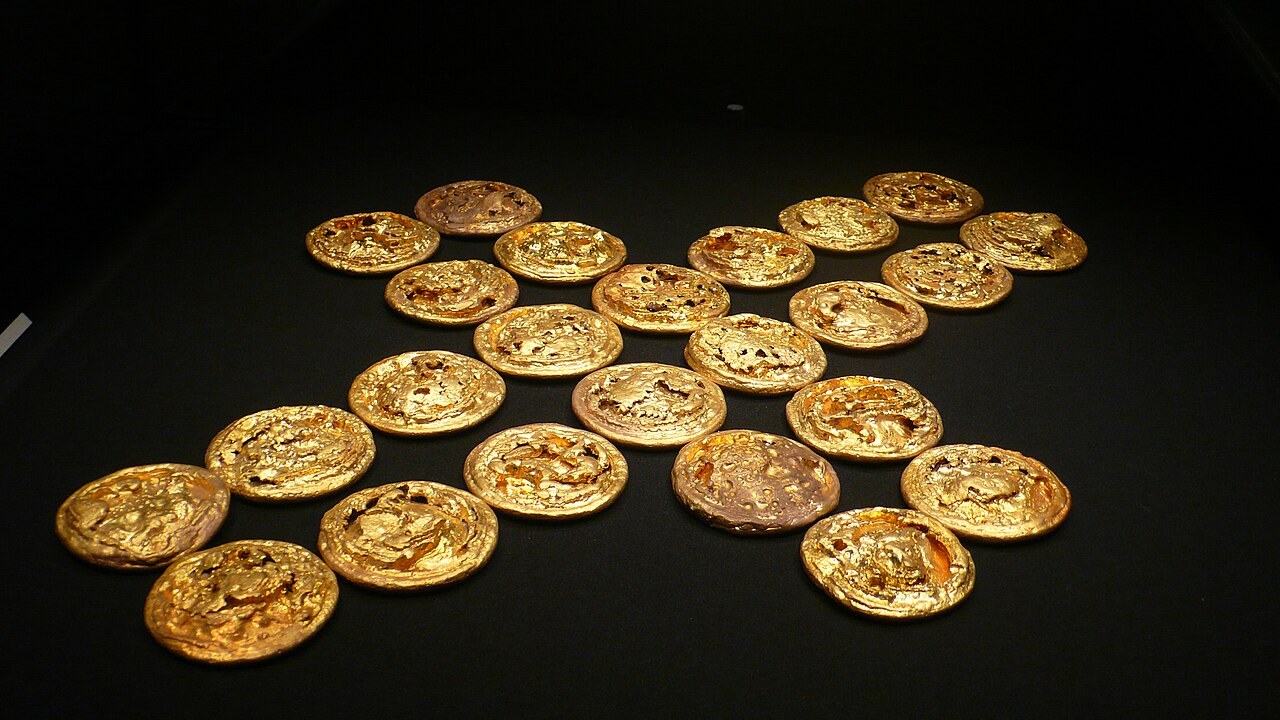
Some of the 385 gold cakes from Liu He's tomb. (Photo: 三猎, Wikimedia Commons, CC BY-SA 4.0.)
Then there's the loose change. Stacked in a dedicated "coin store" the team found roughly two million wuzhu coins (五铢钱) — over ten tonnes of bronze, piled nearly two metres high. The coins were threaded into strings of exactly 1,000, which turned out to be a genuine scholarly bombshell: it proved the Han already counted money in strings of a thousand, a habit historians had assumed came centuries later. The world's heaviest piggy bank, and an accidental footnote in economic history.
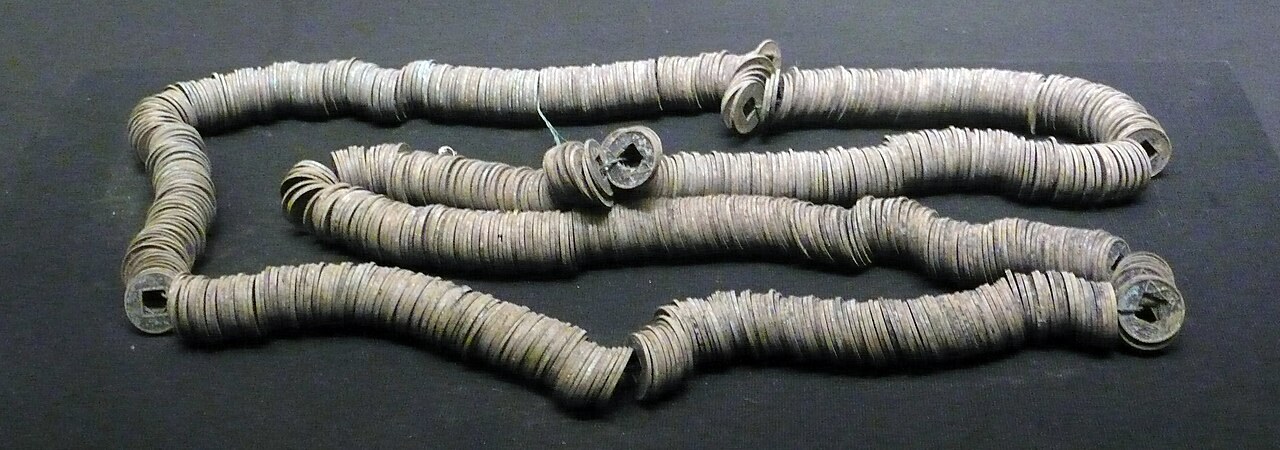
One string of 1,000 wuzhu coins — the tomb held about two million of them. (Photo: 三猎, Wikimedia Commons, CC BY-SA 4.0.)
The fun stuff: a hotpot, a still, and an ancient air purifier
Here's where the marquis becomes oddly relatable. Among the bronzes is a little three-footed vessel with its own charcoal pan underneath — archaeologists call it the earliest known bronze "hotpot" (温鼎), and yes, it still had scorch marks and chestnut residue inside. Beside it sat a set of single-serving sauce-warmers (染炉), one per diner, for keeping your dipping sauce hot. Two thousand years ago, Han nobles were already doing dip-and-eat dinners — which feels deeply right for a province this serious about its food.
Then there's the booze. The tomb held a large bronze distiller (蒸馏器), and in 2024 a research team built a working replica and ran it — successfully distilling liquor, with traces of taro still inside the original. Experiments suggest it could have made distilled spirits, which would nudge the history of Chinese baijiu back by something like a thousand years. (Scholars are still arguing the point, so don't toast to it as settled fact — but raise a glass to the marquis anyway.)
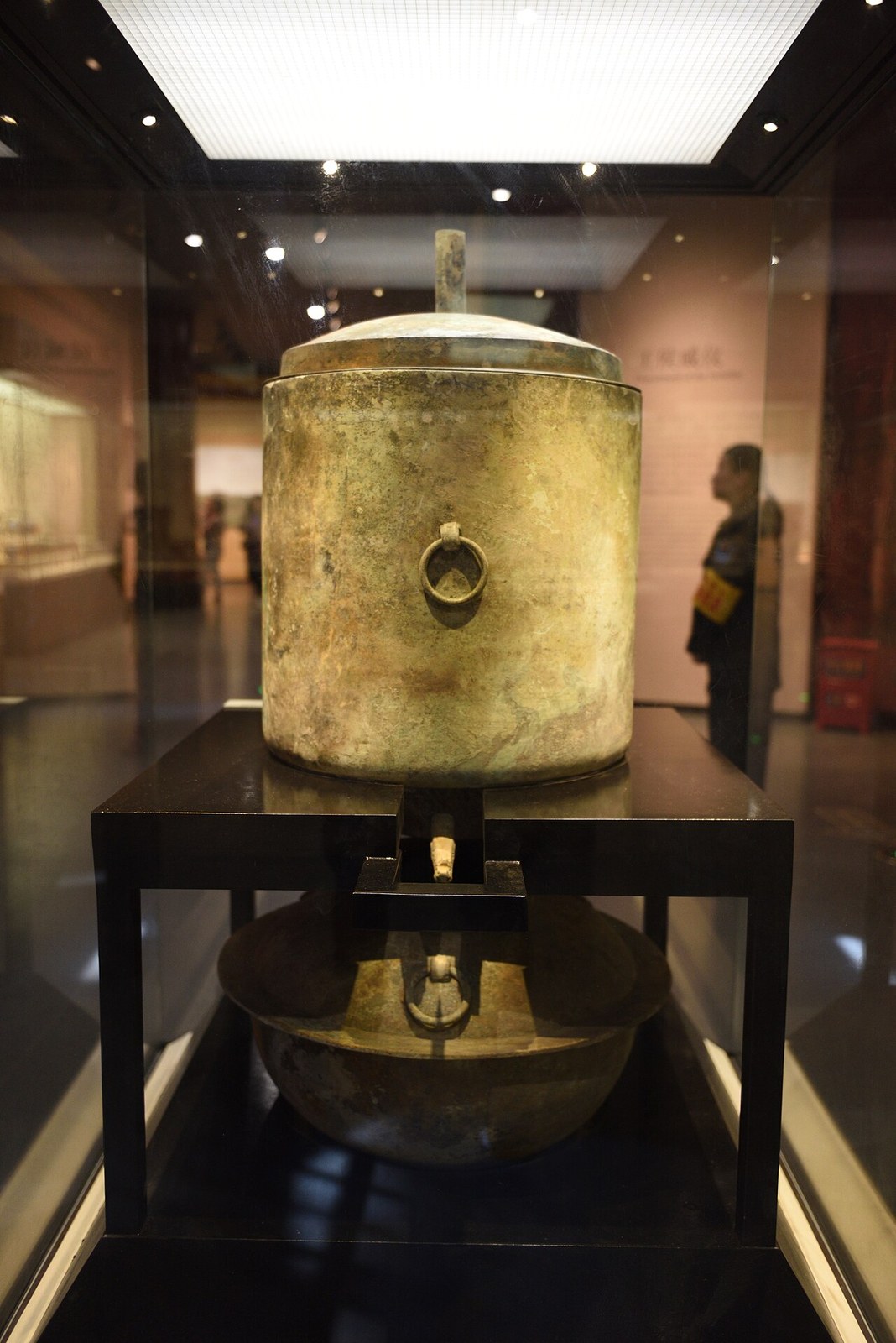
The bronze still — a 2024 replica actually distilled liquor. (Photo: Siyuwj, Wikimedia Commons, CC BY-SA 4.0.)
My favourite object you'll have to picture, because no free photo exists: the goose-fish lamp (雁鱼灯), a bronze wild goose holding a fish in its beak. Light the lamp and the smoke is piped down through the fish and the goose's neck into the water-filled body, where the soot dissolves — a smoke-free, soot-trapping lamp from the first century BC. Eco-friendly mood lighting, two millennia early. The marquis was also buried with a board-game rulebook — over a thousand bamboo slips explaining how to play liubo (六博), his era's favourite dice-and-gambling game. He took the strategy guide with him.
And how did he die? One leading theory, from the melon seeds found in the tomb, is that he ate one bad melon too many in the steamy Jiangxi summer — the same suspected fate as the famous Lady Dai of Mawangdui. A disgraced emperor, possibly done in by fruit. The histories really did have it out for this man.
The serious treasures, too
For all the comedy, this is also one of the most important literary finds in modern Chinese archaeology. Painted on the lacquer panel of Liu He's dressing-mirror (孔子衣镜) is what scholars believe is the earliest known portrait of Confucius, wrapped in more than 1,850 characters of his biography — its inscriptions may even hint at an earlier birth date for the sage than the standard histories give. A deposed playboy's vanity mirror, quietly helping to rewrite the record of China's greatest teacher.
Among roughly 5,000 bamboo slips from the tomb, researchers also identified the long-lost "Zhidao (知道)" chapter of the Qi Analects (齐论语) — a version of Confucius's Analects that had vanished for some 1,800 years. The man who couldn't last a month as emperor was buried with a chapter of Confucius the rest of the world had forgotten.
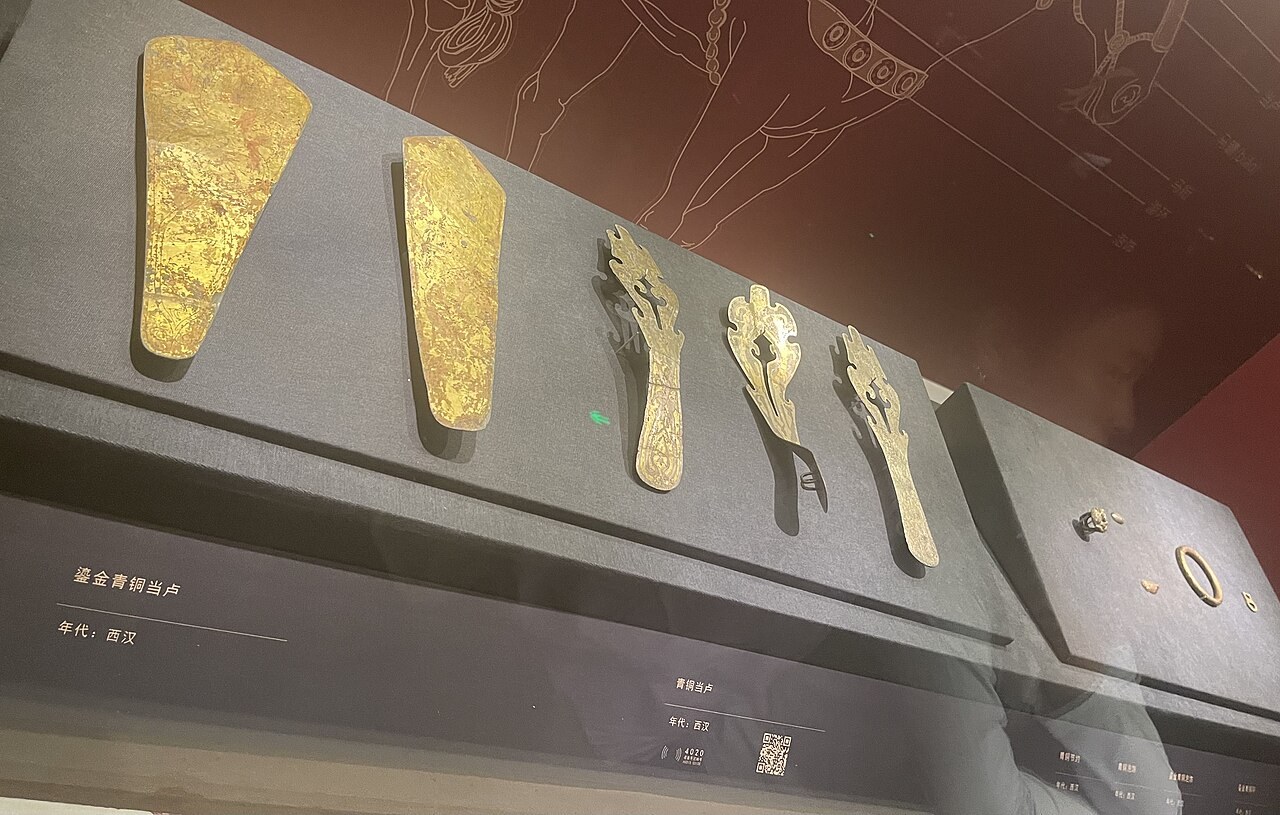
Inside the galleries — treasures from Liu He's tomb on display. (Photo: 章彦博, Wikimedia Commons, CC BY-SA 4.0.)
What you actually see today
The site is huge — a planned park of about 12 square kilometres — but as a visitor you'll focus on two things: the museum and the tomb itself.
The purpose-built museum is modern, generously air-conditioned, and arranged around a flagship hall called "Golden Haihun (金色海昏)", with smaller shows on the bamboo slips ("书香海昏") and the lacquerware ("丹漆海昏") and an interactive gallery ("遇见海昏"). The showpiece is a clever four-layer glass case that reconstructs Liu He's coffin in place, lighting up its layers to show how a Han aristocrat was sent into the afterlife. This is where the gold, the coins, the bronzes and the slips live.
A short way off is the tomb garden (墎墩苑), a building raised over the main tomb (M1) and its chariot-and-horse pit — real chariots and real horses, the only such burial pit ever found south of the Yangtze. Nearby are the rammed-earth walls of Zijincheng (紫金城), the little walled capital of the marquisate, and a satellite tomb that belonged to Liu He's eldest son. Standing on the mound, looking at the spot where two million coins came up out of the clay, is the part that sticks.
One honest heads-up: many of the star objects are conserved originals that travel to special exhibitions around China, and some pieces rotate between here and the downtown provincial museum — so the single artifact you came for might occasionally be on loan. Treat it like any great collection: come for the whole story, not one trophy, and you won't be disappointed.
How to visit (the practical bit)
This is a special trip, not a quick stop. The park sits out in Xinjian District, roughly an hour northwest of central Nanchang, so give it a half-day and a little planning.
- Book ahead — this is the big one. Entry is by real-name advance reservation through the museum's official WeChat account; walk-ups aren't reliable. As a foreign visitor, book with your passport and carry that same passport to the gate. If you don't read Chinese, ask your hotel front desk to make the booking — it takes them two minutes.
- Tickets: the ruins park has run at around ¥60 (or about ¥75 including the on-site shuttle), with roughly half-price concessions and free entry for seniors 65+ and small children. Prices and what's-free-vs-paid change, and sources don't always agree — confirm the current ticket on the official channel when you book.
- Hours: roughly 9:00 AM–5:00 PM, last entry around 4:00 PM. Closing days shift around public holidays — check before you go.
- Getting there: a DiDi (China's Uber) from the city is by far the easiest option — set the destination to "南昌汉代海昏侯国遗址博物馆." Budget tourists can look for the seasonal direct shuttle that has run from near Tengwang Pavilion, or city buses (routes such as 666 and 137) — but timetables change, so check locally. There's plenty of parking if you've hired a car.
- How long: 2–3 hours for the museum, half a day if you add the tomb garden and walls.
- Language: headline labels have some English, but plenty is Chinese-only — keep a translation app handy (point-and-translate works well).
- Good for: history and archaeology lovers, anyone who enjoyed the story above, a cooler indoor option on a hot or wet day. Less ideal for: travellers on a tight one-day Nanchang schedule, or small kids with no patience for glass cases — the downtown Jiangxi Provincial Museum gives you the highlights closer to town.
So — is it worth the trip?
If you've got a single afternoon in Nanchang, do the free provincial museum downtown and call it a day. But if the marquis's story made you grin, and you've got a half-day to spare, the Haihunhou Site Museum is unlike anything else in the province: the actual tomb of a man the empire tried to erase, the richest hoard the Han ever buried, and a string of objects — the hotpot, the still, the lost Confucius — that turn a dry "deposed emperor" into the most human character in the dynasty. Fold it into a longer Nanchang itinerary or browse more things to do in Nanchang, and if you'd like a hand fitting it into your route, plan your trip with us.
FAQ
What is the Haihunhou Site Museum? It's the museum and archaeological park built over the tomb of Liu He (刘贺), the Marquis of Haihun — a Han prince who was emperor for just 27 days before being deposed. His unlooted tomb, found in 2011, is the richest and best-preserved Western Han aristocratic burial ever excavated. It's in Nanchang's Xinjian District, about an hour from the city centre.
How is it different from the Jiangxi Provincial Museum? The downtown Jiangxi Provincial Museum is free, central, and shows a selection of the marquis's treasures alongside Jiangxi's wider history. The Haihunhou Site Museum is the actual tomb site — the full hoard, the in-situ coffin reconstruction and the real chariot pit — but it's ticketed and out of town. History buffs do both.
Do I need to book in advance? Yes. Entry uses real-name advance reservation through the museum's official WeChat account, and foreign visitors should book with — and bring — their passport. If that's tricky, ask your hotel to reserve for you.
How do I get there from Nanchang? A DiDi (ride-hail) is easiest, about an hour northwest to Xinjian District. There have also been seasonal tourist shuttles (e.g. from near Tengwang Pavilion) and city buses, but check current routes and times locally.
How much does it cost and how long should I allow? Recently around ¥60 (about ¥75 with the shuttle), with concessions and free entry for seniors and young children — but confirm the current price when you book. Allow 2–3 hours for the museum, or a half-day with the tomb garden.
Last verified: 2026-06 — tickets, hours, booking rules and which objects are on display change often; please check the museum's official channels before you visit.