Things to Do in Nanchang: A Local's Guide
The best things to do in Nanchang, split by riverbank: Tengwang Pavilion and the old town east, Qiushui Square and Honggutan west.
By Hello Nanchang · Last updated
Both banks of the Gan River, Nanchang
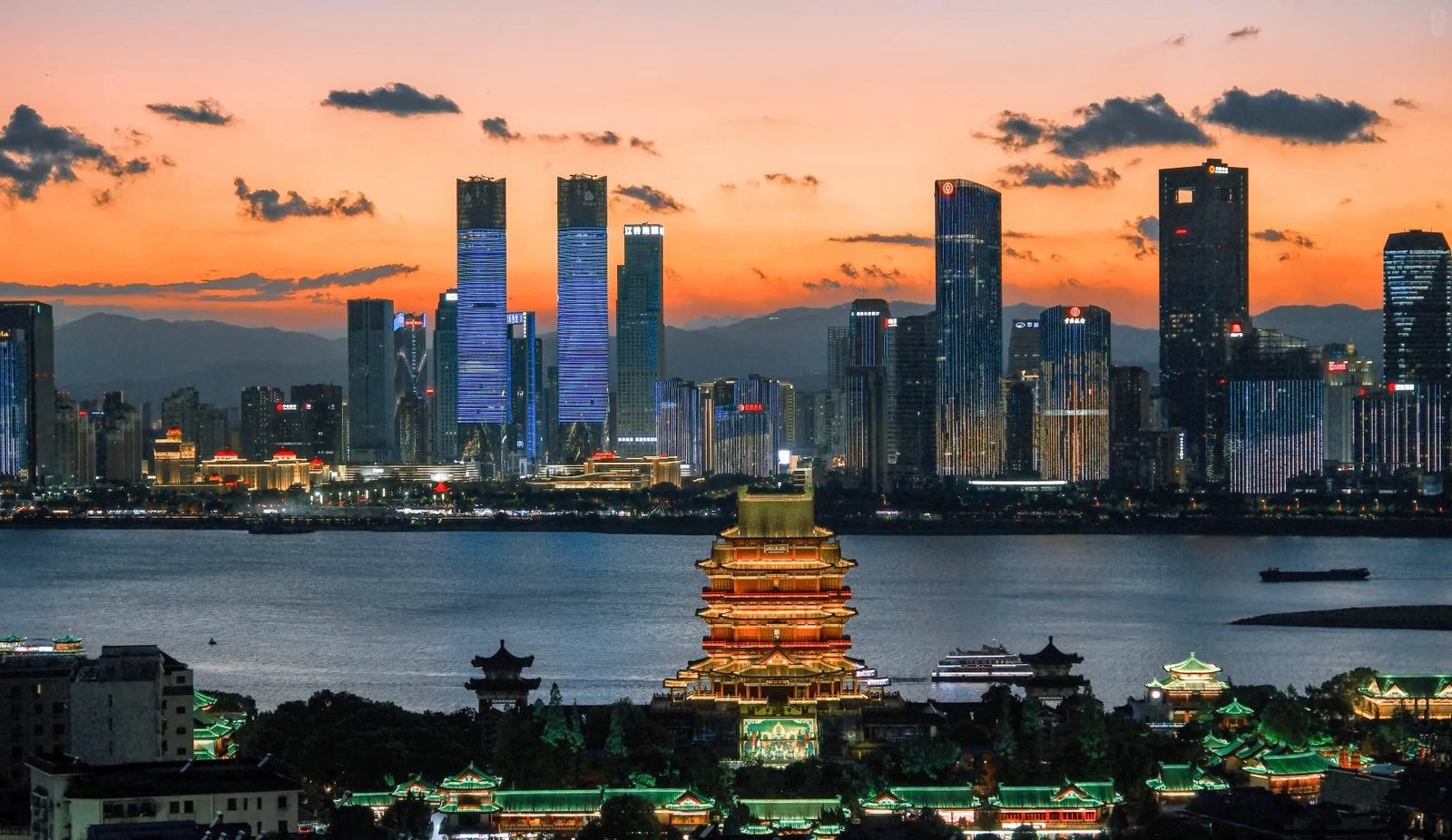
First, understand the river
Most lists of things to do in Nanchang read like a bag of unrelated stops. They don't have to. Almost everything confusing about this city resolves the moment you understand that the Gan River (赣江) cuts it in half, and that the two halves are not the same age.
The east bank is the old Nanchang — two thousand years of it. This is where the Tang-dynasty pavilion stands, where the square commemorating the founding of the Chinese army sits, where the lanes still narrow into night markets. The west bank is Honggutan (红谷滩), and it essentially did not exist a generation ago: a planned district of glass towers, wide riverside promenades, malls, and the fountain show most visitors end up remembering.
Neither bank is the "real" Nanchang. The city works because it has both, and the best evening you can have here involves crossing between them. So this guide is organised the way the city actually is: east bank, west bank, then the things worth leaving the centre for. For wider context — history, when to come, how the city fits into the province — start with our Nanchang travel guide.
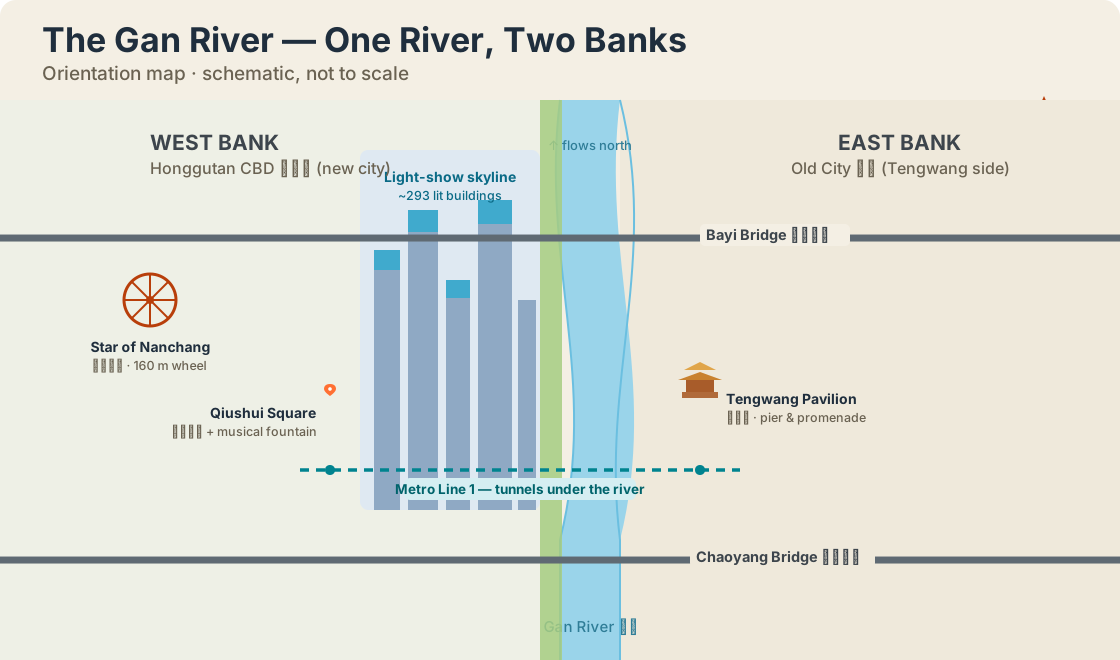 The two banks at a glance — the old city and Tengwang Pavilion east, the Honggutan skyline west.
The short answer: the best things to do in Nanchang in one day
If you have a single day and want to be told what to do:
- Morning — Tengwang Pavilion. Opens 08:00; allow one to three hours. Around ¥50 full price, ¥25 concession. No booking needed.
- Midday — Bayi Square. Free, open around the clock, no ticket and no booking. If you also want the Uprising Memorial Hall about 1.5 km away, book it ahead — and not on a Monday.
- Afternoon — Jiangxi Provincial Museum. Free, air-conditioned, west bank — but book a real-name slot a day or two ahead and bring the passport you booked with. Closed Mondays (except public holidays); on a Monday, walk the riverside boardwalk instead.
- 19:30 — the Qiushui Square fountain. Fifteen minutes of water, light and music with the old-bank skyline behind it. Free, no booking.
- After — Wanshou Palace. Cross back east for lanterns and late food.
That is a full, unhurried day, and four of those five stops are free. Only the museum needs booking — sort that the night before, not on the doorstep.
East bank: the old city
Tengwang Pavilion — and the gatecrasher who made it famous
In the autumn of 675, a travelling poet in his mid-twenties stopped in Nanchang on his way south to visit his exiled father, and was invited to a banquet at a riverside tower. The governor, Yan Boyu, had restored the pavilion and thrown the feast partly to show off his son-in-law, who had quietly pre-written a commemorative preface he was meant to deliver as though it had poured out of him on the spot. When the brush was politely offered around the room, everyone understood the script.
Wang Bo (王勃), who was not supposed to accept, accepted — and wrote the whole thing there and then. Yan is said to have walked out in irritation and posted a servant to relay each new line back to him, and to have returned to the table when the line about the autumn waters arrived:
落霞与孤鹜齐飞,秋水共长天一色
The setting sun-glow and a lone wild duck fly together; the autumn waters merge with the vast sky as one.
Hold on to those two characters — 秋水, autumn waters. You will meet them again this evening, on the other side of the river. Wang Bo himself did not get long. He made the journey he had set out on, reaching his father's posting in what is now northern Vietnam — and drowned on the way home, his boat caught in a storm, around 676, aged about twenty-six.
The building you visit is a modern reconstruction, and people who stop at that fact tend to write the place off — a mistake. What you are visiting is less a building than an address. The full story is in our Tengwang Pavilion feature.
Practical. Tickets are listed at around ¥50 full price and ¥25 for students, children and Nanchang residents; under 1.2 m or six years old goes free. The pavilion opens at 08:00, but read the closing sequence carefully, because it is earlier than people expect and does not change with the seasons: ticket sales stop at 17:15, last check-in is 17:30, visiting runs to 18:00, and the whole site clears at 18:15 year-round. Official guidance is one to three hours inside. Opening and closing times here are restated by announcement rather than by season, so confirm on the day if your plan depends on the last hour.
One consequence worth planning around, and it turns on the 18:00 figure rather than the 18:15 one: 18:15 is when you are put out of the grounds, but 18:00 is when you stop being allowed up the tower. Run the sunset times against that and the window is narrower than most guides suggest — a day ticket catches sunset from about 5 October to about 6 February, and outside that the sun sets after you have been sent down. Late September looks like it should work and does not: on 25 September the sun goes down at 18:10. Plan the climb for the day and the river for the evening. Last verified: 2026-08.
There is also an evening performance, Dreaming of Tengwang Pavilion (寻梦滕王阁), running year-round. Recent listings put it at ¥168 for adults and ¥98 for children between 1.2 and 1.4 metres, with under-1.2 m free but without a seat; sales from 17:20, entry 18:40–20:00, show 19:30–20:15, in through the East Gate. Times and prices are adjusted by announcement, so confirm before you build an evening around it. Be clear about what the ticket buys, because this is where people feel cheated: it is a performance on the grounds after dark, and it does not include going up the pavilion. If your goal is the view from the top, buy a day ticket and go up in daylight.
Getting there: Line 1 to Tengwang Pavilion station — and note the station is not at the pavilion. Leave by Exit 2 for a 1.1 km walk, about 14 minutes, to the south gate. From Wanshou Palace station you get a more scenic approach to the east gate: 1.4 km, 16 to 18 minutes.
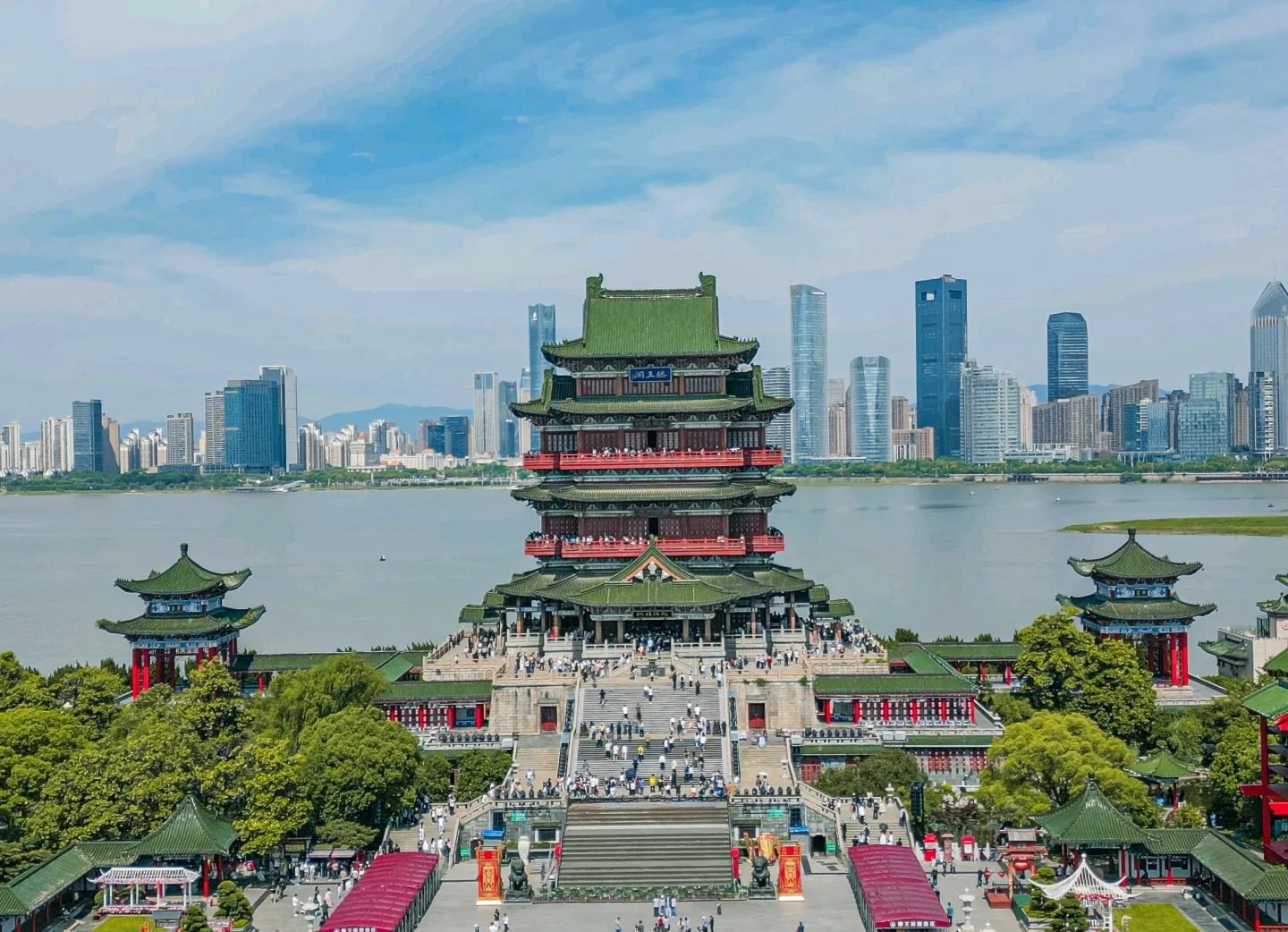 The whole argument of this guide in one frame: the Tang-dynasty tower on the east bank, the Honggutan towers across the water.
Bayi Square — the free one you should not skip
Bayi Square (八一广场) is the civic living room, and where the People's Liberation Army traces its founding to: the uprising of 1 August 1927. That date is why "Bayi" — literally "eight-one" — is stamped across the city's bridges, avenues and parks.
The square itself costs nothing, never closes, needs no booking, and sits on the interchange of Metro Lines 1 and 2 — the most useful orientation point in the city. Come at dusk, when it fills with locals doing what Chinese squares are for.
The Uprising Memorial Hall (八一南昌起义纪念馆) is a different proposition and worth knowing about before you walk over. It sits about 1.5 km from the square — one stop on Line 1, out at Bayiguan, or roughly twenty minutes on foot. It is free, but normally needs a free advance booking, and it closes on Mondays. Bring your passport: Chinese museums run on real-name registration.
If the heat wins, Wushang MALL (武商MALL) is 280 metres off the square's northeast corner — Jiangxi's hard-luxury address, and the closest air conditioning to the monument. Note that it is on this bank: the other flagship mall is across the river and a good way south of the fountain, which the next section gets to.
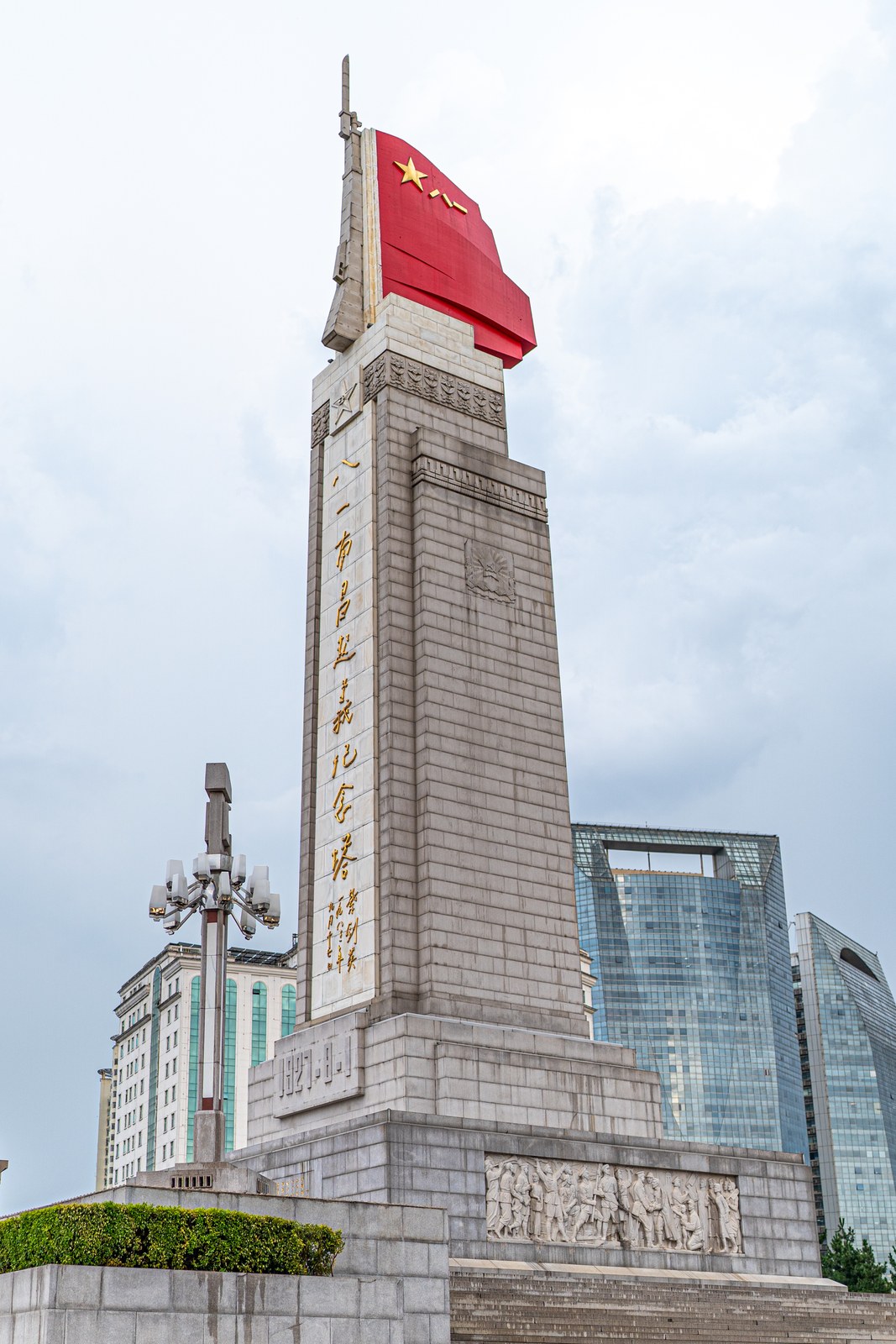 By day you can read the whole spire — the red flag up top, the carved date, and a relief panel at the base. Photo: Heihaheihaha / Wikimedia Commons (CC BY 4.0).
Wanshou Palace — the old town after dark
Wanshou Palace (万寿宫) is a restored historic block at its best after sunset, when the lanterns come on and the lanes fill. The block is open around the clock; shops and market stalls run roughly 10:00 to 21:00.
Use Exit 1 at Wanshou Palace station. Exit 3 puts you out on the north side of Zhongshan Road among office towers, and you will walk back on yourself.
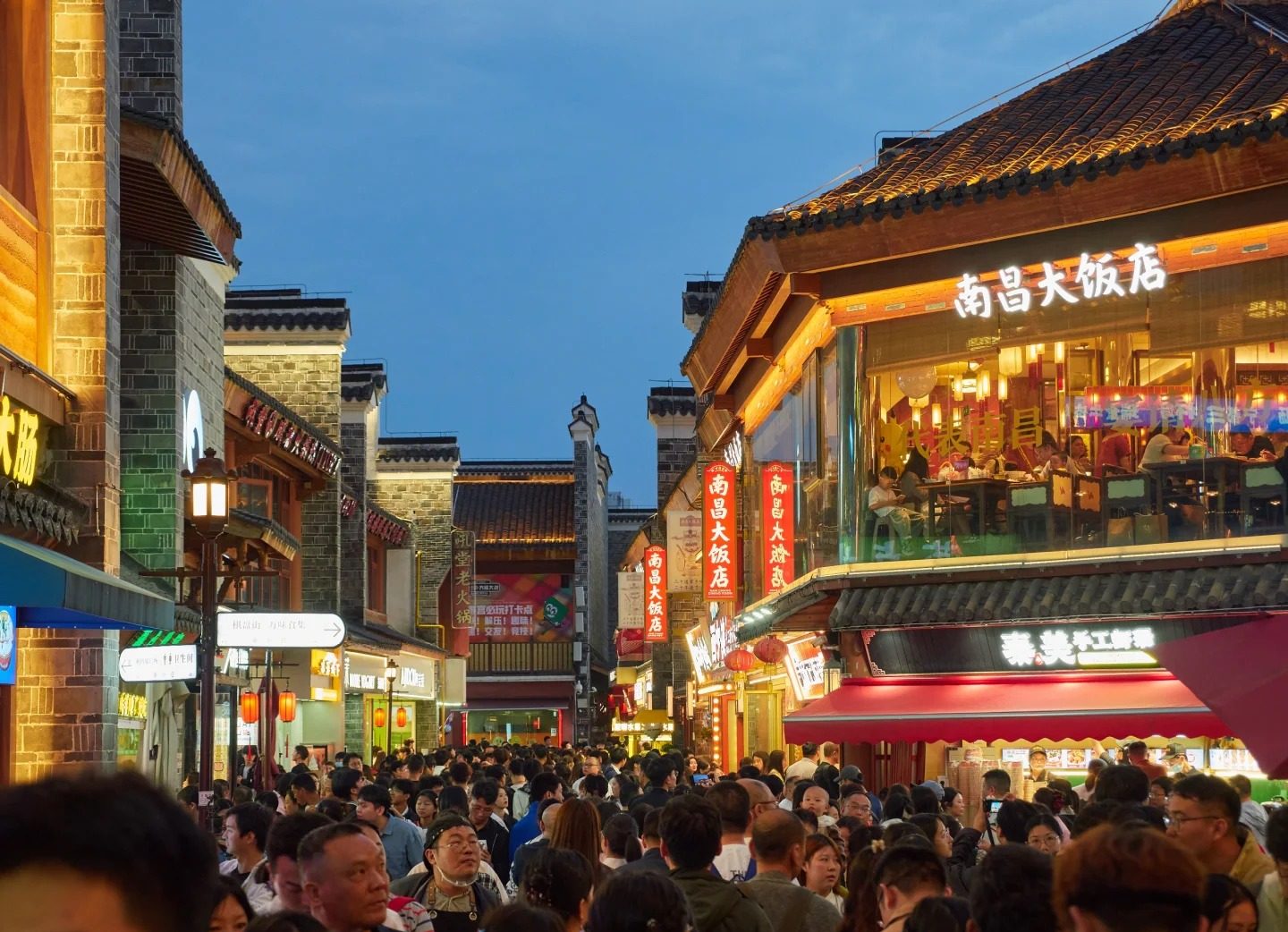 Wanshou Palace at blue hour. This is what "the lanes fill" actually looks like — come hungry and do not expect elbow room.
Shengjin Tower and the night markets
Shengjin Tower (绳金塔) is the old-town pagoda, with a food street attached; leave the metro by Exit 3. For the eating version of the same idea, our night markets guide covers where locals actually queue.
West bank: Honggutan, the new city
The Qiushui Square musical fountain
Remember those two characters from the poem? Qiushui Square — 秋水广场, Autumn Waters Square — is named for the line Wang Bo improvised on the upper floor of the pavilion you can see from it. The tower and the square stare at each other across the water, thirteen centuries apart.
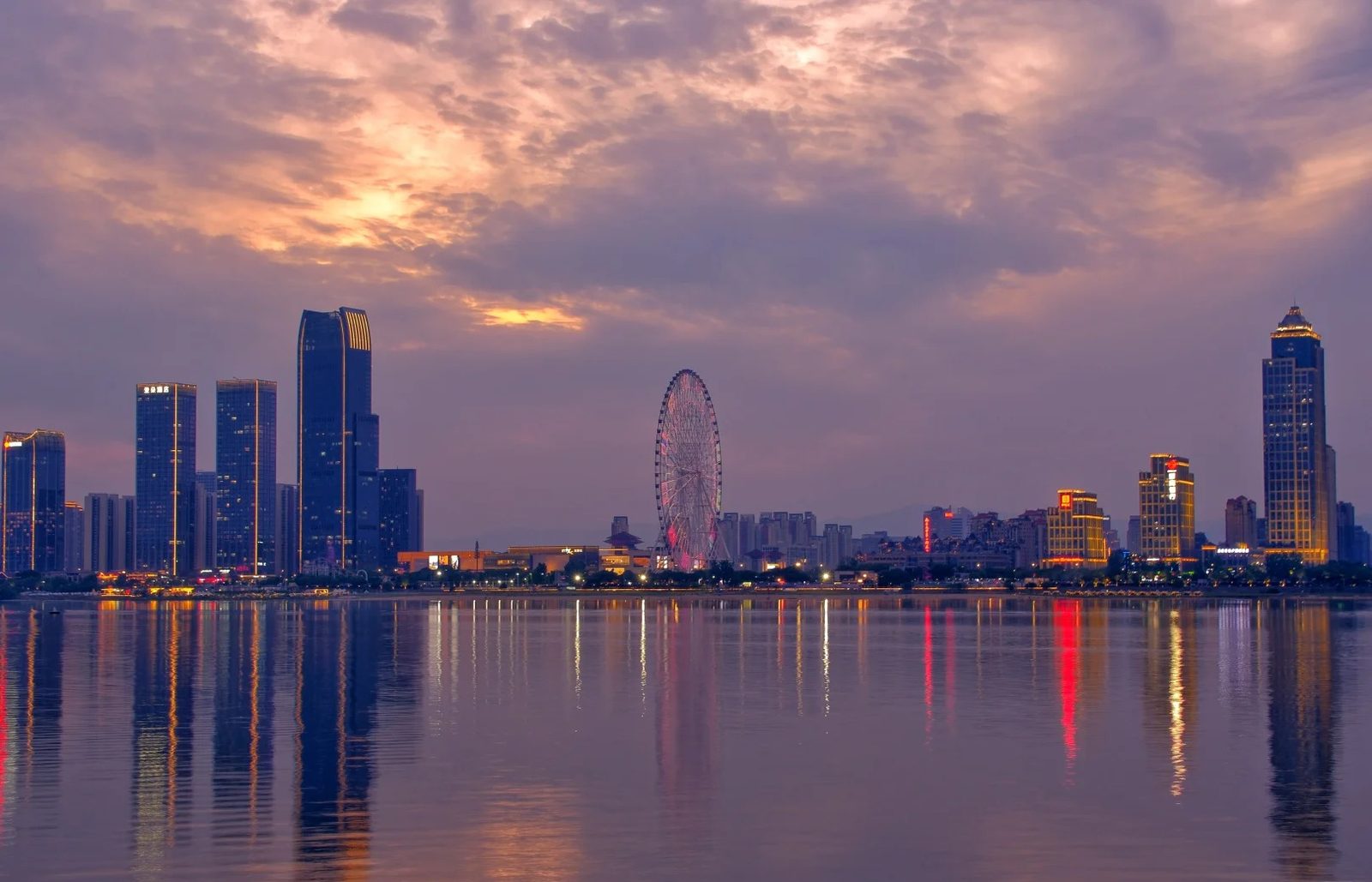 The west bank at dusk, seen from across the Gan. The Ferris wheel is the small bright ring near the middle — and it is much further away than it looks.
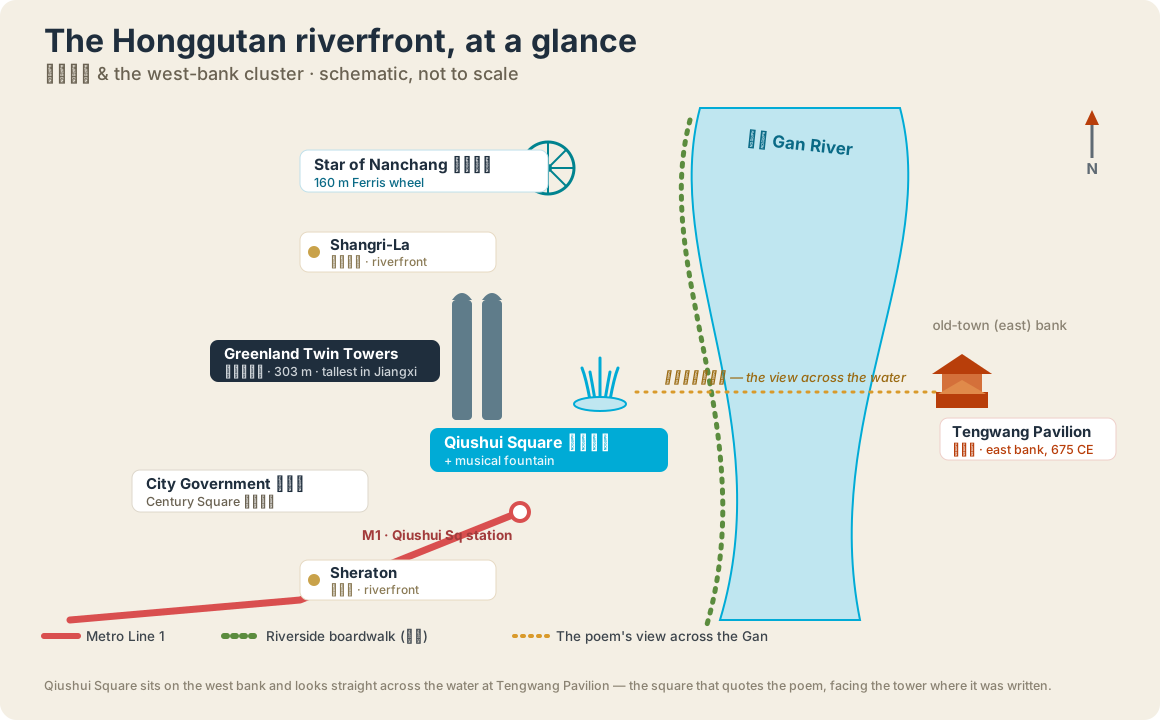 The west bank to scale. The fountain, the towers and the hotels are strung along about 1.4 km of riverfront — walkable end to end. The Ferris wheel and the MixC mall are not on that stretch — they sit about 5 km south by road, off the bottom of the map.
The fountain itself is the most reliable free spectacle in Nanchang, and it runs every night. This matters, because a lot of English-language sources still say weekends only — that is a different fountain, the one at Jiulonghu Park. Qiushui runs two shows of about fifteen minutes: 19:30–19:45 and 20:30–20:45. Shows are cancelled in thunderstorms, fog, or wind above force 5, and the schedule is adjusted by announcement — a third summer show has appeared in past years. Check on the day if it is the reason you are crossing the river. Last verified: 2026-08.
Take Line 1 to Qiushui Square station and leave by Exit 5, which puts you at the fountain; Exit 1 is the one for the Shangri-La, the riverside citizens' park and the shopping centre. A local trick for afterwards: rather than fighting the crowd back into Qiushui Square station, walk on to Ditie Dasha (地铁大厦) and board there.
The Star of Nanchang — and the mistake everyone makes
The Star of Nanchang (南昌之星) is a 160-metre Ferris wheel that opened in May 2006 and was, for two years, the tallest in the world — a title it lost in 2008 to the 165-metre Singapore Flyer. It carries 60 capsules holding up to eight people each, and one rotation takes about 30 minutes. A standard capsule is listed at around ¥50 per person, half price for children between 1.2 and 1.4 metres, free below that. Pricing is market-adjusted; treat the figure as indicative. Last verified: 2026-08.
Now the important part, because it trips up almost every Nanchang itinerary written in English: the Ferris wheel is not at Qiushui Square. It stands at No. 1 Ganjiang South Avenue, near the Nanchang International Expo Centre, roughly 5 km from the fountain by road. A riverside promenade runs most of the way, so you can walk it if a long evening stroll is what you want — what you cannot do is slot it into the 45 minutes between the two fountain shows. Give it its own evening.
Getting there: Line 1 to Ditie Dasha, change to Line 2, out at Xuefu Ave (E), Exit 2 — then a 1.3 km walk. A taxi from the Honggutan riverfront is about fifteen minutes.
Jiangxi Provincial Museum — free, and better than it needs to be
The Jiangxi Provincial Museum sits at No. 998 Ganjiang South Avenue in Honggutan, and admission is free. Opening is Tuesday to Sunday, roughly 09:00–17:00, with no entry after 16:00, and it is closed on Mondays unless the Monday is a public holiday.
"Free" here does not mean "just turn up". You generally need to reserve a timed, real-name slot in advance — through the museum's official 江博预约 mini-programme or website — and carry the passport you booked with. Book a day or two ahead and you walk straight in; arrive without a booking on a busy afternoon and you may not get in at all. If the weather turns — and in a Nanchang summer it will — this is the best indoor afternoon on the west bank, and it pairs naturally with an evening at the fountain a short ride away.
The riverfront itself
The thing to actually do in Honggutan is walk. The riverside green corridor runs about 28 km along the water on timber boardwalks over preserved wetland; counting the inland branches, the Honggutan greenway network totals roughly 50 km. It is flat, free and open at all hours. You do not need a plan: pick a point, walk toward the towers, and let the skyline do the work.
Malls, if it's 37°C outside
In a July afternoon that touches 37°C, "spend two hours in air conditioning" is not a cop-out: it is how residents structure their own days, and it is why the night markets do not get going until after dark. Nanchang's two flagship malls split the market cleanly — and, usefully for planning, they sit on opposite banks.
MixC (万象城) is the everyday one, listed at 10:00–22:00 Sunday to Thursday and to 22:30 on Friday and Saturday. Note where it actually is: southern Honggutan, on Xuefu Avenue — the same Line 2 stop as the Ferris wheel, about 5 km by road from Qiushui Square. The mall and the wheel are 40 metres apart; neither is a quick walk from the fountain. Pair it with the wheel, not with your fountain evening.
What it costs to eat while you do all this
You will not spend much. Nanchang's staple is banfen (拌粉) — cold-tossed rice noodles with chilli, spring onion and pickled radish, eaten standing up at breakfast for about ¥3–6 plain. The thing locals order alongside it is waguantang (瓦罐汤), a clay-pot soup slow-steamed overnight, around ¥5–10 for the standard egg-and-pork-cake version. A noodle-and-soup breakfast lands at roughly ¥9–12 — genuinely one of the cheapest good breakfasts in urban China.
For a snack while you walk, white sugar cake (白糖糕) runs about ¥1 a piece. And the dish to sit down for is xiaochao (小炒) — Jiangxi's fast, fierce wok cooking, which is properly hot. If you don't want that, say bú yào là (不要辣) when you order. Last verified: 2026-08.
Worth leaving the centre for
- Meiling (梅岭) — the forested hills northwest of the city, and where Nanchang goes when the heat becomes unreasonable. Individual sites are listed at around ¥25 for Shizifeng, ¥15 for Shenlongtan, ¥30 for Hongya Danjing, ¥79 for the Ming-Qing houses and ¥88 for rafting. Get there via Line 1 or 2 to Ditie Dasha, then bus 712 or 699 to the Wanli cable-car stop.
- Haihunhou Museum — the tomb of a man who was emperor for 27 days, and one of the richest Han-dynasty finds ever excavated in China.
- Fenghuanggou — cherry blossom, and strictly a spring answer.
- Fish Tail Park — a former coal-ash dump rebuilt as a "sponge city" wetland. Genuinely interesting if you care how Chinese cities are handling flooding.
Where to stay
The choice is really about which bank you want to wake up on. Bayi Square / Donghu (east) is the default and the right call for a first visit: the Line 1 / Line 2 interchange, walkable to Wanshou Palace, and in among the good eating. Honggutan (west) gives you newer rooms, river views and better value per star, at the cost of commuting east for dinner. The Nanchang travel guide goes into station-side options if you arrive late or leave at dawn.
When to come
Late September to early November is the clear winner: dry, blue, 15–25°C, and the best light on the river. One caveat, because it is the kind of thing that gets built into an itinerary: this is not when the Tengwang Pavilion sunset window reopens. That window runs from about 5 October, and in late September the sun is still going down after you have been sent off the tower.
Otherwise: spring is mild but doubles as the rainy season, summer is punishing at 32–37°C, and winter is cold and damp, largely without indoor heating. Season-by-season detail is in the Nanchang travel guide.
Putting it together: an evening that actually works
Get to Tengwang Pavilion with enough afternoon left to actually go up — "late afternoon" here means arriving by about four, not six. Come down, walk the east bank as the towers start lighting up, and cross to Honggutan by bridge, taxi or Line 1. Be at Qiushui Square by about 19:20 for the first show: fifteen minutes later you have seen the thing everyone photographs, and the crowd has not yet peaked.
From there, two honest options. Stay west, walk the promenade, and catch the 20:30 show from a different angle. Or leave straight after the first show and cross back east for Wanshou Palace while the lanes are still busy and the stalls are still open.
For fuller day-by-day plans, see our two days in Nanchang itinerary or the weekend version. If you would rather not build the schedule yourself — or you are fitting Nanchang around a visa-free transit window — we plan custom Nanchang and Jiangxi trips around your dates.
Getting around
The metro does most of the work, and one stretch of Line 1 connects nearly everything above. Station names appear on the map in pinyin, so in the order you will ride them: Bayi Guangchang (Bayi Square) → Bayiguan (Uprising Memorial Hall) → Wanshougong (Wanshou Palace) → Tengwangge (Tengwang Pavilion) → Qiushui Guangchang (Qiushui Square).
Read that sequence carefully, because Bayi Square to Tengwang Pavilion is three stops, not one — about 2.5 km as the crow flies, or a 40-minute walk if you would rather. Several sources compress this into "one metro hop", which is wrong and will wreck your timing.
Three exit notes that save real walking:
- Bayi Guan station, Exit 5 is for the Uprising Memorial Hall. It does not lead to Wanshou Palace.
- Wanshou Palace station, Exit 1 — not Exit 3.
- At Yangming Park station, follow signs for the street you actually want rather than an exit number: the signage sends people to Yuzhang Road when the food lane is on Yuzhang Back Street, a different street.
Full detail in our Nanchang metro guide, and if you are still working out how to reach the city, how to get to Nanchang covers flights and trains.
Practical, in one box
- How long: one day covers the landmarks; two lets you take the west bank at walking pace.
- Tickets: Tengwang around ¥50 (¥25 concession); Star of Nanchang around ¥50. Bayi Square, the Provincial Museum, the Uprising Memorial Hall, the fountain and the entire riverside greenway are free.
- Getting there: Changbei Airport (KHN) is about 28 km north; the high-speed hub is Nanchang West, about 15 km southwest and on Line 2. Full detail in how to get to Nanchang.
- Book ahead: the Provincial Museum and the Uprising Memorial Hall are free but normally need an advance real-name reservation, and both close on Mondays unless the Monday is a public holiday. Reserve the night before and bring the passport you booked with. Nothing else on this page needs booking.
- Paying: set up Alipay or WeChat Pay before you travel and link a foreign card — both now work for visitors, and cash is genuinely awkward in Nanchang. DiDi is the ride-hail app, and it has an English interface.
- Language: metro signage and announcements are bilingual; museums have some English labelling; small restaurants have essentially none. Point at the display fridge and hold up fingers — it works.
- Good for: first-time visitors, evening walkers, anyone on a China trip who wants a city that is not performing for tourists.
- Less good for: travellers who need English everywhere, or who want a single blockbuster sight. Nanchang's pleasure is cumulative.
Frequently asked questions
How many days do you need in Nanchang?
One full day covers the landmarks. Two lets you take the west bank at walking pace and add a museum. Three makes sense only if you are adding Meiling, or using Nanchang as a base for Jingdezhen or Wuyuan.
Is the Qiushui Square fountain on every night?
Yes — two shows nightly, 19:30–19:45 and 20:30–20:45. It is cancelled in thunderstorms, fog or strong wind, and schedules change by announcement, so confirm on the day. The weekends-only fountain people sometimes mean is at Jiulonghu Park, not here.
Can you walk from Qiushui Square to the Star of Nanchang?
You can — they sit on the same west bank and a riverside promenade runs about 3.2 km between them — but it is an evening's walk, not an errand, and it is about 5 km by road. What you cannot do is fit it into the 45 minutes between the two fountain shows. To go directly, take Line 1 to Ditie Dasha, change to Line 2, exit at Xuefu Ave (E) Exit 2 and walk 1.3 km — or take a taxi, roughly fifteen minutes.
What time does Tengwang Pavilion close?
Ticket sales stop at 17:15, last check-in is 17:30, visiting runs to 18:00 and the site clears at 18:15 — year-round, with no summer extension. Arrive by about 16:00 if you want an unhurried visit.
What is Honggutan?
Honggutan is Nanchang's west-bank district: the newer, planned half of the city, holding the musical fountain, the provincial museum, the main shopping malls and the riverside greenway.
Do you need to book anything in advance?
Two things: the Jiangxi Provincial Museum and the Uprising Memorial Hall. Both are free, both normally require an advance real-name reservation, and both close on Mondays unless the Monday is a public holiday. Book the night before and carry the passport you booked with. Tengwang Pavilion, Bayi Square, the fountain and the greenway need no booking.
What can you do in Nanchang for free?
Bayi Square, the Qiushui Square fountain show, and the entire riverside greenway on both banks — all with no ticket and no booking. The Jiangxi Provincial Museum and the Uprising Memorial Hall are also free, but need booking ahead and are shut on Mondays (except public holidays). A good day here costs less than most visitors expect.
Before you go
Prices, opening hours and show times in China move by announcement rather than by season, and Nanchang is no exception — the fountain schedule changed in April 2026 and the pavilion's closing sequence was restated in 2026. Everything above is listed as published; check the ones your day depends on before you set out.
Last verified: 2026-08.