Shengjin Tower: Nanchang's Old-Town Pagoda
A practical guide to seeing the pagoda, eating your way through the old-town food street, and timing a visit for the temple fair.
By Hello Nanchang · Last updated
Shengjin Tower Historical & Cultural District, Xihu District, Nanchang · Saturdays & Sundays, 10:00–21:00 (Ongoing until May) · Free entry; Pay as you go for shopping and dining (Approx. ¥0 / $0)
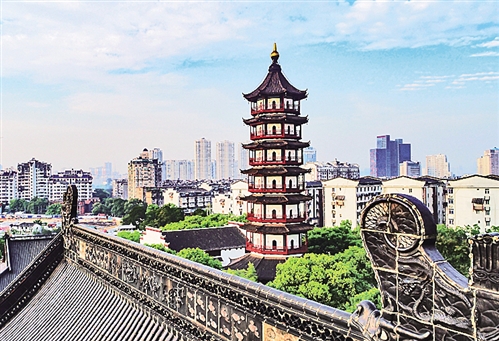
Old Nanchang, the moment you step off the metro
Come up the steps from Shengjinta (绳金塔) metro station, Exit 3, and old Nanchang arrives almost too fast. Snack shops steam at the corners; whitewashed walls rise behind the traffic; and then, over the rooflines, the pagoda itself — seven tiers of dark eaves, a bronze bell hung at each, climbing out of the food street into the sky. This is Shengjin Tower (绳金塔, Shéngjīn Tǎ). It isn't the city's grandest sight — Tengwang Pavilion owns that title — but it may be the easiest place to feel Nanchang's older, earthier self, with bells above you and a bowl of noodles at your elbow.
Give it half an afternoon and you get three things at once: a thousand-year-old pagoda with a good story, a restored old-town quarter built for grazing, and — once a year — one of the liveliest temple fairs in Jiangxi.
The legend behind the name
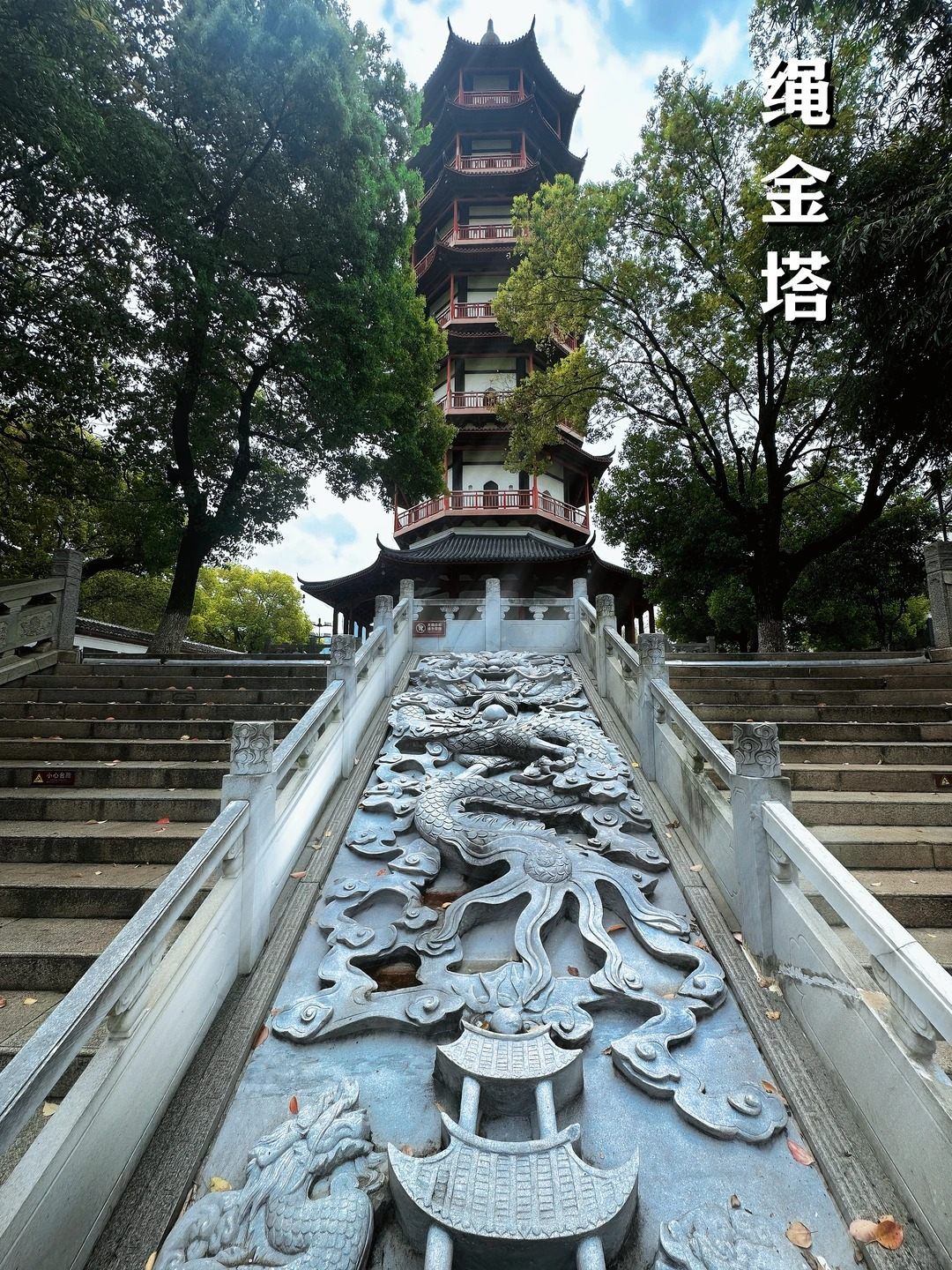
Seven tiers of dark eaves, a bronze bell hung at every corner.
The tower's odd name comes wrapped in a legend. When monks first broke ground here in the Tang dynasty — the Tianyou era, around 904–907 — the workers are said to have struck an iron casket in the earth. Inside lay four coils of golden rope (金绳), three ancient swords (古剑), and three hundred Buddhist relic beads (舍利子). Each sword carried a single charge cut into the blade — drive back the wind, suppress fire, subdue the flood dragon — the three calamities a low, river-bound city feared most. The rope of gold gave the tower its name: Shéngjīn, "rope-gold" — a talisman buried before the first brick was laid.
And a talisman is more or less what Nanchang has treated it as ever since. Fire and flood came anyway; the tower burned and toppled and rose again, more times than the records agree on. The one standing today is a Qing-dynasty rebuild — raised in 1713, restored in 1989 — some fifty metres of brick and timber, eight-sided, with seven tiers you can count from the ground and a hidden eighth within, which locals sum up neatly as "seven bright, one dark." Stand at the foot and look straight up the slender shaft: the eaves curl outward against the sky, and at every one of them a bronze bell waits for wind.
What you'll actually see
Inside its low wall, the pagoda keeps a small, hushed temple compound — incense unspooling in the air, a handful of dim halls, older residents pausing to bow. After the noise of the street, the quiet lands on you all at once. You won't need long: half an hour to circle the base, look into the side halls, and find your angle — the southeast corner of the courtyard, looking up so the tiers stack against the sky, is the one, and a clear late afternoon, when the light turns the brick warm, is the hour.
Step back through the gate and the volume comes up again. The lanes around the tower have been restored into the Shengjin Tower Historical & Cultural Quarter (绳金塔历史文化街区) — whitewashed walls, grey tiles, the stepped "horse-head" gables of old Jiangxi, and, threaded between them, the smell of chilli oil and frying dough. This has been a food corner of Nanchang for generations, and it still is.
One honest note: don't come for a big observation-deck moment. The pagoda is something you admire from the courtyard rather than climb for a view (access can change — follow the on-site signs on the day). Treat it as an atmospheric old-town stop, and pair it with Bayi Square or Wanshou Palace for a fuller half-day.
A simple 60–90 minute route
- Come out of Shengjinta Station, Exit 3, and walk into the historical-cultural block — the pagoda is signposted and quickly comes into view.
- Go to the tower compound first, before the food street fills up: circle the base, step into the quiet halls, look up at the bells.
- Photograph the pagoda from the southeast side of the courtyard, where the tiered eaves stack against the sky — clear late afternoons are best.
- Loop back out through the food street, grazing slowly — one snack per stall, not three.
- Stay until dusk if you can, when the lanterns come on and the lanes feel their most old-Nanchang.
What to eat around Shengjin Tower
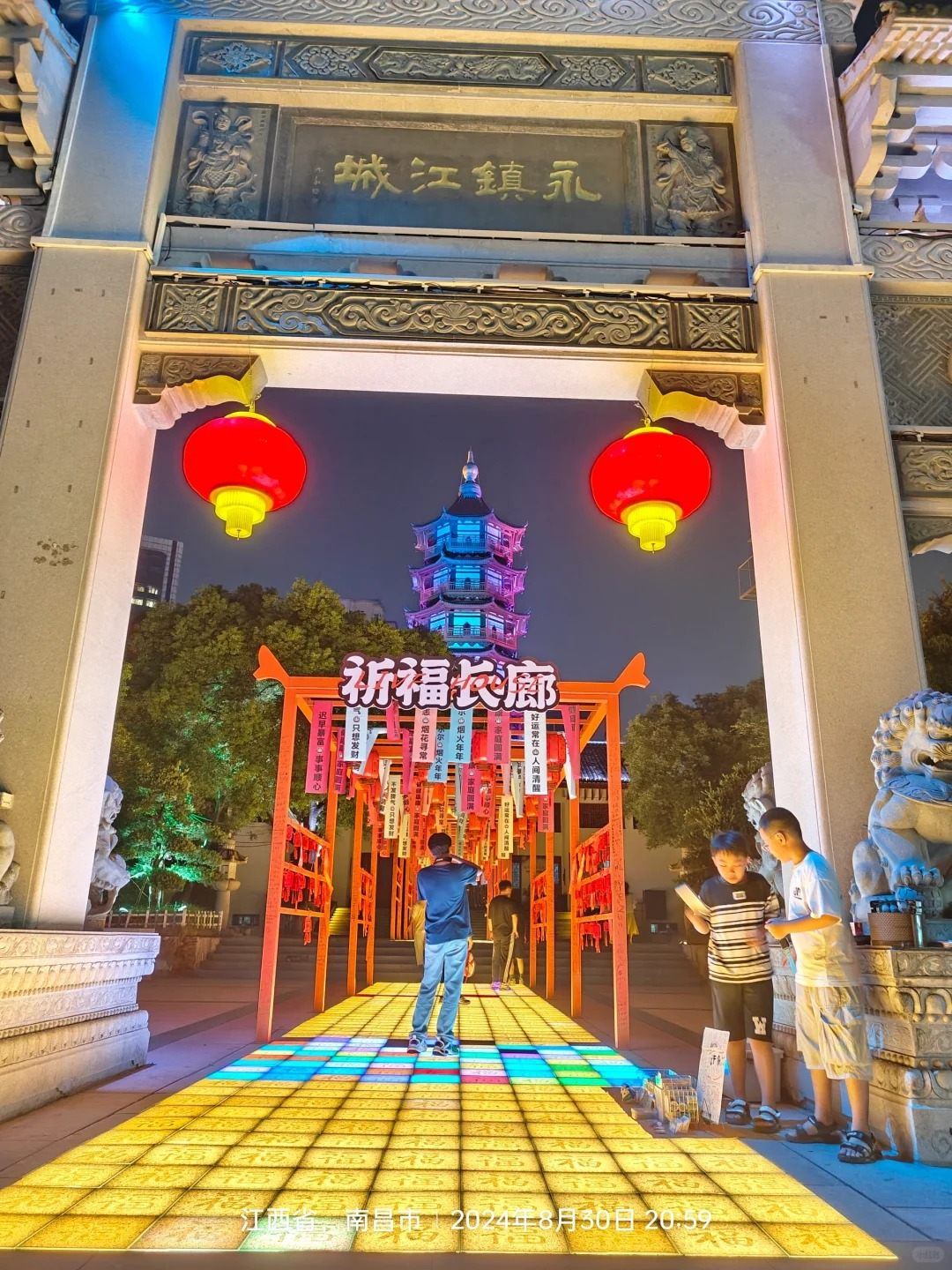
The restored quarter: grey tiles, horse-head gables, and snack stalls in every lane.
So: graze, don't gorge — the pleasure here is trying many small things. These are the dishes to hunt for (and if you've got a local with you, ask which stall they swear by — what follows are the foods, not specific shops):
- Nanchang rice noodles (南昌拌粉) — cold rice noodles tossed with chilli oil, soy, pickled radish and peanuts. The classic any-time-of-day starter; ask for shǎo là (少辣, "less spicy") if you're heat-shy. About ¥6–10. The first thing a first-timer should try.
- Clay-pot soup (瓦罐汤, wǎguàn tāng) — tiny crocks slow-simmered overnight in a giant urn of embers; pork-rib-and-lotus-root or the egg-and-meat-cake versions are the staples, ladled over rice. Mild. About ¥5–12. The local breakfast partner to the noodles.
- White sugar cake (白糖糕) — soft, chewy fried rice-flour cakes, crisp at the edges, best hot off the oil. Sweet, not spicy. About ¥5 a bag. An easy crowd-pleaser.
- Fried rice noodles (炒粉, chǎo fěn) — the heavier, smokier sibling of banfen, wok-tossed over high flame with egg and greens. Mild-to-medium. About ¥8–12. Better as a dinner or late-night plate.
- Hu geng (糊羹) — a thick, peppery Nanchang soup-stew of little diced bits; old-school and very local, more an acquired taste than a first-timer pick. About ¥6–10.
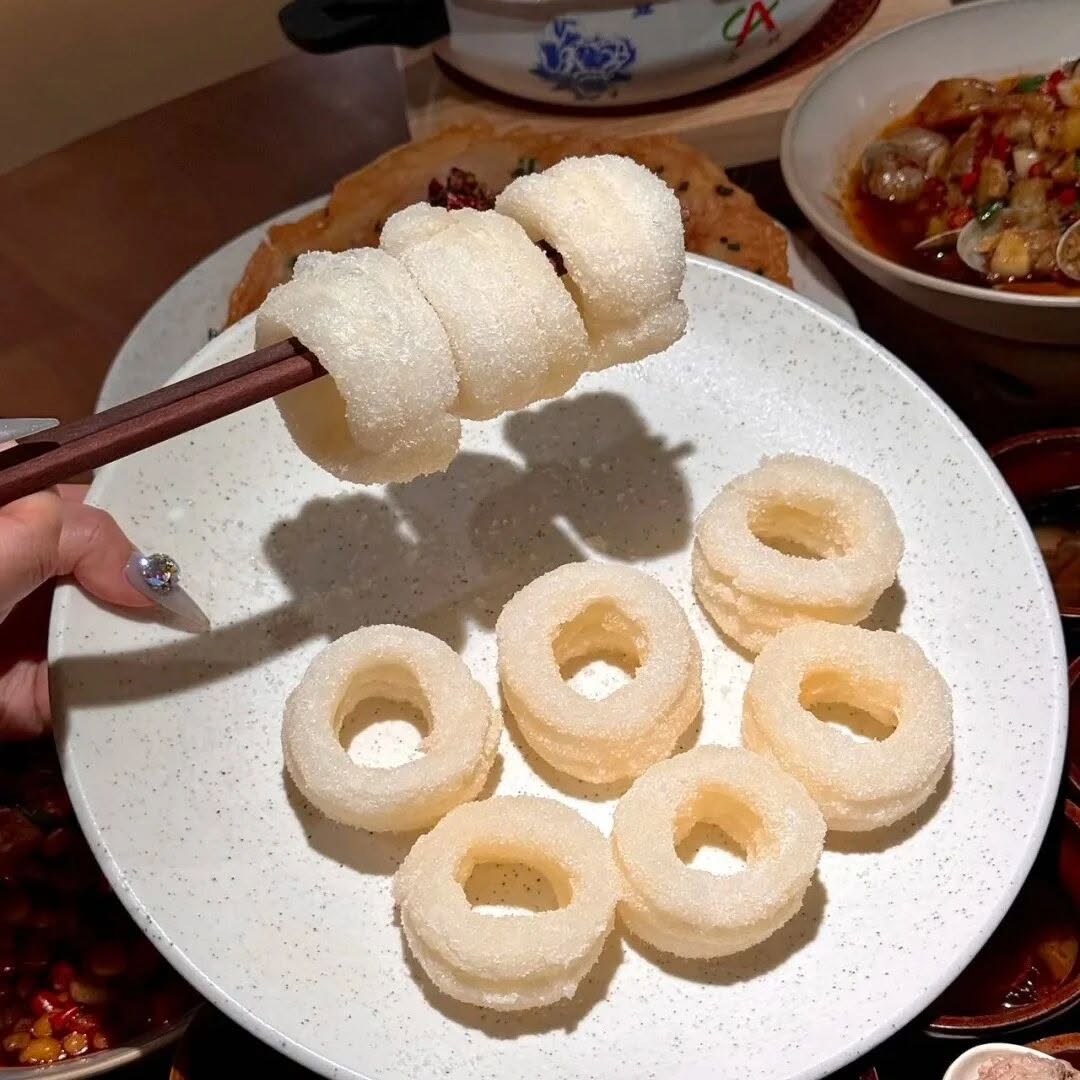
White sugar cake (白糖糕) — best hot off the oil; buy a bag and graze as you walk.
Most stalls run on phone payment (Alipay/WeChat); carry a little cash as backup, and pointing works perfectly well. Prices are small — go hungry, go late afternoon when the woks are firing, and don't fill up at the first stall you see.
The temple fair
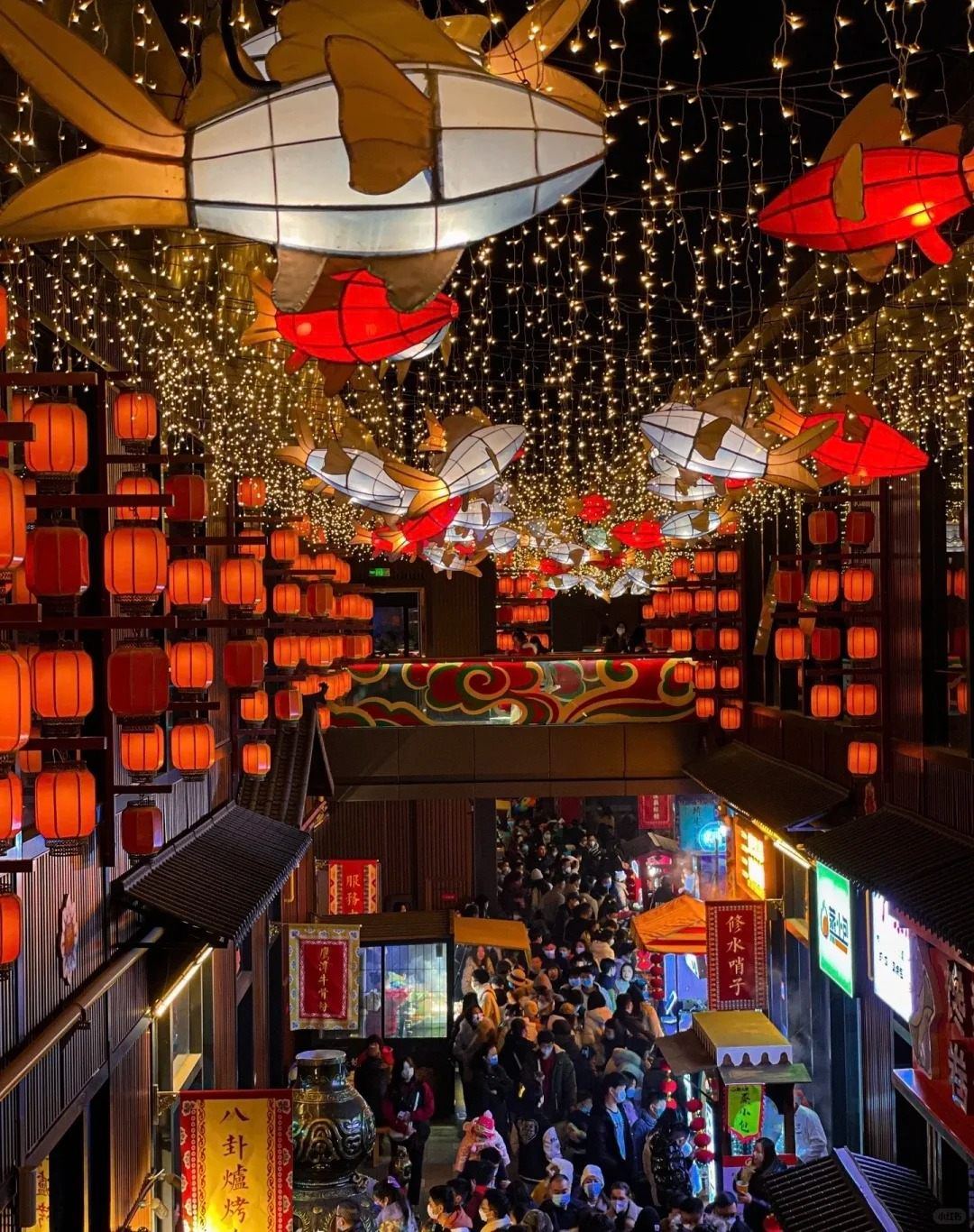
The temple fair around Chinese New Year — the quarter at its most exuberant.
Once a year, around Chinese New Year, the whole quarter goes up like a lantern. The Shengjin Tower Temple Fair (绳金塔庙会) — a Nanchang tradition more than twenty years running — strings red lanterns the length of every lane and fills them with folk opera, lion dancers shouldering through the crowd, heritage-craft stalls, and the smell of a hundred frying pans. It's where regional specialities you won't easily find the rest of the year come out to play — Lidu rice liquor, Anyi loquat pastries, Junshan Lake hairy crab — and it is as crowded as it is joyful.
The catch is the calendar: the exact dates, length and line-up shift every year with the lunar new year. If you want to build a trip around the fair, check the latest local announcement before you book — and go by day if big crowds aren't your thing.
When to go (and when not to)
- Late afternoon to early evening — the sweet spot: good light for photos, stalls firing up, comfortable temperatures.
- After dark — best for lanterns and street-life atmosphere.
- Lunar New Year — best for the temple-fair spectacle, worst for crowds.
- Skip — scorching summer middays, heavy rain (much of the grazing is open-air), and peak holiday dinner hours if you dislike queues.
Practical info
- Getting there: Metro to Shengjinta (绳金塔), an interchange on Lines 3 and 4, Exit 3; or a 10–15-minute taxi/DiDi from Bayi Square or the riverfront.
- How long: 1–1.5 hours for the tower plus a graze through the food street; longer during the fair.
- Tickets: the historical-cultural street is free to wander; access to the tower/compound itself can vary — check current on-site signs or local listings.
- Pay & language: phone payment everywhere (carry some cash as backup); English signage is limited, so save the Chinese name 绳金塔 in your map app for drivers and directions.
- Good for: food-lovers, first-timers after an easy taste of old Nanchang, families, photographers — less so if you came hoping to climb for a city view.
Worth it?
Yes — if you treat it as an old-town food-and-culture stop rather than a must-tick monument. Shengjin Tower isn't Nanchang's grandest sight, but it may be the easiest place to feel the city's older, earthier side: bells above you, snack stalls beside you, a thousand-year legend under your feet. Come late afternoon, see the pagoda before dark, and stay for the snacks. Pair it with more of the city in things to do in Nanchang, or fold it into a Nanchang itinerary. Want us to build the route around you? Plan your trip with us.
FAQ
Is Shengjin Tower worth visiting? Yes, as a half-day old-town stop — the pagoda is genuinely old and atmospheric, and the restored food street around it is one of the easiest places in Nanchang to eat well and feel local life. Treat it as a food-and-culture stroll, not a blockbuster monument.
Can you climb Shengjin Tower? Access can change, so check current on-site information — the exterior, the temple compound and the surrounding food street are the main reason to visit, not a view from the top.
How long do you need at Shengjin Tower? About 1–1.5 hours for the tower and a graze through the food street; longer if the temple fair is on.
What food should you try near Shengjin Tower? Nanchang rice noodles (拌粉), clay-pot soup (瓦罐汤), white sugar cake (白糖糕), fried rice noodles (炒粉) and hu geng (糊羹) — all within a short stroll.
When is the Shengjin Tower Temple Fair? Usually around the Lunar New Year (late January–February), but the dates, length and line-up change every year — check the latest local announcement before planning around it.
Last verified: 2026-06 — transit lines, hours, prices and fair dates change; please double-check official sources before you travel.