Wanshou Palace Nanchang: Old Town by Night
Nanchang's reborn Wanshou Palace quarter — the iron-pillar dragon legend, Gan-style lanes, guild-hall history and street food under 10 yuan, after dark.
By Hello Nanchang · Last updated
Wanshou Palace Historic Block
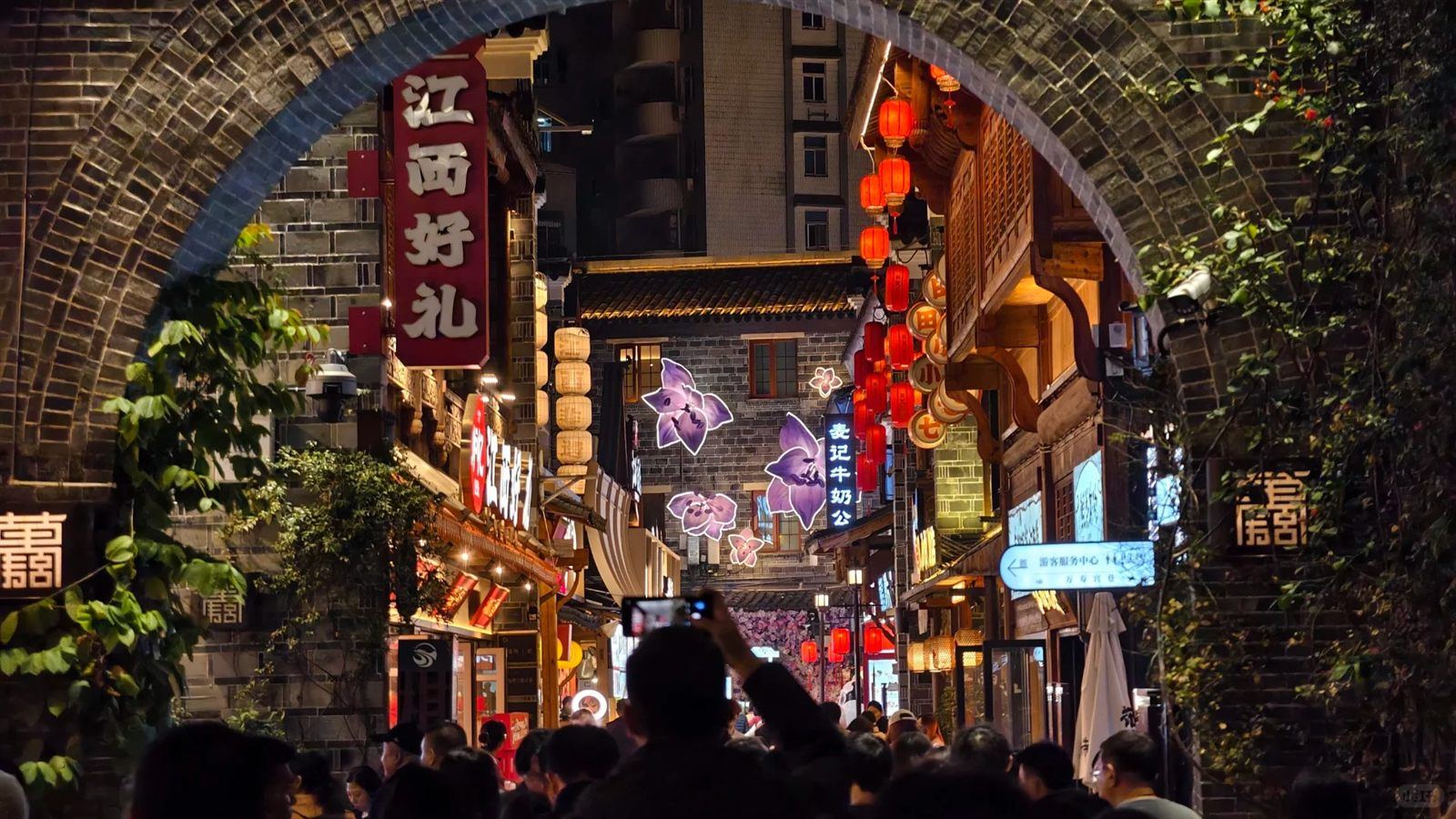
The old town that wakes up after dark
By day it is a handsome grid of grey-brick lanes and upturned eaves — quiet, photogenic, the kind of place you walk through in twenty minutes and think you have seen. Come back after sunset and Wanshou Palace (万寿宫历史文化街区) turns into something else entirely. Red lanterns come on in long strings overhead, neon spills out of shopfronts, a live erhu bends a note somewhere off to your left, and a slow river of people drifts past stalls of steaming, sizzling, sugar-dusted snacks. This restored quarter in the old heart of Nanchang is, without much competition, the city's favourite place to spend an evening.
It is also one of the oldest sacred sites in the province, and the backstory involves a flood, a dragon, and an iron pillar. The catch that most visitors never learn: this single spot is the mother of a network of temples that Jiangxi merchants scattered across China and Southeast Asia — the reason a saying still circulates that wherever there are Jiangxi people, there is a Wanshou Palace. Walk in on any given night and you are standing on the origin point of that entire diaspora, grazing on a bowl of noodles that costs about the price of a bottle of water.
Here is how to read the place — the legend, the architecture, the food, and an evening plan that squeezes the most out of one visit.
The saint, the flood-dragon, and the iron pillar
Start with the man the whole quarter is built to honour: Xu Xun (许逊, roughly 239–374 CE), a Jin-dynasty figure known across Jiangxi as Xu Zhenjun, the "True Lord Xu." The historical Xu Xun was, by tradition, recommended as an honest and filial young official and made magistrate of a county called Jingyang — held the post about a decade, and was remembered for clean, benevolent government. (Sources still argue over where Jingyang actually was, somewhere between modern Sichuan and Hubei; the epithet Xu Jingyang stuck regardless.)
Then the hagiography takes over, and it is glorious. Jiangxi in Xu Xun's day was tormented by floods, blamed on an evil flood-dragon — a jiao — thrashing in the rivers. In the legend, Xu Xun hunts the dragon down, subdues it, and drives a great iron pillar deep into an octagonal well to pin the earth-vein and quell the water for good. That pillar is the reason the temple carries the name Iron-Pillar Wanshou Palace (铁柱万寿宫), and a Tang emperor — Yizong, reigning in the 860s–870s — later formally bestowed the name "Iron-Pillar Abbey" (铁柱观) in honour of the feat.
Treat the dragon as poetry, not history: Chinese sources file the dragon-fighting and pillar-driving squarely under legend. What is genuinely documented is how seriously the empire took Xu Xun's cult. Song emperors kept renaming and re-titling the temple; in the early 1110s, Emperor Huizong canonised Xu Xun with a grand title usually rendered "Perfected Lord of Divine Merit and Wondrous Salvation" (sources give the exact year as 1112, 1116 or 1118). By the Ming, in 1546, the in-city temple settled into the name that stuck: Miaoji Wanshou Gong.
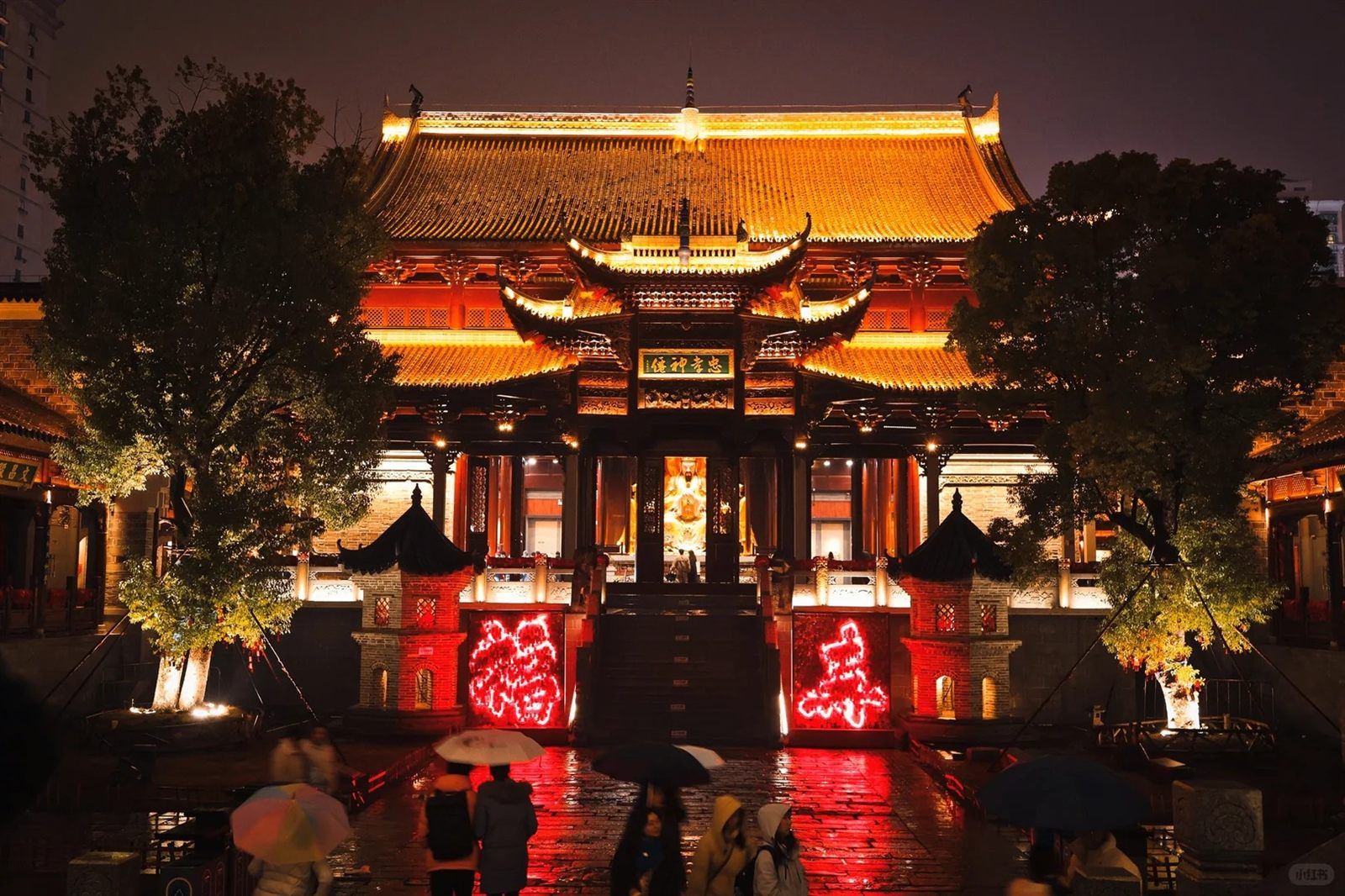 The rebuilt Iron-Pillar temple hall lit up after dark — the ceremonial heart of the district, where legend still pins a flood-dragon underground.
One nuance worth carrying, because it is the single most-mangled fact about this place: Xu Xun is revered as the founding patriarch of Jingming Dao (净明道), the "Pure-Brightness" school of Daoism that fuses Confucian loyalty and filial piety with Daoist practice — but he did not personally found it in the fourth century. The organised sect actually took shape far later, in the Southern Song and the Yuan; Xu Xun is its retrospective, spiritual founder. And there are in fact two great Wanshou palaces honouring him: this downtown Iron-Pillar temple, and the Xishan (Western Mountains) Wanshou Palace out west of the city at his legendary home, which is the ancestral seat (祖庭) of the Jingming Dao school itself. The good legends belong to both. The most cinematic — the one where Xu Xun's entire household of forty-two people ascended to heaven in broad daylight, house, chickens, dogs and all, in the year 374 — belongs to Xishan. Even the sources can't agree whether it happened on the first or the fifteenth day of the eighth lunar month.
Why a bowl of Nanchang noodles connects to a temple in Singapore
This is the part that turns a pretty lane into something you will remember. For centuries, Jiangxi produced one of imperial China's great merchant networks — the Jiangyou or Gan merchants — and wherever they settled to trade, they built a guild hall. And they named it, almost without exception, a Wanshou Palace, after their home province's patron immortal. The Nanchang Iron-Pillar temple is widely regarded as the source of that entire nationwide guild-hall system: the prototype every far-flung Wanshou Palace was modelled on.
The scale is genuinely startling. Nobody has a settled census — estimates range from about 1,400 (the tally reached by the folklorist Zhang Wenhuan) to nearly 2,000 at the Qing-dynasty peak, of which roughly 600-plus stood inside Jiangxi and the rest fanned out across the country and overseas. In the Ming dynasty, Jiangxi guild halls reportedly made up about 34% of Beijing's guild halls, 46% in Hunan, 38% in Yunnan and 34% in Guizhou. Following the trade routes, the Gan merchants carried Wanshou palaces overseas too — into Singapore and Malaysia among others — so that a temple to a fourth-century Nanchang magistrate ended up standing in the Straits.
Mei Lianhua, the district's chief cultural consultant, has described these halls as "spiritual homelands" that carried a whole people's homesickness and merchant spirit. That is the emotional weight under the lanterns. For the Jiangxi diaspora a Wanshou Palace was never just a temple — it was a chamber of commerce, a courthouse, a hostel, a stage and a home away from home, all at once. Standing in the original, you are standing at the headwaters of all of them.
You will find this thread runs through Nanchang's whole old town. If the guild-and-commerce story grabs you, the nearby Shengjin Tower quarter tells the trade-and-pagoda side of the same city, and the modern civic heart at Bayi Square shows where Nanchang's story went next.
Grey brick, small tiles, horse-head gables: reading the architecture
Almost nothing you walk past is medieval — and that is fine once you know it. The temple lineage reaches back to 312 CE, and a formal commercial block grew up on the site in 1873, but the in-city Iron-Pillar temple was destroyed in the twentieth century and the lanes decayed. What stands today is a meticulous rebuild: reconstruction was decided in 2013, cost the government somewhere north of two billion yuan, and took the better part of a decade. The historic-cultural block opened for trial operation on 6 February 2021, on the eve of that year's Spring Festival. (Some earlier dates circulate online, from planning announcements and from an older lakeside reconstruction of the temple — the downtown block's public opening is the 2021 one.)
What they rebuilt is a textbook of Gan-style (赣派) architecture, the vernacular of old Jiangxi, and once you can name its parts you will see them everywhere:
- Grey brick and small grey tiles (青砖小瓦) — the uniform, sober palette that makes the whole quarter read as one organism rather than a row of shops.
- Horse-head fire gables (马头墙) — the stepped, upturned wall-tops that rise above the roofline like a horse's neck. They were fire-breaks between crowded timber houses; now they are the district's signature silhouette against the modern skyline.
- The sky-well courtyard (天井) — a narrow central light-well that each house wraps around, so rainwater runs off all four roof-slopes into the middle. The Chinese phrase is 四水归堂, "four waters return to the hall" — rain, and by extension fortune, kept inside the family.
- Timber-frame construction with carved lattice windows, hanging eaves and covered walkways.
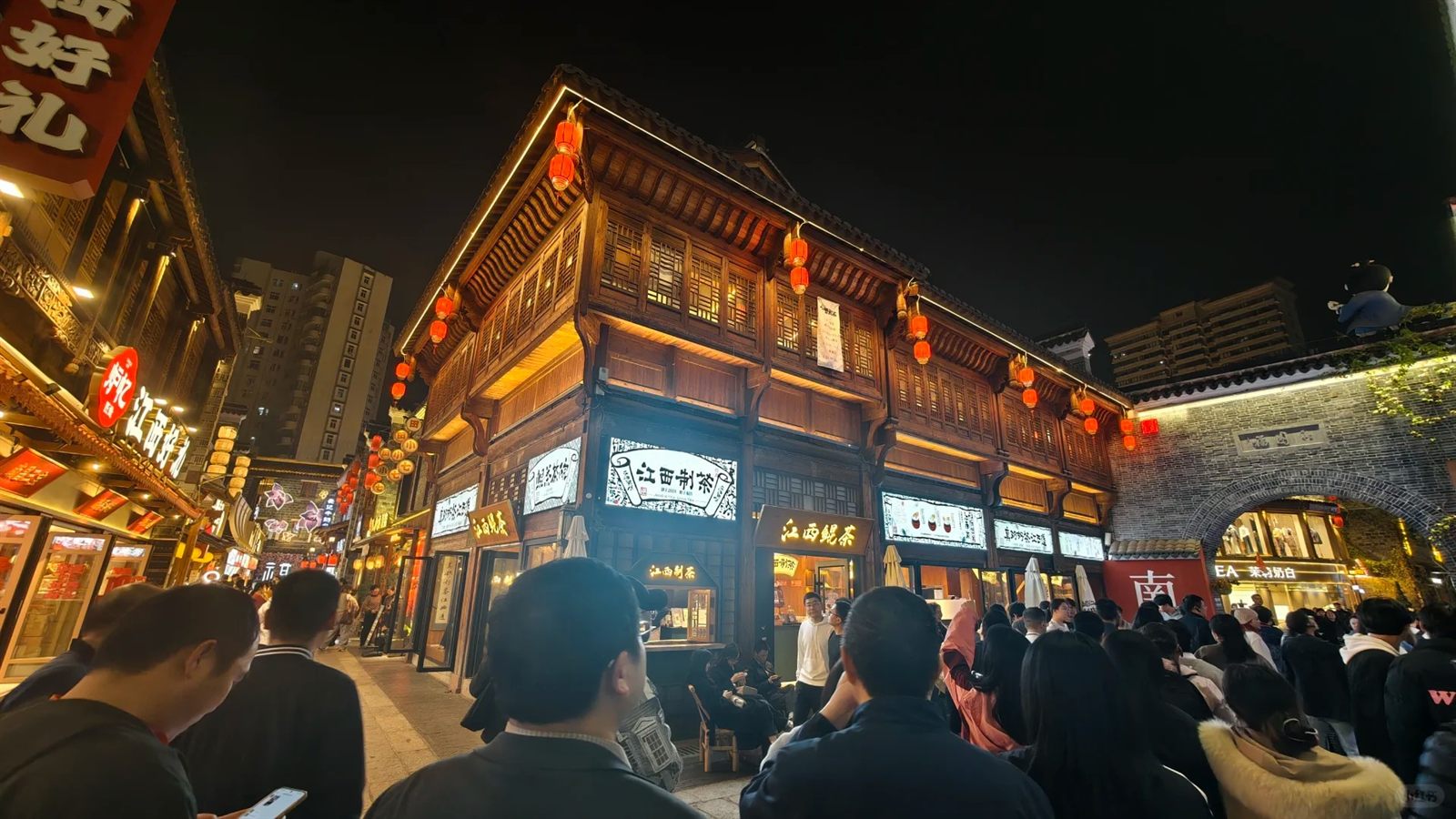 Grey brick, carved timber and hanging lanterns — the quarter was rebuilt in Jiangxi's traditional Gan-style architecture, right down to the tea houses.
The numbers behind the illusion: the block runs to roughly 54,000 square metres of footprint and around 145,000 square metres of built floor area, with about 123 buildings in total. Of those, some 118 are late-Qing Gan-style residences and 45 are designated historic-fabric buildings — the old Nanchang Chamber of Commerce, the Yutai Salt House, the Chizhi Tang and others among them. The layout preserves an old "three streets, five alleys" pattern, and the lane names are Qing-dynasty job descriptions frozen in place: there is a Vinegar Alley (醋巷) where the vinegar-brewers clustered and a Basket Alley (箩巷) for the bamboo-weavers. Walk them slowly; they are short, and each has a different temperature.
What to eat: the under-10-yuan happiness
Nanchang food is sour, spicy, smoky and rice-based, and Wanshou Palace is one of the easiest places in the city to graze through it. Several lanes are wall-to-wall stalls, and a large indoor "scene-style" food street — Wanshougong Haochi Jie (万寿宫好吃街) — opened in August 2024 for the rainy-night contingency. Order in ranges, not exact prices (tourist-block stalls run a touch above neighbourhood spots), and here is the canon:
- 拌粉 — bànfěn — Nanchang mixed rice noodles. The signature. Cold-tossed rice noodles with chilli oil, peanuts, pickled radish and spring onion — the local breakfast, eaten standing up. A plain no-frills bowl runs roughly ¥3.5–6 at a real neighbourhood counter; sit-down tourist versions cost a bit more.
- 瓦罐汤 — wǎguàn tāng — clay-pot soup. Tiny earthenware jars of broth — egg-and-pork-cake, lotus root, tea-tree mushroom — slow-steamed for hours packed inside a big coal-fired drum. Around ¥5–10 a jar, and the classic pairing with a bowl of bànfěn comes to about ¥10–15 for both. This is the platonic Nanchang breakfast.
- 白糖糕 — báitáng gāo — white sugar cake. Deep-fried glutinous discs dusted in sugar, crisp outside and chewy within — a Ming–Qing Nanchang classic that older shops still sell for around ¥1 a piece. The city's one-yuan happiness.
- 臭豆腐 — stinky tofu. Sold hot and pungent from named vendors in the block; follow your nose and the queue. Skewers (串串, lamb and beef) and hot-oil shuǐzhǔ are the other night-snack staples.
- 石头馄饨 / 金线吊葫芦 — a documented Nanchang street bowl of wontons and hand-cut noodles served together, an old-town specialty worth hunting for.
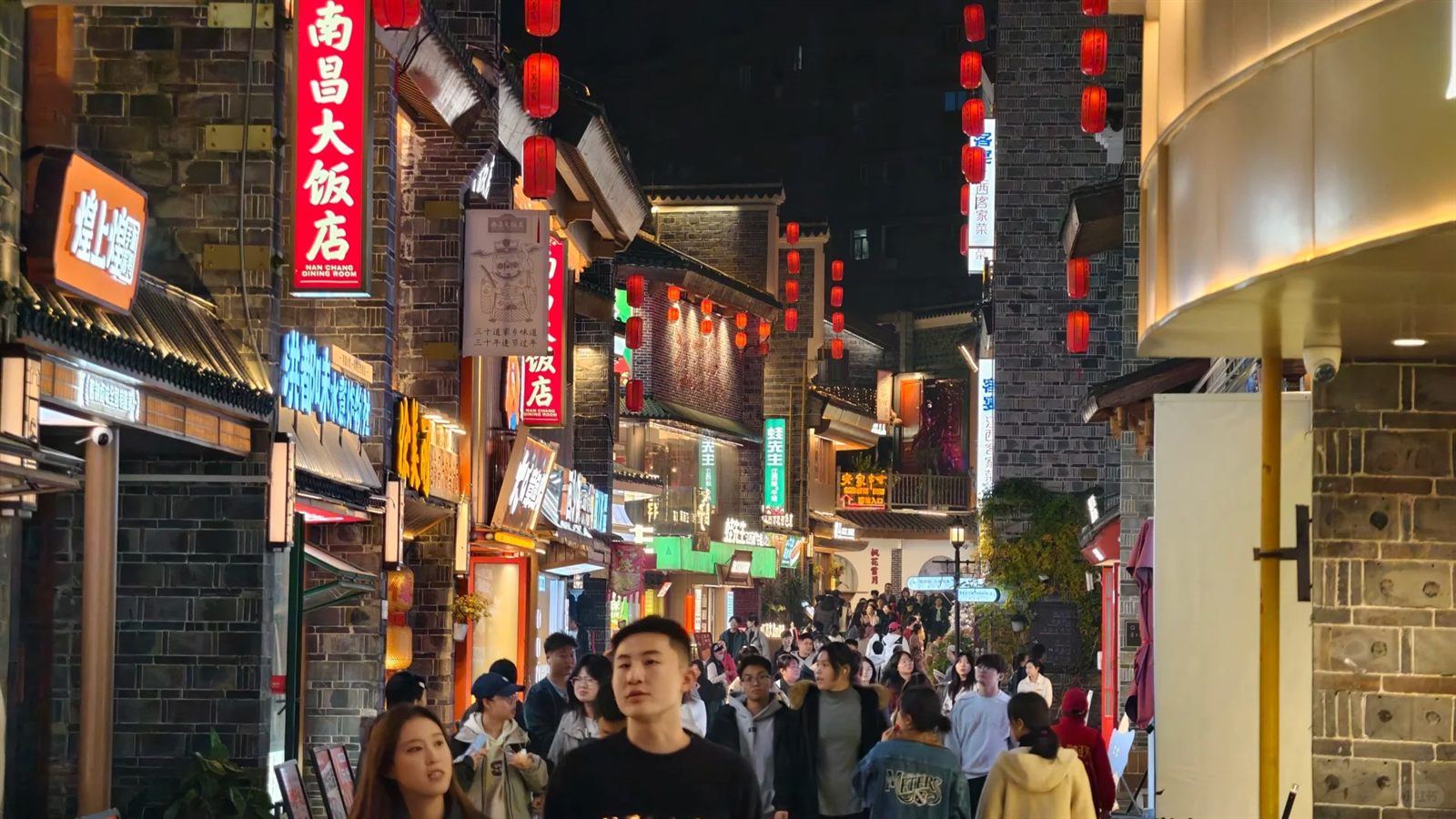 The food lanes after dark — lanterns, signboards and a slow tide of people grazing from stall to stall.
Two honest notes. First, prices drift, so treat everything here as "a few yuan," verify at the stall, and don't be shocked if the block charges above a backstreet joint. Second, Nanchang spice is real — noticeably hotter than northern Chinese cooking. If you're unsure, ask for 不要辣 (bú yào là, "no chilli") and share one chilli-heavy bowl before you commit. For a deeper map of the city's dishes and where to find them, see our Eat & Play guide.
Temple fairs, night-watch drums and a live stage
The district was named to China's first batch of national "intangible-heritage tourism blocks" in 2022, and it earns the label with programming rather than plaques. On a normal evening you can catch 国风 costumed dance sets, classical instruments — erhu, bamboo flute, pipa — and the small theatrical touch that visitors love most: the 整点打更, an hourly night-watch drum, a nod to the old town crier keeping time. Tea houses stage traditional-music sets; there are storytelling and stand-up-comedy rooms; and dragon-and-lion parades (舞龙舞狮) roll through on festival days.
The showpiece is the founding legend, retold in light: an evening hologram-and-laser show of Xu Xun subduing the flood-dragon (许逊斩蛟龙) plays on the main square, typically in the early evening. Times shift seasonally and were affected by a late-2025 upgrade, so check the board at the gate on the day.
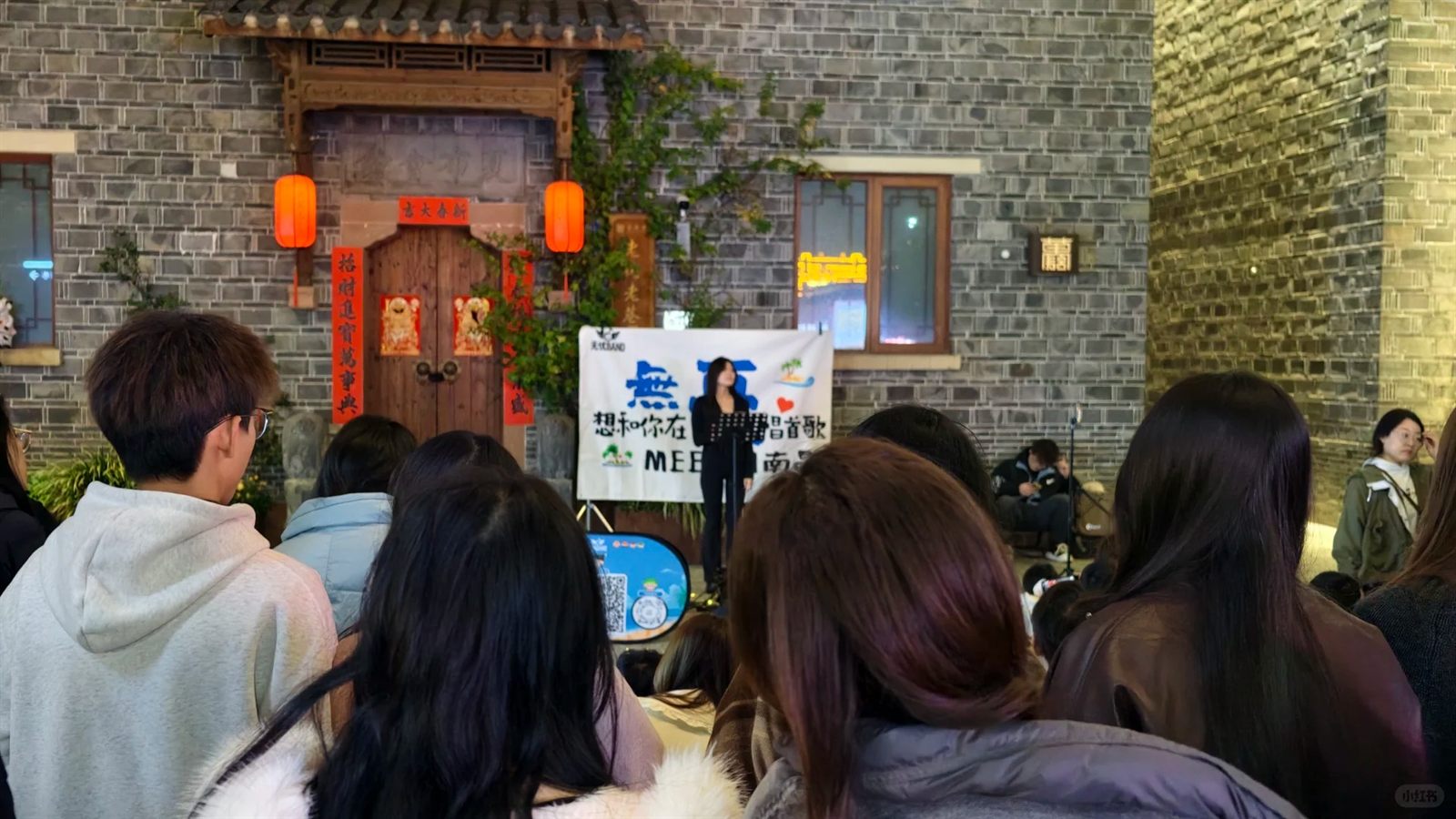 Most nights a live set strikes up in one of the courtyards — as likely a contemporary singer as a costumed troupe.
One trap to sidestep: the famous Xishan Wanshou Palace temple fair — the big lunar-calendar pilgrimage that runs roughly from the 20th day of the seventh lunar month — happens at the Xishan temple out in Xinjian District, not at this downtown block. Search engines cheerfully merge the two. If someone tells you about a huge multi-day temple fair, ask which Wanshou Palace they mean. The downtown block runs its own Spring Festival and Lantern Festival series with Jiangxi heritage showcases and lion-dance parades; specific line-ups vary year to year.
The rebuild has been a runaway success by any measure: the district reports on the order of 74 million cumulative visits since 2021, a single-day peak above 320,000, and well over a million visitors across a single May Day holiday. Which is a polite way of saying: on a public holiday, this is a shoulder-to-shoulder crowd. Plan accordingly.
An evening plan (and how to photograph it)
The district is technically open around the clock, but the stalls and shops keep roughly 10:00–21:00 and the whole place only comes alive at dusk. Here is a two-to-three-hour evening that hits the best of it:
- Arrive around 16:30–17:00. You get late golden light raking across the grey brick, empty-enough lanes for clean architecture shots, and a front-row seat as the lanterns switch on. This dusk hand-off — warm sky, warm lanterns — is the single best photo window of the day.
- Start at the temple (about 30 minutes). Find the rebuilt Iron-Pillar hall at the centre and the octagonal dragon-locking well; read the founding legend into the space before the crowds thicken.
- Walk the main creative street (about an hour) out to the quiet alleys — Vinegar Alley and Basket Alley are the calmest, Cuihua Street the busiest. Duck into an intangible-heritage studio: Gan-style hair embroidery (赣发绣), porcelain-plate painting, ceramic incising.
- Graze the food lane (about 40 minutes): a bowl of bànfěn, a jar of clay-pot soup, a hot white sugar cake, a skewer or two.
- Stay for a show. Catch a stage set or the dragon-slaying light show on the square before you leave.
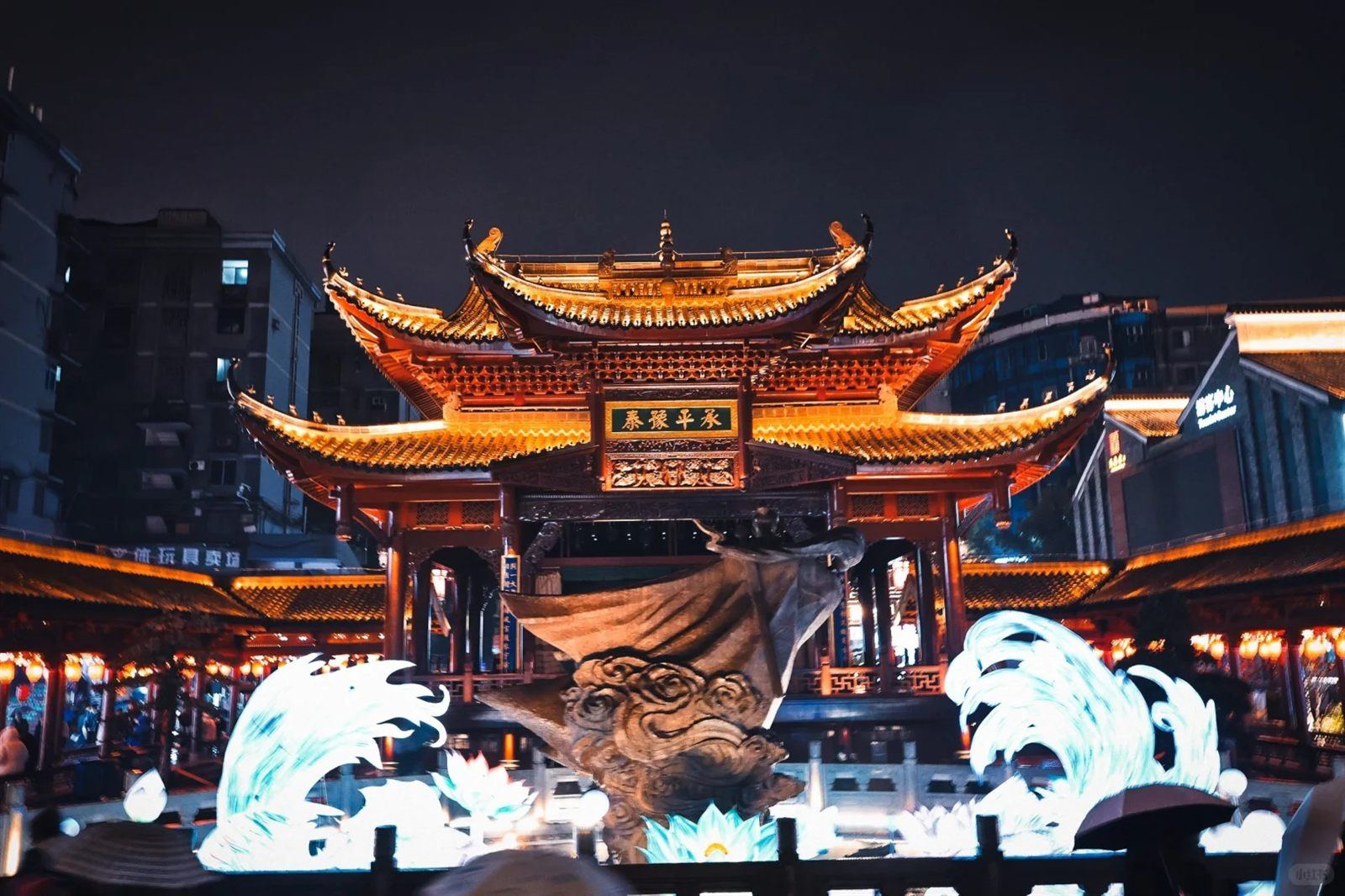 The founding legend retold in light — Xu Xun's flood-dragon coils above projected waves in the evening show on the square.
For photographers: shoot the long perspective straight down a lantern-strung lane for depth; frame the stepped horse-head gables against the modern towers for the old-versus-new contrast that defines the place; and hunt the alley T-junctions where blue-grey stone meets a single red lantern. Include a person in silhouette for scale. Come on a weekday before 11:00 if you want the lanes people-free — but you'll trade away the lantern glow that makes the night shots sing.
Getting there and practical info
- Metro: Take Line 1 to Wanshougong (Wanshou Palace) station — the block sits essentially on top of it, a five-minute walk. Chinese local guides route you out of Exit 1, which connects almost directly to the district. Do not take Exit 3: it surfaces on the north side of Zhongshan Road among office towers, and you will walk back on yourself. (The district itself has eight pedestrian gates, so you can enter from several sides.) Alternatively, ride Line 1 or Line 3 to Bayi Guan station, Exit 5, and walk west.
- Entry: The street block is free — no ticket, no gate. The lanes stay open essentially 24 hours; stalls and shops run roughly 10:00–21:00. The Iron-Pillar temple hall doesn't publish fixed hours in the block guides, so check on-site.
- Time to spend: 2–3 hours for a walk and a meal; a full evening if you add a show and dinner.
- Don't confuse the two: tell a taxi or DiDi driver "Wànshòugōng lìshǐ wénhuà jiēqū" (万寿宫历史文化街区) and make sure they don't drive you to the separate Xianghu (Elephant Lake) Wanshou Palace across town.
- Paying as a foreigner (2026): Alipay and WeChat Pay dominate — most stalls are QR-only, and both apps now let foreigners link a Visa or Mastercard, with Alipay generally the smoother of the two. Set up and test the app before you arrive: since late 2025 the foreign-card binding can take 24–72 hours or fail. Cash is your guaranteed fallback (and from February 2026, refusing RMB is penalised) — carry roughly ¥200 for the most traditional stalls.
What's next door. Nanchang's crown jewel, Tengwang Pavilion, is about an 1.4 km, 16–18 minute walk away — the natural pairing for the same evening. The Bayi Uprising Museum is barely 250 m off, on Zhongshan Road, and free. Bayi Square's musical fountain (roughly 20:00–20:15 nightly) and the Gan-river two-banks light show are a short metro or taxi hop rather than a walk. And if one night market only whets your appetite, the Shengjin Tower food street — the city's original big night market — is a quick ride on a different line. Building a longer trip around all this, or tacking on a mountain like Sanqingshan? We can map it for you on the Plan With Us page.
Is it worth it?
Yes — and the price of admission (nothing) makes it an easy yes. Come at dusk, walk the lanes slowly, eat a bowl of noodles and a jar of soup for pocket change, and let the light show tell you the dragon story you now know better than the crowd around you. It is the most atmospheric single evening in Nanchang, and it happens to be the birthplace of a temple network that once spanned a nation. Not bad for a free walk after dark.
FAQ
Is Wanshou Palace free to visit?
Yes. The historic-cultural block is free and open-access — no ticket, no gate. Individual paid performances or exhibits inside may charge separately, and the on-site temple hall's hours aren't fixed, so check when you arrive.
What's the best time to go?
Arrive around 16:30–17:00 to catch golden-hour light on the grey brick and watch the lanterns come on at dusk. Weeknights are calmer; public holidays and weekend evenings (18:00–22:00) can be shoulder-to-shoulder, with single-day peaks over 320,000 people.
How do I get there by metro?
Take Line 1 to Wanshougong (Wanshou Palace) station; the block sits right on top of it. Leave by Exit 1. Exit 3 puts you out on the north side of Zhongshan Road among office towers, which is a needless detour. Bayi Guan station (Line 1 or 3, Exit 5) is a short walk away too.
What should I eat there?
The Nanchang canon: mixed rice noodles (拌粉, roughly ¥3.5–6), clay-pot soup (瓦罐汤, about ¥5–10 a jar — the noodle-plus-soup combo runs ¥10–15), white sugar cake (白糖糕, around ¥1 each), plus stinky tofu and skewers. Prices drift, so verify at the stall.
Is it the same as the Xishan Wanshou Palace and its temple fair?
No. This is the downtown Iron-Pillar (铁柱) Wanshou Palace, the source of the Jiangxi guild-hall network. The Xishan Wanshou Palace — the ancestral seat of Jingming Daoism and home of the big multi-day temple fair — is a separate site out in Xinjian District. Search results often merge them.
Last verified: 2026-07 — hours, transit and stalls change; please double-check before you go.