Qiushui Square (秋水广场): Nanchang's Fountain
Nanchang's Qiushui Square: a free musical fountain twice a night, the 303 observation deck and the Star of Nanchang wheel. Times, exits and what to skip.
By Hello Nanchang · Last updated
Gan River, Honggutan District · Tonight: check on-site board; typical times 7:30 PM & 8:30 PM
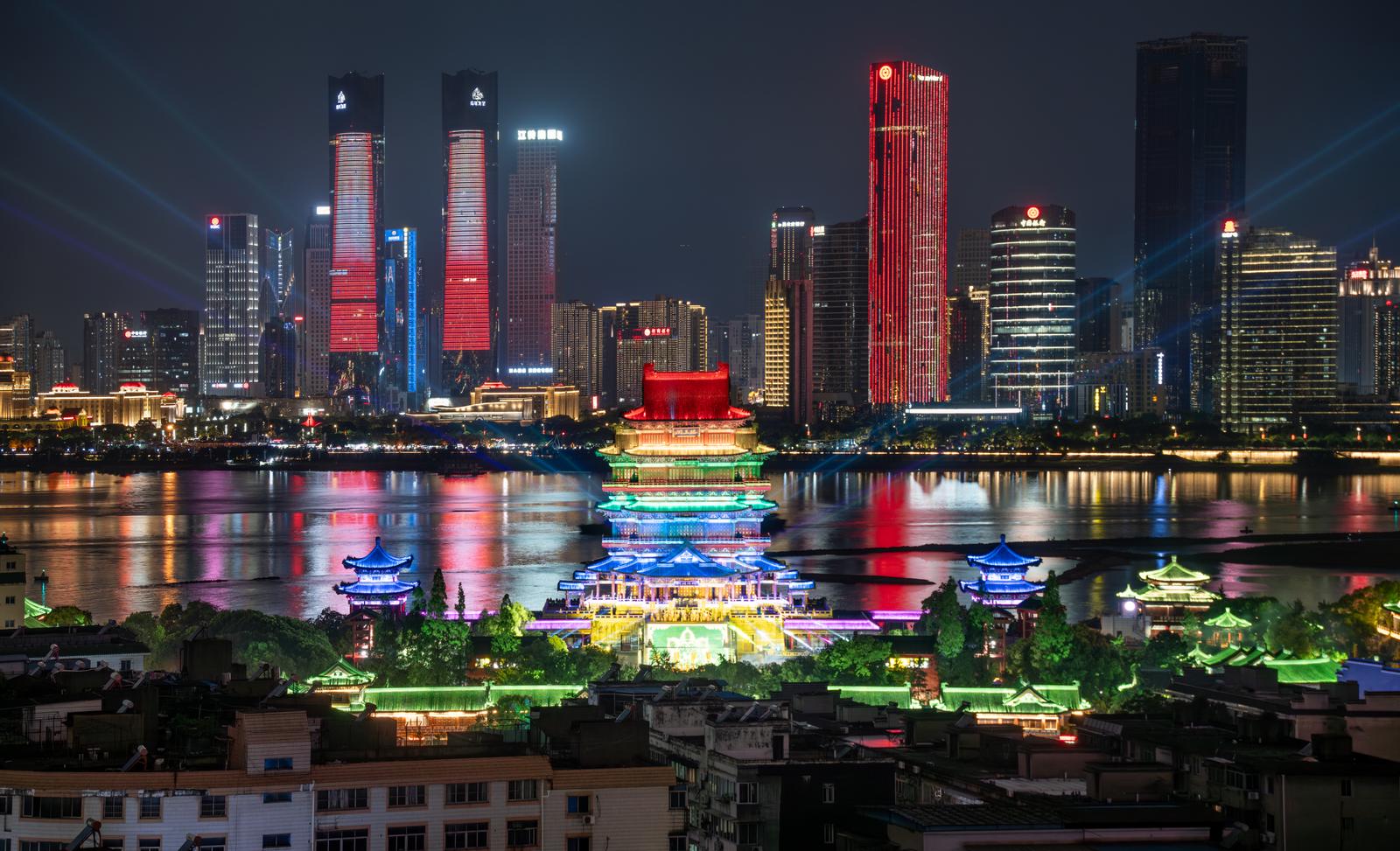
The night the river throws a jet of water 40 storeys high
Get to the railing before the music starts. On a summer weekend the crowd at Qiushui Square (秋水广场, Qiūshuǐ Guǎngchǎng) is three deep along the Gan River (赣江) — grandparents fanning themselves, teenagers filming, a man selling glowing plastic wands nobody's child can resist. Then the first bars roll out of the speakers, the water begins to breathe, and a single central jet climbs, and climbs, until it's a column of white taller than most buildings behind you — reportedly up to around 128 metres, which is roughly a 40-storey tower made of water and light. Downriver, the whole opposite bank flares gold: Tengwang Pavilion (滕王阁), 1,300 years of it, lit up and staring back across the water at a fountain named after a poem written on its own upper floor.
That's the trick of this place, and why it's worth a whole evening rather than a photo stop. Qiushui Square isn't just a fountain. It's the front porch of the new Nanchang — a city that, in a single generation, picked up its government, its banks and its skyline and moved them across the river onto what used to be empty sand flats. Stand here after dark and you're looking at both Nanchangs at once: the ancient one on the east bank, the glass-and-LED one at your back.
(The video at the top of this page is that fountain show — worth thirty seconds before you read on, so you know what you're chasing.)
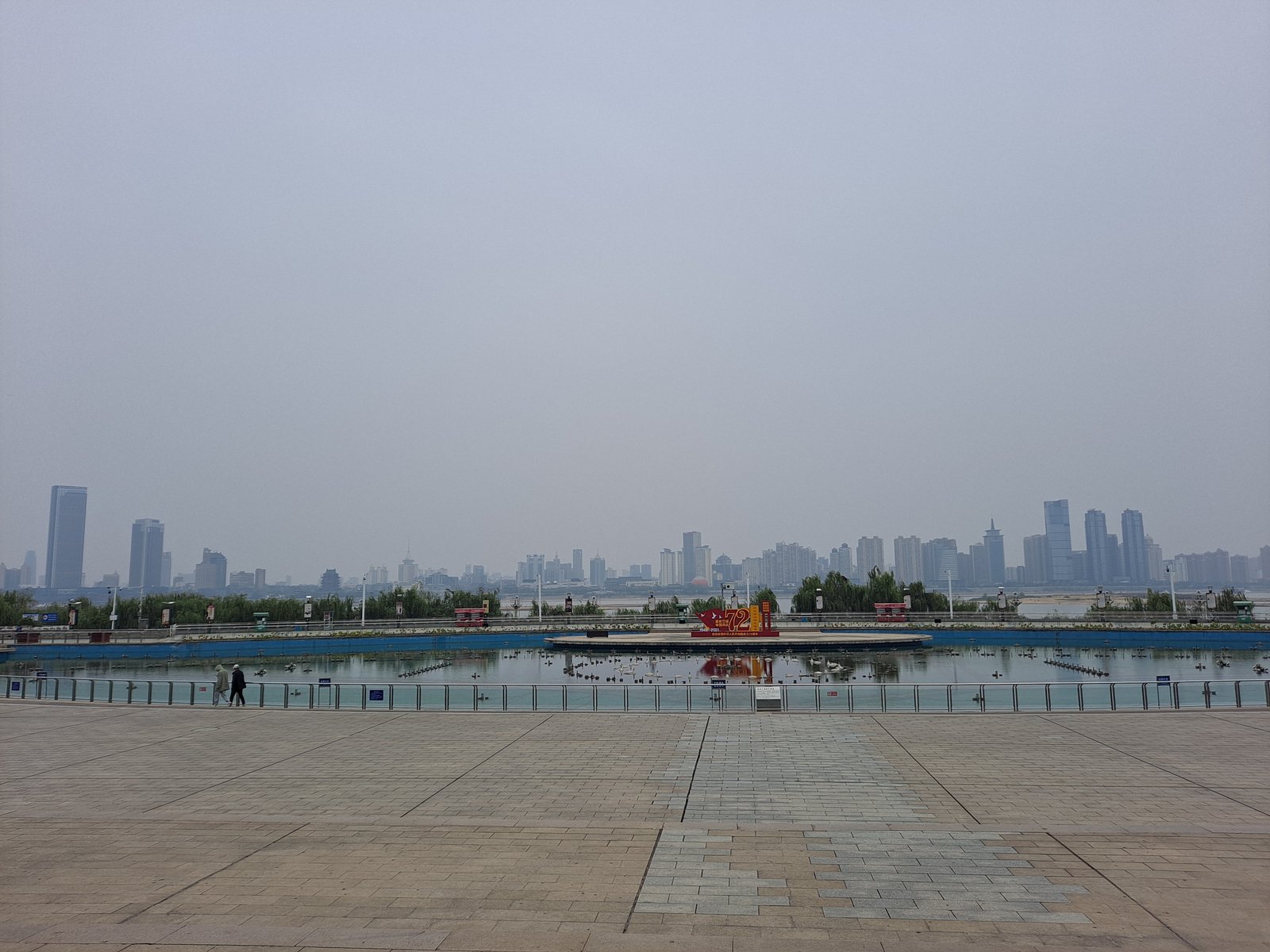 Qiushui Square by day — the vast riverside plaza and its fountain platform at rest, the old-town skyline hazy across the Gan. After dark it becomes the scene in the video above. Photo: 钉钉 / Wikimedia Commons (CC BY-SA 4.0).
A square named after a line of poetry
Start with the name, because it's the soul of the place. In the year 675, a 26-year-old prodigy named Wang Bo (王勃) passed through Nanchang, was pulled into a banquet at the newly restored Tengwang Pavilion, and — as the story goes — dashed off the Preface to the Pavilion of Prince Teng (《滕王阁序》) on the spot, to the astonishment of a room that had expected a polite nobody. One couplet from that evening became one of the most quoted lines in all of Chinese literature:
落霞与孤鹜齐飞,秋水共长天一色
The setting sun-glow and a lone wild duck fly together; the autumn waters merge with the vast sky as one.
The traditional telling makes it better than a plaque ever could. The host, prefect Yan Boyu (阎伯屿), had stage-managed the evening so that his own son-in-law could unveil a preface he had quietly prepared in advance; the brush going round the table was a courtesy nobody was expected to accept. Wang Bo — young, passing through, on his way to visit his father — took it. Yan is said to have walked out in irritation and posted a servant to relay each new line back to him, and to have come back to the table when the line about the autumn waters arrived. Within a year or so Wang Bo was dead. He reached his father's posting in what is now northern Vietnam, and drowned on the way home when his boat was caught in a storm — around 676, aged about twenty-six. The plaza you're standing on is named after fourteen characters written at a party where he wasn't supposed to shine.
Fourteen hundred years later, when Nanchang built its riverfront plaza on the opposite bank, it lifted two characters straight from that line — 秋水, "autumn water" — and called it Qiushui Square. It's a deliberate, almost cheeky echo: the square that quotes the poem sits directly across the Gan from the pavilion where the poem was written, close enough that on a clear night you can read one skyline against the other. Baidu's own encyclopedia calls it "a cultural echo across time and space with the Tengwang Pavilion on the opposite bank," and for once the marketing copy is right.
So before you cross over to the fountain, it's worth knowing you're standing inside a 1,300-year-old joke about the same stretch of water — the "autumn waters merging with the sky" that Wang Bo saw, now doing it in light. If you haven't yet, pair this with our guide to Tengwang Pavilion (滕王阁) on the far bank; the two sights are two halves of one view.
The fountain: how big, how high, and is it really Asia's largest?
Let's settle the question everyone asks, honestly. Chinese tourism sources routinely bill the Qiushui Square music-fountain group as the largest in Asia — and you'll see that line on signboards, travel apps and half the blog posts about it. Local guides hedge it down a notch to "the largest musical fountain group in China," which tells you something in itself. It's a genuine spectacle, and on the ground it certainly feels that big. But "largest in Asia" is a promotional claim, not a figure certified by any international body, and older descriptions of the same fountain called it "Asia's second largest." No neutral referee has ever ranked the world's musical fountains. So: enjoy it as one of Asia's great fountain shows, treat the superlative as a boast rather than a fact, and don't let the ranking decide whether you go — the show itself does that.
What's more useful is the scale you can actually see:
- The central jet — widely cited at up to around 128 metres, a tower of water taller than almost everything on the old-town bank. (Reported heights for the jet vary by source, so read that as "reportedly up to," not a surveyed number.)
- The spread — this isn't one nozzle but a battery of them, local listings counting somewhere around 22 different water effects — the central column, rings of high-pressure jets, low rolling "wave" fountains — arranged along roughly 800 metres of waterfront. That's why the show reads as choreography rather than a firehose: things are happening at three different scales at once.
- The water line — the fountains run in a long arc along the riverbank, part of a crescent plaza with roughly 1,100 m of river frontage and a total square area cited at somewhere around 87,000–100,000 m² (sources differ). The fountain pool alone is reported at something like 12,000 m².
- The choreography — jets fan, cross, pulse and collapse in time to music, backlit in colour, so the whole arc reads as one moving sculpture rather than a row of sprinklers.
The square opened in January 2004, and the fountains were given a major upgrade in December 2013. It has been rebuilt and refitted more than once since — the whole installation has gone dark for several weeks at a stretch for maintenance — which is the first reason to check before you make the trip.
When the fountain runs — and how to watch it well
Here is the thing a lot of English-language pages get wrong, and it costs people an evening: Qiushui Square is not the weekends-only fountain. That's the one at Jiulonghu Park (九龙湖公园), across town, which performs on Saturdays, Sundays and public holidays. Qiushui Square runs every night, weather permitting, in two shows of about 15 minutes each — the first around 7:30pm, the second around 8:30pm. It's free. There's no gate, no ticket and no seated section.
Two caveats keep that honest. The operator changes the timetable by public notice and does so often — past summer holidays have added a third show around 9:30pm, National Day evenings have opened with an extra prelude — and the water stops for weather, the posted rule being that shows are suspended for thunder, rain, winds above force 5 or heavy fog. Both point the same way: check the same day, on Nanchang's local listings or at your hotel front desk, rather than trusting any page, this one included.
How to do it like someone who's been:
- Come out at Exit 5. Metro Line 1 stops at Qiushui Square (秋水广场) station, and local guidance points you to Exit 5 for the fountain — you surface a couple of minutes from the water. Exit 1 is the one for the Shangri-La, the riverside park and the shopping centre. (Station layouts do get renumbered; the in-station signage names the square.)
- Arrive 15–20 minutes early and claim a spot on the front railing — the crowd thickens fast in the last ten minutes.
- Stand river-left of centre if you want Tengwang Pavilion lit up in the same frame as the jets — that's the shot.
- Buy your drinks before the show. The snack and cold-drink sellers cluster along the square in the evening and thin out to almost nothing in the afternoon, so if you turn up at five, bring water.
- Expect a little spray if there's any breeze off the water. Front-row is wetter and better.
- Enter from the north or south gates and leave by the main gate — that's the crowd flow the square's own notices ask for, and on a busy night it's the difference between walking out and shuffling out.
- You have 45 minutes between shows, not an hour — enough for a stretch of boardwalk, a cold drink and the twin towers' LED wall from the plaza, and not enough for the observation deck (lift queue included) or the Ferris wheel (see below, it's further than it looks). One caveat on that LED wall: the fountain is nightly, but the towers' big animated sequence usually only runs Fridays and Saturdays, roughly 19:30–21:30.
- Golden hour first, then the show. Come at sunset, watch the light go off the water the way Wang Bo did, then let the fountain take over as it gets dark.
- Get out the smart way. Several thousand people head for the same metro entrance the moment the second show ends. Locals walk over to Shuangzita · Ditie Dasha (双子塔·地铁大厦), the next station along Line 1 by the twin towers, and board there instead — ten minutes on your feet against twenty-five in a queue.
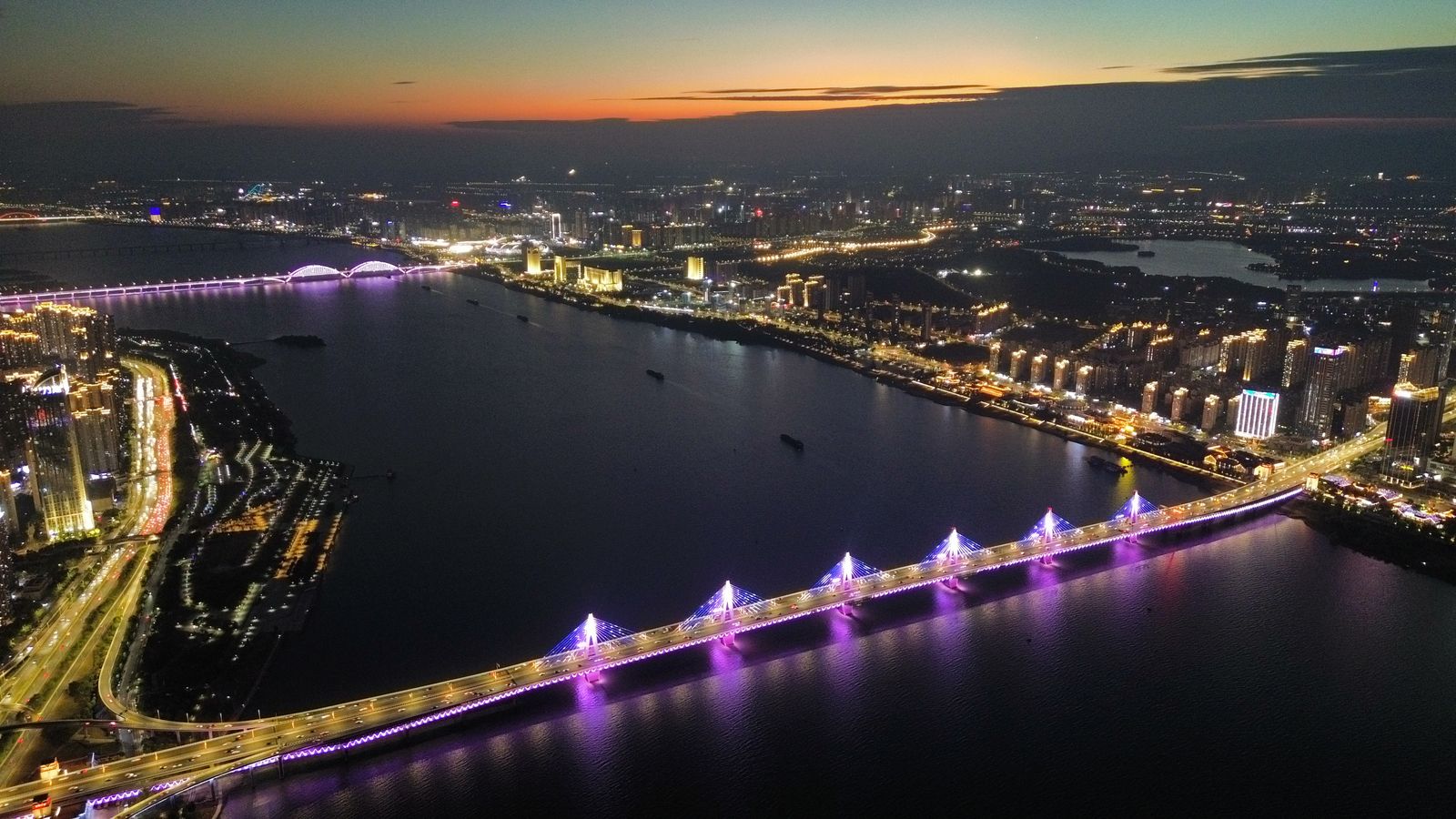 Dusk over the Gan and the Honggutan waterfront — the hour to arrive, when the water goes the colour Wang Bo wrote about and the lights come up. Photo: Ddayzzz / Wikimedia Commons (CC BY 4.0).
What you're standing on
The district behind you is called Honggutan (红谷滩), and the name gives the game away: "red valley sandbank." Within living memory it was flood-prone sand nobody built on, which is why everything standing on it looks new and faintly oversized. It also explains the second show going on above your head: nearly every tower along this bank carries facade LEDs, choreographed into one nightly animation — the display that holds the Guinness World Record for the most buildings in a permanent light-and-sound show, at 293 buildings. The fountain performs in front of it, which is exactly why visitors muddle the two. How the city crossed the water, how that skyline show is programmed, the 28 kilometres of riverside park behind you, the bridges, and the best free vantage points on both banks are a guide of their own: read One River, Two Banks: Nanchang's Gan riverfront before you decide which side of the river to spend your evening on.
The landmark cluster around the square
From the fountain railing, almost everything worth pointing at is within a short walk. Here's what you're looking at.
The Greenland Twin Towers — the tallest thing in Jiangxi
The two identical towers rising right beside the square are the Greenland Twin Towers (南昌绿地双子塔), officially the Jiangxi Nanchang Greenland Central Plaza (南昌绿地中央广场). Each is 303 metres tall — a matched pair, about 100 m apart — which makes them, as of now, the tallest buildings in Nanchang and in all of Jiangxi. (They were planned at 289 m, then raised mid-build to clear the 300-metre "supertall" mark — a very Honggutan move.) A taller tower has been planned for the city, so read "tallest" as "tallest to date."
- Architect: the American firm SOM (Skidmore, Owings & Merrill) — the same practice behind a good chunk of the world's supertalls — for developer Greenland Group.
- Built: construction began in 2011; the towers topped out in 2014 and are generally cited as completed in 2015.
- Function: mostly Grade-A offices, with retail, conference space and a hotel component. Address: 998 Honggu Middle Avenue (红谷中大道998号), a few minutes from the square.
- The record on the glass: the LED lighting curtain wrapping the two towers set a Guinness record for the world's largest LED-illuminated facade at the time — reported at around 35,300 m² by secondary sources, and said to have surpassed the Burj Khalifa's display — recognised in 2015. That's a separate record from the 293-building skyline show, and the two get conflated constantly; if someone tells you the towers hold the "293 buildings" title, they've merged two different plaques.
- The view: the public "303 Observation Deck" sits on the 60th floor of the A1 tower — glass all the way round, with a small sky cinema and a café. From it you can pick out Tengwang Pavilion east across the Gan, the Meiling hills to the west and the fountain directly below at night. Recent listings put tickets around ¥80, with hours from late morning to roughly 9:30–10pm and longer at weekends — but the deck has closed for months at a stretch for refurbishment before, so check Ctrip/Trip.com or Amap the day you plan to go up.
One disambiguation, because it trips people up: this is not the "Greenland Zifeng Tower (绿地紫峰大厦)." That's a different, single 268 m Greenland building in another part of Nanchang (the Qingshan Lake / Gaoxin area), also by SOM. The twin towers by the square are the 303 m pair — that's the pair you want.
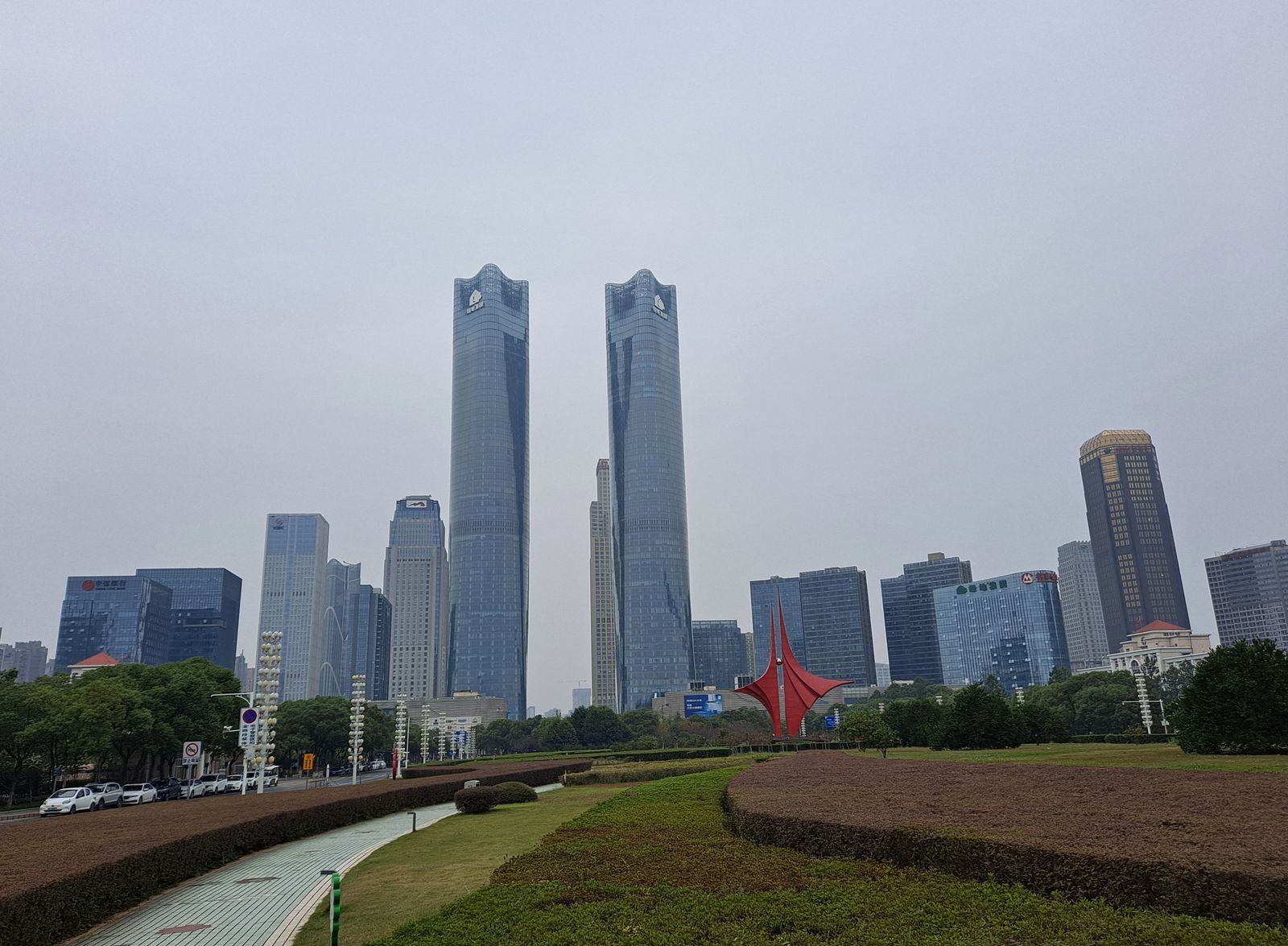 The 303-metre Greenland Twin Towers over Honggutan's administrative square — the tallest buildings in Jiangxi to date, a few minutes' walk from the fountain. Photo: 钉钉 / Wikimedia Commons (CC BY-SA 4.0).
The city government — Nanchang's civic front yard
Immediately beside the square sits Nanchang's municipal administrative center (南昌市行政中心), around Century Square (世纪广场). This is the concrete result of the river crossing: the city's government seat, planted on the west bank, with the twin towers rising beside it and the fountain out front. It's a civic complex rather than a ticketed sight, so treat it as orientation — but it explains why this particular stretch of riverbank got the grand plaza, the tallest towers and the marquee fountain. This is Nanchang's official front yard, and it was designed to be seen from across the water.
The Star of Nanchang — the wheel, and the honest truth about reaching it
The Star of Nanchang (南昌之星) is the giant white ring you can see upriver from the square: a 160-metre Ferris wheel that opened in May 2006 at 1 Ganjiang South Avenue (赣江南大道1号), beside the international exhibition centre. Here's the fun bit of trivia: when it opened it was briefly the tallest Ferris wheel in the world, taking the title from the 135-metre London Eye and holding it until the 165 m Singapore Flyer overtook it in March 2008. So it's not the world's tallest anymore — don't repeat that on the postcard — but it is still a genuine giant.
- The ride: 60 enclosed, air-conditioned gondolas carrying up to eight people each — about 480 riders on the wheel at once — and a full rotation of roughly 30 minutes, slow enough that it never quite stops to load you.
- Tickets and hours: a standard cabin has recently been priced around ¥50 per adult, half price for children 1.2–1.4 m and free below 1.2 m; it turns from mid-morning to around 10pm, later on public holidays, with ticketing closing an hour or so before the end. Pricing here is market-adjusted rather than fixed by the city, so treat ¥50 as the going rate, not a guarantee.
- When to ride: dusk, without question. Board about 40 minutes before full dark and one rotation carries you up through sunset over the Gan and back down into the lit skyline — the wheel's one unbeatable advantage over the 303 deck, which is higher but doesn't move.
Now the part most guides skip: the wheel is not next door. It sits roughly 5 km upriver from Qiushui Square, and on public transport it's genuinely awkward — Line 1 to Ditie Dasha, change to Line 2, out at Xuefu Ave (E) (Exit 2), then about 1.3 km on foot. A DiDi is 15 minutes and worth it. So don't plan to nip over between the two fountain shows, because you can't: ride the wheel at dusk and taxi back for the 8:30 show, or give it its own evening.
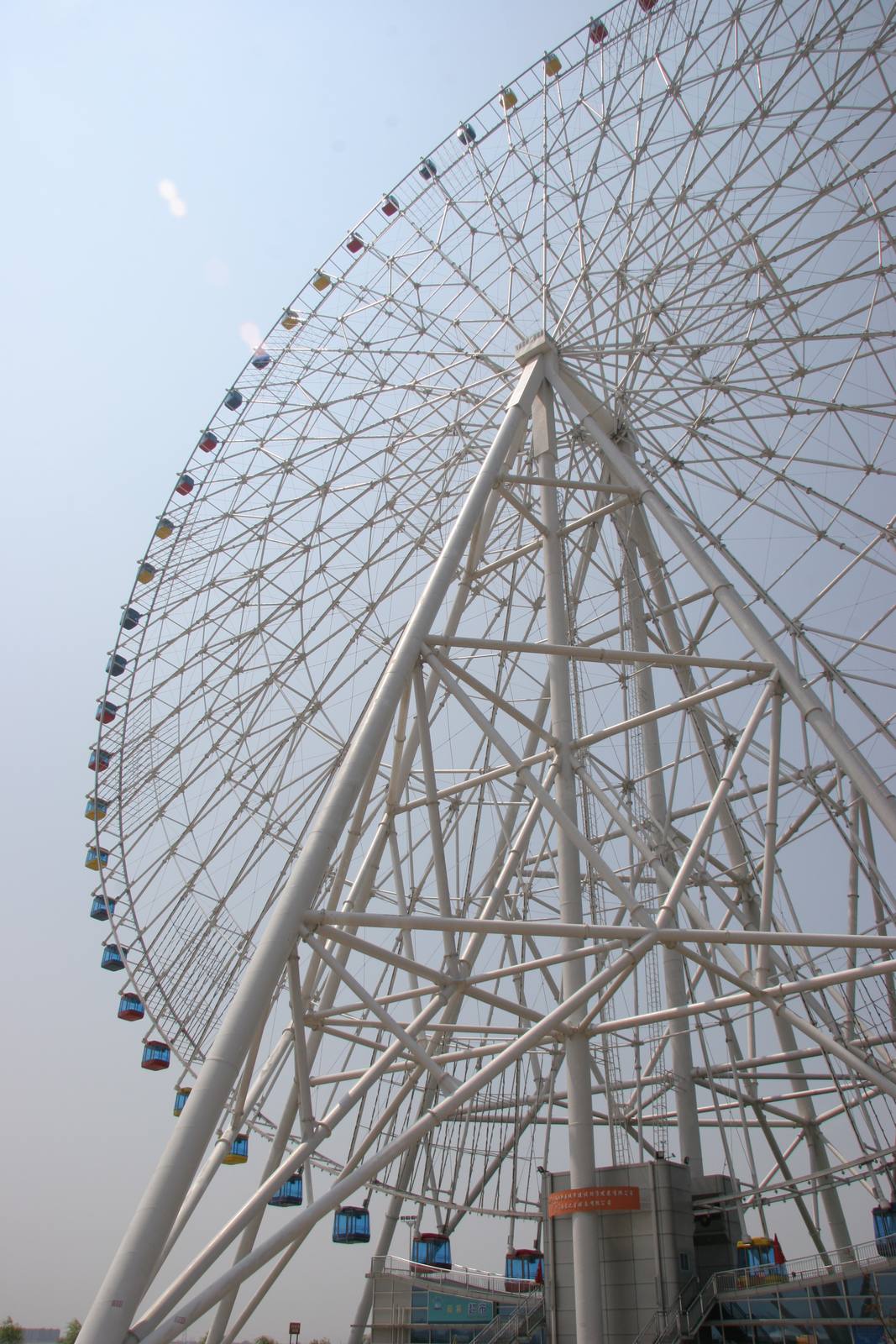 The Star of Nanchang: 160 metres tall and, for two years after it opened in 2006, the tallest Ferris wheel on Earth. Photo: Saganaga / Wikimedia Commons (public domain).
And the walk along the water
The best free thing here after the fountain needs no ticket and no plan: turn left or right at the railing and keep walking. The bank is threaded by the Gan River Citizens' Park (赣江市民公园), a green corridor running some 28 kilometres along the water on timber boardwalks (栈道) over preserved wetland — flat, free and open at all hours. Ten minutes in either direction gets you clear of the fountain crowd; the One River, Two Banks guide maps the corridor phase by phase if you want a longer stretch of it.
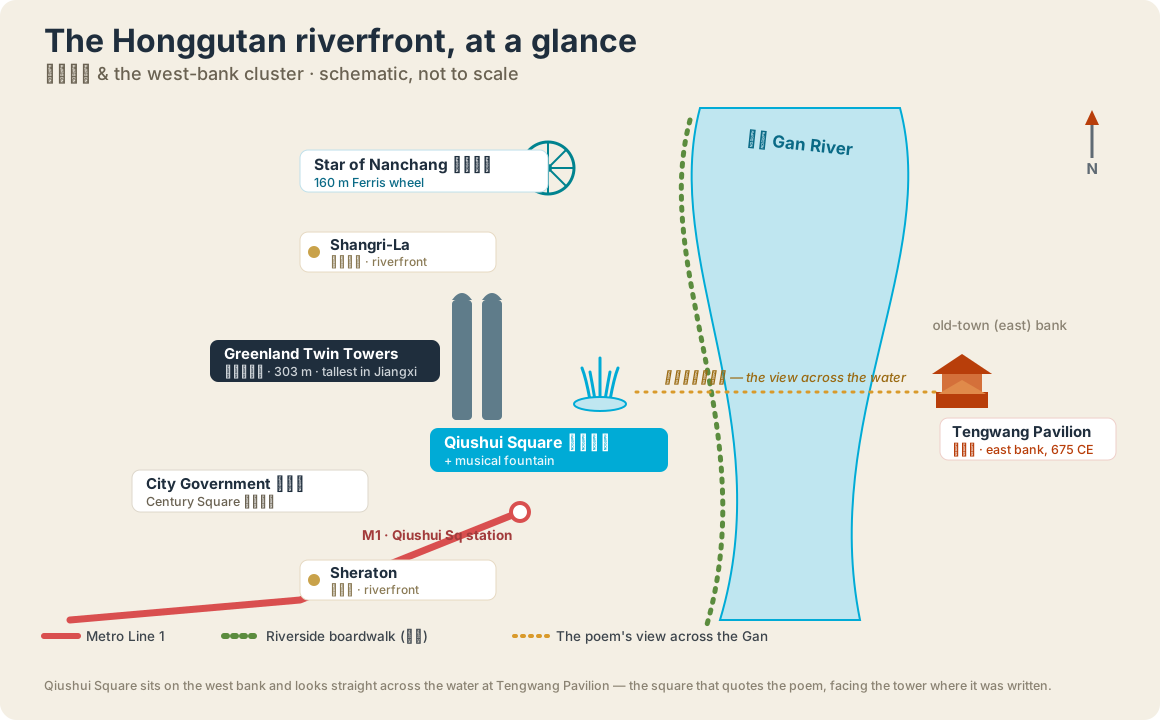 How the west-bank cluster actually sits, plotted to scale from surveyed coordinates. Qiushui Square is on the water and looks straight across the Gan at Tengwang Pavilion, 1.8 km away; the hotels and towers behind it stand 180 to 780 metres back from the bank. The Star of Nanchang wheel is off the bottom of the map — 3.3 km in a straight line, about 5 km by road.
Where to eat around the square
Be realistic about where you are: Honggutan is the glass-and-boulevard side of Nanchang, built for offices and government, and the food matches. There is no old street of noodle shops behind the plaza. What there is:
- On the square, in the evening — carts selling cold drinks, ice cream, skewers and the inevitable glow wands, busiest in the half-hour before each show and largely absent by mid-afternoon. A snack while you wait; not dinner.
- Honggutan Wanda Jinjie (红谷滩万达金街) — the nearest real cluster, about five minutes by DiDi inland at Fenghuang Middle Avenue: a roughly 500-metre strip with something north of 200 places on it, hotpot and skewers through to Japanese, Korean and bubble tea, with local listings putting the average spend around ¥50 a head. Loud, bright, open late.
- The hotel restaurants — the Shangri-La and Sheraton dining rooms if you want a river view, air conditioning and an English menu, at international-hotel prices.
If you came to Nanchang to eat rather than to look at buildings, do that on the other bank. The ¥3–6 breakfast bowl of Nanchang rice noodles (南昌拌粉) with a crock of soup is an old-town ritual, and the city's best after-dark eating is at the night markets, none of which are here. Fountain on this side, dinner on that one.
Where to stay: the riverfront hotels
Honggutan is where Nanchang's best international-brand hotels cluster, most within a stroll or a short DiDi of the square — handy, because it puts you on the right bank for the fountain and the night lights without a river crossing. The two big names:
- Shangri-La Nanchang (南昌香格里拉大酒店) — the city's flagship five-star, at 669 Cuilin Road in Honggutan, right in the riverfront CBD. Rooms are sold on their Gan River views, and the hotel's own materials list Qiushui Square, the music fountain and the Tengwang Pavilion cruise among its neighbours — which tells you exactly how close it is. Exit 1 at Qiushui Square station is the one signed for it. Around 470-odd rooms; a proper luxury base if you want the river out your window.
- Sheraton Nanchang Hotel (南昌喜来登酒店) — an international-brand riverfront hotel at 1669 Honggu Middle Avenue, near "Autumn Water Square" (the English name you'll see for Qiushui Square) and the financial-center towers. Upper-upscale Marriott/Sheraton tier; star ratings are listed inconsistently across booking sites, so book on the room and the location rather than the number of stars.
Other strong Honggutan options in the same CBD orbit include Wanda Vista and Wanda Realm Nanchang, and the InterContinental Nanchang (a touch further from the water but top-tier). Room counts and openings shift, so confirm current details when you book. If you'd rather have someone match a hotel to your dates, budget and which bank you want to wake up on, our team does exactly that — see Plan With Us.
How to visit — the practical plan
The good news: this is one of the easiest big-ticket evenings in Nanchang, and most of it is free.
A simple evening plan (about 2–3 hours)
- Ride Metro Line 1 to Qiushui Square (秋水广场) station and come out at Exit 5 — the square and the river are a couple of minutes away.
- Arrive around sunset. Walk out to the river railing and watch the light go off the water toward Tengwang Pavilion on the far bank — the exact view Wang Bo wrote about.
- Stroll the boardwalk (栈道) north or south along the Gan River Citizens' Park while the sky darkens and the skyline show comes on across the buildings.
- Catch the first fountain show (typically around 7:30pm) from a front-row spot river-left of centre, so the jets and the lit pavilion share your frame.
- Fill the 45-minute gap — walk further along the water, take a cold drink to the railing, or shoot the twin towers' LED wall from the plaza. Not the observation deck and not the Ferris wheel; there isn't time for either. If you want the deck, do it before the first show.
- Catch the second show (around 8:30pm), then walk to Shuangzita · Ditie Dasha station rather than joining the crush at Exit 5. Last trains leave the Line 1 termini around 22:30, and closer to 23:00 on Fridays, weekends and public holidays — but your own station's last train is earlier, so check the platform board (details in our Nanchang metro guide).
What to skip / know before you go
- Don't treat the schedule as fixed. The shows run nightly, but the timetable is adjusted by notice, and thunder, rain, strong wind or fog will cancel the water outright. A ten-second check the same day saves a wasted trip.
- Midday is the weak version of this place — hot, no show, no lights. This is an after-dark sight; treat daytime as a walk, not the main event.
- Don't build the Ferris wheel into the gap between shows. It's about 5 km away and a metro change plus a walk, or a 15-minute taxi each way.
- Watch the last-metro time. If you stay for the 8:30 show and a boardwalk stroll, DiDi (China's ride-hail) is the easy fallback — set up Alipay or WeChat Pay before you travel so you can pay for everything, including any wheel or observation-deck ticket.
- It gets busy on summer weekends and holidays. That's part of the atmosphere, but if you want the railing, come early.
Practical info
- Getting there: Metro Line 1 to Qiushui Square station, Exit 5 for the fountain (Exit 1 for the Shangri-La and the riverside park); or DiDi/taxi to 秋水广场, Honggutan District. It's on the Gan's west bank, across from Tengwang Pavilion.
- How long: 2–3 hours for a full fountain evening; 30–45 minutes if you're just walking the boardwalk by day.
- Tickets: the square, the fountain shows and the boardwalk are free. The Greenland 303 observation deck (around ¥80) and the Star of Nanchang wheel (around ¥50) are separately ticketed — confirm current prices and opening status before you count on either.
- Fountain schedule: two roughly 15-minute shows nightly, typically around 7:30pm and 8:30pm, weather permitting — check the same-day schedule locally, as the operator adjusts it by notice and cancels for wind, rain and fog.
- Pay & language: Alipay/WeChat Pay everywhere; little English signage — screenshots and a translation app help.
- Good for: families, couples, photographers, first-timers, an easy free night out. Less good for: anyone expecting a quiet midday sight, anyone who needs a guaranteed show, or anyone hoping to eat seriously well without crossing the river.
Chain it into your trip
Qiushui Square pairs naturally with the old town: do Tengwang Pavilion and the east bank by day, cross to Honggutan for the fountain and skyline after dark, and you've seen both Nanchangs in one loop. If you'd rather watch the skyline show from the old side — or want the bridges, the river cruise and the 28 km of park — start with our One River, Two Banks riverfront guide and pick your bank before dinner. For where this evening sits in a wider trip, our Nanchang city guide and our Nanchang itineraries already build the river night into the flow, and the city's best photo spots tells you which railing to stand at.
FAQ
Is the Qiushui Square fountain really Asia's largest?
It's widely billed that way by Chinese tourism sources, and it's genuinely one of Asia's biggest and most impressive musical fountains — but "largest in Asia" is a promotional claim, not an independently certified ranking (older descriptions even called it "second largest," and local guides often say "largest in China" instead). Go for the spectacle, not the superlative.
When does the fountain show run, and is it free?
It's free, and it runs nightly, weather permitting — two shows of about 15 minutes, typically around 7:30pm and 8:30pm. (The weekends-and-holidays-only fountain people confuse it with is the one at Jiulonghu Park.) The operator adjusts the timetable by public notice, and shows are cancelled in thunder, rain, strong wind or heavy fog, so check the same-day schedule locally before you go.
How do I get to Qiushui Square?
Take Metro Line 1 to Qiushui Square station and use Exit 5, which puts you a couple of minutes from the water, or DiDi to 秋水广场 in Honggutan District. It's on the west bank of the Gan, directly across from Tengwang Pavilion. After the second show, walking one stop to Shuangzita · Ditie Dasha station beats queuing at Exit 5.
What are the tall twin towers next to the square?
They're the Greenland Twin Towers (Jiangxi Nanchang Greenland Central Plaza) — two matched 303 m towers designed by SOM, completed around 2015, and currently the tallest buildings in Nanchang and Jiangxi (a taller tower is planned). The public 303 Observation Deck is on the 60th floor of the A1 tower, recently around ¥80, and has closed for refurbishment in the past — check before you go up.
Can I ride the Star of Nanchang between the two fountain shows?
No — and this catches people out. The wheel is about 5 km upriver from the square, roughly 15 minutes by taxi or a metro change plus a 1.3 km walk, and one rotation alone takes 30 minutes. Ride it at dusk before you come to the square, or give it its own evening.
What's the connection to the Wang Bo poem?
The square takes its name — 秋水, "autumn water" — from Wang Bo's famous line "the autumn waters merge with the vast sky as one," written at Tengwang Pavilion in 675 CE, on the bank you can see directly across the river.
Is it worth pairing with Tengwang Pavilion?
Absolutely — they face each other across the Gan and are two halves of one view. Do the pavilion and the old town by day, then cross to Qiushui Square for the fountain and the lit skyline after dark.
Before you go
No page keeps up with a timetable that changes by public notice. Use this for the shape of the evening — sunset first, Exit 5, the railing river-left of centre — and let a same-day check settle the times.
Last verified: 2026-08 — fountain schedules, ticket prices, opening hours, metro exits, hotel details and building records change; the "largest in Asia" fountain claim and some height and area figures are promotional or vary by source, so please double-check official and local sources before you travel.