2–3 Day Jingdezhen Ceramics Itinerary
A 2–3 day Jingdezhen ceramics itinerary from Nanchang: ancient kilns, the Imperial Kiln Museum, Taoxichuan, Sanbao art village — and throw your own pot.
By Hello Nanchang · Last updated
Jingdezhen, Jiangxi Province, China (from Nanchang) · 2–3 days from Nanchang · porcelain-focused; time an overnight around the Fri–Sun Taoxichuan market
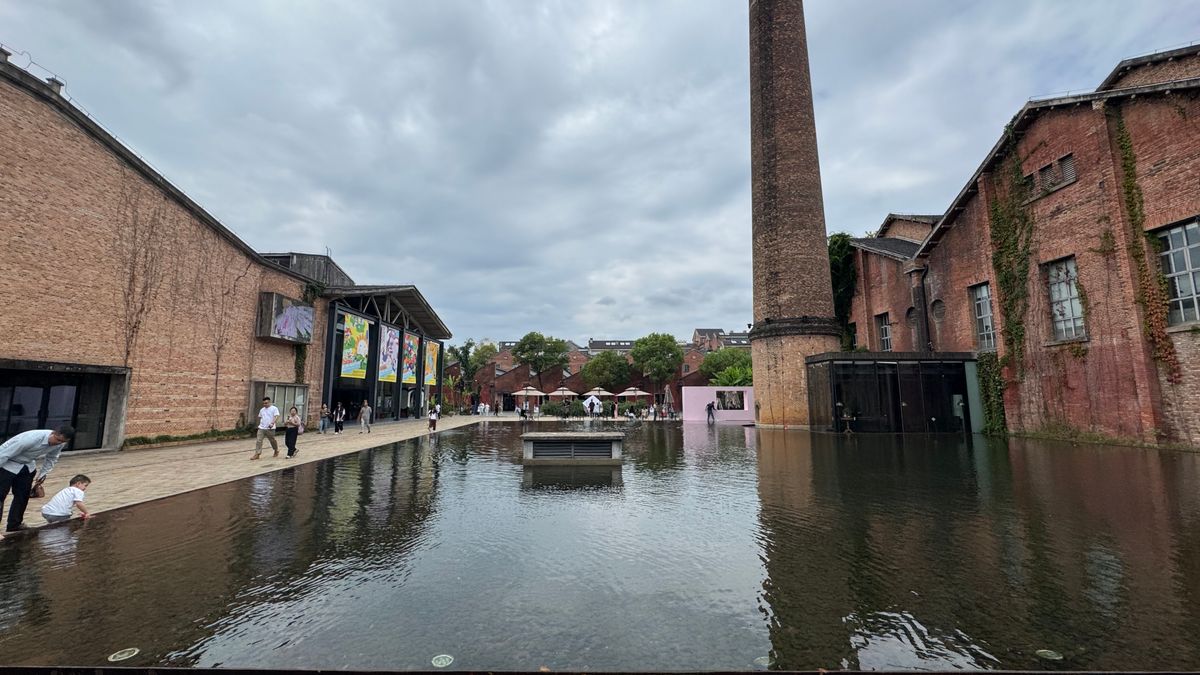
Nobody's first bowl is any good. You centre the clay, or you think you have, and the moment your thumb goes in the whole thing starts wobbling like a hubcap coming loose. The teacher reaches over, puts two wet hands on top of yours, presses down, and it steadies. Then they let go and it wobbles again. That's the afternoon: forty minutes of failing, ten seconds of it working, and a slightly lopsided cup that you'll drink out of for the next decade.
That is what this itinerary is built around. Plenty of Jingdezhen plans read like a museum checklist. This one treats the museums as the warm-up and the wheel as the main event, because the wheel is the thing people remember — and because getting a piece made, fired and shipped home takes planning that no attraction list tells you about.
Who it's for: anyone who likes making things, and travellers who'd rather come home with one object they made than a suitcase of ones they bought. No skill needed. Children manage from about eight with a teacher's hands over theirs; younger ones do better painting a blank. It works from Nanchang as a two-nighter or a three-nighter, and the trains are short enough that you don't lose a day to either end.
The two rules that decide your dates
Before you book anything, understand that Jingdezhen's week has a shape, and fighting it wastes a day.
- The big museums close on Mondays. The Imperial Kiln Museum and the China Ceramics Museum both run Tuesday to Sunday. A Monday in Jingdezhen is a studio day, not a museum day.
- The Taoxichuan creative market runs Friday, Saturday and Sunday, from around 4:30pm into the late evening. Midweek, the yard is quiet and only the permanent shops trade. If the market matters to you — and it should — one of your nights needs to be a Friday or a Saturday.
Put those together and the calendar mostly plans itself:
| You arrive on… | Best shape for the trip |
|---|---|
| Friday | The ideal. Kilns Friday afternoon, market Friday night, museums and your wheel session Saturday, Sanbao Sunday. |
| Thursday | Also excellent. Museums Friday morning while they're empty, market Friday night, studio time Saturday. |
| Saturday | Fine, but busier. Do the market on your first night and hit the museums Sunday morning at opening. |
| Sunday | Front-load: market Sunday evening, museums Tuesday. Spend Monday in Sanbao and at a wheel. |
| Monday | The awkward one. Studios, Sanbao, the Taoyangli lanes and shopping on day one; museums from Tuesday. |
Three things this itinerary doesn't repeat
To keep the days below readable, the reference material lives in one place — our Jingdezhen destination guide, which is where we maintain the ticket prices, hours and fares so they only ever have to be corrected once.
- The background. A thousand years of kilns, the imperial supply chain that made "china" a common noun, and the jingpiao — the tens of thousands of young arrivals who now keep the studios running. The guide tells it properly, including the potter who threw himself into a burning kiln in 1599 and got made a god for it.
- Tickets and hours. They change here more than anywhere else we cover: two of the big museums have gone free-with-reservation, the Ancient Kiln park's list price has moved, and the scenic-area ticket around the imperial kiln site is separate from the museum inside it. All of it moved again on 25 July 2026, when UNESCO's World Heritage Committee, meeting in Busan, inscribed the Jingdezhen Handicraft Porcelain Industry Sites (景德镇手工瓷业遗存) — China's 61st World Heritage property, the first anywhere with porcelain at its centre, covering five areas: the workshop district in town, the Hutian kiln site (湖田古瓷窑址), the Gaoling and Changling raw-material mines, and the Jiaotan firewood district. The city reacted fast — the Folk Kiln Museum out at Hutian scrapped its reservation requirement the day after the vote and reported footfall up around 150% — so assume the town is busier than the older guides suggest. Current figures are in the guide; check them the week you travel.
- Best time of year and the wider loop. Short answer: late September to November, October driest, April–June wet, July–August hot. And Wuyuan is a half-hour train away, which makes the extension obvious. Both are covered in full in the guide and in our 5–7 day Jiangxi loop.
Day 1 — Nanchang to the kilns
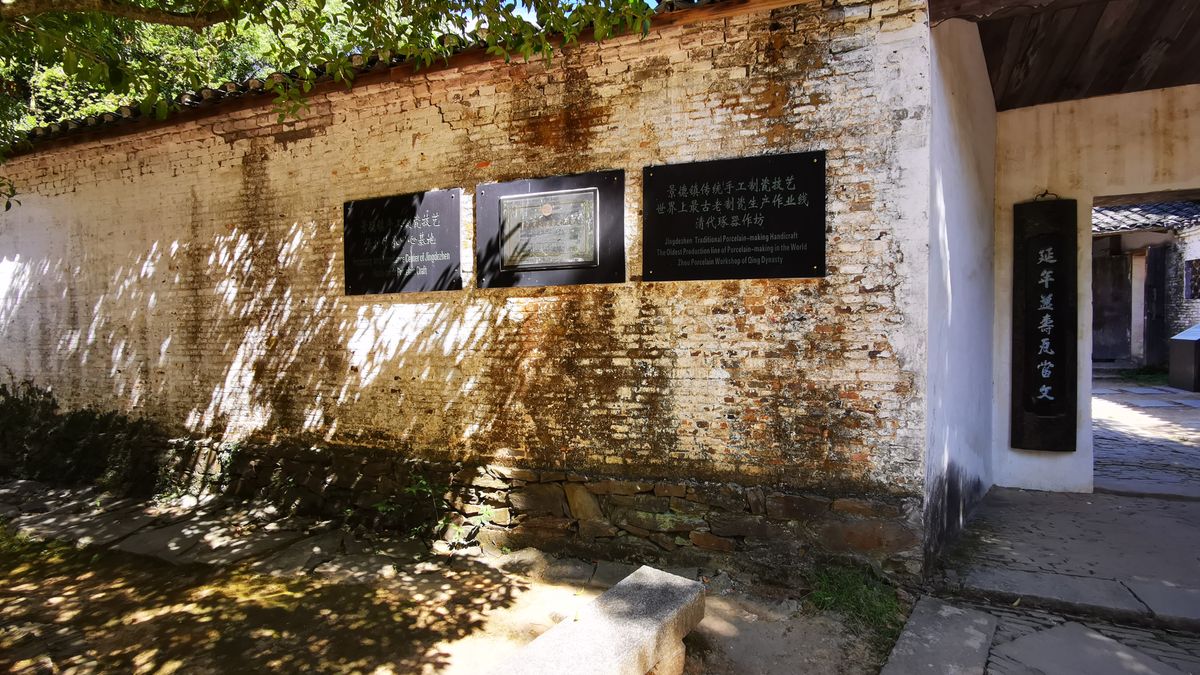
Day 1 sets the reference point: the workshop yard at the Ancient Kiln park, where the plaque on the old brick wall bills the Qing-dynasty Zhen kiln workshop as the oldest porcelain production line in the world. Photo: Liuxingy, "景德镇古窑民俗博览区 古建筑与制造瓷器的窑 01" (CC BY-SA 4.0) via Wikimedia Commons.
Morning — get on an early train. Nanchang East (南昌东) to Jingdezhen North (景德镇北) takes 42 minutes on the fastest services and under an hour on most; there are around 35 a day. Aim to be on something leaving between 7am and 8:30am. Check which Nanchang station you are booked from — the wrong one costs you the better part of an hour. Fares and booking detail are in the destination guide; carry your physical passport for the gate.
On arrival — drop bags first. The station is about 10 km out; a taxi into town takes around 15 minutes. Go straight to your guesthouse, leave your luggage even if the room isn't ready, and start the day unencumbered. You'll be climbing in and out of workshops.
Afternoon — Ancient Kiln & Folk Customs Museum (古窑民俗博览区). Give it two to three hours, and treat it as research rather than sightseeing. What you want from this afternoon is the sequence: watch the thrower pull a bowl off the hump in seconds; watch the trimmer put it upside-down on the wheel and shave a foot ring out of the base; watch the painter lay a cobalt line without a guide. Every one of those people has done only that job for decades. Tomorrow you'll attempt the lot in ninety minutes and understand exactly why your version wobbles.
Late afternoon — pick your project. While it's fresh, decide what you actually want to make. A cup is much easier than a bowl. A bowl is much easier than anything with a neck. If you don't fancy the wheel at all, hand-painting a ready-made blank produces a better-looking object and is genuinely relaxing. Knowing your answer before you walk into a studio saves twenty minutes of hovering.
Evening — Taoxichuan, and book tomorrow. Walk the old factory yard as the studio shopfronts light up. If it's a Friday, Saturday or Sunday you've landed on a market night: get there around 5pm before the crowd thickens. Message or call a studio now and book your session for tomorrow afternoon — weekends fill.
Day 2 — Imperial porcelain in the morning, clay in the afternoon
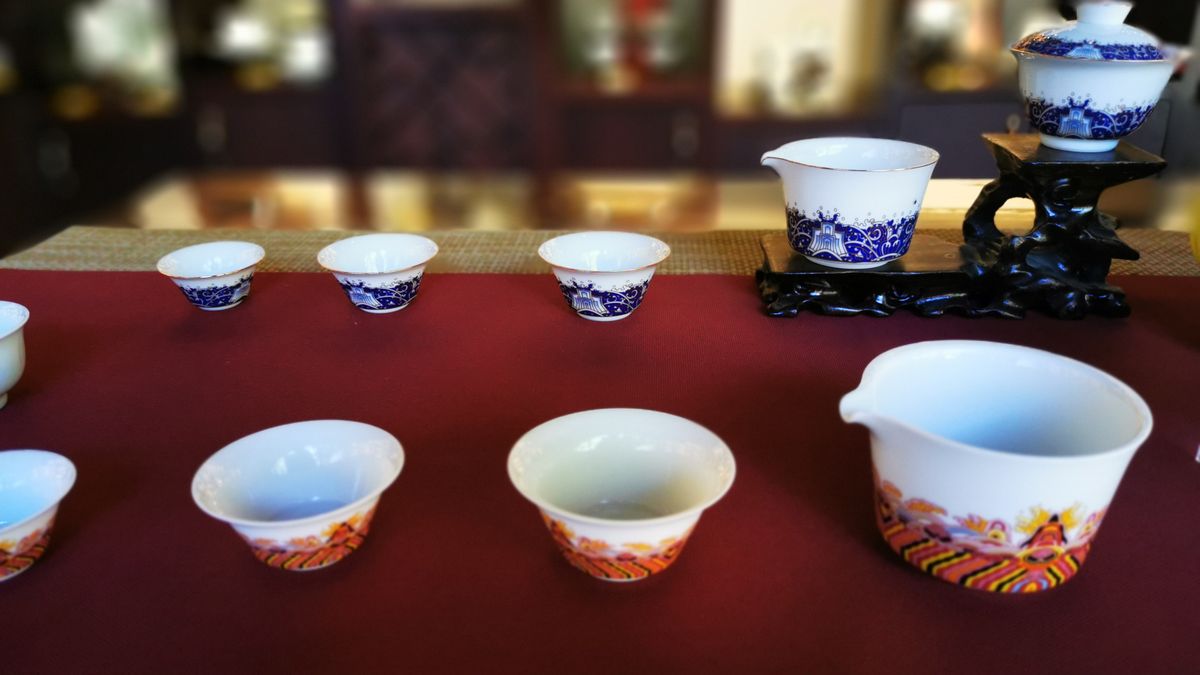
Jingdezhen tea ware on a display table — bright overglaze enamel and gilt rims in the front row, and behind them the blue-and-white idiom you'll be attempting on a blank in a few hours. Photo: Liuxingy, "景德镇古窑民俗博览区 精美瓷器 02" (CC BY-SA 4.0) via Wikimedia Commons.
9am — Imperial Kiln Museum (御窑博物馆) and the Taoyangli lanes. Be there at opening; the brick vaults are best photographed before the room fills. Go looking specifically for the reassembled vessels — the ones glued back together from excavated fragments. Read a couple of their labels and the whole logic of imperial quality control clicks into place, and you'll spend the rest of the day noticing rejects. Afterwards, give the surrounding lanes half an hour on foot; the Xujia kiln (徐家窑) stands at the end of one of them. Note the museum needs an advance reservation slot and is closed Mondays.
11:30am — lunch, then a choice. If you're a museum person, add the China Ceramics Museum (景德镇中国陶瓷博物馆) — the big collection, six floors of it, and home to the small clay figure the Chinese internet nicknamed the "speechless bodhisattva." It also needs a booked slot and a physical passport, and it also closes Mondays. If you're not, skip it and go shopping in the Taoxichuan permanent shops instead. Don't try to do both plus the studio; you'll be rushing the part you came for.
2pm — your session. Block out two to three hours door to door for what is usually a ninety-minute session; the rest is getting there, changing, waiting for a wheel and settling up. This is the heart of the trip and it gets its own section below.
Evening — market or lanes. On a market night, go early, walk the whole yard once without buying, then double back for the three stalls you can't stop thinking about. Everything on sale was made by the person selling it, so ask — most makers will tell you what kiln fired it and what the glaze is. Midweek the yard is quiet: walk the Taoyangli lanes after dark instead and eat where the noise is.
Day 3 — Sanbao, then home
Morning — out to the Sanbao valley. Leave by 9am and don't try to combine it with anything else. No bus goes there, so take a taxi and ask for Sanbao Peng Art Centre (三宝蓬艺术中心); it's a twenty-minute ride from the Taoxichuan side of town, and there's a shuttle buggy that saves you walking the length of the valley. What Sanbao is, and why it's different from the city studios, is in the destination guide.
What you do here: book the longer, slower workshop you didn't have time for yesterday. Half-day and full-day formats are the norm in the valley, the studios are working ones rather than tourist-facing, and the teaching is better because nobody is queuing behind you. Then eat — the valley's cafés are the best lunch of the trip and the one hour that feels like a holiday rather than a field trip.
Afternoon — settle your piece, then go. Before you leave town, go back to the studio (or message them) and confirm three things in writing: that they have your shipping address correctly, what the courier fee will be, and roughly when to expect it. Then taxi to Jingdezhen North and take the ~45-minute train back to Nanchang East. Services run into the evening, so a 5pm or 6pm departure is comfortable.
Monday variant: swap Days 2 and 3. Sanbao and your studio session on the Monday, museums on the Tuesday morning before your train.
Your hands on the clay: what actually happens
This is the part every other Jingdezhen article waves at and doesn't explain. Here's the whole thing.
Pick a format before you pick a studio
- Wheel throwing (拉坯) — the classic. Roughly an hour to ninety minutes at the wheel, one lump of clay, one or two survivors. Basic sessions have commonly run around ¥80–150 including instruction, clay and firing, with cheap street-side studios in the Sculpture Factory and Sanbao areas doing a full throw-glaze-fire go for as little as ¥30–60. Messy: wear something you don't care about, roll your sleeves properly, take your rings off.
- Painting a blank (彩绘) — a bisque-fired cup, plate or vase and a pot of cobalt. Around ¥50–100, an hour, no mess, and the finished object usually looks better than a beginner's thrown one. The right choice for small children, for anyone with a bad back, and for the sceptic in your group.
- Hand-building / sculpting (捏塑) — no wheel, no coordination required, oddly meditative. Often bundled into the same price as a basic session.
- Half- or full-day course — ¥200–400 gets you the full arc: throwing, then trimming, then decorating and glazing, rather than handing your wet pot to a stranger and walking away. If ceramics is why you came, this is the one to book.
- Multi-day residencies — Sanbao and a handful of guesthouses run immersive programmes of several days with accommodation included, historically in the ¥1,500–2,800 range per person. Book these weeks ahead by message, not on arrival.
Prices move and vary hugely between a tourist-facing studio and a working one, so treat every figure above as a band. Some guesthouses include a free basic session for guests — worth asking before you book a bed. And ask one question before you pay: is firing included, and is shipping included? The answer is usually yes to the first and no to the second.
The five stages your pot has to survive
You leave after stage one. The rest happens without you, which is why the object arrives weeks later.
- Throwing and trimming. Your ninety minutes. On a longer course you come back the next day to trim the leather-hard piece and cut the foot — the stage that turns a lump into an object.
- Drying. One to three days in open air. Rushing this cracks pots, which is why nothing can be fired the same day.
- Bisque firing. A low burn at roughly 800°C to harden the clay so it can take glaze without collapsing.
- Glazing. Dipped or poured, then wiped clean at the foot so it doesn't weld itself to the kiln shelf.
- The high firing. Around 1,300°C, one to two days including the cool-down. This is where the glaze turns to glass, the piece shrinks, and the colour you painted in dull grey oxide comes out blue.
Ask what happens if it cracks. Kiln losses are real and studios differ: some re-fire a replacement, some refund the firing fee, some shrug. A studio that answers the question straight is a studio worth using.
Getting it home
- Timeline: from the day you finish, allow 7–15 days before it ships, and roughly two to three weeks door to door within China. Sanbao and the outlying villages tend to run at the slower end, nearer 20 days.
- Cost: domestic courier is normally paid by you on receipt, historically around ¥15–25 within eastern China, ¥25–35 to the north or south, and ¥40–60 or more to the far west.
- Packing: the standard here is bubble wrap, a foam box and a thick outer carton, sent by SF Express or Deppon. Breakage rates are low — this town has been posting porcelain for a very long time.
- The overseas catch: most small studios ship domestically only. If you're flying home, the realistic options are to give them a Chinese address you'll still be at (a later hotel, a colleague, a friend), or to have it sent to a forwarding service. Sort this out before you pay, not on the last morning.
- Carrying it yourself: only workable if you're staying in China long enough for the firing, and only in hand luggage. Do not check a hand-thrown pot.
Two days or three?
- Two days (one night) — Day 1 as written, then on Day 2 do the Imperial Kiln Museum in the morning, your session at lunchtime, and a late-afternoon train home. Tight but real: you get the kilns, the imperial history and your own pot. Skip the China Ceramics Museum and Sanbao.
- Three days (two nights) — the version above, and the one to pick if making things is the point. It buys you Sanbao, a longer workshop, a market night without watching the clock, and enough slack that a rainy morning doesn't wreck the plan.
- One day only? Still worth it: early train, Ancient Kiln park, Taoxichuan, home for dinner. You'll miss the museums and the studio. The day-trip version is set out in the Jingdezhen destination guide.
- Adding a fourth day? Take the half-hour train to Wuyuan rather than stretching Jingdezhen — the city gives up its secrets in three days, and the villages are a genuine change of scene.
Where to sleep and eat on this plan
Sleep near Taoxichuan. For this specific itinerary it's the correct call: you're walkable to the market, the evening food and the studio cluster, and taxis to everything else are ten minutes. Sanbao guesthouses are lovelier but you'll spend the trip in cars. The full area-by-area breakdown and price bands are in the destination guide.
Eat the cold rice noodles. Jingdezhen's lengfen (冷粉) is a fat, cool, pickle-heavy rice noodle and the standard local breakfast — a good one costs less than a coffee. Ask your guesthouse which stall they use rather than trusting a review app. The full food rundown, including the steamed dumpling cakes you'll want on the morning of Day 2, is in the guide; if you're arriving from the provincial capital, our piece on Nanchang rice noodles explains what's different about the version you already know.
Practical notes for the days themselves
- Book two things in advance, earlier than you would have needed to a year ago: your museum slots and your studio session. Individual slots for the China Ceramics Museum open about five days out on the official WeChat mini-programme, and since the World Heritage listing the good ones go quickly — book the hour the window opens rather than the night before, and treat weekends and public holidays as full unless the app tells you otherwise. Studios take bookings by message; weekends fill there too.
- Carry your physical passport. It's your train ticket ID and the museums will not accept a photo or a photocopy.
- Set up Alipay or WeChat Pay before you arrive. Market stalls, taxis, noodles — all of it. Cash is awkward here.
- Wear the right clothes on studio day. Clay does not fully come out of good fabric. Short sleeves or sleeves that roll above the elbow; closed shoes.
- Pack tissues. Public toilets at attractions rarely stock paper.
- Leave room in the bag. Even with a piece shipped, you'll buy things at the market. A folded soft bag weighs nothing and solves the problem.
- Rain plan: museums, the Ceramics Museum's six floors and a studio session are all indoors. Only Sanbao and the market really suffer.
Frequently asked questions
How many days do you need in Jingdezhen?
Two nights is the sweet spot for a ceramics-focused trip: kilns, both museums, a proper hands-on session, a market night and Sanbao. One night covers the essentials and your own pot. A single day works from Nanchang but drops the museums and the studio time.
Can a complete beginner throw a pot in Jingdezhen?
Yes — that's most of the customers. A basic wheel session assumes zero experience, a teacher steadies the clay when it goes wrong, and you'll usually get one keepable piece out of an hour or so. Children from about eight manage with help; younger ones are happier painting a blank.
How do they send your pottery home, and how long does it take?
The studio dries, bisque-fires, glazes and high-fires your piece over roughly one to two weeks, then packs it in bubble wrap, foam and a carton and sends it by courier, with you paying the delivery fee on arrival. Two to three weeks door to door within China is normal. Most small studios don't ship internationally, so arrange a Chinese address or a forwarder before you leave.
Do I have to visit on a weekend?
Only if you want the Taoxichuan market, which runs Friday to Sunday evenings — and it is one of the best things in the city, so most people should. Midweek is quieter at the museums and easier for booking studio time, and the permanent Taoxichuan shops trade every day.
Is it worth adding Wuyuan or Sanqingshan?
Wuyuan is about half an hour by direct train from Jingdezhen North and pairs beautifully — villages and terraces after three days of workshops. Sanqingshan takes most of a travel day to reach and deserves its own two nights. Both are mapped out in the 5–7 day classic Jiangxi loop.
Have us build it
Want this trip on your dates, with a studio booked at your skill level, a room that's actually walkable to the market, and the shipping sorted before you land — or extended into a northeastern Jiangxi loop? Plan this trip with us. If you're starting from scratch in the provincial capital, pair it with 2 days in Nanchang.
Images: "景德镇古窑民俗博览区 古建筑与制造瓷器的窑 01" and "景德镇古窑民俗博览区 精美瓷器 02" by Liuxingy (CC BY-SA 4.0); cover "Taoxichuan 20241019" by Simon Wade (CC BY-SA 4.0) — all via Wikimedia Commons.
Last verified: 2026-08 — train times, museum hours and closed days, market days, workshop prices and shipping costs all change. Studio prices in particular vary widely between businesses; treat every figure here as a band and confirm when you book.