2 Days in Nanchang: The Perfect Itinerary
A practical 2-day Nanchang itinerary for first-timers and business travellers: Tengwang Pavilion, old town, the fountain show, museums & local food.
By Hello Nanchang · Last updated
Nanchang, Jiangxi Province, China · 2 days · ideal for first-timers and business travellers with 1–2 spare days
Two days, and why the order matters
Most people arrive in Nanchang knowing one thing: there's a famous tower. Two days later they leave able to name three dishes, argue about chilli, and describe the moment a whole skyline switches on across a river. The difference is sequencing. River and old town on day one, treasure and market on day two, both nights outdoors — do it in that order and the city unfolds neatly. Do it backwards and you'll be standing outside a closed museum on a Monday, or on an empty west bank on a Tuesday wondering where the fountain went.
This plan is for two kinds of visitor: the first-timer who wants the best of the city without wasted metro rides, and the business traveller who has bolted a spare day onto a work trip. It assumes you're staying centrally, you're happy on the metro, and you're not renting a car.
The honest pitch: Nanchang isn't a polished tourist city, and that's the appeal. Nothing here has been softened for foreign visitors, you'll rarely hear another English speaker, and breakfast costs less than a bottle of water at Shanghai Hongqiao. What it has is a 1,300-year-old literary landmark on a river, the place the People's Liberation Army was born, a free museum holding the richest Western Han burial ever excavated in China, and a riverbank that performs nightly.
Before you go — sort these at home
- Alipay or WeChat Pay with a foreign card linked. You'll pay for everything by QR — noodles, metro gates, museum bookings. Binding a foreign card can take anywhere from an hour to a couple of days to clear, so don't leave it for the airport. Carry about ¥200 in cash for the oldest stalls.
- A VPN, installed and tested at home. Google, Gmail, WhatsApp and Instagram don't work on local networks.
- DiDi (ride-hailing) and Apple Maps. Inside China, Apple Maps runs on local AutoNavi data, is accurate for Nanchang and downloads offline; Google Maps doesn't work. Amap / 高德 is worth adding as well — it knows every metro exit by letter — but its interface is mostly Chinese.
- Your passport, on you, daily. Hotel check-in, train gates and museum entry all run on real-name registration. A photo on your phone won't do.
- Two free museum bookings. The Jiangxi Provincial Museum and the August 1st Uprising Memorial Hall both cap daily numbers and want an advance real-name reservation. Five minutes the night before saves a closed door.
- Clothes for the season. Late September to early November is the sweet spot. Summer is punishing — Nanchang is one of China's "furnace" cities — though the night markets are at their best then. Winter is cold, damp and largely without indoor heating.
The scheduling rule that decides this itinerary: most Chinese public museums close on Mondays. If your two days include a Monday, swap the days round and put the indoor sights on the other one.
Day 1 — the river, the poem and the lantern lanes
Day one is the east bank, worked west to east: the tower, the old lanes, the hall where the People's Liberation Army was born and the square named after the same date, then a crossing back to the west bank at dusk. A few short hops on Line 1 and a lot of walking.
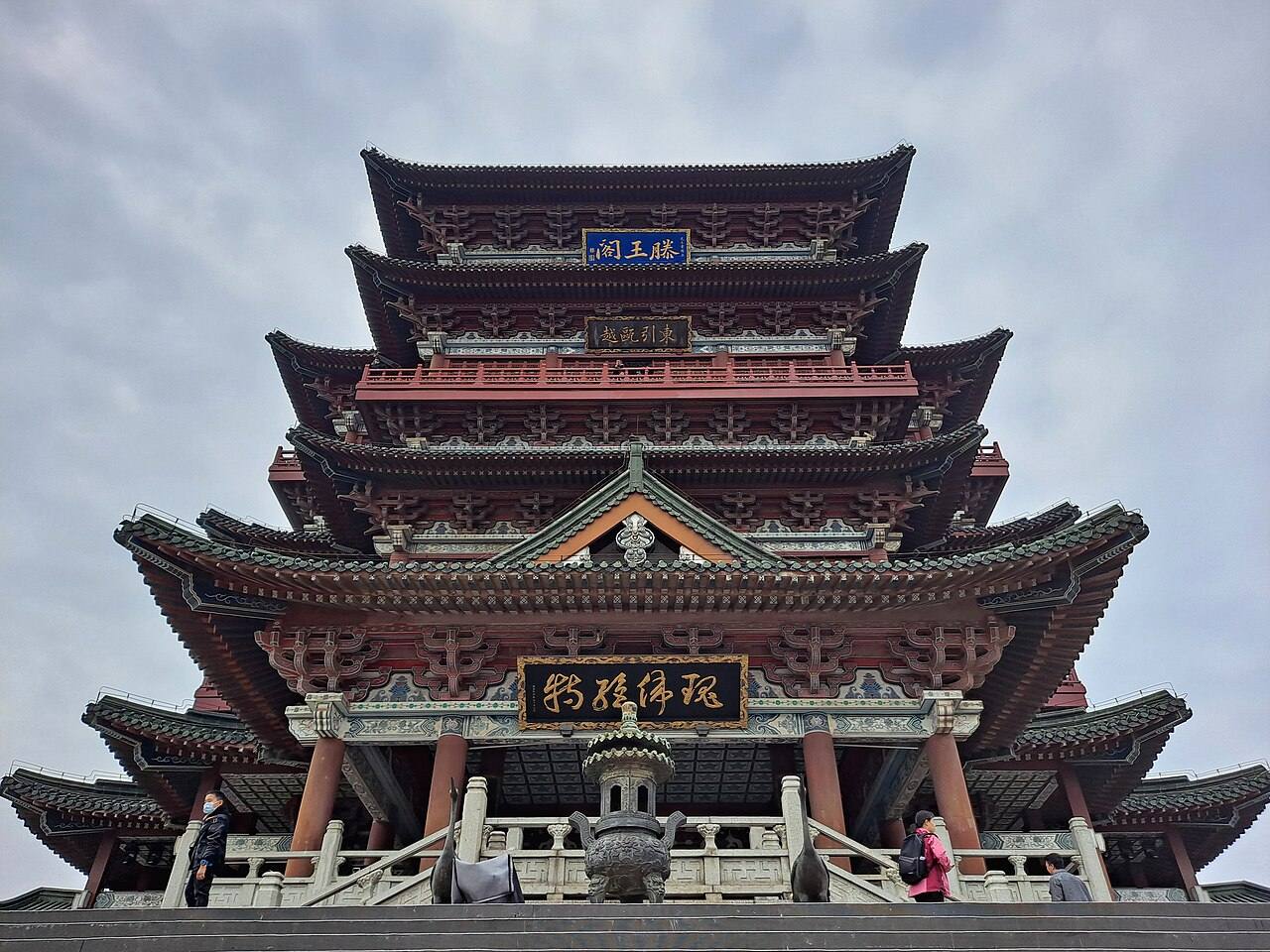
Morning · Tengwang Pavilion (滕王阁), 1.5–2 hours
Ride Metro Line 1 to Tengwangge (滕王阁) Station and leave by Exit 2; the tiered roofs come into view within a few minutes' walk toward the water. Go early — the ticket queue and the stair traffic both thicken by mid-morning.
The story that makes the climb worth it: in the 670s a poet named Wang Bo, barely into his twenties, turned up at a banquet the governor was hosting here. The governor had already arranged for his son-in-law to produce the commemorative preface as if improvised, so when paper and brush went round the room, every guest politely declined. Wang Bo took them. The governor stalked off behind a screen in a temper — then couldn't help himself, and sent a servant to relay each line as it was written. The opening was conventional and he scoffed. Then came the line about the setting sun and the lone wild duck flying together, the autumn waters sharing one colour with the sky, and he said nothing at all.
Practically: the adult day ticket has been running around ¥50, a little less booked online a day ahead, with daytime visiting roughly 08:00–18:00. The trap is the evening — after dark the grounds reopen only for holders of a separate, pricier night-show ticket, so "climb at sunset and stay for the show" needs two tickets, not one. Entry is by timed slot and real-name booking, and the app doesn't always accept foreign passports: bring the physical one and be ready to buy at the window. Full detail in our Tengwang Pavilion guide.
Midday · Wanshou Palace (万寿宫), lunch on your feet
One stop along Line 1 to Wanshougong (万寿宫) Station and you surface underneath the block itself — Chinese signage routes you out of Exit 1, some English listings say Exit 3, so follow the in-station signs for the historic quarter. The lanes are free and open around the clock; shops and stalls run roughly 10:00–21:00.
Don't sit down for lunch here. Graze: a bowl of banfen at one counter, a pot of clay-pot soup at the next, a white sugar cake from the fryer for about ¥1, eaten standing up while it's still too hot. Come back after dark if you can — the lanes glow red with lanterns, and an evening light-and-hologram show on the main square retells the founding legend, in which the Daoist master Xu Xun subdues a flood-dragon. Stall-by-stall notes: our Wanshou Palace guide.
Afternoon · the Uprising Memorial Hall, then Bayi Square (八一广场)
Keep walking. The August 1st Nanchang Uprising Memorial Hall stands at 380 Zhongshan Road, five minutes on foot from the Wanshou Palace lanes — the two sit almost back to back, which is why you do them in this order. It is the reason this city has a number for a name. Before dawn on 1 August 1927, with the alliance between China's two great parties in pieces, a group of commanders launched an armed uprising here and held Nanchang for a few hours. That date became the founding day of the People's Liberation Army, and the "八一" on the railway station, the square and the Ferris wheel all point back to it. Entry is free but needs advance real-name booking through the museum's WeChat or Alipay mini-programme — and foreign passports are accepted, which isn't true everywhere. Closed Mondays; opening has been running roughly 9:00–17:00, last entry around 16:30 (some listings show extended evening hours in peak season, so check when you book). Allow 1.5–2 hours. Coming straight here rather than from lunch? The hall has a metro stop named after it: Bayiguan (八一馆) Station, where Lines 1 and 3 cross under Zhongshan Road.
Still light out? Shengli Road Pedestrian Street (胜利路步行街) runs about 960 metres north from Zhongshan Road, starting a couple of minutes from the hall — a century-old commercial strip, now chain stores and snack shops, and the easiest place to replace whatever you forgot to pack.
Finish on the square, and don't underestimate the gap: Bayi Square is about 1.5 km east of the memorial hall, so reckon on twenty minutes along Zhongshan Road on foot, or one stop on Line 1 from Bayiguan to Bayi Square Station, the Line 1 / Line 2 interchange, with exits directly onto the plaza. The square is free and open all hours; our Bayi Square guide explains why the granite monument, the star-topped hall and the evening crowd of dancing aunties add up to the most Chinese hour of your trip. There is no daily flag ceremony at a fixed time, whatever you've read.
Evening · cross the river, and let it switch on
This is the night that sells the city. Take Line 1 west to Qiushui Square (秋水广场) — the tunnel runs straight under the Gan from Tengwang Pavilion station to the west bank, no changes — and surface facing back at the old town. The arc, in order:
- Arrive around 18:30–19:00, while there's still colour in the sky, and walk the boardwalk through Ganjiang Citizen Park.
- Watch the switch-on. The Honggutan towers light nightly from roughly 19:10 until about 22:30, and the synchronised sequences hold a Guinness record for the most buildings in a permanent light-and-sound show — 293 of them certified. The biggest animation, on the tallest twin towers, tends to be a Friday and Saturday thing rather than nightly.
- Time it for the fountain if you can. Qiushui Square's musical fountain is free and runs nightly: two shows of roughly 15 minutes around 7:30pm and 8:30pm, cancelled in thunder, heavy rain, strong wind or fog. Check the same day — ask your hotel, or see our Qiushui Square fountain guide.
- Fill the gap between shows by walking the water's edge — free, and the best thing here anyway. Don't try to squeeze in the "Star of Nanchang" Ferris wheel: it is about 5 km away, a metro change plus a walk or a 15-minute taxi each way. Give it an evening of its own (recently around ¥50 for adults, one rotation about half an hour).
- Eat late, on the way back. Dinner is a xiaochao place near your hotel: point at the display fridge, order three dishes and rice, let the wok do the rest.
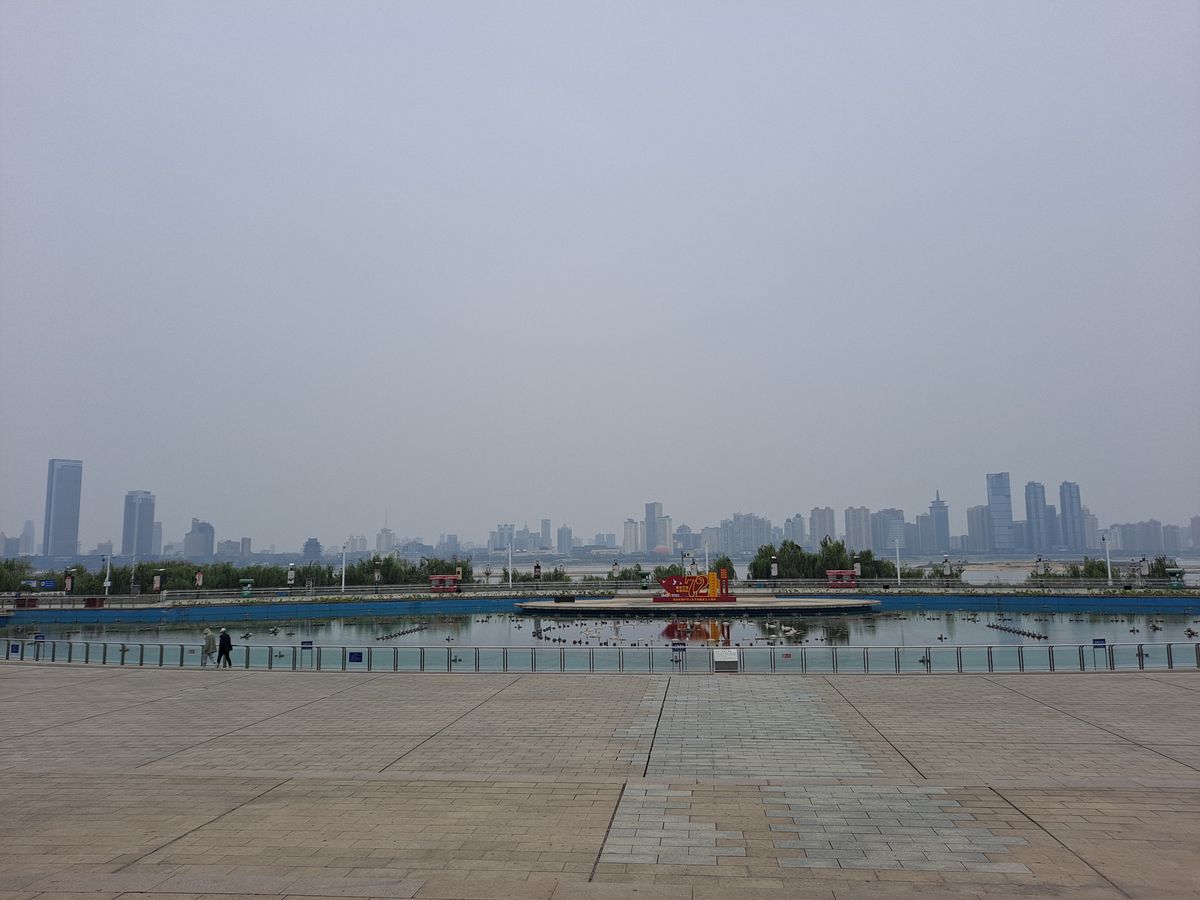
Qiushui Square on the west bank — free to walk by day, and where the crowds gather once the skyline lights up after dark. Photo: 钉钉 / Wikimedia Commons (CC BY-SA 4.0).
Midweek, with no fountain? The lit skyline still runs and the boardwalk is still free; an evening Gan River cruise from the Tengwang Pavilion pier loops the illuminated stretch in about an hour for roughly ¥80–170 a head. Vantage points on both banks are mapped in our One River, Two Banks guide. And watch the last train — the last trains leave the termini around 22:30, and closer to 23:00 on Fridays, weekends and holidays — but your own station's last train comes earlier, so read the time posted on your platform. Stay for the late show and you're taking a DiDi.
Day 2 — buried treasure, pagoda smoke and a night market
A slower shape than day one: one long indoor stop, one old quarter, and a lot of eating.
Morning · Jiangxi Provincial Museum, 2–3 hours
Free, air-conditioned, mostly bilingual, and the best two hours you'll spend indoors in Jiangxi. The headline is the Han-dynasty Haihunhou hoard — the tomb of a marquis who was briefly emperor for 27 days, and the richest, best-preserved Western Han aristocratic burial ever excavated — alongside a thousand years of Jingdezhen porcelain. Entry is free but generally needs a timed slot booked in advance with your passport through the official 江博预约 mini-programme; it runs Tuesday to Sunday, roughly 9:00–17:00, no entry after 16:00, closed Mondays. It's in the Honggutan Cultural Centre: a DiDi is easiest, or take Line 1 to Qiushui Square and walk north along the river. What to look for first: our Provincial Museum guide.
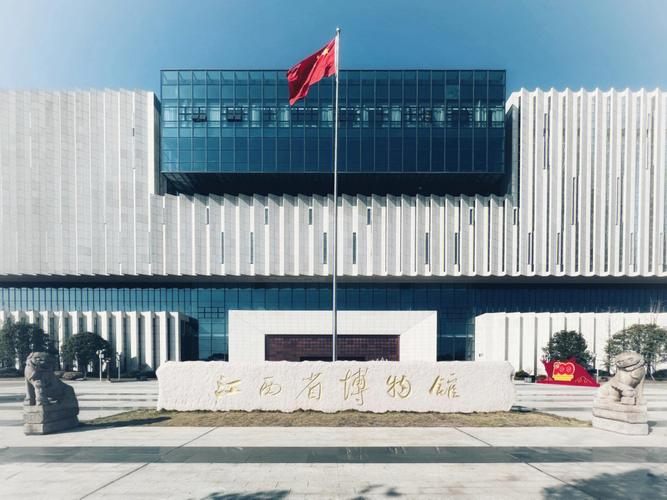
The Jiangxi Provincial Museum in Honggutan — free entry, but book a timed slot with your passport first.
Lunch · Shengjin Tower (绳金塔) food street
Come up from Shengjinta (绳金塔) Station, Exit 3 — an interchange on Lines 3 and 4 — and old Nanchang arrives fast: a brick-and-timber pagoda, a temple courtyard, and a hundred-odd food vendors packed around them. Most plates land between ¥5 and ¥12. The historical-cultural street is free to wander; access to the tower and compound itself can vary, so read the on-site signs. Allow an hour and a half, and see our Shengjin Tower guide for the stall-by-stall walk.
Afternoon · pick exactly one
- Buried treasure, properly. The Haihunhou Tomb Site Museum in Xinjian district shows the marquis's tomb in full. It's a genuine half-day — DiDi out, 2–3 hours inside, recently around ¥60, real-name booking required — so take it instead of everything else this afternoon.
- The photographer's option. Fish Tail Park (鱼尾洲公园) — Metro Line 4 east to Yuweizhou Station (鱼尾洲站), the line's outer terminus and named after the park, then follow the signs. Free, un-gated: a wetland of pond cypress standing in water, threaded with white minimalist bridges. Late November to early December the trees turn rust-red and mirror perfectly.
- The lazy option, and a good one. Stay on the river, or duck into a Honggutan mall if it rains — the MixC is the glossy one. Two days of sightseeing in a hot city earns you an afternoon of nothing.
Evening · the night market
Nanchang eats late and outside, and this is the meal you'll remember. Two choices, both best after 8pm:
- Hama Jie (蛤蟆街) — the old one. Officially Yuzhang Houjie, a 330-metre strip in Donghu district a short walk from Tengwang Pavilion, and the city's original late-night canteen. Forty-odd stalls, most things ¥5–30. Order the stir-fried river snails (炒螺蛳) — you suck them from the shell, and yes, it takes a couple of tries — plus beef fried noodles (牛肉炒粉) and a fistful of skewers.
- Zijing Night Market (紫荆夜市) — the big one. More than a hundred stalls out near the university campuses in the Jingkai zone, under tidy red canopies, food from all over China, prices like a ¥5 bowl of liangpi. Further out; worth it if you've got a serious appetite.
Pay by phone, keep a little cash for the smallest carts, and order small from several stalls rather than committing to one. More in our night markets guide.
Flying out the same night? Changbei Airport (KHN) is about 28 km north: reckon on 30–45 minutes by taxi or DiDi in normal traffic, 45–60 minutes on the ¥15 airport shuttle, or an hour-plus on Metro Line 1, which now reaches Terminal 2 but is a city line, not an express. Which door to use, and how to reach each: our airport and stations guide.
What to eat over two days, and what it should cost
Eating is the main event here rather than a break between sights, and a full day of it costs less than one mid-range dinner in Shanghai. This is Gan cuisine (赣菜) — fresh chilli used as a vegetable rather than a seasoning, tea oil and lard instead of neutral oil, wok heat pushed until the food carries smoke. Say 少辣 (shǎo là) for less, 不辣 (bù là) for none. Even "less" is a workout.
- Banfen (南昌拌粉) — round rice noodles boiled, rinsed cold so they stay springy, then tossed dry with chilli oil, soy, pickled radish, mustard greens, peanuts and scallion. Breakfast, best 6–9am. About ¥3–6 plain, ¥8–12 with beef. Start here. It arrives cool rather than steaming — that's correct, not a mistake. (Full story.)
- Clay-pot soup (瓦罐汤) — small sealed earthenware pots slow-cooked seven hours or more inside a charcoal-heated urn. Breakfast and lunch, always beside the noodles; locals call the pairing 一粉一汤, one noodle and one soup, and ordering noodles alone gets you a look. Not spicy at all. About ¥5–10 a pot, or ¥10–15 for noodles and soup together. Point at 鸡蛋肉饼汤 (pork cake with an egg) if you can't choose. Safe for everyone.
- Stir-fried pork with green chilli (青椒炒肉) — the benchmark xiaochao dish: pork belly, whole sliced green chillies, fermented black beans. Lunch or dinner, medium-hot, typically ¥28–38. If a restaurant can't do this one well, leave.
- Three-cup chicken (三杯鸡) — a Jiangxi classic from Ningdu: bone-in chicken simmered with a cup each of rice wine, soy and sesame oil, finished with basil. Mild, typically ¥48–78. The order for anyone spice-shy.
- Fried rice noodles (南昌炒米粉) — the same noodle thrown into a screaming wok until it's oil-bright and smoky. Breakfast, or more often a late-night supper. ¥8–15 at a street counter, ¥15–25 as a restaurant plate. Ask for the beef version, 牛肉炒粉.
- White sugar cake (白糖糕) — fried glutinous discs dusted in sugar, crisp then chewy, around ¥1 each. Eat it immediately, burn your mouth, buy another. (More here.)
A full xiaochao dinner — three or four dishes plus rice for two — runs about ¥50–65 a head even in a busy city restaurant. Do ask for the rice (米饭, usually ¥1–3 a bowl); it doesn't always arrive by itself. The whole menu, meal slot by meal slot, is in what to eat in Nanchang.
Where to stay
Nanchang is compact enough that you won't ruin the trip with the wrong choice, but the bases differ. Whichever you pick, get within a few minutes' walk of a metro station — that's the difference between a five-minute hop and a twenty-minute crawl on Bayi Avenue at 6pm.
- Donghu / Bayi Square — the default. Dead central, on the Line 1 / Line 2 interchange, walkable to Wanshou Palace, the Uprising Memorial Hall, the shopping streets and (at a push) Tengwang Pavilion. The base this itinerary is written around, and the right call for a work trip: dinner is ten minutes after you close the laptop. The trade is noise and older buildings.
- Honggutan — the modern one. The new west-bank district: international-brand hotels, wide streets, the Provincial Museum nearby, the fountain and lit skyline on your doorstep. Better rooms for the money and quieter at night. The trade is that the old town is a river away, so day one starts with a metro ride.
- Beside a station — the stopover option. Arriving late and leaving early? Nanchang Railway Station is central, about 3 km from Bayi Square and on Line 2 — better than a taxi at dawn. Nanchang West is the busier high-speed hub but sits roughly 15 km southwest: fine for a train, a long way from dinner.
Two notes. Bring the physical passport to check in — it's registered, not glanced at. And some smaller local hotels aren't set up to register foreign guests, so an international booking platform or a mid-range chain saves an awkward conversation at 11pm.
When the plan breaks — Mondays, rain and short versions
- One day only. Tengwang Pavilion in the morning, Wanshou Palace for lunch, the Uprising Memorial Hall in the afternoon, Qiushui Square at dusk. Skip the Provincial Museum with regret.
- One evening only — the classic business-trip situation. Line 1 to Qiushui Square by 19:00, walk the boardwalk, watch the switch-on, eat noodles near your hotel. Two hours, one line, no tickets.
- It's a Monday. Both museums are shut. Flip to the outdoor version — pavilion, lanes, riverfront, night market — which is mostly free anyway.
- It's raining. The Provincial Museum absorbs three happy hours, and clay-pot soup was invented for exactly this weather.
- You've got kids. The Ferris wheel, the fountain, Fish Tail Park's boardwalks and night-market skewers do most of the work; our Jiangxi with kids itinerary takes it further.
- You're coming for the weekend from Shanghai, Hangzhou or Guangzhou. Same city, different rhythm — train times, which station to book, and a Friday-night-to-Sunday shape are in our Nanchang weekend by high-speed rail.
Got a third day? Take the train to Jingdezhen
The obvious add-on is the porcelain capital, and it's close: high-speed trains from Nanchang East (南昌东) reach Jingdezhen North in a little over 40 minutes. Go early, do the Ancient Kiln & Folk Customs Museum and the Taoxichuan art district, throw a pot if you fancy it, and be back for dinner. The Imperial Kiln Museum closes Mondays — on a Monday, lean into the kilns, studios and markets instead. Full plan: our Jingdezhen ceramics trip, and the wider province in the 5–7 day Jiangxi loop.
Practical info at a glance
- Getting around: Metro Line 1 links the airport, Tengwang Pavilion, Bayi Square, Qiushui Square and Honggutan; Line 2 links all three railway stations. Fares about ¥2–7, paid by Alipay/WeChat QR at the gate, signage bilingual throughout. (Metro guide.)
- How long: two full days covers the city; a third lets you add Jingdezhen or the Haihunhou site.
- Book ahead: Provincial Museum and Uprising Memorial Hall (free, real-name, passport accepted); a Tengwang Pavilion timed slot; the separate night-show ticket if you want the pavilion after dark.
- Language: minimal English outside hotels and the metro. Amap, a translation app and pointing carry you through everything here.
- Good for: first-timers, business travellers, food travellers, anyone who prefers a working city to a preserved one. Less good for: travellers who need English menus, spice-averse eaters with no backup plan, and anyone expecting an intact old town — Nanchang's history survives in fragments, not one walled quarter.
Want it booked rather than planned? We can line up the reservations, a guide for the red-history morning, or a Jingdezhen add-on — plan this trip with us. More routes in our Jiangxi itineraries, and the city in full in the Nanchang destination guide.
FAQ
Is two days enough for Nanchang?
Yes, for the city itself. Two days covers Tengwang Pavilion, the old lanes, the Uprising Memorial Hall, the Provincial Museum, the riverfront show and a proper night market without rushing. A third day is only worth adding if you spend it out of town — Jingdezhen is a little over 40 minutes by high-speed train from Nanchang East.
What's the one thing I shouldn't miss?
The riverfront after dark. Tengwang Pavilion is the landmark and worth the ticket, but the free hour on the west bank at Qiushui Square — the whole Honggutan skyline animating across the water, and a musical fountain in front of it — is what people describe when they get home.
Do I need to book museum tickets in advance?
For the Jiangxi Provincial Museum and the August 1st Uprising Memorial Hall, yes. Both are free, both cap daily numbers, and both use real-name advance booking through their official mini-programmes — foreign passports are accepted. Do it the night before. Both are closed Mondays.
How spicy is the food, really?
Jiangxi cooking is among the hottest in China, and unlike Sichuan's numbing heat it's straightforward fresh-chilli fire. Ask for 少辣 and it will still be warm work. The reliable non-spicy orders are clay-pot soup, three-cup chicken and steamed pork with rice flour.
Is Nanchang easy without Chinese?
Easier than you'd think. Metro signage and announcements are bilingual, payment is by QR code, DiDi handles addresses for you and museum labels are largely bilingual. Restaurants mostly aren't — a translation app and a willingness to point at the display fridge solves that.
Cover: "Pavilion of Prince Teng1" by 钉钉 (CC BY-SA 4.0), via Wikimedia Commons. Inline photos credited in their captions.
Last verified: 2026-08 — transit times, prices, opening hours, booking rules and the fountain schedule change often; please double-check official sources before you travel.