Fish Tail Park Nanchang: A Sponge City
Nanchang's Fish Tail Park is a cypress forest engineered to flood — a sponge-city landmark that rivals Singapore. Ecology, design, and how to visit.
By Hello Nanchang · Last updated
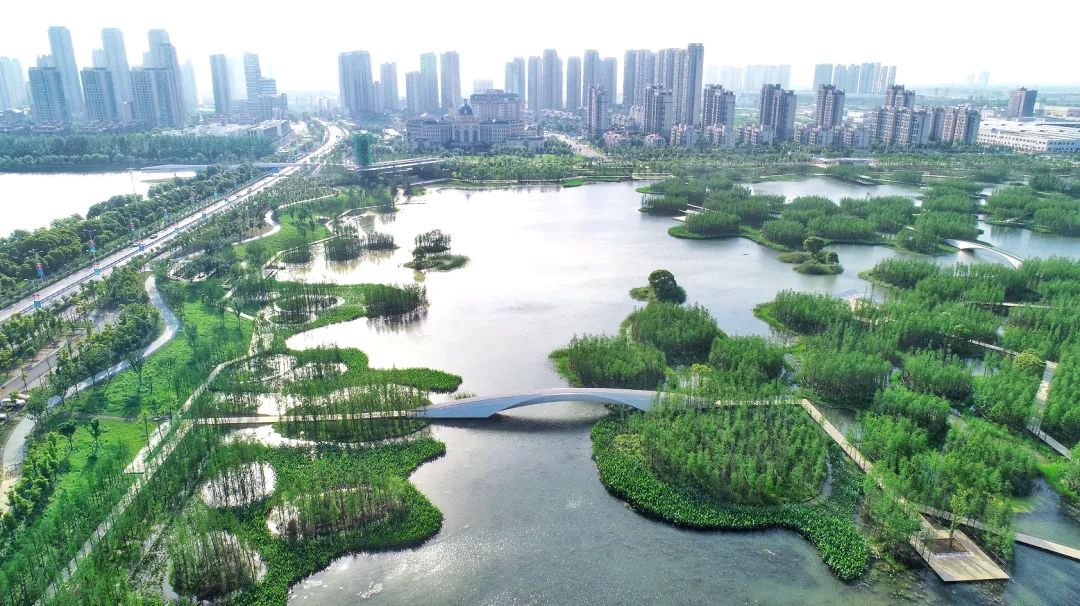
On a summer evening in Nanchang, the heat finally lets go around eight. That is when the boardwalks of Fish Tail Park (鱼尾洲公园, Yúwěizhōu Gōngyuán) fill up. Grandparents fan themselves under the cypress trees. Kids chase each other across the arc bridges. Down at the water's edge, a cluster of teenagers hunch over the channel with string, a stick, and a torch, hauling up crayfish (钓小龙虾) one indignant claw at a time. A breeze comes off the lake, moves through tens of thousands of feathery trees, and the whole place drops a few degrees. This is the classic Nanchang summer ritual — 纳凉, "taking the cool" — and Fish Tail Park has become one of the city's favourite stages for it.
Which is a strange thing to say about a park that is, structurally, designed to drown.
Because underneath the evening stroll is one of the most quietly radical pieces of landscape architecture in China. Fish Tail Park is a sponge park: a working piece of flood infrastructure disguised as a beautiful place to walk. Its forest is built to be submerged. Its lake is engineered to swallow a small district's worth of storm water. And it exists because a Chinese landscape architect spent two decades arguing that cities should stop fighting water and start drinking it. If you have heard that Singapore does this sort of thing better than anyone — the naturalised rivers, the parks that double as drains — the interesting news is that China now has a homegrown answer, and a lot of it starts here, on the northern shore of Aixi Lake.
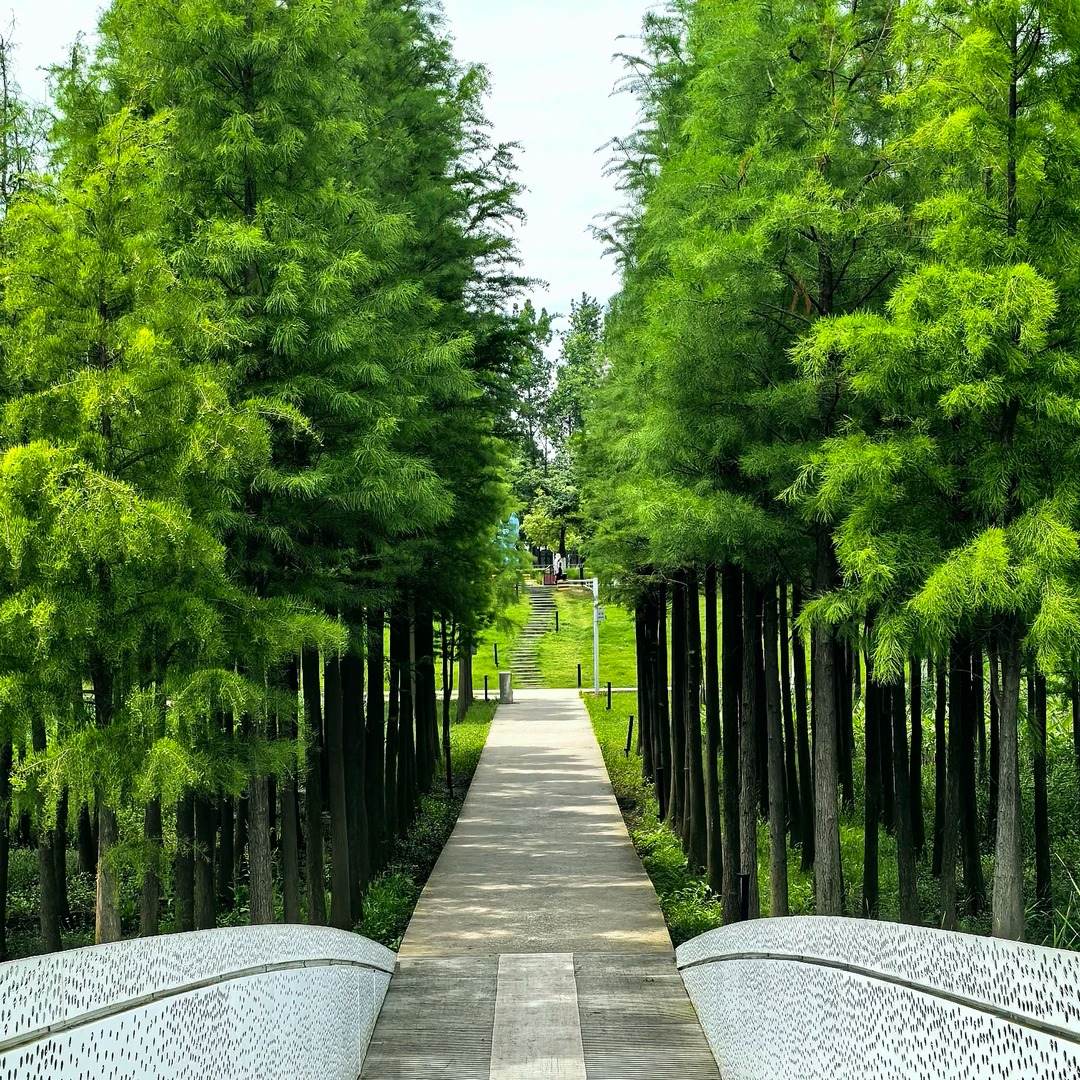 Summer green: the cypress avenues and boardwalks that draw Nanchang out for an evening walk — the same trees built to stand in floodwater a few months later.
What a "sponge city" actually is
Start with the problem. For most of the twentieth century, cities dealt with rain the way you'd deal with an unwanted guest: get it out fast. Pave everything, pitch it toward gutters, funnel it into concrete channels and underground pipes, and rush it to a river before it can pool. Engineers call this grey infrastructure, and it works right up until it doesn't — until a storm dumps more water than the pipes can carry, the channels back up, and a district floods. Nanchang knows this pattern intimately. The city sits in the Poyang Lake and Yangtze flood plain, where the summer monsoon can turn streets into rivers within an hour.
The sponge city (海绵城市) idea flips the logic. Instead of speeding water away, you slow it down and let the ground drink it. Permeable pavements, rain gardens, planted swales, restored wetlands and lakes all act like a sponge: they absorb rain where it falls, hold it, let it soak into the earth, clean it naturally as it filters through soil and roots, and release only the excess — slowly. Chinese planners summarise the whole approach in a tidy six-character formula: 渗 · 滞 · 蓄 · 净 · 用 · 排 — infiltrate, slow, store, purify, reuse, and (only then) discharge.
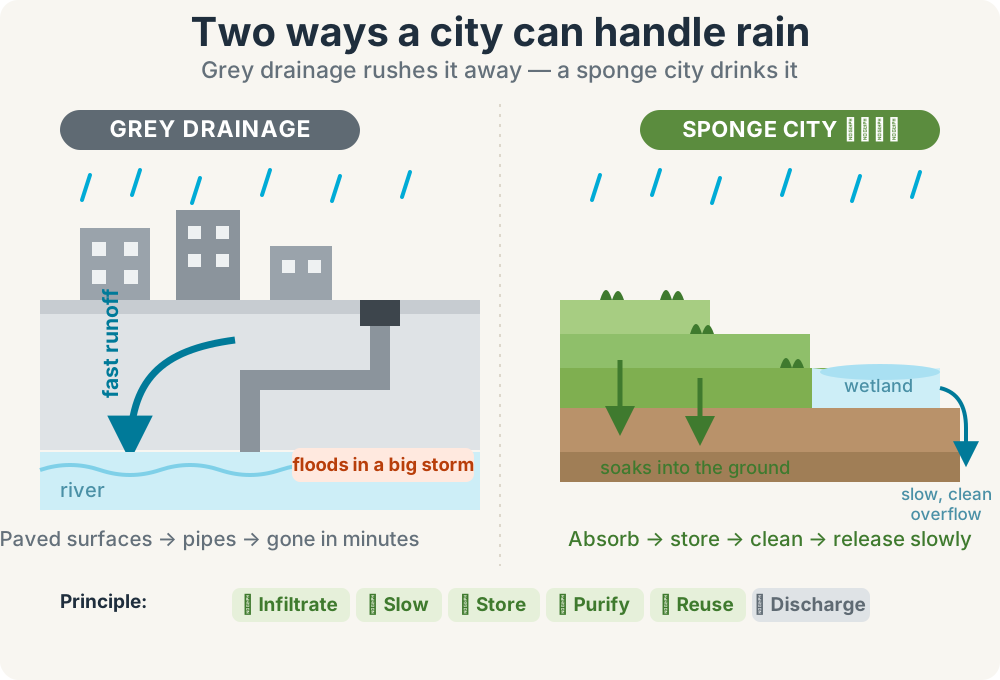 Grey vs. green: conventional drainage rushes storm water into pipes and channels; a sponge city absorbs it, stores it, and releases it slowly.
This is not a boutique idea in China — it is national policy. The concept was endorsed at the top in December 2013, written into technical guidelines by the housing ministry in 2014, and rolled out through pilot cities starting in April 2015, when 16 cities were chosen as the first batch, followed by a second batch of about 14 more in 2016. The stated national targets are ambitious: the policy calls for a large share of urban built-up area to absorb and reuse around 70% of the rainfall that lands on it. (Treat those as targets, not tallies — this is where the country wants to go, not a report card of where it is.) The man most credited with turning this from an academic argument into state policy is a landscape architect named Kongjian Yu (俞孔坚) — and to understand Fish Tail Park, you need to understand him.
How this park drinks the rain
Before it was a park, this was a mess. The 55.6-hectare site (about 137 acres) was a patchwork of abandoned fish ponds and lotus paddies, and — crucially — roughly 30% of it had been a dumping ground for coal ash from the city's power plants. Most designers would have hauled the ash away and trucked in clean fill. Instead, Fish Tail Park's designers recycled it: the coal ash was mixed with soil dredged from the old fish-pond dykes and mounded up into islands. It is a cut-and-fill trick borrowed from centuries of Chinese marshland farming — build your ground from what's already on site — and it kept costs remarkably low. The whole park reportedly went up at around US$4 per square foot.
At the centre sits an engineered lake designed to accommodate a two-metre rise in water level, giving it the capacity to hold up to roughly one million cubic metres of storm water — enough to buffer the surrounding new district when Aixi Lake and the summer rains overload the system. (That figure is a design capacity — what the lake is built to hold — rather than a measured storm volume, but it appears consistently across the project's documentation.) Terraced wetlands step down toward the water like paddy fields; as runoff moves through them, plants and soil strip out pollutants before the water reaches the lake. According to the project team, the wetland system is designed to treat on the order of tens of thousands of tonnes of water a day and meaningfully improve its quality — one of those self-reported performance numbers worth citing with the source attached rather than as gospel.
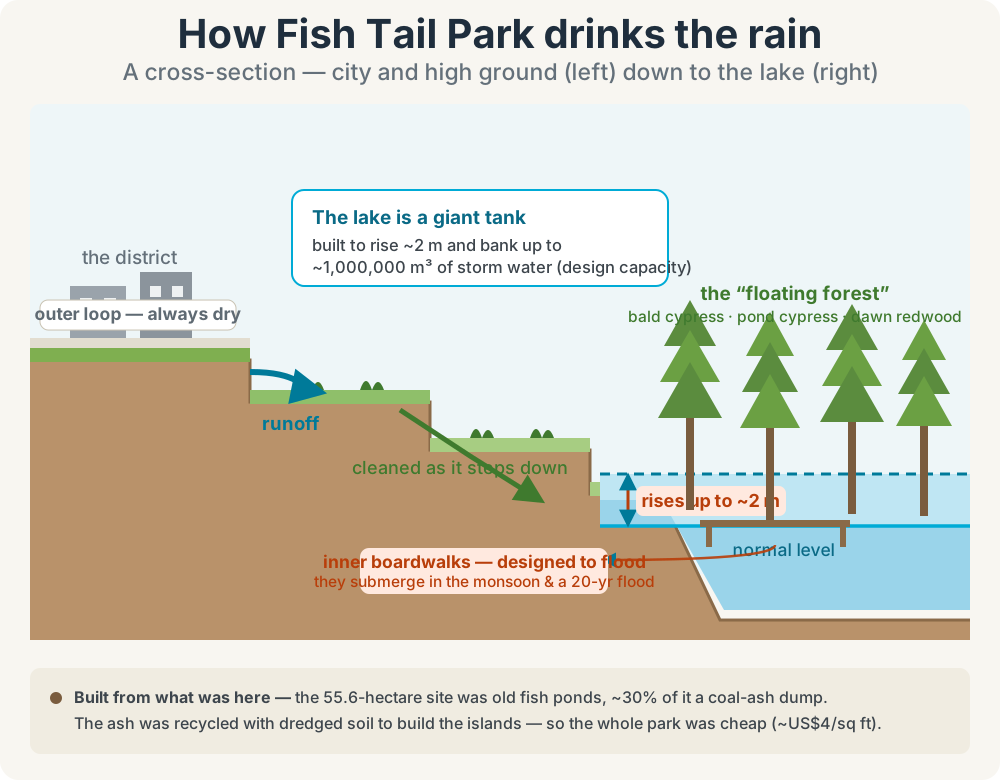 How the park drinks the rain: runoff filters down through planted terraces into a lake engineered to rise ~2 m and bank up to ~1 million m³ of storm water.
The genius is in the planting. The park's forest is a "floating forest" of trees that don't just tolerate flooding — they need the seasonal rhythm of wet and dry. Three species do the heavy lifting: bald cypress (落羽杉, Taxodium distichum), pond cypress (池杉), and dawn redwood (水杉, Metasequoia glyptostroboides) — that last one a "living fossil" once known only from fossils until wild trees were found in China in the 1940s. Roughly 19,700 pond cypress went in as the backbone of the forest, planted at about 9-foot intervals, with bald cypress and dawn redwood added on the islets. Along the shoreline, lotus and seasonal wetland plants flood and re-emerge with the water. The whole system is modelled on Poyang Lake's monsoon-adapted marshes, where nature has been doing exactly this for millennia.
So the park is built on a deliberate hierarchy of flooding. The inner boardwalks and platforms are meant to go under water during the annual monsoon floods and during a once-in-20-years flood event — you're expected to lose access to them for a while, and that's the point. The outer bike-and-pedestrian loop sits above the 20-year flood line, so there's always a dry ring to walk. The forest submerges; the trees don't mind; the district behind stays dry. When the water drops, the boardwalks re-emerge, a little muddier, entirely intact.
The designer, and a philosophy of living with water
Fish Tail Park was designed by Turenscape (土人设计), the Beijing firm founded in 1998 by Kongjian Yu. Yu is the closest thing landscape architecture has to a household name in China. He earned a Doctor of Design at Harvard, went on to found the landscape school at Peking University, and is widely credited as the originator and great popularizer of the sponge-city concept. He called landscape architecture "the art of survival," and he meant it as a rebuke: to him, decorative lawns and ornamental fountains were vanity, what he mockingly called "little feet" landscaping — pretty and useless, like bound feet. He championed the opposite: productive, working, sometimes messy "big feet" landscapes that actually do ecological labour.
His core conviction was that grey infrastructure — the dams, the concrete channels, the fast pipes — is "disconnected and unsustainable," because it severs water from its natural cycles. The alternative he spent his career building is disarmingly simple to state: live with water, not against it. Let it spread, soak, and slow. Treat a flood not as an enemy to be walled out but as an ecological process to be accommodated. Fish Tail Park is that philosophy rendered in cypress and coal ash — a place that opens space in the city, as Turenscape puts it, "not just for people, but also for nature, and for powerful forces like monsoon storms."
The idea travelled far beyond Nanchang. Turenscape has applied versions of it across more than 250 Chinese cities, and Yu collected the field's top honours along the way — the 2020 IFLA Geoffrey Jellicoe Award and the 2023 Cornelia Hahn Oberlander Prize among them. Fish Tail Park itself won a stack of international awards: the 2022 AZ Awards (jury Winner for Landscape Architecture, plus a People's Choice award for Environmental Leadership), and, most prestigiously, a 2025 ASLA Award of Excellence in General Design — one of just two Awards of Excellence the American Society of Landscape Architects gave that year, and the top honor in its category.
There is a sombre coda. In September 2025, Kongjian Yu died in a small-plane crash in Brazil's Pantanal wetlands, at 62, while filming a documentary about his sponge-city work. He didn't live to see the ASLA award announced. It's worth knowing when you walk here: this floating forest is, now, partly a monument to the man who argued cities should learn to flood gracefully.
The Singapore benchmark — and why a domestic answer matters
If you want to grasp why Fish Tail Park is a big deal, hold it up against the place everyone benchmarks: Singapore. The city-state has spent nearly two decades turning its drains into landscapes under the ABC Waters (Active, Beautiful, Clean Waters) Programme, launched by its national water agency PUB in 2006, with dozens of projects completed island-wide. The flagship is Bishan-Ang Mo Kio Park: designers took a dead-straight concrete storm canal, demolished it, and rebuilt it as a meandering ~3 km river with soil-bioengineered banks, reopened in 2012 after a revamp costing around S$76–77 million. In dry weather it's a park; in a heavy storm, parts of the channel widen to as much as five times their normal width to carry the flood, and the park uses a water-level warning system to clear people off the low ground during surges. It's brilliant, and it's justly famous.
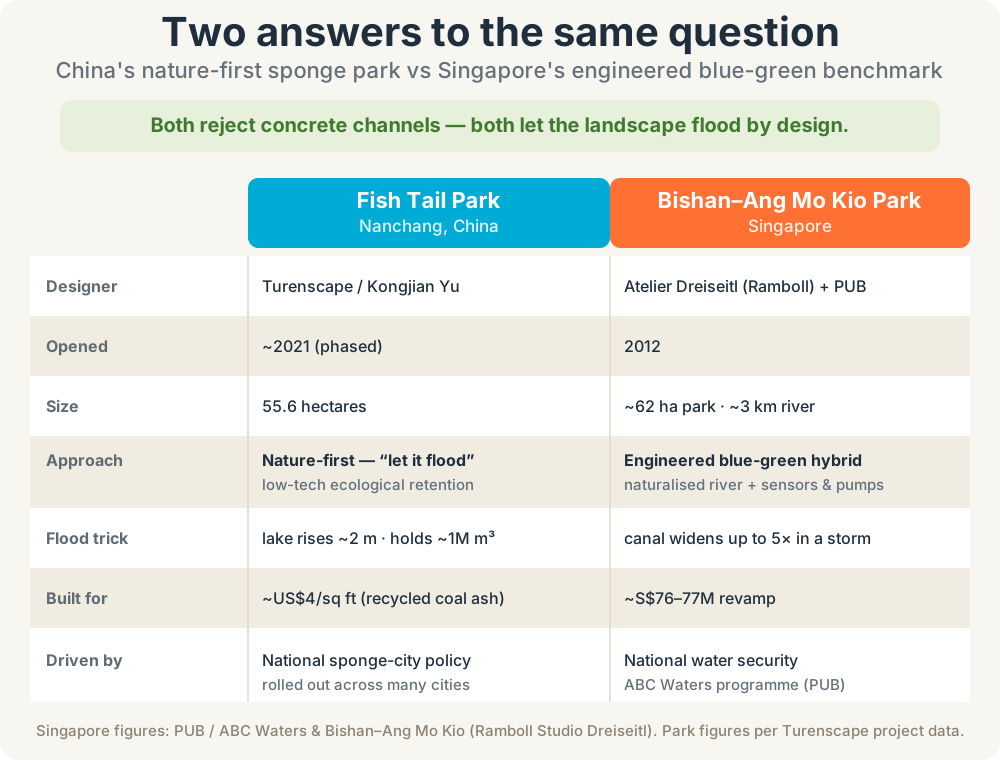 Two answers to the same question: Fish Tail Park's nature-first sponge approach vs. Singapore's engineered blue-green model at Bishan–Ang Mo Kio Park.
Fish Tail Park and Bishan share a worldview. Both reject the mid-century instinct to flush water away in concrete. Both use vegetated banks, let the landscape flood by design, and stack up co-benefits — cleaner water, more wildlife, somewhere lovely to be — on the same patch of ground. But they lean different ways. Singapore's model is state-led, richly instrumented, and pragmatically hybrid: PUB pairs its naturalised rivers with serious hard engineering — the Marina Barrage dam, drainage pumps, sensor networks — in a compact, wealthy city-state where water security is existential (roughly two-thirds of the island is water catchment). Yu's approach leans further toward pure ecological retention, almost as ideology: minimise the grey engineering, let the water spread and soak, and trust the plants. Singapore is engineering-plus-nature; Turenscape is nature-first as doctrine.
Here's why the comparison matters. Sponge-city policy is nationwide in China, but plenty of implementations are token or engineering-led — a permeable car park here, a rain garden there, box ticked. Fish Tail Park is one of the rare ones that fully commits: a design-led sponge park that genuinely lets a forest go under water, repeatedly singled out by international critics as world-class. It's the credible domestic answer to Singapore's celebrated Bishan — proof that China isn't just importing the idea, but building its own exemplars of it. And unlike Bishan's tens of millions, this one was assembled cheaply, out of a coal-ash dump.
The everyday park: crayfish, cool air, and a red forest
All of which would be an interesting footnote if the park weren't also, simply, a great place to spend an evening — which it is.
On summer nights it's one of Nanchang's best-loved spots for a stroll. Locals walk and run the waterside boardwalks (亲水栈道), do yoga among the trees, watch the moon break up on the water, and cross the "Crane Dance" sky-bridge (鹤舞鱼尾天桥), a pedestrian span that lifts you over a six-lane road and links Fish Tail Park to the older Aixi Lake wetland park (艾溪湖) next door. The tall trees and lake breeze make it a natural cool-off — genuinely a few degrees cooler than the surrounding streets on a sticky night. Bring water, bug spray, and time it for after sunset.
The crayfish are a whole culture of their own. On warm evenings you'll see families and teenagers crouched along the channels with the simplest possible tackle — a line, a bit of bait, a phone torch — pulling small crayfish out of the water. It's grassroots, social, and very Jiangxi. A word of honesty, though: this is something locals do, not an advertised park amenity, and rules for fishing in Chinese urban parks and Yangtze-basin waters can vary and change. Treat it as local colour to watch or join gently — check any posted signs, don't disturb the wildlife, and if you catch, consider catch-and-release. Don't assume it's officially sanctioned just because a crowd is doing it.
Then there's the park's showstopper season. For most of the year the floating forest is green, but in early winter — roughly mid-November into early December — the bald cypress and pond cypress turn a deep russet-gold, and the whole forest goes up in warm colour reflected across the still water. Local media call it the "颜值巅峰," the park's peak-beauty moment, and it draws photographers from across the city; you'll hear the palette described in fashionable shorthand as "美拉德"/Maillard tones, all caramel and rust. There's a bonus autumn act, too: large stands of pink muhly grass (粉黛乱子草) that blush rose-pink before the cypress turns. If you're planning a trip around one thing, plan it around the red forest.
It's also quietly serious about birds. The site was conceived as part of a migratory-bird green corridor between Aixi Lake and the Gan River, and about half the islands are left deliberately inaccessible to people, kept as refuge. Birds and wildlife have returned to the restored land-and-water edges — by the project's own monitoring, at least a dozen species have been recorded using the park, a sign the ecology is doing its job. Come early with binoculars if that's your thing; the still mornings are best.
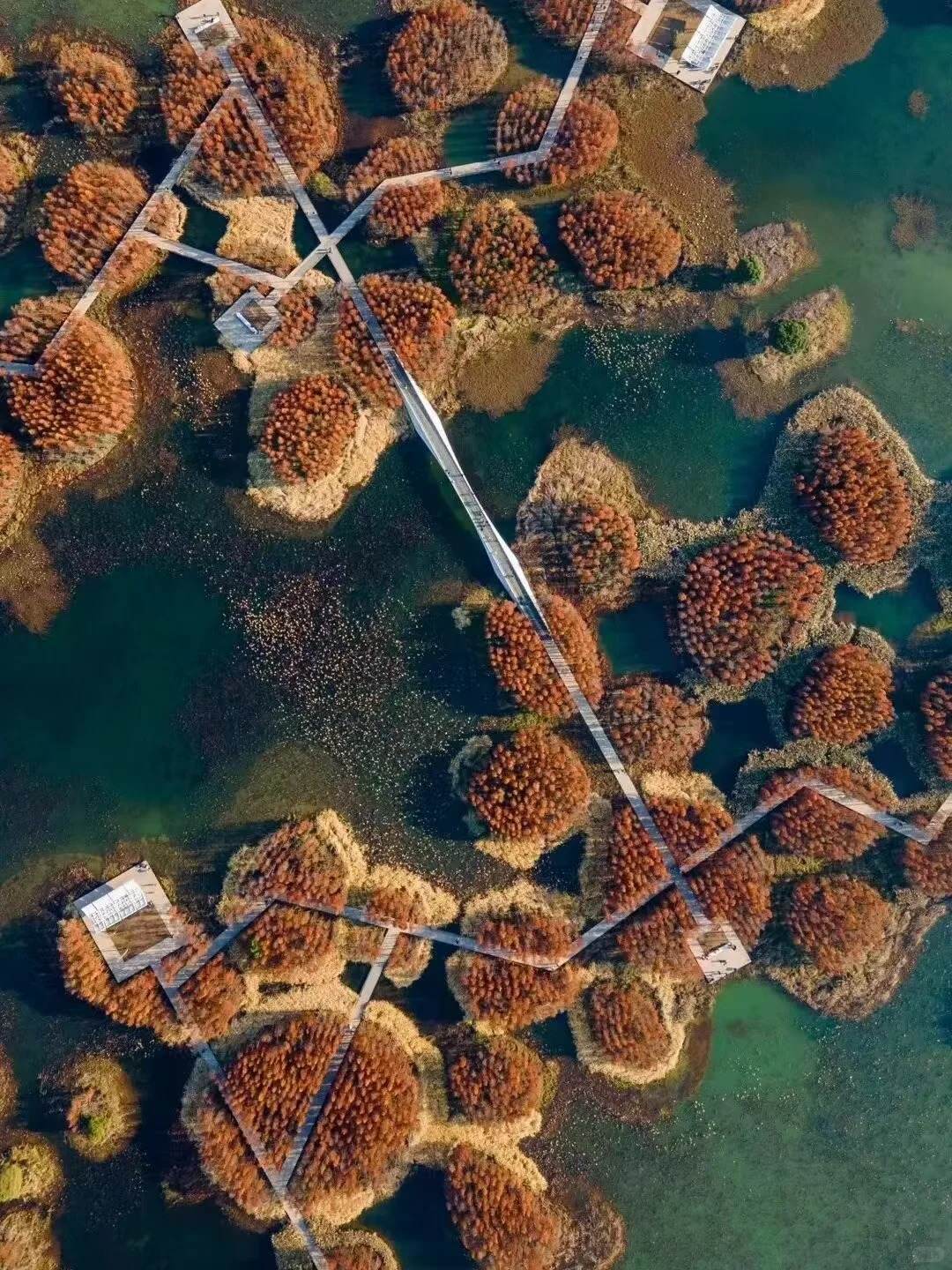 The same forest from directly above in early winter, turned russet-gold — the flooded islands and zig-zag boardwalks that make this the park's peak-beauty season.
When to go, and how long to stay
There are three ways to enjoy Fish Tail Park, and they want different timing:
- The red forest (photography): mid-November to early December, in the golden hours after sunrise or before sunset, when the low light sets the cypress alight and the water goes mirror-still. This is the marquee visit — give it half a day.
- Summer cool-off (the local ritual): June through September, after sunset. Come for the breeze, the boardwalks, the crayfish crowds, the moon on the lake. A relaxed 1–2 hours, or longer with a picnic.
- The everyday loop: any mild day, morning or late afternoon. Walk the boardwalks and the Crane Dance bridge into Aixi Lake park next door — an easy 1–2-hour circuit on the ~8.7 km network of boardwalks, greenways and rain-shelter corridors.
What to skip: midday in high summer (brutal sun, thin shade until the canopy fills in), and — if you're chasing the red forest — a grey, flat-light day, which flattens the whole effect. The colour also runs on nature's clock, not a calendar, so the exact peak shifts a week or two each year; check recent local photos before you commit a special trip.
Practical info
- Where: Nanchang High-Tech Zone (高新区), on the northern shore of Aixi Lake (艾溪湖), between the lake and the south branch of the Gan River. (Some travel apps tag it under Qingshan Lake District because Aixi Lake straddles the boundary — the managing authority is the High-Tech Zone.)
- Getting there: Metro Line 4 has a stop named after the park — Yuweizhou Station (鱼尾洲站). Surface and follow the signs to the park; the nearby Line 4 stops Nanchang Bridge East (南昌大桥东站) and Guanzhou (观洲站) also work. A DiDi from the city centre is quick and cheap if you'd rather not change lines.
- Tickets: free — it's an open, un-gated public park, no ticket required.
- Hours: effectively open day and night; locals come at all hours, and the after-dark stroll is a signature use. There's no ticket gate to close. (Confirm on-site signage for any posted rules.)
- How long: 1–2 hours for a boardwalk loop and the sky-bridge; half a day in cypress season or for a slow summer evening.
- Pay & language: nothing to pay to enter; bring Alipay/WeChat for the café or any snacks. Little English signage — download an offline map and screenshot the station name in Chinese.
- Good for: photographers, families, birdwatchers, evening walkers, anyone curious about urban design. Less good for: visitors wanting shops and buzz (this is nature, not a night market), or anyone here only in flat-light midday summer.
Fish Tail Park pairs naturally with other Nanchang days. If you're building an itinerary, it slots neatly into an easygoing green-and-water half-day; browse our Nanchang itineraries to see where it fits. For the city's headline sights, contrast this modern landmark with the classical drama of Tengwang Pavilion and the red-history heart of the city at Bayi Square. Hungry after your walk? Our Eat & Play guides cover where to find Nanchang's fiery street food. And if you'd rather someone else stitch it all together — including the best window for the red forest — we can help you plan your trip.
FAQ
Is Fish Tail Park worth visiting?
Yes, especially if you like nature, photography, or urban design. It's free, easy to reach on Metro Line 4, and it's one of China's standout "sponge parks" — a floating cypress forest engineered to flood, internationally awarded, and genuinely lovely to walk. The two best reasons to go are the russet cypress forest in early winter and the cool, social summer evenings by the water.
What is a sponge city, in one sentence?
A sponge city is one designed to absorb, store, clean and slowly release rainwater — using wetlands, permeable surfaces and green space to soak up storms — instead of rushing every drop away in concrete channels and pipes. Fish Tail Park is a working example: its lake and forest are built to catch and hold flood water.
When is the best time to see the red cypress forest?
Roughly mid-November to early December, when the bald cypress and pond cypress turn russet-gold and reflect across the water. Go in the golden hours near sunrise or sunset for the best light. The exact peak shifts a week or two each year with the weather, so check recent local photos before planning a special trip.
How do I get to Fish Tail Park, and is it free?
Take Metro Line 4 to Yuweizhou Station (鱼尾洲站), named after the park, and follow the signs; a DiDi from the centre is also quick. It's a free, un-gated public park with no ticket — you can come day or night.
Can you catch crayfish in the park?
You'll see locals doing it along the channels on summer evenings — it's a grassroots pastime, not an advertised amenity. Rules for fishing in Chinese urban parks and Yangtze-basin waters vary and can change, so check any posted signs, avoid disturbing wildlife, and don't assume it's officially permitted just because others are doing it.
Last verified: 2026-07 — details change; please double-check before you go.