Nanchang Metro Guide: Lines, Fares & Tips
How to ride the Nanchang Metro: 4 lines, paying by QR or ticket, fares (~¥2-7), hours, and the stops for Tengwang Pavilion, Bayi Square & the airport.
By Hello Nanchang · Last updated
Nanchang Metro, covering major areas like Bayi Square (八一广场), Tengwang Pavilion (滕王阁), and Wanshougong (万寿宫). · Ongoing. The metro operates daily, typically from 6:00 AM to 10:30 PM (check specific line schedules).
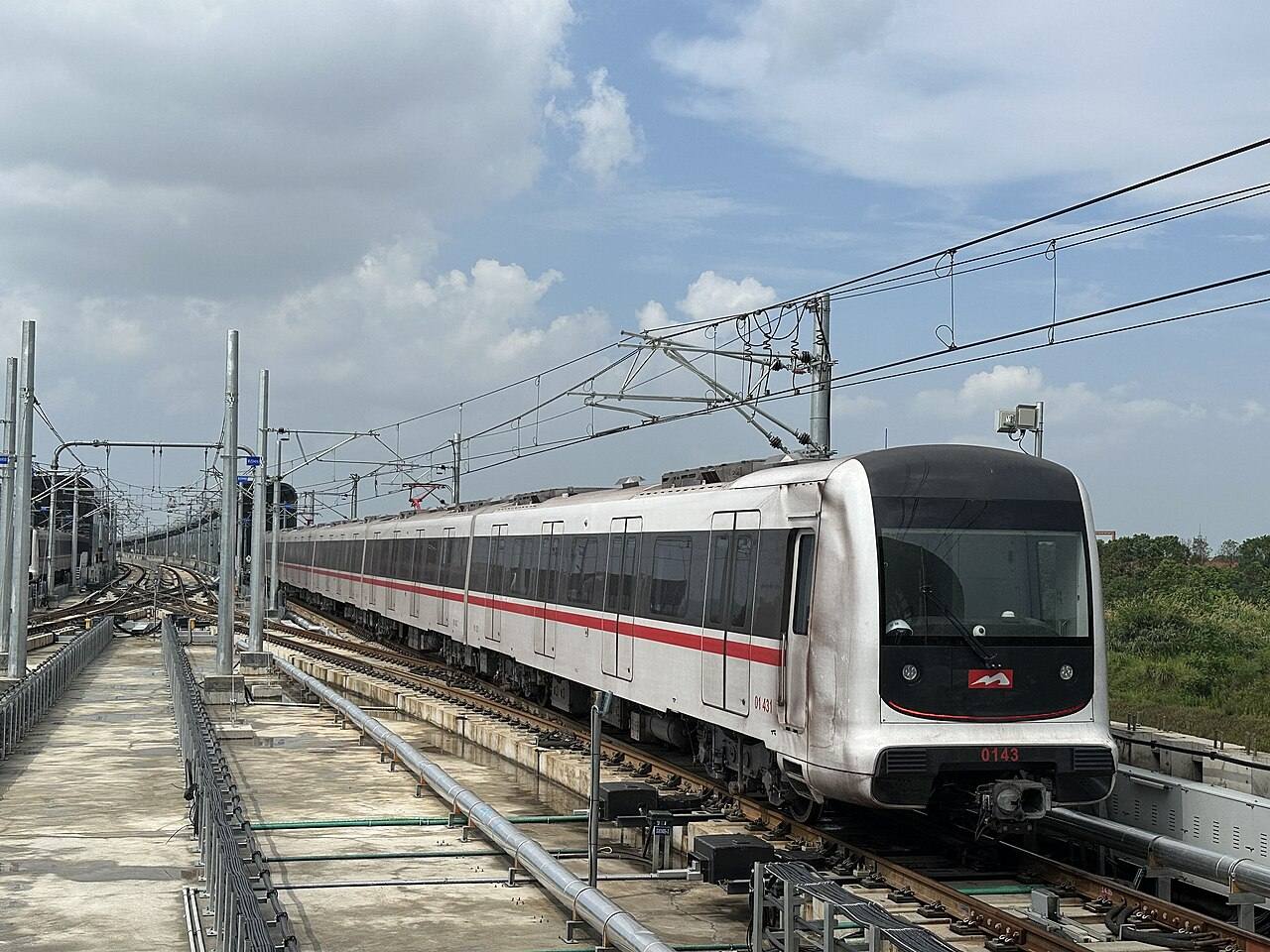
Here is the good news, fresh off the train: getting around Nanchang (南昌) is genuinely easy, and the metro is your secret weapon. Traffic in the centre can crawl, taxi drivers rarely speak much English, and the summer heat is no joke — but down in the cool tunnels a clean, quiet train takes you from the high-speed railway station to Tengwang Pavilion in the time it takes to scroll your phone. Crack the payment system, which takes about ninety seconds, and you will wonder why you ever stood at a kerb waving at cabs.
This guide is the city-level one: the four lines, what each is good for, what a ride costs, how to pay as a foreigner, when the last train goes, and the handful of local quirks — a free left-luggage locker, an airport train that only runs every other service — that nobody tells you at the gate. For long-distance rail (passport bookings, 12306, station-by-station times across Jiangxi), see our Jiangxi high-speed rail guide; for arriving and leaving the city, our airport and stations guide.
Why the metro is the smart way to get around
Nanchang's metro opened in December 2015, which is exactly why you will like it: spotless stations, quiet trains, and English on every sign, map and announcement, so you are never guessing. The network now runs to about 163 km across four lines and carries somewhere north of a million rides a day. Better still, the lines were practically drawn with a visitor in mind — one of them links the airport, the river and most of the big sights without a single change.
- It is dirt cheap. Single rides run roughly ¥2 to ¥7 by distance — pocket change against a metered cab.
- No language barrier. Bilingual signs, maps and announcements let you navigate entirely in English.
- It connects the dots that matter. Airport, all three railway stations, Bayi Square, the riverside light show — all on the network.
- It is predictable. No surge pricing, no crawling along Bayi Avenue at 6pm in the rain.
The network at a glance: four lines, four colours
Nanchang runs four lines, colour-coded red, yellow, blue and green, with a fifth in planning. As a visitor you really only need to befriend two of them, but it helps to know what all four are for.
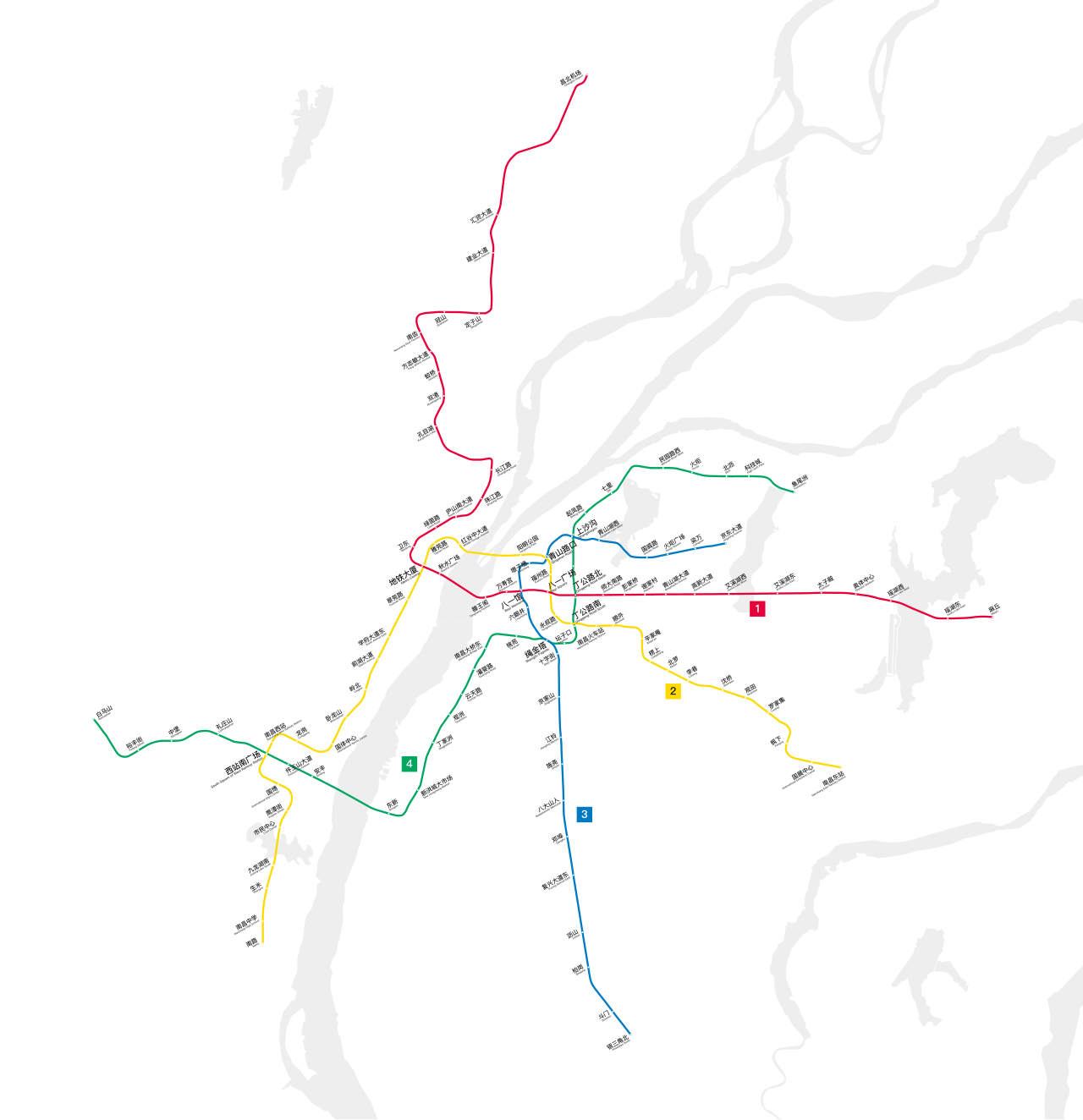 The four-line network, schematic. A full-size, station-by-station version is posted at every station entrance and inside the official app — worth a photo on your phone. Map: Kmchang28 / Wikimedia Commons (CC BY-SA 4.0).
Line 1 (red) — your sightseeing line
This is the one you will ride most. Line 1 starts at Changbei International Airport (昌北机场) in the north-west, crosses under the Gan River, and threads straight through the old town before running out east to Maqiu. Five consecutive stops cover most of a first visit:
- Qiushui Square (秋水广场) — the west-bank front row for the musical fountain and the skyline light show.
- Tengwang Pavilion (滕王阁) — the city's icon, one stop east and under the river. Exit 2 is the one signed for the pavilion, the city library and the city museum.
- Wanshou Palace (万寿宫) — the restored lantern-lit quarter, best after dark.
- Bayi Memorial (八一馆) — the August 1st Uprising museum, and the interchange with Line 3.
- Bayi Square (八一广场) — the giant central plaza, and the interchange with Line 2.
Further east, Line 1 also reaches Aixihu West / Aixihu East (艾溪湖西/东) for the lakeside wetland parks and the autumn ginkgo.
Line 2 (yellow) — your railway line
Arriving by bullet train? Line 2 is your friend. It strings together all three main rail gateways — Nanchang West (南昌西站), the big hub most fast trains use; the central Nanchang Railway Station (南昌站); and, since June 2025, the newest and grandest, Nanchang East (南昌东站) at the line's eastern end. It crosses Line 1 twice, at Metro Central and Bayi Square, so you can roll off a train from Jingdezhen or Lushan and reach a central hotel without ever flagging a taxi.
Line 3 (blue) — the culture line
Line 3 runs north-east to south-west through the older side of town. It is how you reach Bada Shanren (八大山人) for the classical Meihu garden and the painter's memorial hall, and Shengjinta (绳金塔) for the seven-tier pagoda and its food street. It meets Line 1 at Bayi Memorial and Line 2 at Qingshan Road.
Line 4 (green) — the outer arc
Line 4 curves around the south and east of the city. Two stops matter to visitors: Yuweizhou (鱼尾洲) at the eastern end, named after the "floating forest" of Fish Tail Park and about eight minutes' walk from it, and Baimashan (白马山) at the western end, out in Xinjian District. It also serves People's Park and shares Shengjinta with Line 3.
Where the lines actually cross
Nine stations do transfer duty, and knowing three of them saves you most of the map-reading:
- Bayi Square (八一广场) — Line 1 × Line 2. The one to remember: the symbolic heart of the city and the busiest interchange on the network.
- Metro Central (地铁大厦) — Line 1 × Line 2 again, over on the Honggutan side. Often the quicker change if you are coming from the west.
- Bayi Memorial (八一馆) — Line 1 × Line 3, one stop from Bayi Square.
- Shengjinta (绳金塔) — Line 3 × Line 4 (not Line 2 — plenty of older blog posts get this wrong).
- Also: Qingshan Road (Line 2 × 3), Dinggong Road North (1 × 4), Dinggong Road South (2 × 4), Shangshagou (3 × 4), and West Station South Square (2 × 4).
If you remember one station name in Nanchang, make it Bayi Square. Almost every central hotel is a short walk or one change away from it, and it is the easiest place to reorient when a route goes sideways.
What a ride costs
Fares are by distance, and the formula is published: ¥2 for the first 6 km, then +¥1 per additional 6 km up to 12 km, +¥1 per 8 km up to 28 km, and +¥1 per 10 km beyond that. In practice:
- Almost every trip you make inside the centre is ¥2–4.
- Airport into town lands in the ¥2–7 band — cheaper than a coffee, slower than a taxi (see below).
- Children under 1.2 m ride free with an adult.
- A stored-value Hongcheng Yikatong (洪城一卡通) card takes 10% off every metro fare and works on city buses too.
Treat these as the published structure rather than a promise: fare rules and concessions do get revised. The price is posted at every ticket machine.
How to pay, three ways
If you have used a subway anywhere, you already know the rhythm. The only real question is how to pay — and you have options, so pick whichever suits how long you are staying.
The easy way: scan with your phone
If you have Alipay (支付宝) or WeChat Pay (微信支付) set up — and both now let foreign Visa and Mastercard holders link a card — this is the move. In Alipay, open your payment-code screen and switch to the transit / ride code (乘车码), then scan it at the gate to enter and again to exit; the fare comes off automatically. UnionPay's 云闪付 app carries a Nanchang metro ride code too, and the metro's own app, 鹭鹭行 (Lùlùxíng), does the same while also working in a dozen-odd other Chinese cities.
One honest caveat: transit QR codes have historically been fussier for foreign-issued cards than ordinary shop payments are. Activate and test yours before you are standing at a gate with a queue behind you — and if it refuses, walk twenty metres to the ticket machine and buy a token with cash.
The old-school way: a single-journey ticket
No mobile pay? No problem. Use the self-service machines in every station — tap the English button, find your destination on the map, and pay. Machines take cash and QR; many do not take foreign cards, so keep some small notes and coins on you. Out pops a token: tap it on the reader to enter, and drop it in the slot at the gate when you leave. If a machine defeats you, the staffed window by the entrance will sort you out — point at your destination on the map and they will do the rest.
Staying a while: a transit card
Riding a lot over several days? Grab a rechargeable Hongcheng Yikatong (洪城一卡通) from a station window. It shaves about 10% off every metro fare, works on city buses, and spares you the QR dance at every gate. Lovely if you are settling in; overkill for a two-day visit.
Your first ride, step by step
- Bag on the belt. Every entrance has an airport-style scanner. Nanchang's screeners work to a "every bag, every liquid" rule, so expect your water bottle to be glanced at and occasionally tested. It takes seconds.
- Match your direction to the terminus. Platform signs are labelled by the last station on that branch, not by "northbound" — read the terminus, not the line number.
- Scan or tap in. QR readers are on the gate face; tokens go on the round pad.
- Ride. Every stop is called and displayed in English, with the next-station arrow above the door.
- Pick your exit before you climb. Exits are lettered (A, B, C…) or numbered, and each sign lists the streets and landmarks above it. Choosing right at the concourse saves a five-minute detour at street level — at big interchanges like Bayi Square, a wrong exit puts you on the far side of an eight-lane road.
- Scan or drop your token at the exit gate. Done.
A Line 1 train leaving Huixian Avenue, one of the eight stations added when the line reached the airport in 2025. Photo: Kmchang28 / Wikimedia Commons (CC BY-SA 4.0).
Line 1 to the airport — and the catch
The single most useful recent change: on 28 June 2025, Line 1 was extended north to Changbei Airport, adding eight stations and putting the terminal on the metro map for the first time. Any guidebook telling you there is "no metro to Nanchang airport" is out of date.
- Terminal to platform: the station's Exit 1 feeds a covered walkway (风雨连廊) — about 240 metres, three minutes, to Terminal 2. Terminal 1 is roughly ten minutes on foot, further along under the elevated road. Coming the other way, domestic arrivals leave T2 by Gate 7 and turn left into the walkway.
- The catch: Line 1 runs long and short workings at roughly a one-to-one ratio. Half the trains do the full run to and from the airport; the other half turn back at Shuanggang (双港), several stops short. So an airport train comes about half as often as the platform's headline frequency suggests — read the destination on the train and the platform display, not just the line colour.
- The other catch: this is a city line, not an express. Airport to the centre takes about an hour or a little more. It is the cheap, traffic-proof option, not the fast one. With a tight connection or heavy bags, take a taxi or DiDi and enjoy the guilt.
- Early flight? The airport end starts earlier than the rest of the network — first departures have run from around 5:15am. Confirm it on the platform board the day before rather than betting a flight on it.
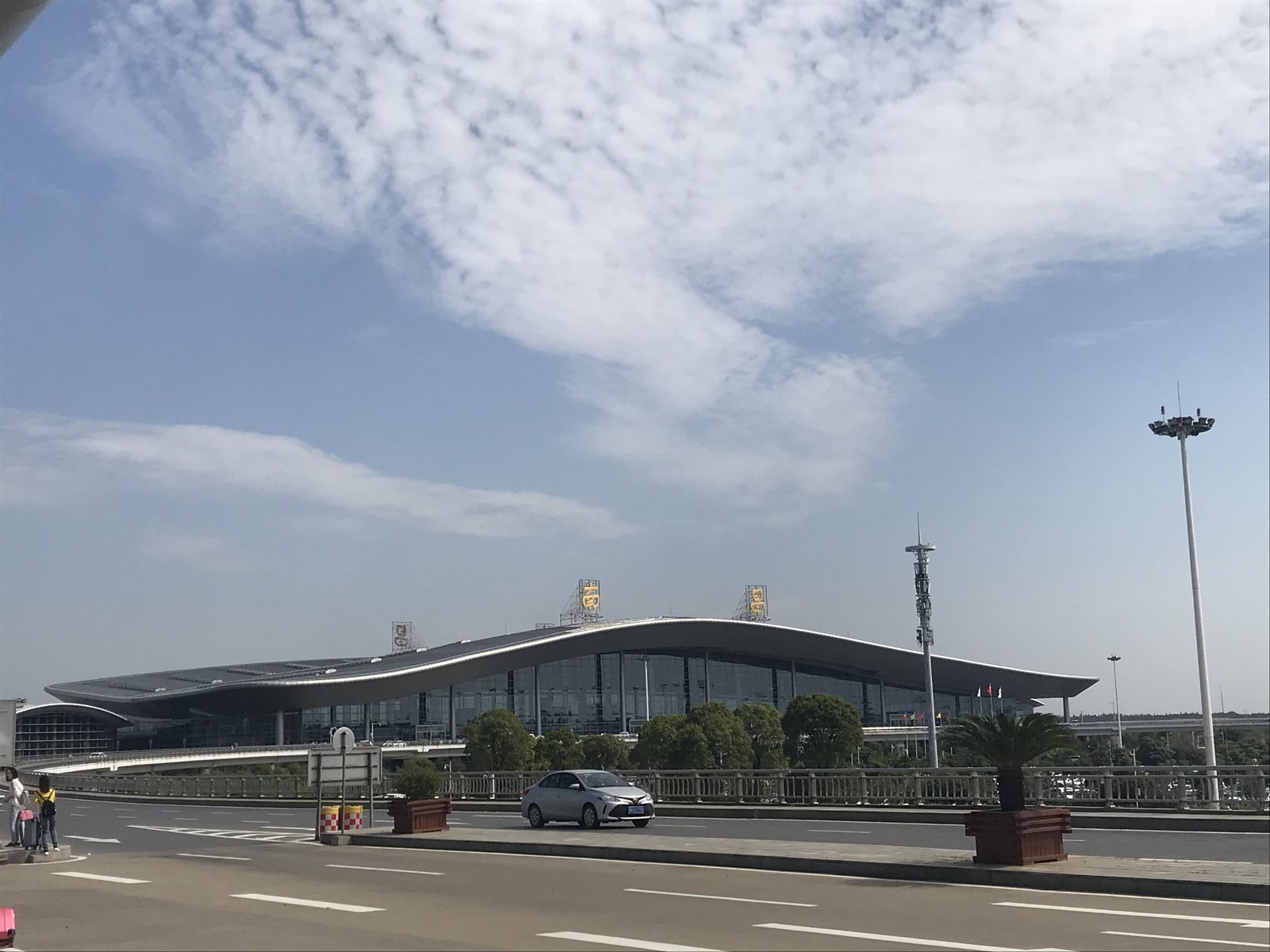 Changbei's Terminal 2 — three minutes along a covered walkway from the Line 1 platform since the 2025 extension. Photo: 丰泽一号 / Wikimedia Commons (CC BY-SA 4.0).
Full arrival logistics — terminals, shuttle buses, taxi fares and which railway station is which — are in our Nanchang gateways guide.
Hours, and the last-train problem
Service runs roughly 06:00 to 22:30, with last departures commonly extended to about 23:00 on Fridays, weekends and public holidays. Waits are short through the day — the platform countdown clock gives you the exact number — and stretch out noticeably after about nine in the evening.
That 22:30 is a soft number and it is the one that catches visitors. It is the time the last train leaves a terminus, so the last useful train from your own station is different — earlier in one direction, later in the other. Every platform posts its own first and last times on a board near the middle of the platform; photograph yours on the way in.
This matters most on exactly the nights you will want to be out late: the second fountain show at Qiushui Square runs to around 8:45pm, and the night-market lanes at Wanshou Palace and Shengjin Tower are only warming up at ten. Either build the last train into your evening, or accept from the start that you are taking a DiDi (滴滴) home — it is cheap, and it is a better plan than sprinting down an escalator.
Two seasonal footnotes worth checking rather than counting on: the metro has run free late-evening travel in recent summers (in 2025, every night after 9pm from July into October, scanned with the official 鹭鹭行 code) as part of the city's night-economy push, and it opens some stations as public cooling shelters during heatwaves. Both are announced season by season.
The free locker nobody mentions
This is the best-kept practical secret on the network. Nanchang Metro runs a free left-luggage service (阳光寄存) at a set of tourist-heavy stations — smart lockers at around a dozen of them, plus a staffed counter at Bada Shanren. The list has grown over time and includes the ones you would actually want: Tengwang Pavilion, Qiushui Square, Wanshou Palace, Bayi Memorial, Bayi Square, Nanchang Railway Station and West Station South Square among them.
- Cost: free.
- Limit: up to 8 hours, and you must collect before service ends for the day (the posted cut-off has been around 22:00).
- Rules: bags go through the security scanner first; no valuables, fragile items or fresh and frozen food; nothing over 30 kg, 1.8 m long, or 0.5 m wide or high.
On a checkout day this is transformative: drop the bag at Tengwang Pavilion station in the morning, do the pavilion, the riverfront and lunch unencumbered, and collect on your way to the train. Ask at the customer-service desk inside the concourse — availability and the station list can change, so have a backup plan for a big suitcase.
Security, etiquette, and the eating question
- What you cannot bring: the published limits are one item up to 30 kg, 1.8 m long and 0.5 m wide and high — fine for normal luggage, awkward for a bike box. Liquids get checked: cosmetics and perfume up to 500 ml, pressurised cans up to 700 ml each and 1,000 ml in total.
- Dodge the peaks if you can. Roughly 7:30–9am and 5:30–7pm are the crush; travel between them and you will usually get a seat, which matters more than it sounds when you are carrying a camera bag.
- Let people off first. Locals mostly do this well here; the doors are the one place a queue-jumper stands out.
- Priority seats at the car ends are taken seriously. Give them up.
- The eating question. Here is the quirk: when Nanchang drafted its rail-transit ordinance, it considered banning food and drink in the carriages and decided not to legislate it — too hard to define, and some passengers genuinely need to eat. So the request lives in the passenger code rather than the law. Translation: nobody is going to fine you for a bubble tea. Nobody will be impressed, either. Eat before you tap in.
- Look up occasionally. The network was designed one line, one colour, with Jiangxi themes worked into the stations — the lamps at Bada Shanren station are fan shapes lifted from one of the painter's own works. It is a small thing, and more than most metros bother with.
An easy sightseeing day, built on Line 1
Five consecutive Line 1 stops give you a complete first day in Nanchang with no changes and about ¥8 in fares.
- Start at Bayi Square (八一广场) mid-morning — the vast central plaza, the uprising monument, and the red-star hall on its west side, now the provincial art museum.
- One stop north-west to Bayi Memorial (八一馆) for the August 1st Uprising museum — the old Jiangxi Grand Hotel (江西大旅社), whose rooms the uprising's commanders took over in the last week of July 1927. It has run Tuesday to Sunday, closed Mondays outside public holidays, so check the day before you build a morning on it.
- One more to Wanshou Palace (万寿宫) for lunch in the restored Gan-style lanes — grey brick, carved timber, and rice noodles at street prices.
- One more to Tengwang Pavilion (滕王阁), Exit 2, timed for late afternoon. Drop your bag in the free locker here if you are between hotels.
- One final stop west to Qiushui Square (秋水广场) — the tunnel runs under the Gan — for blue hour, the skyline switch-on and the nightly fountain.
- Home: back on Line 1, or a DiDi if you have stayed for the second show. Our Nanchang photo-spots guide times this same run for the light.
Where the metro will not take you
Honest limits, so you plan around them rather than discovering them at a gate:
- Haihunhou Tomb Site Museum — out in the north-west, no metro. A DiDi is roughly an hour from the centre.
- Fenghuanggou (spring cherry blossom) — Line 3 south to Fuxing Avenue East, then bus 128 or C64; about two hours door to door, or 45–60 minutes by DiDi.
- Meiling — Line 1 or 2 to Ditie Dasha (地铁大厦), then bus 712 or 699 to the Wanli cableway station and the cableway up; or a 30–40 minute drive. Allow the whole morning. Costs, trails and timings are in our Meiling guide.
- Jiangxi Provincial Museum — Line 1 to Qiushui Square, then a short taxi or riverside walk north.
- Anywhere after the last train, and any airport run with a tight connection or real luggage. That is what DiDi is for: set up Alipay or WeChat before you travel and the whole thing works in English.
Practical info
- Network: four lines (red, yellow, blue, green), about 163 km, opened December 2015; a fifth line is in planning.
- Hours: roughly 06:00–22:30, with last trains commonly to about 23:00 on Fridays, weekends and holidays; the airport end starts earlier. Check the board on your own platform.
- Fares: ¥2 for the first 6 km, rising by distance; ¥2–7 covers essentially everything a visitor does. Under-1.2 m free; 10% off with a Hongcheng Yikatong card.
- Paying: Alipay or WeChat transit code, UnionPay 云闪付, the 鹭鹭行 app, a cash-bought token, or a stored-value card. Test your QR before you need it.
- Language: signs, maps and announcements are bilingual throughout; staffed windows are at every entrance.
- Good for: sightseeing, railway-station transfers, avoiding rush-hour traffic, travellers with no Chinese. Less good for: late nights, tight airport connections, big suitcases at rush hour, and anything outside the city proper.
Tap in, ride a few cool, quiet stops, come up next to a thousand-year-old pavilion — that is Nanchang on easy mode. For the wider arrivals picture, see our Plan Your Trip hub; for what to do once you surface, our Eat & Play picks are all a metro ride away. Want it threaded into one smooth itinerary? Plan your trip with us.
FAQ
How much does the Nanchang Metro cost? Fares are by distance: ¥2 for the first 6 km, then rising in ¥1 steps. Most trips inside the city are ¥2–4, and ¥2–7 covers essentially everything a visitor does, including the airport run. Children under 1.2 m travel free, and a Hongcheng Yikatong stored-value card takes 10% off.
Can I use Alipay or WeChat Pay on the Nanchang Metro? Yes — open the transit / ride code (乘车码) in Alipay or WeChat and scan it at the gate to enter and exit. UnionPay's 云闪付 app and the metro's own 鹭鹭行 app work too. Foreign-issued cards linked to these wallets usually work, but test yours before you rely on it; otherwise buy a token with cash at the machine.
Does the metro go to Changbei Airport? Yes, since 28 June 2025. Line 1 runs from Changbei Airport station straight into the centre with no change. From Exit 1 a covered walkway reaches Terminal 2 in about three minutes; Terminal 1 is roughly ten. Budget an hour or more into town, and note that only about every other Line 1 train runs all the way to the airport — check the destination on the train.
What time does the Nanchang Metro stop running? Roughly 22:30 from the terminals, with last departures commonly extended to about 23:00 on Fridays, weekends and public holidays. Your own station's last train will differ, so check the board on the platform — and if you are staying out for the second fountain show or a night market, plan on a DiDi.
Which line goes to Tengwang Pavilion and Bayi Square? Line 1 serves both, along with Qiushui Square, Wanshou Palace and Bayi Memorial — five useful stops in a row. Bayi Square is also where Line 1 meets Line 2, the line that links all three railway stations.
Can I leave luggage in a Nanchang metro station? Often, yes, and for free. The metro's 阳光寄存 service offers lockers at a set of tourist stations including Tengwang Pavilion, Qiushui Square, Wanshou Palace, Bayi Square and Nanchang Railway Station, for up to 8 hours, collected before the day's service ends. Bags are screened first, and there are size and weight limits. Ask at the customer-service desk, and keep a backup plan for oversized cases.
Last verified: 2026-08 — line count, fares, hours, payment methods and station services change as the network expands; please double-check the in-station signs or official sources before you travel.
Cover photo: Kmchang28 / CC BY-SA 4.0 via Wikimedia Commons (cropped & resized).