Tengwang Pavilion: the tower a poem rebuilt
How a Tang prince's riverside party house became the most quoted building in China — and what you actually see when you climb it today
Tengwang Pavilion (滕王阁) is Nanchang's signature landmark: a jade-green-tiled tower above the Gan River, first built in 653 CE by a Tang prince as a private banquet hall. In 675, a travelling poet named Wang Bo improvised the Preface to the Pavilion of Prince Teng here — and one line, "the sunset glow and a lone wild duck fly as one," made the building immortal. Burned, toppled and rebuilt roughly 28 or 29 times over thirteen centuries, the pavilion you climb today is a 1989 reinforced-concrete reconstruction in Song-dynasty style, about 57.5 metres tall, built from drawings the architect Liang Sicheng made in 1942. This storybook walks you through the preface line by line, up the tower floor by floor, and out onto the top gallery for the sunset view that started everything — plus everything you need to visit. Last verified: 2026-08.
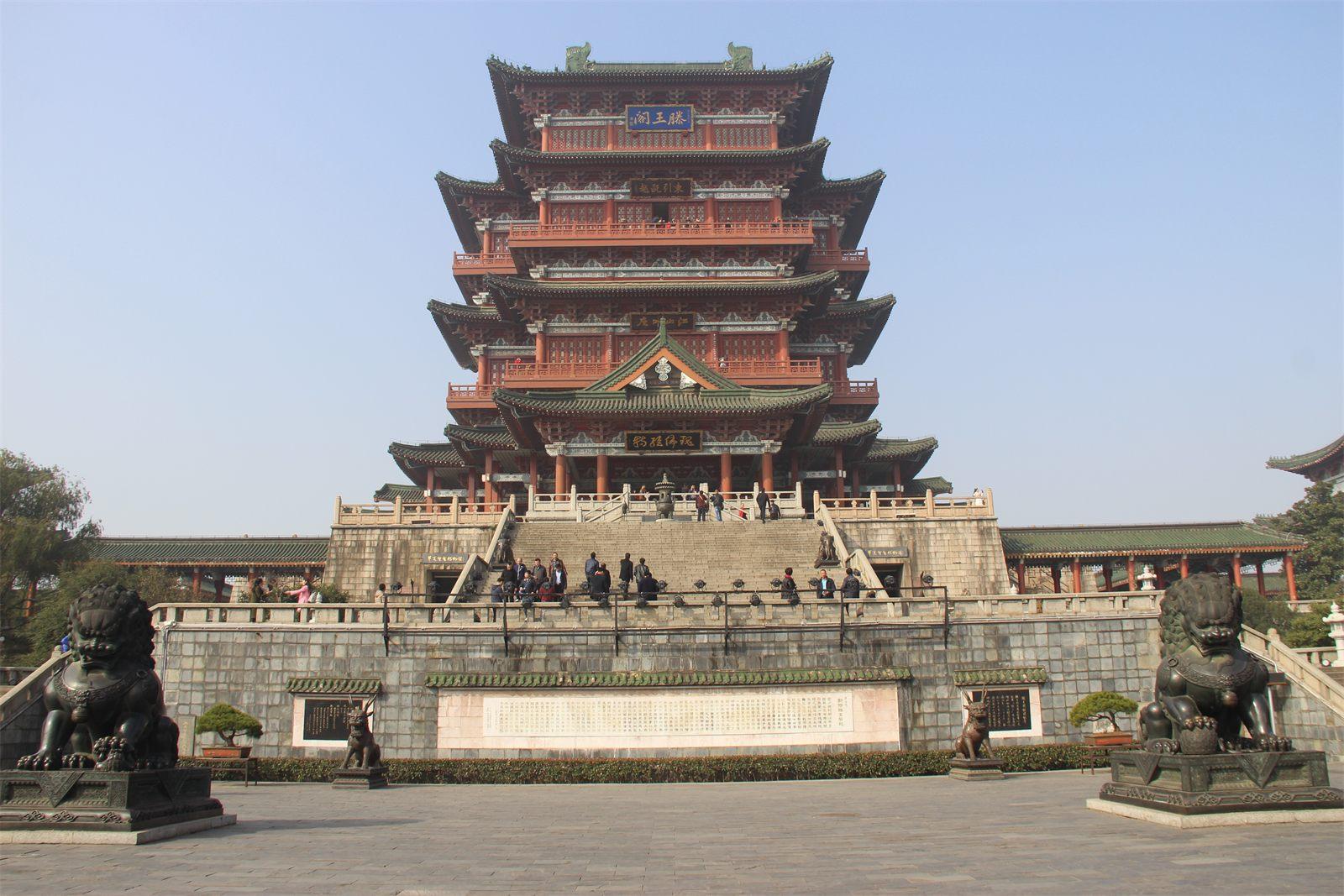
Tengwang Pavilion (滕王阁) from the entrance plaza, where the climb begins — jade-green roofs, vermilion pillars, and the stone plinth that stands in for the old city wall. — Photo: Gary Todd / Wikimedia (CC0)
Stand here first
Sunset on the top gallery — the one view that started everything.
Stop reading for one second and just look. You are on the top gallery, a little out of breath from the stairs, the rail under your hands, a wide brown river going gold below you — and the sun is sliding down to meet it. This is Tengwang Pavilion (滕王阁, Téngwáng Gé — "the Pavilion of Prince Teng"), on the east bank of the Gan River in the middle of Nanchang. Give it the last hour of daylight — and check the visiting section before you book, because for much of the year that means an evening ticket rather than a day one. You'll understand this whole story faster standing still than reading it.
Out past the eaves the Gan River (赣江, Gàn Jiāng) turns silver, then bronze, then the colour of weak tea. One bird crosses it. On the far bank the glass towers catch fire in the last light. For a few minutes the water and the sky are the exact same colour, and you genuinely cannot find the line where one ends and the other begins.
A young man stood about where you're standing and watched this precise thing happen, roughly 1,350 years ago. He wrote one sentence about it. That sentence is the reason you climbed up here tonight — even if nobody told you that yet, and even though almost nothing you can touch is older than 1989.
Here's the strange thing about this tower, and it's worth carrying up the stairs with you: it keeps burning down. Fire, war, flood, plain collapse — over thirteen centuries this pavilion has been destroyed and built again, and again, roughly twenty-nine times.
Most things that burn down twenty-eight times are left as ash. Nobody rebuilds a wooden tower for the twenty-ninth time by accident. Every single time, somebody stood in front of the rubble and decided it had to exist again.
So this story isn't really about "how old is it" — the building under your feet is younger than a lot of the people reading this. The question is sharper, and stranger: why has one riverside tower refused to stay dead for thirteen hundred years, when the wood keeps turning to ash? The answer isn't in the timber. Hold that thought, and let's go back to the start.
What you're actually looking at
What a "pavilion" really is, and why China builds towers just to climb them.
First, what kind of building is this — because the English word sells it short. We translate the Chinese 阁 (gé) as "pavilion," and you immediately picture a little garden gazebo. Wrong size, wrong mood. A gé is a tall, open, many-storeyed wooden hall built for one purpose: the view. Airy, railed, made to be climbed and looked out of. It's not a temple — you don't pray here. Not a palace — nobody ruled from here. Not a fortress — it never defended a thing. It's a building whose entire job is to get you up high and hand you the horizon.
That craving has a name in China: 登高 (dēng gāo) — "climbing high" — the old, deeply Chinese pleasure of getting above the land to feel the size of things. People have built towers for no reason but this for as long as there have been people in China to build them. Tengwang Pavilion is, at bottom, the grandest excuse in all of Jiangxi to climb high and look far.
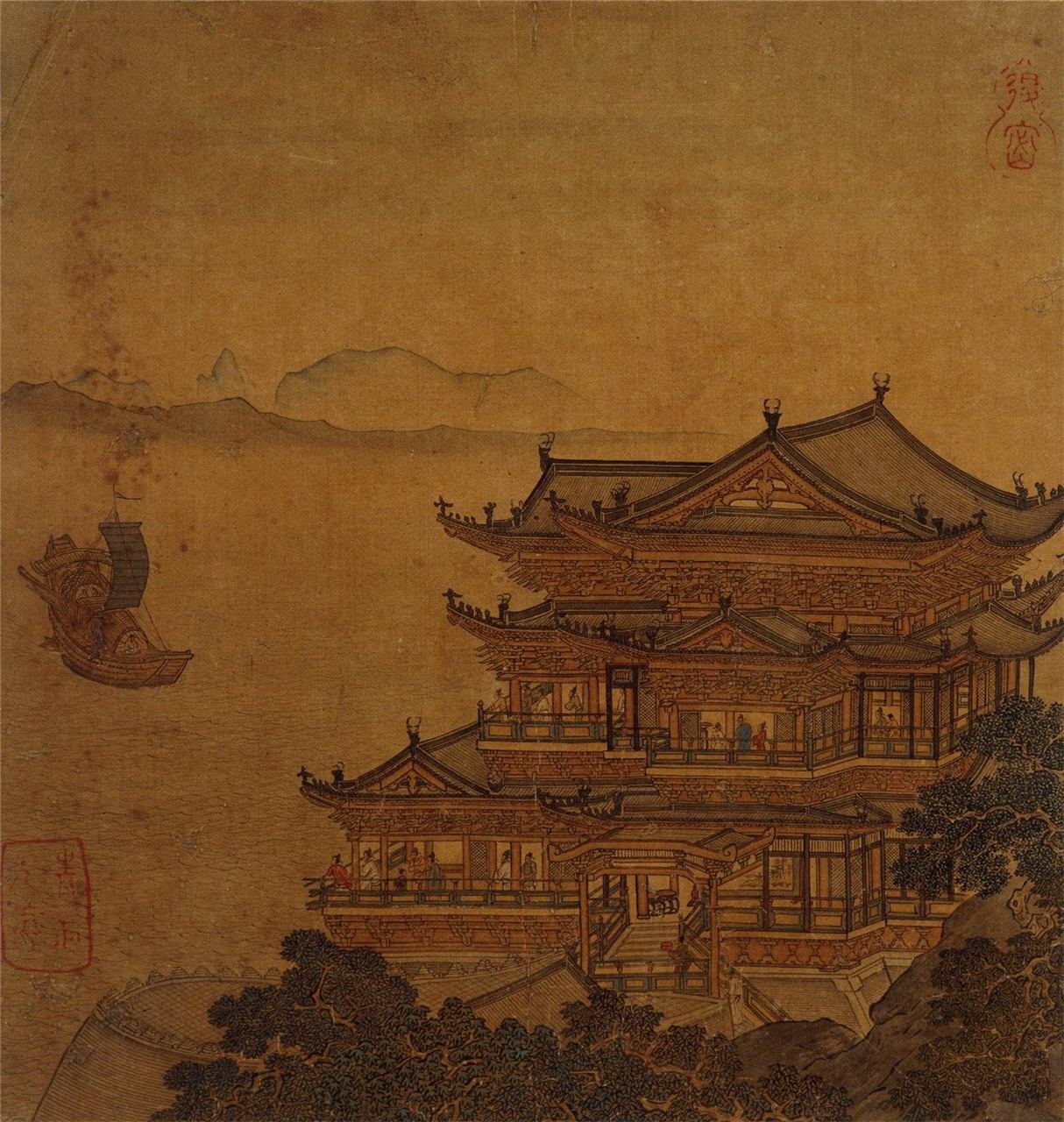
A riverside tower as the old painters imagined it — built for the pleasure of climbing high. — Qiu Ying (Ming), Shanghai Museum (public domain)
Where you're standing: the east bank of the Gan River — the old-city side, with the glass towers of Honggutan on the far bank, central Nanchang (南昌, Nánchāng), capital of Jiangxi province (江西, Jiāngxī) in southeastern China — river country, deep inland, a long way from any coast. Thirteen centuries ago, in the Tang dynasty, this was a rich river prefecture called Hongzhou (洪州, Hóngzhōu). The pavilion has stood, fallen, and stood again on this same stretch of riverbank the entire time.
Now the big claim. Tengwang counts as one of the Three Great Towers of the South (江南三大名楼, Jiāngnán sān dà mínglóu) — the three most celebrated towers in all the land south of the Yangtze River. The other two are the Yellow Crane Tower (黄鹤楼, Huánghè Lóu) in Wuhan and Yueyang Tower (岳阳楼, Yuèyáng Lóu) on Dongting Lake.
And here's the detail that unlocks everything else. Each of those three is famous for the same reason — not its height, not its age, not any battle. Each one is famous because of a single piece of writing. One poem or essay, written at the tower, made it immortal. Take the words away and you've got three pleasant old towers among hundreds. The writing is the building. Hold onto that one — it's the whole secret of this place.
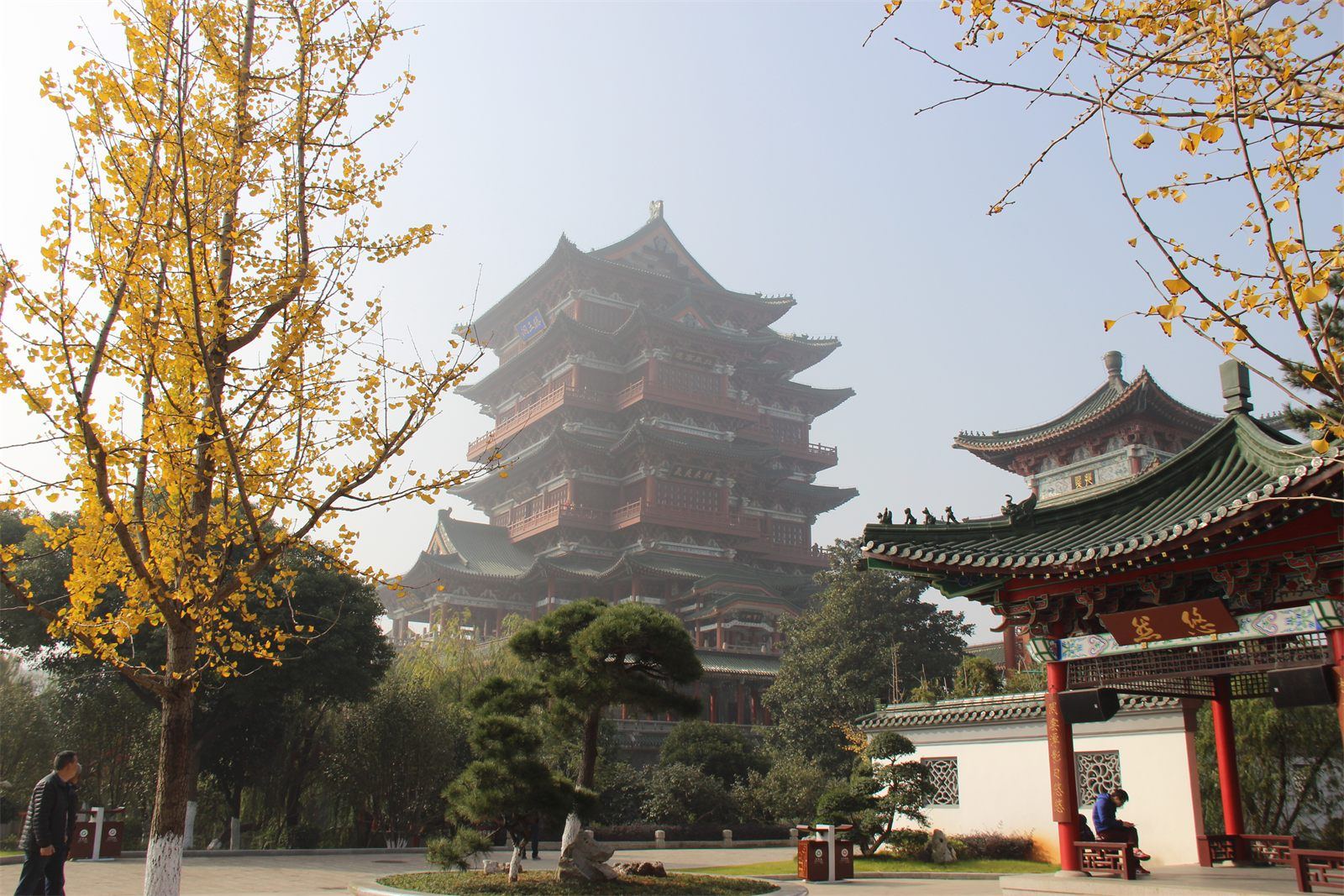
The pavilion you climb today, rebuilt in 1989 on the same riverbank — jade-green (碧瓦) roofs and red pillars, not imperial yellow. — Photo: Gary Todd / Wikimedia (CC0)
So who built it. "Tengwang" means Prince Teng (滕王, Téng Wáng), and the prince was a real man: Li Yuanying (李元婴, Lǐ Yuányīng) — the twenty-second and youngest son of Gaozu, the founding emperor of the Tang. That made him the younger half-brother of the great emperor Taizong, and uncle to Gaozong, the emperor sitting on the throne in his day. The court posted him out to govern Hongzhou (洪州, Hóngzhōu) — the Tang-era name for Nanchang — around the year 653, and that is when this pavilion first went up.
Now forget any picture of a solemn royal patron. Li Yuanying was, by every account, a glorious waste of a governor — a man who loved music, danced beautifully, painted well enough to launch his own little school of butterfly painting, and put up elegant pleasure-pavilions in every city they sent him to. One in Suzhou, this one here, another later in Sichuan.
Which means the most quoted building in all of Chinese literature began life as a bored prince's riverside party house — somewhere to pour wine, hear music, and watch the Gan River drift by. No god, no emperor's tomb, no holy relic. A banquet hall with a really good view. Everything sacred about Tengwang Pavilion got added later — by accident, by a stranger, in the space of one afternoon. That's the story the next chapter picks up.
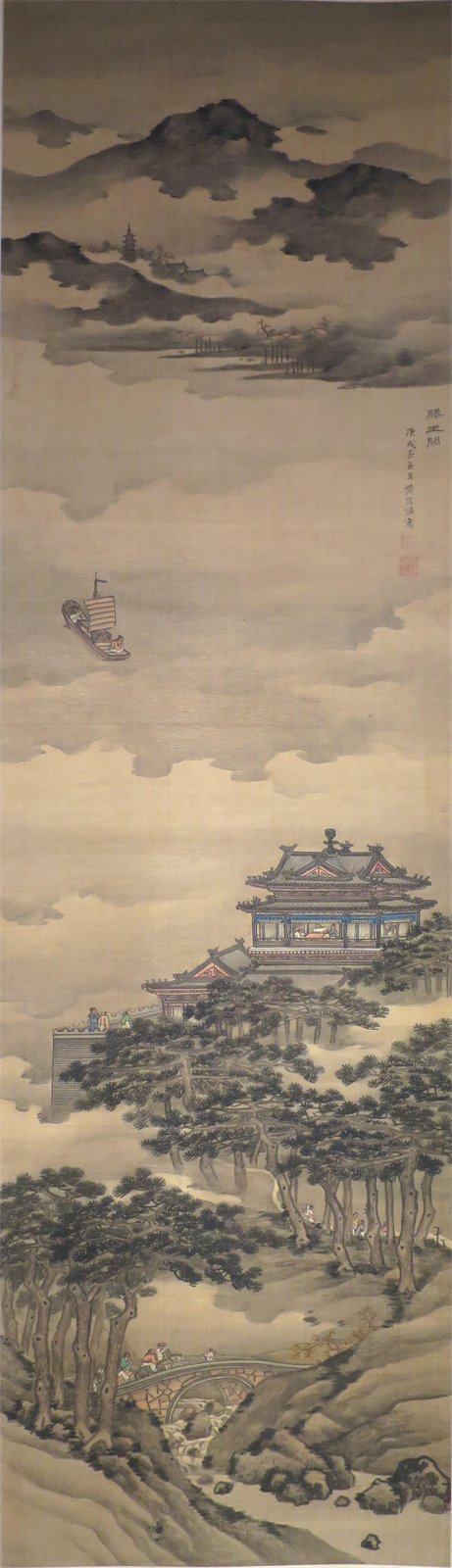
The tower as 1670 remembered it — a prince's party house, already a thousand years famous. — Huang Yingchen, 1670 (public domain)
Destroyed & Reborn
Fire, war, flood — and thirteen centuries of rebuilding. The full timeline.
The year was 653. No temple. No fortress. Just a place to drink wine, hear music, and watch the boats slide past on the Gan.
The prince, as the last chapter set out, was Li Yuanying — imperial blood, a talent for parties, and a governorship he treated as a posting to be decorated rather than administered. Nothing about the tower's first years suggests anyone expected it to outlive him, let alone the dynasty. He had no idea he was building a thousand-year-old idea.
Hold that as you climb it. The Tengwang Pavilion was never planned to be a monument. It became one almost by accident — and then it spent the next thirteen centuries refusing to stay standing.
A building can be born twice. The Tengwang Pavilion's second birth came in the autumn of 675 — and this one was not made of wood. It was made of words.
The governor of the day, Yan Boyu (阎伯屿, Yán Bóyǔ), had just restored the pavilion and threw a banquet to show it off. The date was the Double Ninth Festival — the ninth day of the ninth lunar month, the one day in the calendar when Chinese tradition sends everyone climbing to high places. A passing young poet named Wang Bo (王勃, Wáng Bó) picked up a brush at that banquet and, the story goes, wrote on the spot the single most famous piece of prose the building would ever inspire.
From that afternoon the pavilion stopped being a structure on a riverbank and became the thing the poem described — a name every Chinese schoolchild still memorises. And here is the strange consequence, the one that explains everything that follows: a building made immortal by a poem no longer really needs to survive as a building. It only needs to keep being rebuilt. Which is exactly what happened — again, and again, and again.
落霞与孤鹜齐飞,秋水共长天一色
the setting sun and a lone wild duck fly together; the autumn waters share one colour with the boundless sky
Wang Bo, 675 — the line that made the tower
1648.
The first of the great burnings came as one dynasty killed another. In 1648, with the Ming dynasty collapsing and the Qing conquest tearing through central China, the pavilion went up in flames — caught in the fighting as the Ming defenders torched the ground around the city to deny it to the enemy.
Nanchang sat squarely in the path of that change of dynasties, and the same fire and sword that ate the tower was busy reordering the whole country. Within a few years the pavilion was up again — and so the pattern that defines it was set. This was only the opening round of the Qing dynasty's long, brutal run with the building: over roughly 260 years the Qing would watch it ruined and raised again thirteen separate times — by fire, by war, by simple collapse.
1853.
Two centuries on it happened on a far larger stage. In 1853, during the Taiping Rebellion — by death toll the deadliest civil war in human history — Taiping armies stormed Nanchang, and the pavilion burned to ash in a fire that ran for three days and took much of the city down with it.
This is the rhythm of the place. The pavilion does not stand outside Nanchang's history, watching it pass. It stands dead in the middle of it. When the city burns, the tower burns. When the city rebuilds, so does the tower. Read its scars and you are reading the city's.
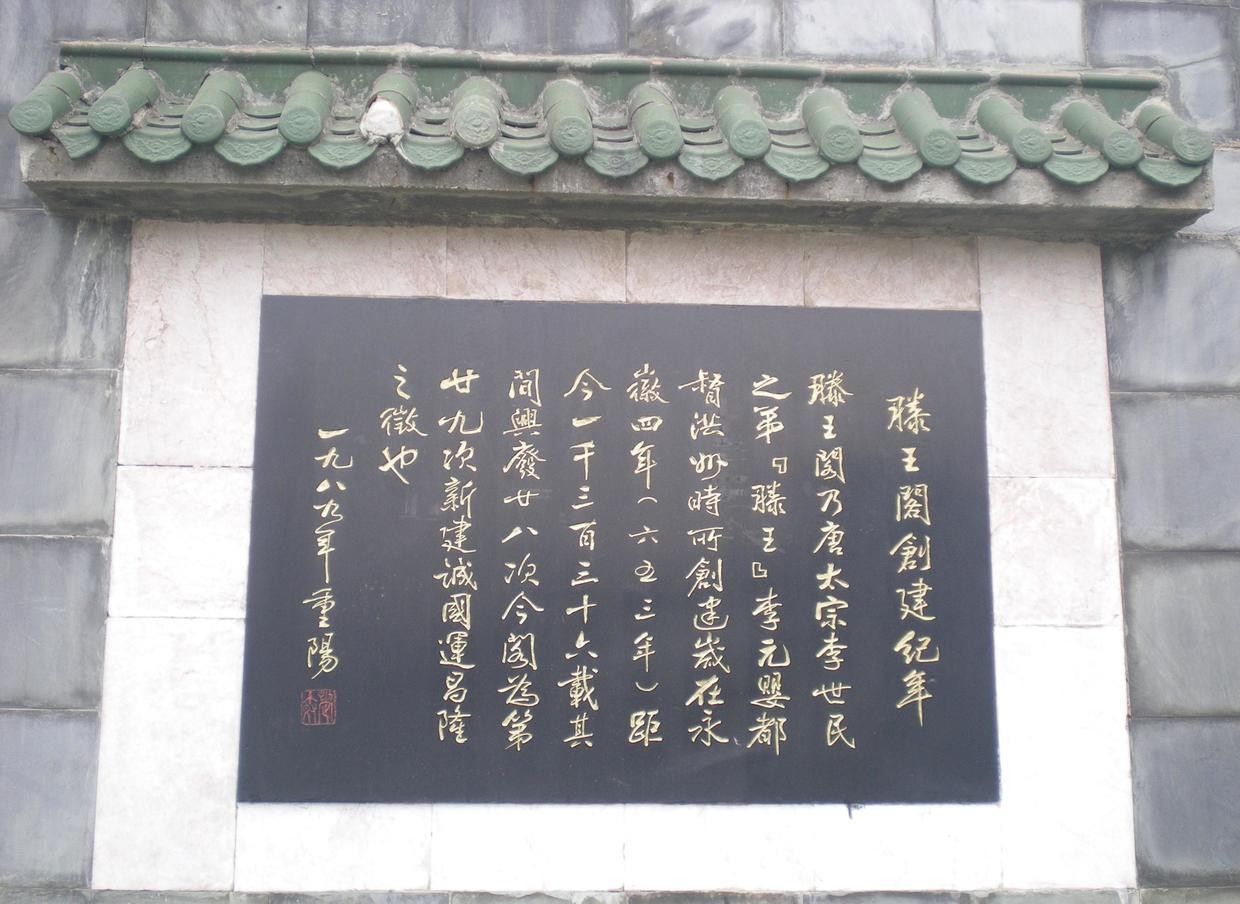
The 滕王阁创建纪年 tablet on site does the counting for you. It records the founding in the fourth year of Yonghui — 653 — and then, plainly: 其间兴废廿八次,今阁为第廿九次新建. Twenty-eight cycles of rise and fall; the tower you are standing in is the twenty-ninth. It is signed at the Double Ninth Festival, 1989 — the very day the present pavilion opened.
October 1926.
The last of the old pavilions died in October 1926 — and almost nothing of it lived to be photographed.
As the Northern Expedition army closed in on Nanchang, the warlord commander defending the city, Yue Siyin (岳思寅, Yuè Sīyín), ordered the whole zone outside the city wall set alight to deny the attackers any cover. The pavilion stood inside that zone. It went up with everything else. When the smoke finally cleared, all that was left of thirteen centuries was a single blue-stone plaque carved with three characters — 滕王阁, "Tengwang Pavilion." One slab of stone, and a name.
And then — nothing. For the better part of sixty years. The riverbank where a tower had stood since the Tang lay empty for the better part of sixty years. By tradition the ruined site sank to its lowest use of all: at one bleak point under wartime occupation it was a pasture for army horses. The grandest symbol of old Nanchang had become a vacant lot by the river.
The 1927 coincidence next door
Here is the coincidence that haunts this riverbank — and it is only a coincidence; hold it as one. The old city's grandest symbol burned to a single stone in 1926. One year later, on 1 August 1927, a few streets away in a building called the Jiangxi Grand Hotel (江西大旅社), the Nanchang Uprising broke out — the moment the modern Chinese army dates its birth to, the reason Nanchang calls itself "the place where the army's flag rose."
One symbol of old Nanchang went dark as a new, modern one was lit — within a year of each other, in the same city, with nothing connecting them but the calendar. The pavilion did not start the revolution, and the revolution never touched the pavilion. But stand on this riverbank with both dates in your head, and it is hard not to feel them leaning quietly against each other.
1983–1989.
The tower you climb today opened on 8 October 1989 — and the most remarkable thing about it is that it was built from a forty-seven-year-old drawing of a building that no longer existed.
Back in 1942, with the old pavilion already fifteen years gone and the country at war, the great architect Liang Sicheng (梁思成, Liáng Sīchéng) — the man who first mapped China's ancient buildings as a scholarly field — set out to bring it back on paper. With his young assistant Mo Zongjiang (莫宗江, Mò Zōngjiāng), he drew a full set of reconstruction sketches, working from a surviving Song-dynasty painting of the pavilion and checking every joint against the Song building manual Yingzao Fashi (《营造法式》, "Treatise on Architectural Methods"). They were designing a tower no one had the money or the peace to build. The decision to actually raise it came decades later: the city resolved to rebuild in 1983, broke ground in 1985, and opened the doors in 1989. What rose is honest about what it is: reinforced concrete, dressed in the timber-frame style of the Song, standing about 57.5 metres tall on a broad stone plinth that stands in for the old city wall the pavilion once rose beside. How many storeys that actually gives you is its own puzzle, and the floor-by-floor chapter takes you through it.
So how many times has the Tengwang Pavilion fallen and risen? The tablet standing on the site answers it in one line, and the two numbers people quote turn out to be the same count read two ways: twenty-eight cycles of destruction and rebuilding, which makes the tower you are standing in the twenty-ninth.
Count one way and it is 28 — a careful, dynasty-by-dynasty tally of every repair and rebuild: five times under the Tang, once under the Song, twice under the Yuan, seven times under the Ming, and thirteen times under the Qing. Count the 1989 concrete tower as the newest in the line and it becomes 29. Sober sources hold to each total with a straight face.
Either way, the number is the point: about 28 or 29 times across roughly thirteen centuries, this building has burned, fallen or simply crumbled to nothing — and every single time, someone in Nanchang decided it had to come back. Few buildings on earth have been so thoroughly destroyed, so many times, by so many different disasters, and so stubbornly raised again anyway.
- 653 CE — Prince Teng builds it Li Yuanying (李元婴), Prince of Teng and youngest son of the Tang founding emperor, raises the pavilion on the Gan River as a riverside banquet hall while governing Hongzhou (Tang-era Nanchang). The most quoted building in Chinese literature begins as a prince's party house.
- 675 CE — Wang Bo writes the Preface Governor Yan Boyu restores the pavilion and holds a Double-Ninth banquet; the passing young poet Wang Bo improvises the 《滕王阁序》 (Preface to the Pavilion of Prince Teng) on the spot. The tower's "second birth" — physical building becomes cultural landmark.
- 848 — Burned and rebuilt the same year One of five Tang-era rounds of ruin and repair; rebuilt within the year.
- 1108 — Song rebuild Restored under the Northern Song (governor Fan Tan).
- 1294 & 1334 — Yuan rebuilds Twice rebuilt under the Yuan dynasty.
- 1519 & 1616 — Ming destructions Destroyed in the Prince of Ning (朱宸濠) rebellion in 1519, burned again in 1616; seven Ming-era cycles in all.
- 1648 — Burned in the Ming–Qing war Put to the torch as the Ming dynasty fell and the Qing conquest swept central China; rebuilt 1654. Opens the Qing's run of 13 rebuilds over ~260 years.
- 1853 — Burned to ash in the Taiping Rebellion Destroyed with much of Nanchang in a three-day fire during the Taiping assault, the deadliest civil war in history; rebuilt 1872.
- 1908–1909 — The last pre-modern rebuild The final Qing-era burning and rebuild; the last old pavilion.
- October 1926 — The last old tower burns As the Northern Expedition closes on Nanchang, warlord commander Yue Siyin orders the area outside the city wall torched; the pavilion is destroyed, leaving only a single blue-stone "滕王阁" plaque. The site then lies empty for ~57 years.
- 1942 — Liang Sicheng draws the plans Architect Liang Sicheng and his assistant Mo Zongjiang produce reconstruction sketches, based on a surviving Song-dynasty painting of the pavilion and the Song manual Yingzao Fashi.
- 1983 — Rebuild begins Nanchang resolves to rebuild and forms the preparatory committee. Ground is broken on 22 October 1985 — itself a Double Ninth — on the original riverbank site, following Liang Sicheng's 1942 scheme.
- 8 October 1989 — The present pavilion opens Reinforced concrete in Song-dynasty style, about 57.5 metres tall, 明三暗七 (three storeys seen, seven hidden). The latest in the line — by one count the 29th.
A fair question to ask at the foot of a 1980s concrete tower: is this really the Tengwang Pavilion? Or just the newest copy of something genuinely gone?
It is the question you could put to almost any ancient Chinese landmark — because Chinese tradition has never located a building's soul in its original timbers. It locates it in three things that have come down unbroken: the site — this exact bend of the Gan River; the name — those three characters that outlived every one of the fires; and the memory — a poem thirteen hundred years old that every visitor still carries up the stairs.
By that reckoning the building was never really the pavilion in the first place. The pavilion is the idea — and the idea has not once burned down. The concrete is simply this century's way of holding it up. You don't climb the Tengwang Pavilion to see a Tang building. You climb it to stand inside a Tang poem, on the spot where it was written, looking at the river that put it there.
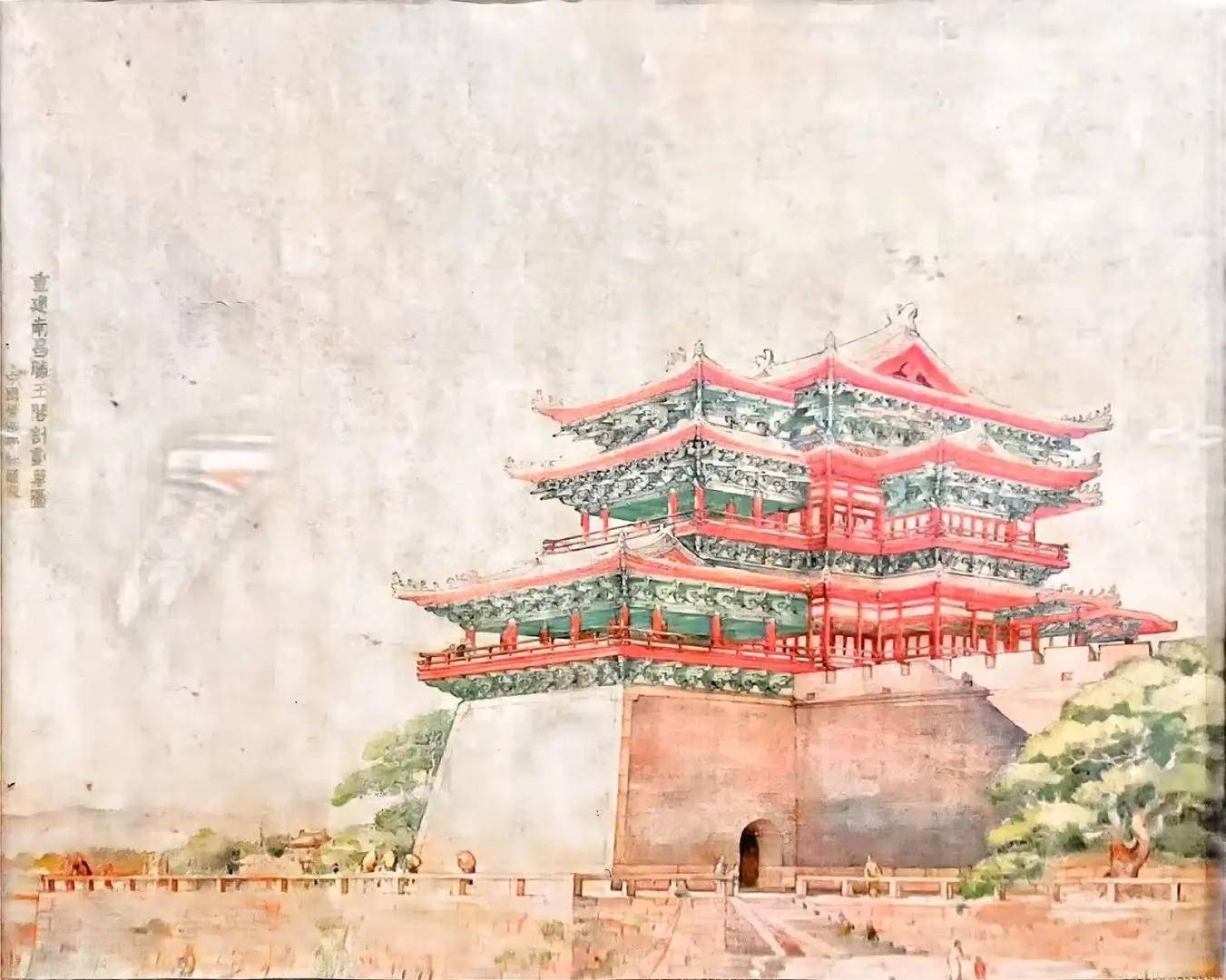
What they drew while the site was empty: the coloured presentation sheet of 重建南昌滕王閣計劃草圖, 1942. There was no money, no peace and no prospect of building it. The tower that finally opened in 1989 followed this scheme, though it grew taller and lost the gate.
Wang Bo & the Preface
A young poet gatecrashes a governor's banquet — and writes the Preface.
The young man who walked into the banquet in 675 was a prodigy in disgrace, travelling toward the unhappiest reunion of his life.
His name was Wang Bo (王勃, Wáng Bó), courtesy name Zi'an. He was around twenty-five, and already famous — ranked first among the "Four Paragons of the Early Tang" (初唐四杰, Chū Táng Sì Jié), the cluster of young writers credited with snapping Tang poetry out of the hollow, over-perfumed court style of the age before and bending it toward greatness. He had been writing acclaimed verse since he was a child.
He was also a genius at wrecking his own life. His first court post collapsed when he dashed off a joking mock-proclamation during a princes' cockfighting feud; the emperor was not amused, and threw him out. Then came something far darker — he sheltered a runaway government slave and then, by most accounts, killed the man to cover himself when the matter surfaced. The crime carried a death sentence, later lifted under a general amnesty. But the wreckage didn't stop at him.
His father was demoted and banished for it — sent far south to Jiaozhi (交趾, Jiāozhǐ), Tang-ruled territory in what is now northern Vietnam, out near the edge of the known world. And that is the only reason Wang Bo was on the road through Hongzhou at all. He was travelling to visit the father his own disgrace had exiled.
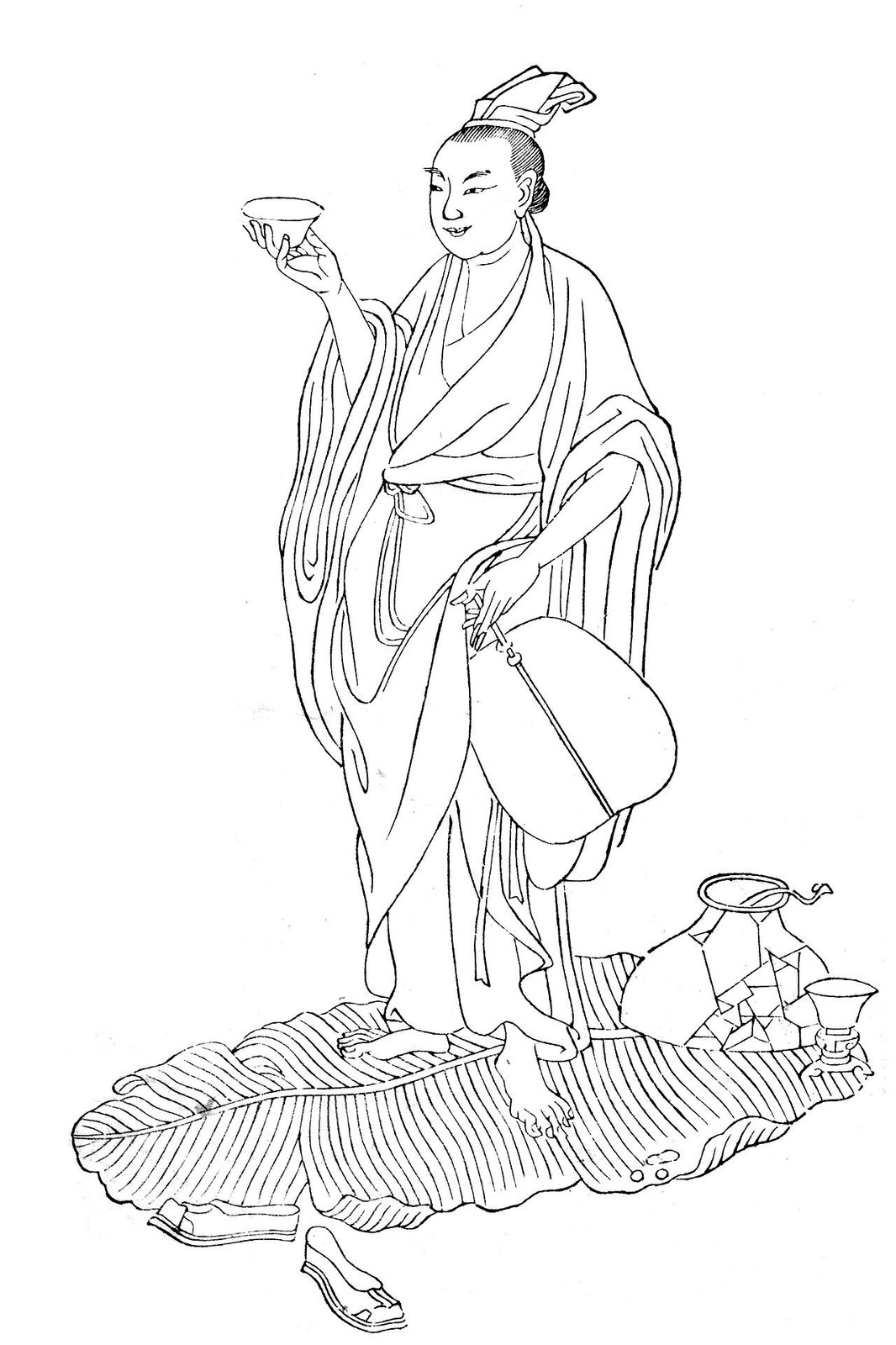
Wang Bo (王勃, 650–676) — the disgraced prodigy who walked into the banquet and, in one afternoon, made the building immortal. — Portrait from 《晚笑堂竹莊畫傳》 (public domain)
The banquet he stumbled into was, the story goes, a setup — and it was not arranged for him.
The tale comes from a collection of anecdotes set down generations later, so treat it as the beloved legend it is, not a transcript. The governor, Yan Boyu (阎伯屿), had restored the pavilion and thrown the Double-Ninth feast partly to show off his son-in-law, who had quietly pre-written a preface he was meant to deliver as if it had poured out of him on the spot — a little piece of theatre to dazzle the guests.
So when Yan made his grand show of inviting any guest to compose a preface then and there, the whole room understood the script. The brush and paper went round the tables, and one polished guest after another politely declined — clearing the stage, as planned, for the son-in-law.
Everyone declined, that is, except the unknown, low-ranking, twenty-something traveller sitting in the corner. Wang Bo took the brush. And he began to write, in front of the entire banquet, the preface he had not prepared and had no business attempting.
Yan Boyu, the story goes, was furious. He rose and stalked off behind a screen — but he couldn't quite let it go. He sent a servant creeping back to relay each line as the young stranger wrote it.
The opening came back to him: "Nanchang the old commandery, Hongdu the new prefecture…" — the usual stock openings, he scoffed, nothing to fear here. The next lines came back, and he said nothing at all. And then the servant carried in the line that ended the argument.
落霞与孤鹜齐飞,秋水共长天一色
the setting sun and a lone wild duck fly together; the autumn waters share one colour with the boundless sky
Wang Bo, Preface to the Pavilion of Prince Teng
And the governor, the story goes, gave up the fight. "此真天才" — "This is true genius," he is said to have cried, "it will last forever." The son-in-law's prepared speech was never called for. A passing stranger had walked in off the road and written, off the cuff, the thing the building would be remembered for forever.
So how much of that really happened? The hard core is solid: Wang Bo did compose the《滕王阁序》(Téngwáng Gé Xù — Preface to the Pavilion of Prince Teng) at this banquet, in 675, and he finished it on the spot. The rigged son-in-law, the storming-off, the servant relaying lines, the governor's cry — those all come from a later anecdote, retold so often it now feels like fact. The legend even shaves a decade off his age to make the feat more miraculous, casting him as a boy of fourteen; he was closer to twenty-five. The most romantic version has a water god send a magic wind to blow his boat hundreds of miles overnight so he'd reach the party in time — and that one is openly a folk tale. Strip all of it away and the astonishing part survives untouched: a young man in disgrace sat down at a stranger's party and improvised a masterpiece.
You'll notice the English of that line above is lovely and still somehow falls short. There's a reason — and it's worth understanding before you climb.
Wang Bo wrote in parallel prose (骈文, piánwén), the most prestigious high style of his age, nicknamed "four-six prose" for its lines of four and six characters. Three things make it sing in Chinese, and English can hold none of them at once. First, everything arrives in matched pairs — line answering line, noun for noun, image for image, like architecture built out of words, every beam balanced by its twin.
Second, tone. Classical Chinese ran on rising and falling tones, and the lines are tuned so the sounds chime against one another — it is built to be chanted aloud, with a music English simply has no equivalent for. Third, allusion: nearly every line folds in a buried reference to older history or legend, so an educated Tang reader heard a dozen echoes inside a single phrase.
Put it this way: in Chinese the preface is a piece of music; in English you only get the lyrics. Which is exactly why it's worth standing where it was written — the river and the sunset are the one part of it that needs no translation at all.
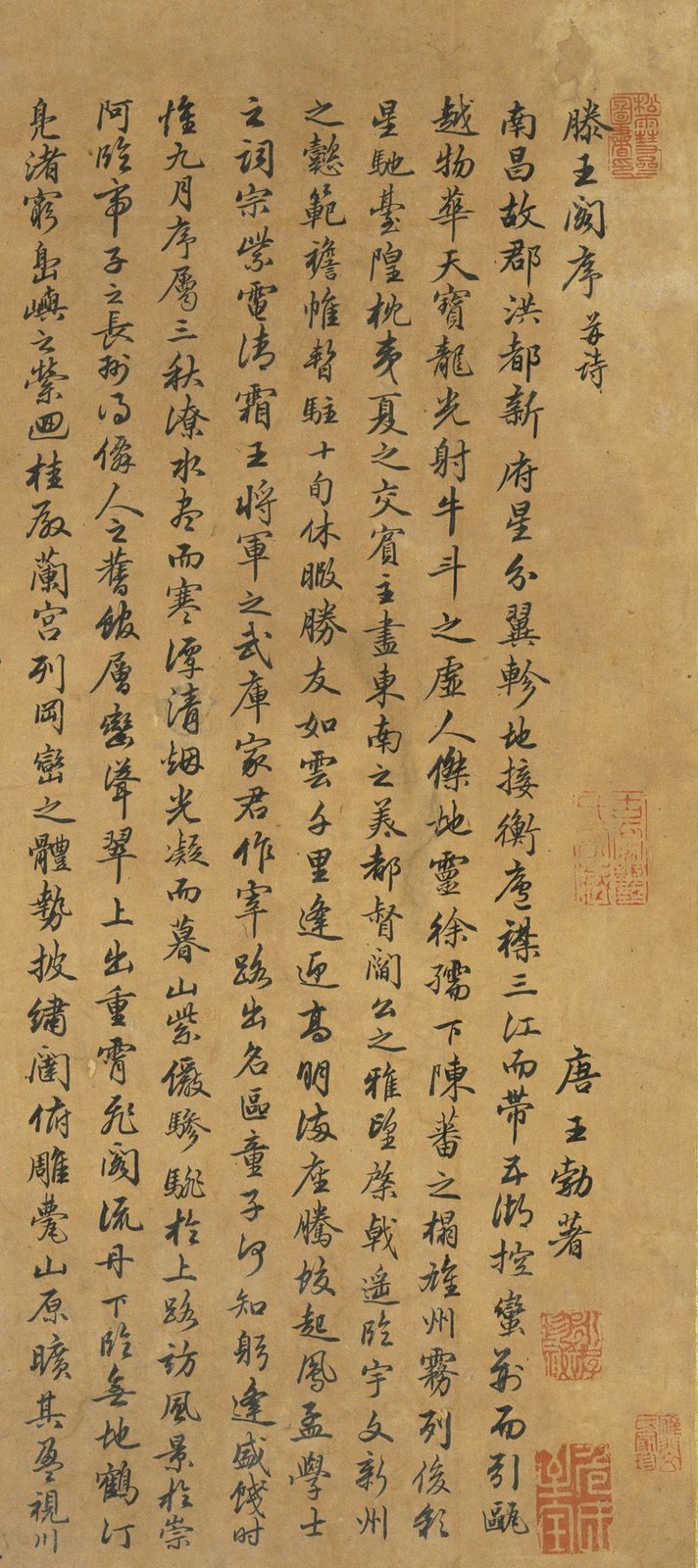
Up close you can see the collector's seals stamped down the margins in vermilion, and the title and attribution — 滕王閣序 並詩, 唐王勃著 — brushed at the head of the scroll. The same handscroll, attributed to Zhao Mengfu and catalogued by the museum as spurious. — National Palace Museum, Taipei — public domain
Here is the gut-punch. Wang Bo wrote the most celebrated lines of his life on this one trip — and he was dead within about a year, before he turned twenty-seven.
He went on south and reached his father in Jiaozhi. Then, crossing the sea on the way home, by the traditional account his boat was caught in a storm and went under, and he drowned — around 676, aged roughly twenty-six. The first of the Four Paragons of the Early Tang, the prodigy who had outshone them all, was gone almost before his greatest work had finished circulating.
So the building and its poet share one strange fate. Wang Bo's body was lost to a storm at twenty-six; the pavilion he made famous burned to the ground some twenty-eight or twenty-nine times over. Neither, in the ordinary sense, survived. And yet both are still here — the tower raised one more time in concrete, the poem recited one more time by every visitor who climbs it. He looked at this river one autumn afternoon and found words that outlasted his own life, the building, and thirteen centuries of dynasties. Stand on the top gallery at dusk and you can check his work: the sun goes down over the Gan, the river and the sky run together into a single colour — and it turns out he wasn't exaggerating at all.
The preface, line by line
The famous lines, decoded — Chinese, pinyin and plain English.
One sentence, written here in a single autumn afternoon, is the reason this tower has been rebuilt for thirteen hundred years. You are about to read the four lines that matter most. First, ten seconds of secret decoder — because the best part of this poem is the part that does not survive the trip into English.
10-second decoder: why it sings in Chinese
Watch what the form does to this one couplet. Sunset answers autumn water; a lone duck answers the endless sky; motion answers stillness, one small living thing answers the whole horizon. Each half is built to the same length and the same grammar as its twin, so the two halves lock together like a beam and its mirror.
That is the part translation cannot carry across, and it is why the four lines below are set out as pairs. Read each one as two halves answering each other rather than as a sentence, and you will hear the shape of it even without the Chinese.
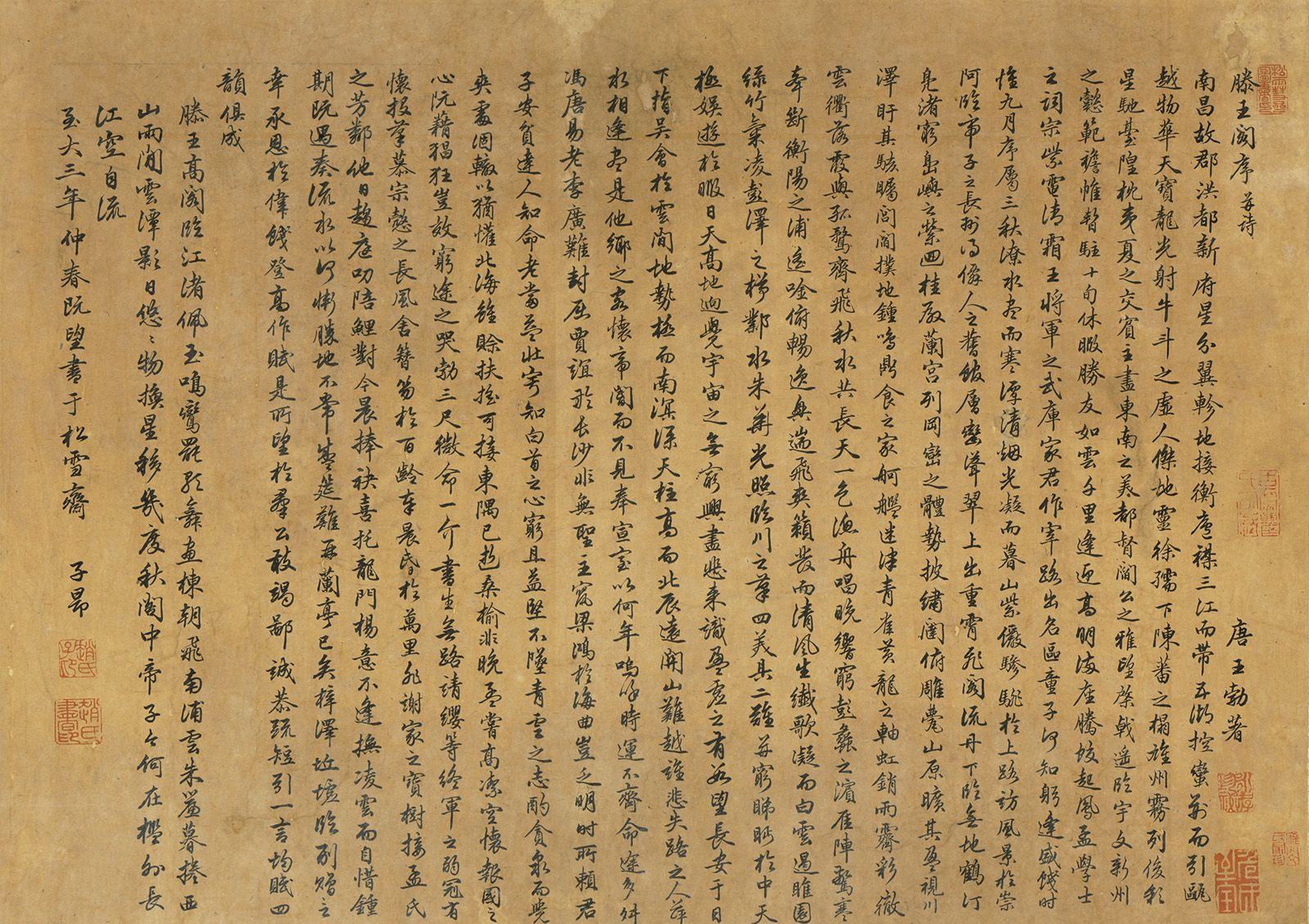
The Preface as calligraphy rather than as text — a handscroll of 滕王閣序並詩 in the National Palace Museum, Taipei. It is traditionally attributed to the Yuan master Zhao Mengfu; the National Palace Museum catalogues it as spurious (僞) — not his hand — which is worth knowing before anyone tells you otherwise. The four lines below are in there somewhere. — National Palace Museum, Taipei — public domain
滕王阁序 — lines from the Preface
Wang Bo (王勃)
落霞与孤鹜齐飞,秋水共长天一色。
Luòxiá yǔ gūwù qí fēi, qiūshuǐ gòng cháng tiān yì sè.
The sunset glow and a lone wild duck fly as one; the autumn waters and the endless sky run together into a single colour.
Word for word: Falling sunset-glow and a lone wild duck fly together; the autumn river and the long sky are one colour.
The most famous line in the whole preface — and, frankly, the reason this view is worth a special trip. Stand on the top gallery in the last hour of light and you see almost exactly what he saw: the Gan River (赣江, Gàn Jiāng) and the sky melting into one band of gold, a single bird crossing it. He didn't decorate the river. He described it. Time your climb for golden hour and the line stops being literature and becomes the thing right in front of you.
关山难越,谁悲失路之人?
Guānshān nán yuè, shuí bēi shī lù zhī rén?
The mountain passes are hard to cross — and who feels for the one who has lost his way?
Word for word: Passes and mountains are hard to cross; who pities the person who has lost the road?
Here the dazzle drops away and a young man's ache shows through. Wang Bo was brilliant, frozen out of court favour, and travelling far from home to see his exiled father when he stopped here. "Lost the road" (失路) means both things at once — blocked mountain passes, and a blocked career. This is the turn where the poem stops impressing you and starts moving you, which is why it has lasted thirteen centuries instead of just being admired.
萍水相逢,尽是他乡之客。
Píng shuǐ xiāng féng, jìn shì tā xiāng zhī kè.
We meet the way drifting duckweed meets the water — all of us strangers, far from home.
Word for word: Like duckweed and water meeting by chance, all are travellers in a strange land.
He wrote this about the room he was sitting in: a banquet of guests thrown together by chance, none of them local. 萍水相逢 — "duckweed meeting water" — became a stock Chinese phrase for a chance encounter, still said today. And it is the warmest of the four lines for a traveller standing on this exact floor: whoever you are, you are one more guest passing through, just like everyone in the room that autumn day in 675.
老当益壮,宁移白首之心?穷且益坚,不坠青云之志。
Lǎo dāng yì zhuàng, nìng yí báishǒu zhī xīn? Qióng qiě yì jiān, bù zhuì qīngyún zhī zhì.
Grow older and grow only bolder — why should grey hair change the heart? Fall on hard times and harden your resolve — never let go of the ambition that reaches the clouds.
Word for word: Old, one should be all the stronger — would one change a white-haired heart? Poor and worse off, one should be all the firmer — never let fall the ambition that reaches the blue clouds.
And then he refuses to feel sorry for himself. After the homesick gloom, this is the fist on the table — the part Chinese readers still quote to fire each other up: setbacks should make you tougher, not smaller. 青云之志, "ambition that reaches the blue clouds," is a living idiom for soaring aspiration to this day. He wrote it at about twenty-five and drowned at sea roughly a year later, near twenty-six — which lands like a weight when you read the words carved inside the tower he made immortal.
Pinyin (the scholar layer)
Pinyin, line by line. 落霞与孤鹜齐飞,秋水共长天一色。 — Luòxiá yǔ gūwù qí fēi, qiūshuǐ gòng cháng tiān yì sè. · 关山难越,谁悲失路之人? — Guānshān nán yuè, shuí bēi shī lù zhī rén? · 萍水相逢,尽是他乡之客。 — Píng shuǐ xiāng féng, jìn shì tā xiāng zhī kè. · 老当益壮,宁移白首之心?穷且益坚,不坠青云之志。 — Lǎo dāng yì zhuàng, nìng yí báishǒu zhī xīn? Qióng qiě yì jiān, bù zhuì qīngyún zhī zhì.
The building, floor by floor
Jade roofs, hidden storeys, and what's waiting on each of the six floors.
Stand on the plaza and count the storeys: three bright verandahed levels, stacked like a Song-dynasty painting. Now climb inside — and lose count completely. There are more floors in here than the outside will admit to.
That is on purpose, and it has a name: míng sān àn qī (明三暗七) — "three storeys seen, seven hidden." From outside the tower shows three bright, verandahed levels — floors one, three and five. The hidden four are not mezzanines or crawl spaces: they are the biggest rooms in the building. The Hall of Eminent People, the Hall of the Blessed Land and the Nine Heavens hall at the top are all "dark" storeys, invisible from the plaza because they have no open verandah. Add the two levels of the great stone platform it stands on and you reach the nine that some guidebooks quote. Three, seven or nine — every number is true, depending on where you're standing when you count.
The numbers worth pocketing: about 57.5 metres tall · reinforced concrete dressed as a Song-dynasty timber pavilion · roughly 13,000 square metres of floor space · opened 8 October 1989.
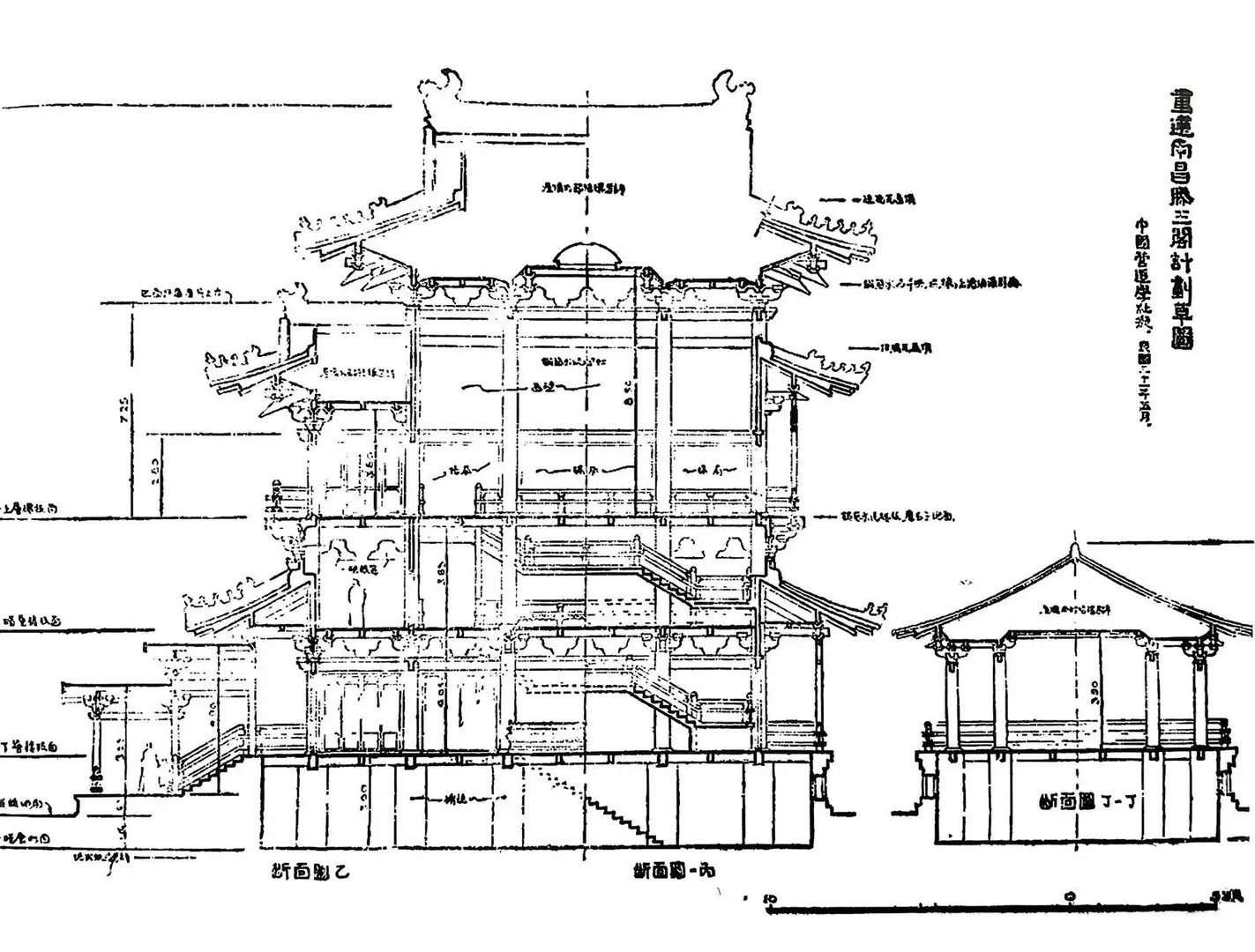
The clearest answer to the three-or-seven question is a drawing that cuts the building open. These 1942 sections — 斷面圖乙, 丙 and 丁 — cut the tower open so you can count what the facade hides: full-height halls stacked between the verandahed levels, not the shallow mezzanines the outside implies.
Notice the colour of the roof before anything else: the glazed tiles are jade-green (碧色琉璃瓦), not the imperial yellow that crowns the Forbidden City. That is a quiet signal. Yellow was the emperor's colour and his alone; green-blue glaze marks this as a nobleman's and a scholar's pavilion — a place for poetry and banquets, never a palace.
Look closer and the building is wearing the poem. The eave-end tiles are stamped "滕阁秋风" ("autumn wind at Tengwang Pavilion"), and the drip-tiles below carry a lone wild duck (孤鹜) — the exact bird from Wang Bo's crown line, repeated all the way round the roofline. The poem isn't only inside the tower; it's pressed into its edges.
The tower doesn't stand alone, either. Two smaller pavilions flank it — Yìcuì Pavilion (挹翠亭) to the north and Yājiāng Pavilion (压江亭, "pressing on the river") to the south — linked to the main hall by green-tiled covered galleries. The whole group rides a two-tier stone platform about twelve metres high, raised, the story goes, to stand in for the old city wall the pavilion once rose behind.
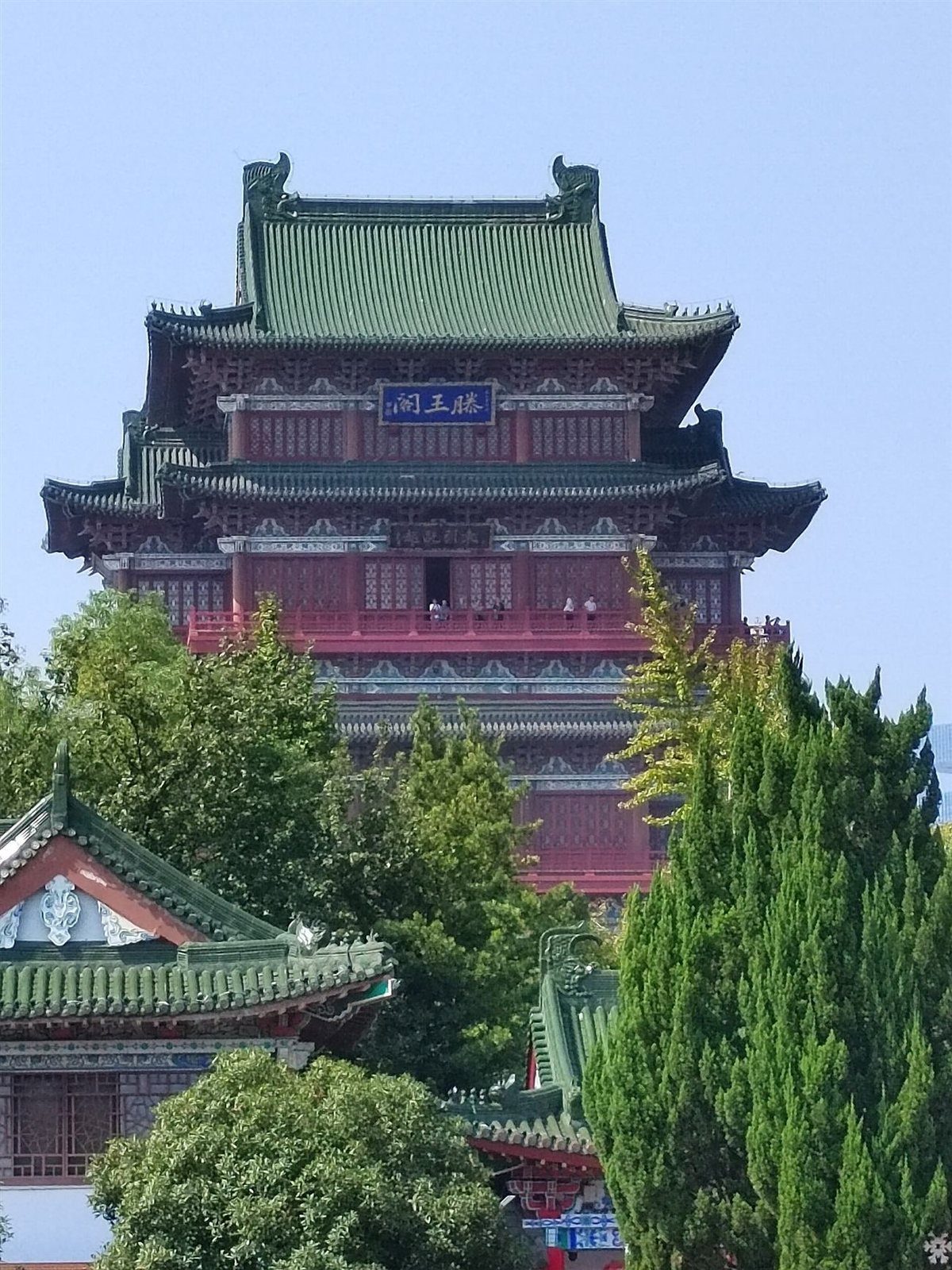
Jade-green tile, not imperial yellow — look closely and the roof is wearing the poem. — Photo: 沈澄心 / Wikimedia (CC0)
The most surprising thing about this very modern building is that its drawings are older than the country that built it. Liang Sicheng and Mo Zongjiang finished them in 1942; the concrete went up between 1983 and 1989. Forty-seven years passed between the drawing and the pouring, and almost nothing was changed in between — which is why a reinforced-concrete tower reads, from the plaza, as Song-dynasty carpentry.
Which is the answer to the objection you may already be forming — that a 1989 concrete tower cannot be the pavilion Wang Bo wrote about. Chapter seven takes that one on properly.
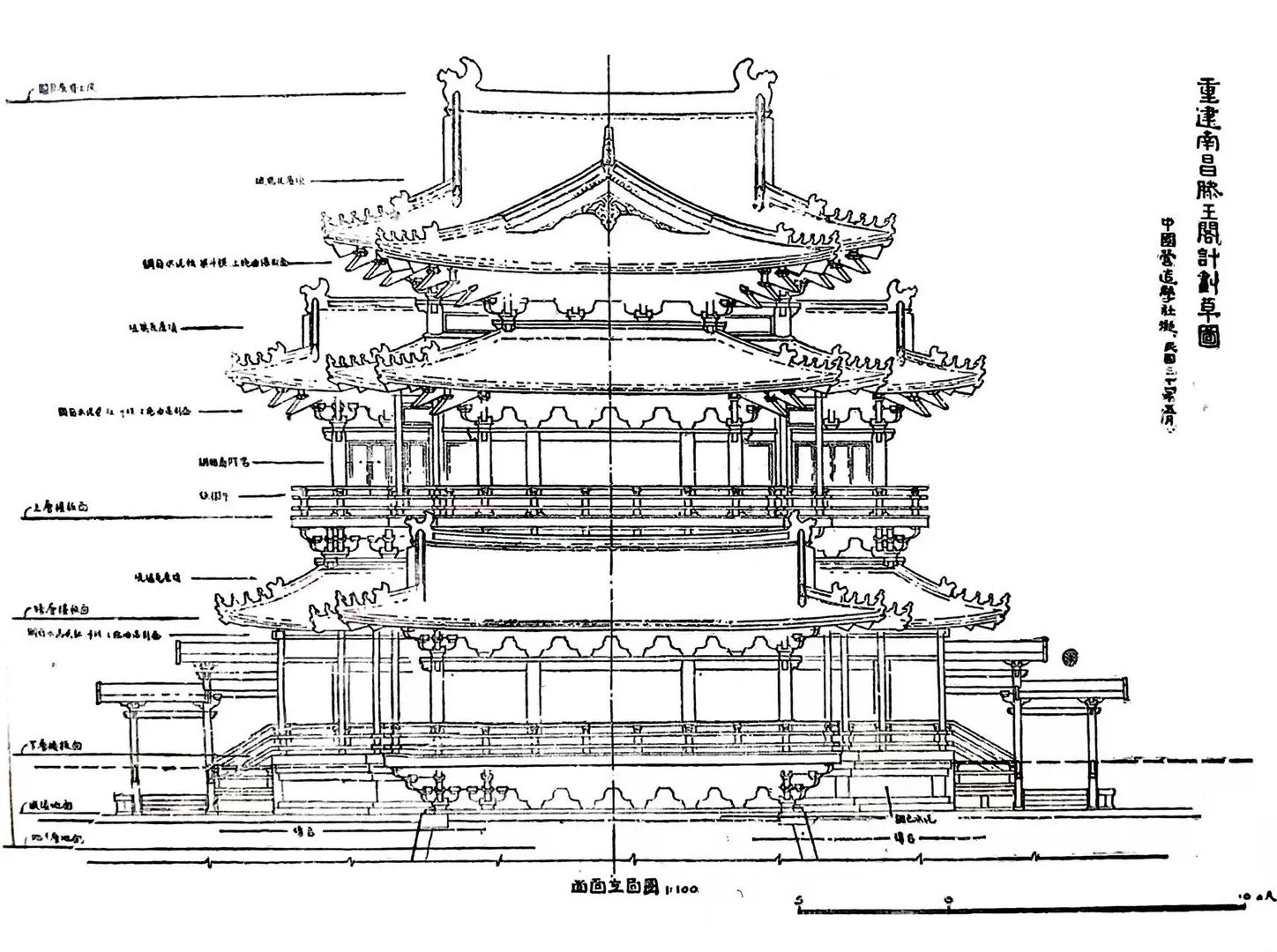
The elevation, drawn at 1:100 and inscribed 中國營造學社擬,民國三十一年五月 — the Society for Research in Chinese Architecture, May 1942. Forty-seven years before anyone poured concrete.
- Floor 1 — Entrance Hall (序厅) You walk in past a huge white-marble relief, "The wind that carried Wang Bo to the pavilion" (《时来风送滕王阁》) — the old legend that a river god sent a magic wind to blow the poet's boat here overnight, in time for the banquet. Above the pillars hangs Mao Zedong's calligraphy of the sunset couplet, The name-board "滕王阁" is attributed to, or written in the style of, the Song poet Su Shi (苏轼) — you will see it on the building's outer eaves rather than in here. A west hall stages the banquet itself, with lifelike figures of governor Yan Boyu and his guests caught mid-feast.
- 白玉浮雕《时来风送滕王阁》
- Mao Zedong 落霞 couplet calligraphy
- 滕王阁 name-board (on the outer eaves) — attributed to / in the style of Su Shi (苏轼)
- Yan Boyu banquet figures
- Floor 2 — Hall of Eminent People (人杰厅) The showpiece. "Portrait of Eminent People" (《人杰图》) is a polished-acrylic scroll-mural 2.55 metres high and 43.9 metres long that marches around the walls with roughly 80 famous figures from Jiangxi's history — poets, reformers, painters — spanning some two thousand years. This is the "人杰" (outstanding people) half of Jiangxi's old boast that it is a land of 人杰地灵, brilliant people and blessed land.
- 《人杰图》acrylic scroll-mural, 2.55 m × 43.9 m
- ~80 Jiangxi luminaries over ~2,000 years
- Floor 3 — Verandah Level (明层, 回廊) A bright verandahed level — step outside here for your first real look at the river. Inside: lacquer paintings and a screen-mural called "The Linchuan Dream" (《临川梦》), conjuring the great Ming playwright Tang Xianzu and his "Four Dreams of Linchuan."
- Lacquer paintings
- 《临川梦》 screen-mural; first river view
- Floor 4 — Hall of the Blessed Land (地灵厅) Floor 2's twin: "Portrait of the Blessed Land" (《地灵图》), a mural of Jiangxi's mountains and waters — Lushan, Poyang Lake, Jinggangshan — the "地灵" half of the saying. Stand between Floors 2 and 4 and you have met the province's people and its landscape face to face.
- 《地灵图》 mural of Jiangxi's mountains and lakes
- Floor 5 — Literary Level The literary heart, for anyone who climbed up for the poem. The entire Preface covers a wall, in the style of Su Shi's calligraphy and about ten square metres of it — sources differ on whether what you are looking at is a rubbing or an engraved tablet, so judge for yourself; nearby hangs "A Hundred Butterflies, a Hundred Flowers" (《百蝶百花图》), a nod to Prince Teng himself, who founded a whole school of butterfly painting.
- The full Preface on the wall, in the style of Su Shi's calligraphy (~10 m²)
- 《百蝶百花图》 butterfly lacquer
- Floor 6 — Nine Heavens Hall + Lingxiao Stage (九重天 + 凌霄古戏台) The crown, and the payoff. A vast Tang-style hall holds the "Music and Dance of the Great Tang" (《大唐舞乐》) in glazed Tang sancai ceramic — a dragon wall to the south, a phoenix wall to the north — and the antique Lingxiao stage (凌霄古戏台), where costumed performers dance through the day — flanked by replicas of the Marquis Yi of Zeng tomb orchestra, the bianzhong (编钟) chime-bells among them. Then you push through to the open galleries and the whole reason for the climb falls open below you: the Gan River, its bridges and barges, and the glass towers of Honggutan (红谷滩, the new-city district across the water) catching the light on the far bank. This is the balcony from Wang Bo's line. Come at dusk and the view is the poem.
- 《大唐舞乐》 Tang sancai dragon & phoenix walls
- Lingxiao stage (凌霄古戏台), daytime performance
- Bianzhong (编钟) and the Marquis Yi of Zeng replica orchestra, beside the stage
- 360° Gan River panorama — the view from Wang Bo's crown line
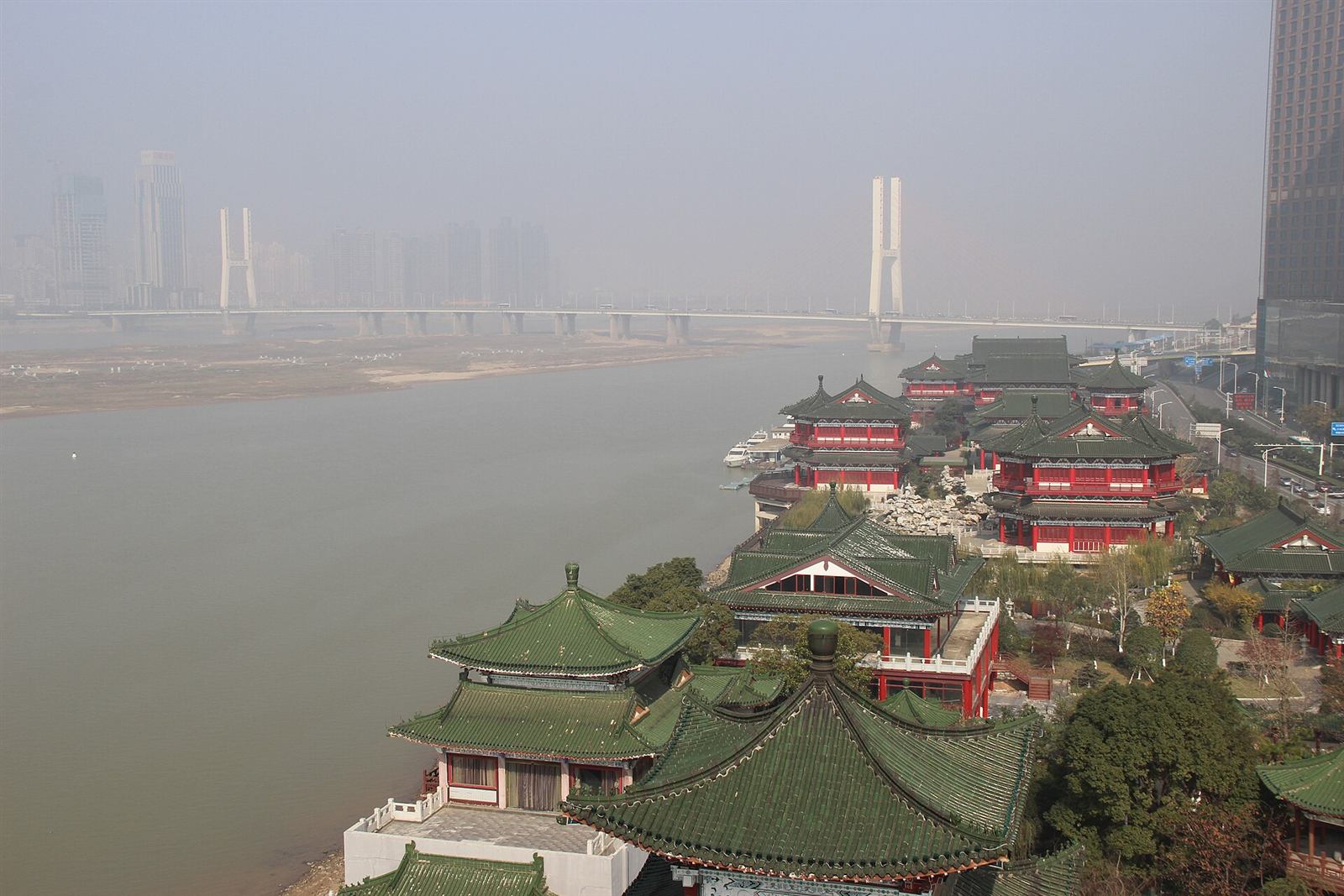
The payoff, from the top gallery — the Gan River, the Bayi Bridge, and the glass towers of Honggutan across the water. This is the balcony from Wang Bo's most famous line. — Photo: Gary Todd / Wikimedia (CC0)
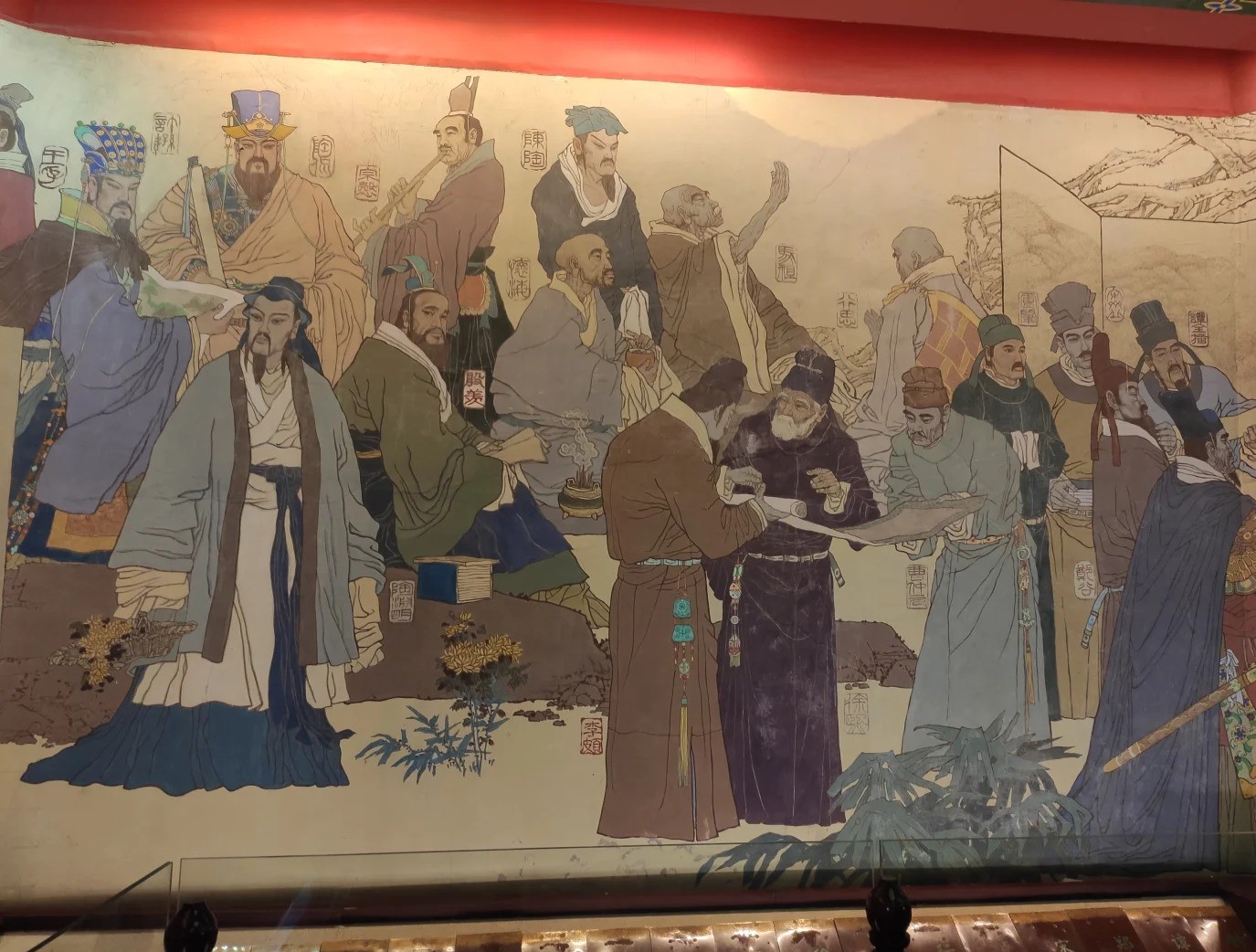
A stretch of 人杰图 on the second floor — eighty of Jiangxi's notable figures across nearly forty-four metres of wall, each one captioned in a small red cartouche. You will not take it in from one spot; walk it.
Why it keeps coming back
Rebuilt in concrete — and why, here, that doesn't make it fake.
You've climbed the tower now, walked the timeline, met the poet. So circle back to the question from the very start: why does this keep happening? Why does a whole culture rebuild the same wooden tower for the twenty-eighth time, the twenty-ninth time, after fire and war keep taking it away?
Because — and this is the part outsiders almost always miss about Chinese landmarks — the tower isn't really made of wood. It's made of words. In 675 a young poet named Wang Bo wrote one essay here, the Preface to the Pavilion of Prince Teng (《滕王阁序》, Téngwáng Gé Xù), and from that afternoon on, the building stopped being a building. It became the place where the poem happened. You can't burn that down. Fire takes the wood; the sentence lives on in every schoolbook in the country — so the wood gets raised again to match the sentence.
Two very old Chinese feelings live inside this tower. Name them and the whole place lands deeper.
The first you've already met: 登高 (dēng gāo), the love of climbing high to see far. China names its great towers and keeps them the way other cultures keep cathedrals — fixed points you ascend to feel the scale of time and land. To climb a named tower is to step, for a moment, into everyone who ever climbed it before you.
The second is harder, and it's the hidden engine of the whole story: 怀才不遇 (huái cái bù yù) — "to hold great talent and never be recognised for it." It's one of the most deeply felt ideas in Chinese culture: the gifted person passed over, exiled, wasted by the world.
That was Wang Bo's own life, almost to the letter. A brilliant young writer, disgraced twice, drifting far from the capital toward a father he had gotten exiled — and he poured that exact ache straight into the preface, hidden under all the dazzling scenery: the mountain passes are hard to cross — and who feels for the one who has lost his way? The building and the poet share one wound. A pleasure-tower for a sidelined prince; an immortal essay by a sidelined genius. People don't come back for thirteen centuries to admire a tower. They come back because somebody, long ago, stood right here and said the unsayable thing about being unseen — and made it beautiful.
Which brings us to the rebuilds, and to the thing Western visitors sometimes trip over. Purists will tell you the present pavilion is "fake" — reinforced concrete in Song-dynasty timber costume, opened in 1989, younger than your parents. They're not wrong about the concrete. They're just asking the wrong question.
In the Chinese way of thinking about heritage, a building is not its original timbers. It's its continuity — its place, its name, its meaning carried forward. Rebuild it faithfully on the same spot and it is, in every way that counts, the same pavilion Wang Bo wrote about. The wood is only the current edition of a thirteen-hundred-year-old idea. So when you stand inside the 1989 tower, you are not standing in a replica. You are standing in the twenty-ninth printing of the same book.
There's a quietly devastating footnote to this. The two men drew those 1942 plans with the pavilion a heap of rubble, the country at war, no money, and no real prospect of building anything at all. They designed a building they had every reason to believe would never be built, because the idea was worth keeping ready. It took the country until 1989 to catch up to their faith.
Step back to the gallery and look out one more time. Across the Gan River, modern Nanchang glitters — a wall of glass towers in Honggutan (红谷滩, Hónggǔtān, the new-city district built up on the far bank — the subject of our One River, Two Banks guide), and after dark the whole riverfront lights up in a single coordinated show, buildings flashing in time like one giant instrument. The city wrapped a thirteen-centuries-old tower inside a brand-new one and never once felt the contradiction.
That's modern China in one frame: a concrete tower built to honour a Tang poem, gazing out at a 21st-century skyline, while somewhere below a recorded voice recites lines a poet improvised in 675. The old and the new aren't fighting on this riverbank. They're sharing it — which is more or less what this country has always done with its past.
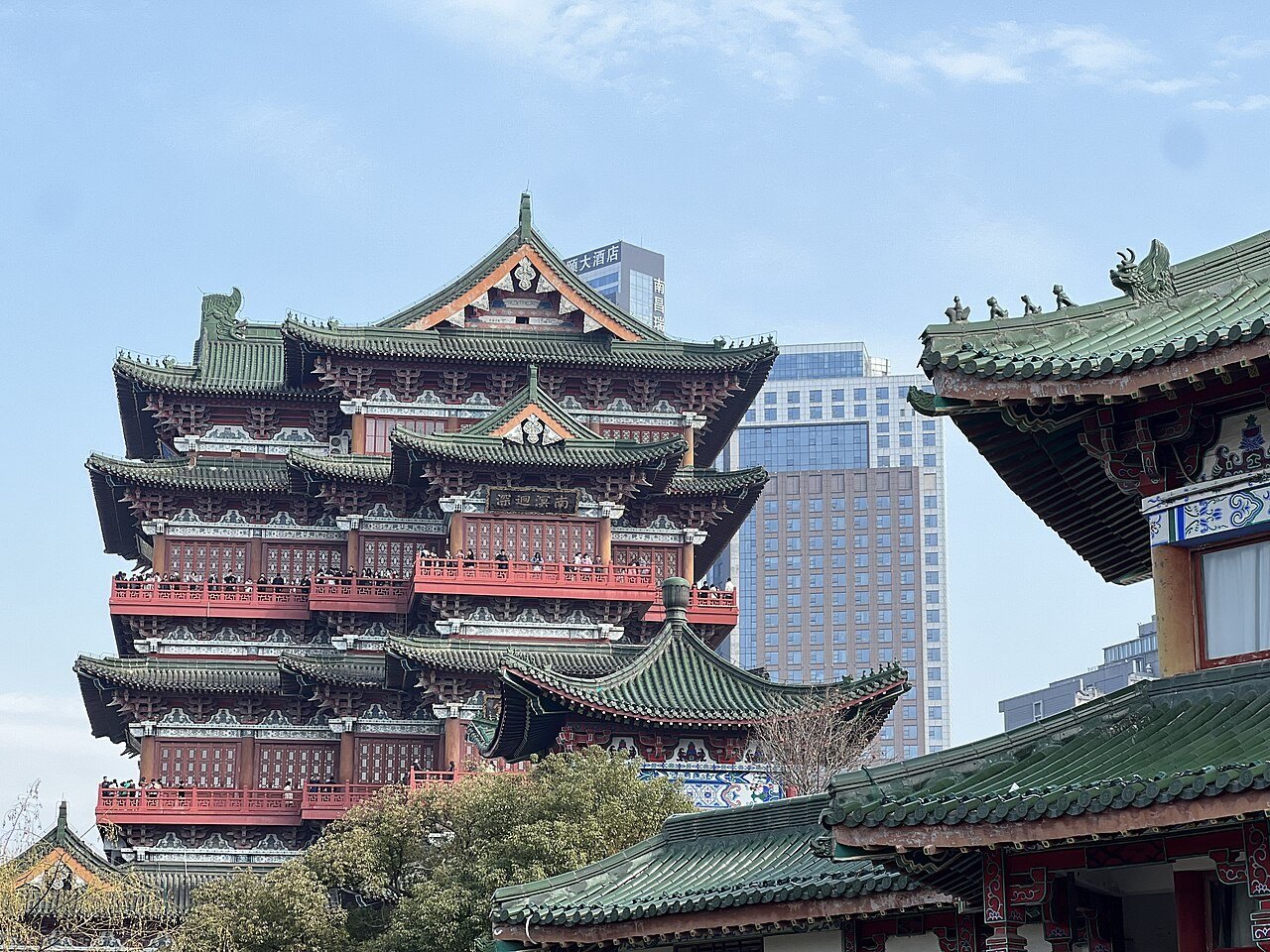
This chapter's argument in one frame: a Song-dynasty silhouette with twenty-first-century Nanchang stacked up behind it. The people on the balustrades give you the scale. — Photo: Huangdan2060 / CC BY 4.0 via Wikimedia Commons
Visit it today
Tickets, timing, routes — and a famous recite-the-poem trick.
If you read for the poem. This is a pilgrimage. Climb slowly, save Floor 5 for the Su Shi-style rubbing of the full Preface, and be on the top gallery for sunset — you came to stand where the line was written, and from about 5 October to about 6 February a day ticket still has you up there at dusk. Outside that window the evening ticket gets you into the grounds but not up the tower, so the view from the gallery has to wait for another trip.
If you have one afternoon in Nanchang. This is the one sight to make time for. Two to three hours covers the climb and the galleries; add an hour for the sunset or an evening show.
If you're travelling with kids, or aren't here for literature. It still delivers: a tall tower to climb, a stage with costumed Tang dancers, bronze bells, dragon-and-phoenix ceramic walls, and a big river view at the top. The marble relief and the banquet figures on Floor 1 tell the whole story without a word of reading.
Recite the Preface, get in free — a real, running scheme, not folklore. Ten machines on the second floor of the South Gate visitor centre score you by software, 09:00–12:00 and 13:00–16:00. Two ways to pass: the whole Preface in six minutes, scoring 60 or better, or a passage the machine picks at random, two minutes, 80 or better — the short one is the easier target and most visitors never learn it exists. Scan to register, scan to recite. One attempt per person per day, and a week's lock-out once you have won. Children can play too, and a child who passes gets one accompanying adult in free. The catch if you are not Chinese: the free ticket is issued against an ID card number and you are admitted by swiping that card, so passing on a passport means sorting it out with staff rather than walking through. Expect to queue at weekends and holidays. Enquiries 0791-86703825. Last verified: 2026-08.
A heads-up on stairs & a lift
A heads-up on stairs. You climb the floors. Whether there's a visitor lift for those who need one is not something we can confirm from a desk — ask staff at the gate if mobility is a concern.
The quick climb · about 1 hour. Straight up, take the view from the top, straight down. Book a daytime slot, move through the lower galleries lightly, and give the top floor and its river panorama the time they deserve. Good if you're chaining several sights into one day.
The classic visit · 2–3 hours — the one most people want. Arrive with an hour in hand before the 18:00 cut-off. Work up through the floors as the light turns amber — people, landscape, the Preface rubbing — then take the top gallery for the view west over the Gan. Whether that view includes the luòxiá, the "falling glow" itself, is a calendar question: from about 5 October to about 6 February the sun goes down before you have to be off the tower, and a day ticket catches it — though National Day week only half qualifies, from the 5th onward. Outside those dates you will be walked down before sundown, so either take the evening ticket for the show and the lit facade, or do what costs nothing and cross to the riverside promenade for the floodlit tower and the free One-River-Two-Banks light show across the water.
Poem, sunset and night show · half a day. The classic climb, plus a separately booked evening-show ticket so you can re-enter after dark. The catch that trips everyone up: your daytime ticket does not roll into the evening — to be inside the grounds after dark you need the night ticket (see the practical box). Plan it as two tickets, not one long visit.
The free option most visitors never hear about · as long as you like. Since 4 February 2024 the scenic area's North Garden (北园) has been open and free — about 90% of the area, with the north-expansion works completing in January 2025. The ticketed core — the tower itself and the walled courtyard around it — is only part of the site; the strip running north along the water is not. Walk in from the Diéshān Road junction (叠山路口) and three routes open up: north to the foot of the main pavilion, south to Zhangjiang Xiaodu (章江晓渡) and the cruise wharf, or west up the steps to the Gan itself. The West Plaza is reachable from Nanxinzhou Road (南新洲路). You get the tower from below, the riverbank, and the whole Honggutan skyline across the water without paying for anything — which makes it the sane move on a hot afternoon, or when the sunset slots have gone. It is also somewhere to stand for the Lunar New Year fireworks over the Gan, on the years the area stays open for them — though the frame everyone wants is Wang Bo Square, directly below the pavilion; our guide to Nanchang's firework shows has the timings, the viewpoints and the crowd warnings.
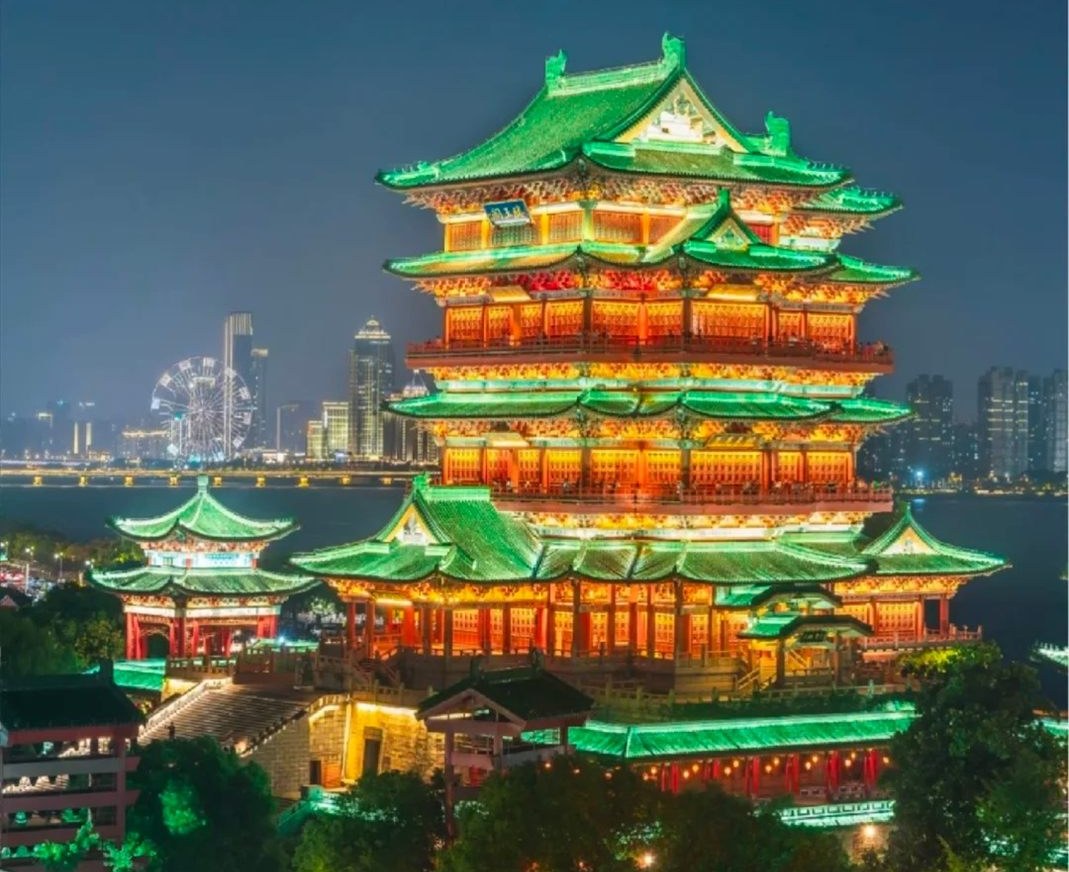
The free version of the evening: the tower is floodlit from outside, and the promenade below looks straight across at the Ferris wheel and the Honggutan light show. No second ticket needed.
Golden hour is the hour — if the calendar allows it. The tower faces the river to the west, so it takes the sunset full in the face, and river and sky running into one colour from the top gallery is the literal scene of the famous line. The number that binds is not the 18:15 clearance of the grounds but the 18:00 that ends your time up on the tower — fifteen minutes earlier, and the fifteen minutes that decide the evening. From 5 October to 6 February, the sun goes down before that 18:00 cut-off — by a single minute at either end of the window, by something closer to half an hour at midwinter — and a daytime ticket is enough. Outside those dates it comes too late: on 25 September, which looks safe on paper, sunset is 18:10, ten minutes after the top gallery has emptied. The evening ticket gets you back into the grounds, but it does not include the climb. Either way this single timing call is the whole difference between a nice tower and an unforgettable one.
Day versus night. By day you get the galleries, the murals and the climb. After dark the pavilion is floodlit gold and handsome from the riverside even if you don't go back in — and on many evenings there's a ticketed light-and-performance show in the grounds (more below). The free move: floodlit tower plus the riverside light show, no second ticket needed.
Season. Autumn suits it best — the Preface is set at the Double Ninth Festival in the ninth lunar month, so clear autumn skies give you the true "autumn waters" mood. Spring is lovely too. Summer is hot and hazy and the top gallery is fully exposed; bring water and sun cover.
Crowds, and the booking rule that changed. Weekends and Chinese public holidays — National Day in early October, Lunar New Year, May Day — are busy. But you do not need to reserve: the scenic area's current guidance is that no booking is required, and on peak days they cap numbers and meter entry instead, so a holiday afternoon means queueing rather than being locked out. Older write-ups describing compulsory timed, real-name slots are out of date. Last verified: 2026-08.
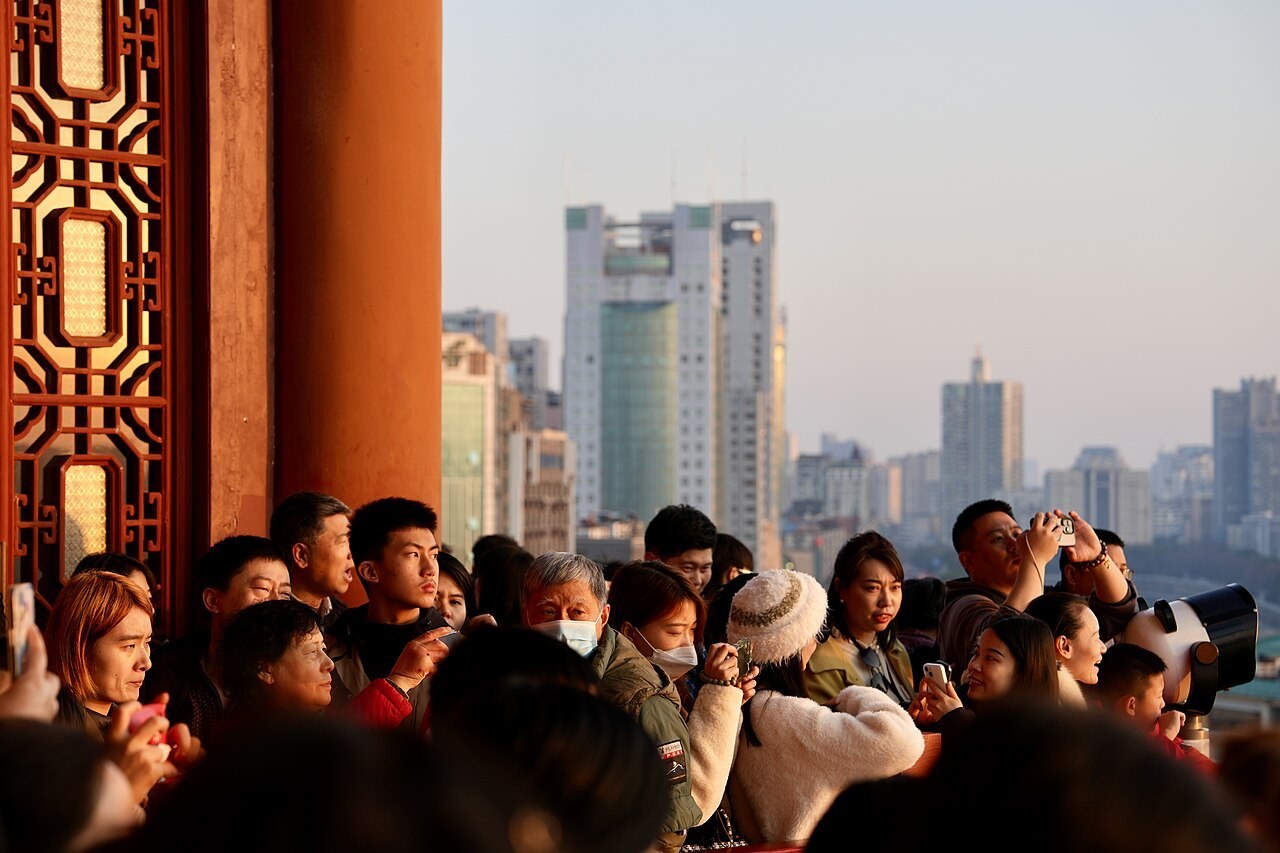
What golden hour on the top gallery actually looks like: you and everyone else. Come for the light; do not expect the rail to yourself. — Photo: UserAlbert / CC BY-SA 4.0 via Wikimedia Commons
Address. No. 58 Fanggu Street, Donghu District, Nanchang — show your driver: 南昌市东湖区仿古街58号.
Hours. Daytime: the grounds open at 08:00, ticket sales stop at 17:15, the last ticket-check is 17:30, visiting runs to 18:00 and the main pavilion and grounds are cleared at 18:15. The evening is a separate ticket: the《寻梦滕王阁》show admits 18:40–20:00 and runs 19:30–20:15, all year, entering by the East Gate — and it does not include climbing the pavilion. So the "open until 10pm" you may see online is that show, not the daytime climb.
Tickets. Adult day ticket ¥50 at the gate, and booking ahead saves almost nothing — about ¥49.8 on Trip.com, ¥47 via Meituan; students and Nanchang residents about ¥25 with ID; free for young children and seniors (check the current height and age cut-offs at the gate — sources disagree on the exact numbers). The night show is a separate, pricier ticket (recently around ¥168) and does not include the daytime climb.
Foreign passport? Read the booking catch
If you hold a foreign passport. The good news first: no advance booking is required, so the app-based reservation problem that used to catch foreign visitors is mostly gone — buy at the window with your passport. Two things still run on the Chinese national ID card, though, and a passport will not substitute. The concession prices for Nanchang residents key off a 3601-prefixed ID. And the recite-the-Preface free-entry scheme issues its ticket to an ID card number and admits you by swiping that card — so if you win it on a passport, expect to sort it out with staff rather than walking through the gate. Bring the physical passport either way.
Getting there — metro. Metro Line 1 is the sightseeing line — see our Nanchang metro guide for tickets, timings and the last train. Tengwangge (滕王阁) Station, Exit 2 — the north side of Zhongshan West Road, signed for the pavilion along with the city library and museum, and the one exit with a lift. It does not surface at the gate: it is a walk of roughly 1.1 km, about 14 minutes, to the south gate. Wanshou Palace (万寿宫) Station is the scenic alternative — about 1.4 km / 16–18 minutes to the east gate. Sources disagree on which exit, so don't chase a number: come up, head north-west towards the river, and you will pick up the riverside road. (Exit 1 serves the Wanshou Palace block itself; for the pavilion the direction matters more than the exit number), handy if you're chaining in Wanshou Palace.
Door-to-door routes from the station / airport
Getting there — from your arrival point. From Nanchang Railway Station: Line 2, change at Bayi Square (八一广场, "August 1st Square" — for the 1927 uprising) to Line 1, to Wanshou Palace (~16–18-min walk) — or hop the tourist tram from the station's west plaza to Tengwangge. From Nanchang West HSR: Line 2, change to Line 1, to Wanshou Palace (~16–18-min walk; ~55 min total). From Changbei Airport (~30 km out): a DiDi or taxi is simplest with luggage; otherwise Airport Bus + Metro. Taxi / DiDi is the easy door-to-door option from the centre — DiDi's app has an English interface; have the Chinese address ready.
How long. 1.5–3 hours for the climb and galleries; longer for sunset or an evening show.
Accessibility & facilities
Accessibility & facilities. Toilets on site, with a map at the entrance. A visitor lift inside the pavilion, bag storage / lockers, and a baby-care room are not something we can confirm from here — ask at the gate.
Most evenings the grounds stage an immersive light-and-performance show — recently 《寻梦滕王阁》 ("Dream of Tengwang Pavilion"), typically starting around 19:30 — on a separate, pricier ticket (recently about ¥168).
Before you bank on the night show — read this caveat
One honest caution: these evening programs get renamed, rescheduled and sometimes paused from season to season — one source even lists the headline show as having ended, while others list current sessions. So treat the night show as a "check the latest before you commit" item, not a sure thing. If it isn't running, the floodlit tower and the free riverside light show still make a fine evening.
Wanshou Palace (万寿宫) — a lantern-lit historic block of shops and snacks, one metro stop away (enter via Wanshou Palace Station). The natural pairing for a half-day.
The Gan River waterfront — the free promenade right below the pavilion is a front-row seat for Honggutan's (红谷滩, the new-city district across the water) nightly building-facade light show, the famous "One River, Two Banks" (一江两岸).
Bayi Square (八一广场, "August 1st Square") — central Nanchang and the Line 1–2 interchange, about ten minutes away, named for the 1 August 1927 uprising; across the river, Qiushui Square (秋水广场) — its name lifted straight from the preface's "autumn waters" — has its own fountain-and-light show after dark.
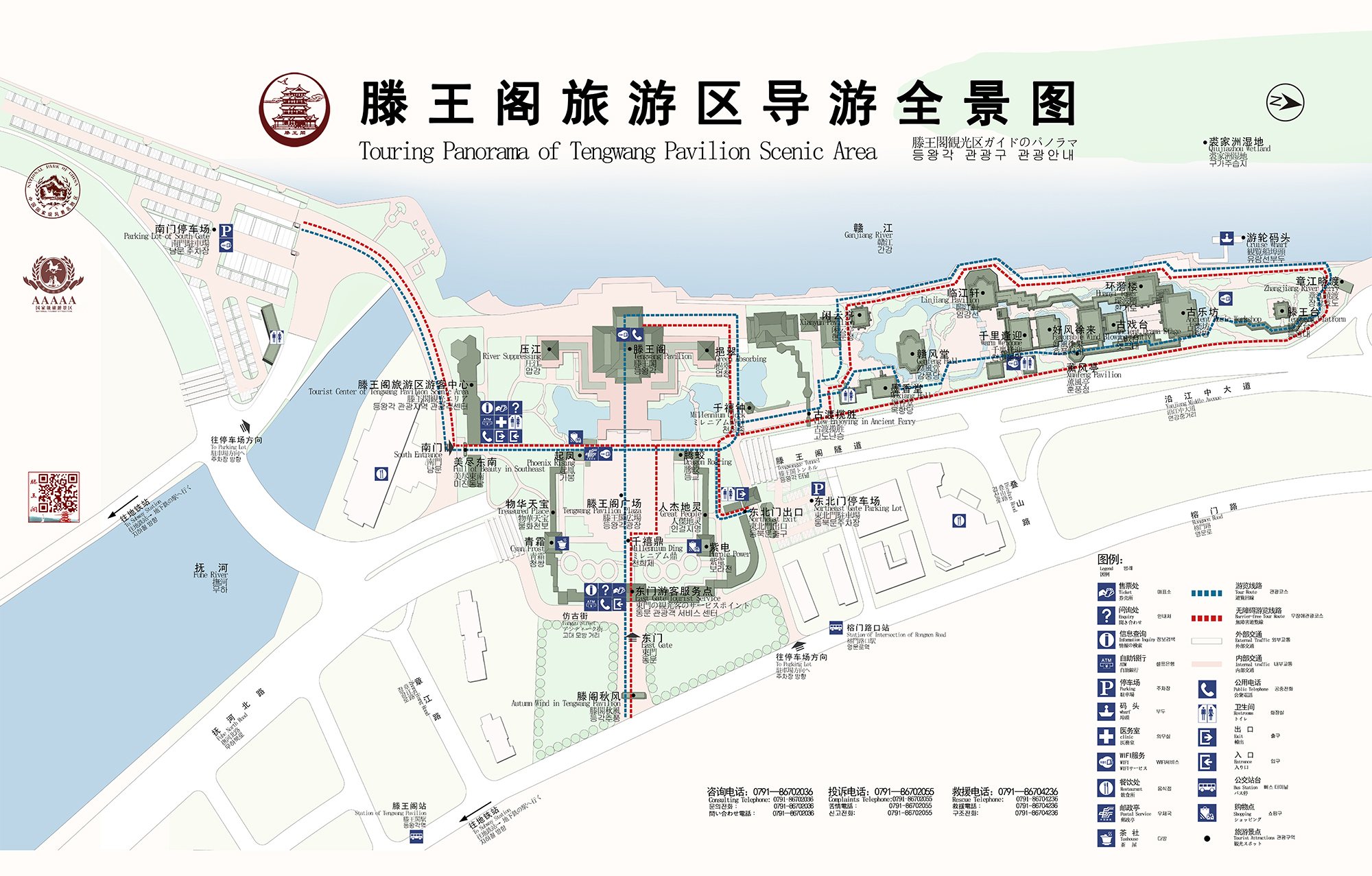
The scenic area's own plan, in four languages — worth opening full size before you go. The pink block around the pavilion is the ticketed core; everything green along the river to the north-east is the free North Garden. Note how far apart the south and east gates are: choose your gate before you choose your metro exit.
One building, one poem, one long memory
The whole story, folded into one last look from the rail.
The sun is almost gone now. You're back where the story started — leaning on the top rail, the Gan River going dark below, that last band of light where the water and the sky still refuse to come apart. This is the moment the entire tower is built around. Don't rush it. Stay.
Three things are standing up here with you, and they're worth counting out loud. There is a building — the twenty-ninth-or-so version of a prince's party-house, raised fresh in 1989 on a riverbank it has held for thirteen hundred years.
There is one piece of writing — a few hundred characters of impossible balance, written in a single afternoon by a young man who would drown at sea within the year, and carved now into the walls all around you.
And there is a memory a thousand years long — the unbroken decision, made by generation after generation, that this particular view over this particular river was worth keeping. Worth rebuilding through every fire and every war. Worth your climb tonight.
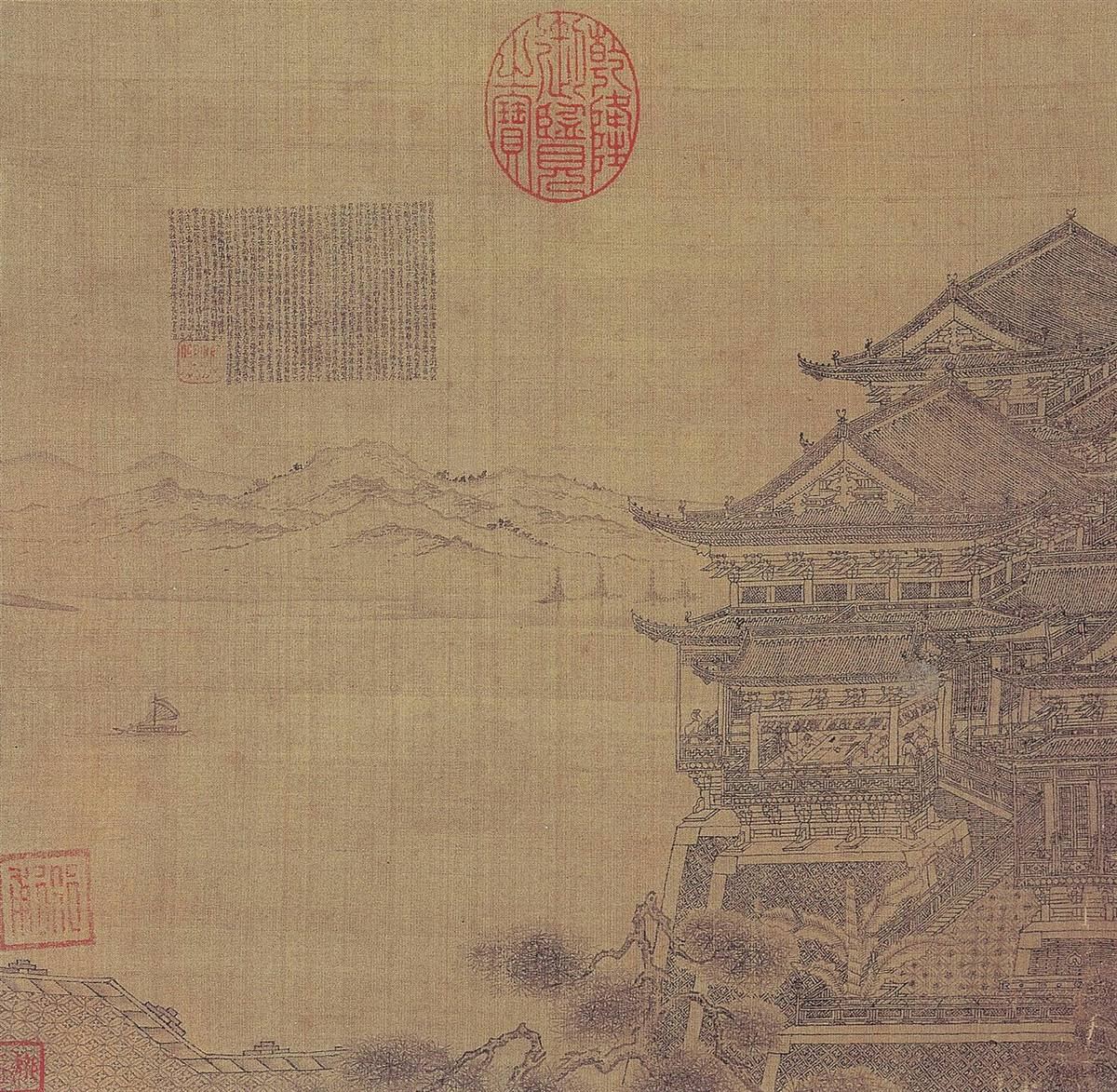
One link in that thousand-year memory: a Yuan-dynasty painting of the pavilion, made long before the tower you climbed tonight was raised. — Yuan dynasty, anonymous (public domain)
So here, as the light goes, is the sentence that started all of it — the one Wang Bo wrote about exactly this, from exactly here, looking at exactly what you are looking at right now:
落霞与孤鹜齐飞,秋水共长天一色
The sunset glow and a lone wild duck fly as one; the autumn waters and the endless sky run together into a single colour.
Wang Bo, Preface to the Pavilion of Prince Teng, 675
He didn't decorate the river. He just described it. Thirteen hundred years, about twenty-nine towers, one unbroken afternoon of light over the Gan — and the words still fit the view exactly. That's why they keep rebuilding it. That's the whole answer. Now put the reading down and watch the last of the sun go, the way he did.
Where to go from here. The pavilion is an afternoon; Nanchang is a city and Jiangxi is a province. Our Nanchang city guide is the place to start. The One River, Two Banks guide picks the story up at the waterfront directly below you, the Gan River bridges explain the skyline you have been looking at from the top gallery, and the Nanchang photo spots guide times this same sunset for the light.
Visiting Tengwang Pavilion
- Address: No. 58 Fanggu Street, Donghu District, Nanchang, Jiangxi (南昌市东湖区仿古街58号)
- Hours: Daytime: the grounds open at 08:00, ticket sales stop at 17:15, the last ticket-check is 17:30, visiting runs to 18:00 and the main pavilion and grounds are cleared at 18:15. The evening is a separate ticket: the《寻梦滕王阁》show admits 18:40–20:00 and runs 19:30–20:15, all year, entering by the East Gate — and it does not include climbing the pavilion. So the "open until 10pm" you may see online is that show, not the daytime climb.
- Tickets: Adult day ticket ¥50 at the gate — ¥49.8 on Trip.com, ¥47 via Meituan. Students, children and Nanchang residents (3601 ID) ¥25. Free with ID at the ticket window for children under 6 or under 1.2 m, over-65s, serving and retired military, families of the fallen, people with disabilities and journalists. The evening《寻梦滕王阁》show is separate at ¥168 adult / ¥98 for children 1.2–1.4 m (under 1.2 m free, one per adult, no seat) and does not include climbing the pavilion. No reservation is needed; at peak times numbers are capped and entry metered. Prices are market-set — check the official platform (cntwg.com) on the day.
- Getting there:
- Metro Line 1 to Tengwangge (滕王阁) Station, Exit 2 — north side of Zhongshan West Road, signed for the pavilion, and the exit with a lift. It does not surface at the gate: allow roughly 1.1 km, about 14 minutes, to the south gate. Line 1 is the sightseeing line and also runs under the river to Qiushui Square. Buses 2 (inner loop), 7, 26 (inner loop) and 302 (inner loop) stop at Tengwangge.
- Metro Line 1 to Wanshou Palace (万寿宫) Station: the scenic alternative, ~1.4 km / 16–18 min to the east gate. Sources disagree on the exit, so head north-west towards the river rather than chasing a number (Exit 1 serves the Wanshou Palace block itself), handy if you're chaining in Wanshou Palace.
- From Nanchang Railway Station: Line 2, change at Bayi Square (八一广场) to Line 1, to Wanshou Palace (~16–18-min walk) — or take the tourist tram from the station's west plaza to Tengwangge.
- From Nanchang West HSR: Line 2, change to Line 1, to Wanshou Palace (~16–18-min walk; ~55 min total).
- From Changbei Airport (~30 km out): a DiDi or taxi is simplest with luggage; otherwise Airport Bus + Metro.
- Taxi / DiDi is the easy door-to-door option from the centre — DiDi's app has an English interface; have the Chinese address ready.
- Best time: Golden hour is the hour: the tower faces the river to the west and takes the sunset full in the face. Note which number governs, though. The grounds clear at 18:15, but you have to be down off the pavilion at 18:00, so that last quarter-hour is for walking out, not for looking west. Measured against 18:00, a daytime ticket reaches sunset from about 5 October to about 6 February; either side of that the sun goes down later than you are allowed to be up there — 25 September looks like it should work and doesn't (18:10). Outside the window the evening ticket is what's left, and it does not include the climb: you get the grounds and the lit facade, not the gallery. National Day straddles the line — the first days of October fall just outside it, the 5th onward is inside. Autumn suits the place best (the Preface is set at the Double Ninth Festival); spring is lovely too; summer is hot, hazy and exposed on the top gallery — bring water and sun cover. Weekends and Chinese public holidays (National Day in early October, Lunar New Year, May Day) are busy; no booking is required, but at peak times numbers are capped and entry is metered, so arrive with slack.
- Accessibility: Toilets on site, with a map at the entrance. You climb the floors. A visitor lift inside the pavilion, bag storage / lockers, and a baby-care room are not something we can confirm from a desk — ask staff at the gate if mobility or storage is a concern.
- Official site: http://www.cntwg.com
Frequently Asked Questions
Is Tengwang Pavilion original, or a reconstruction?
A reconstruction, and openly so. The pavilion has burned, fallen and been rebuilt roughly 28 or 29 times in thirteen centuries. The tower you climb opened on 8 October 1989 — reinforced concrete dressed in Song-dynasty timber style, about 57.5 metres tall, built from plans the architect Liang Sicheng and his assistant Mo Zongjiang drew in 1942 from a surviving Song painting.
What is the famous line written at Tengwang Pavilion?
落霞与孤鹜齐飞,秋水共长天一色 — "the sunset glow and a lone wild duck fly as one; the autumn waters and the endless sky run together into a single colour." Wang Bo wrote it here in 675 CE, in the Preface to the Pavilion of Prince Teng (滕王阁序). It is the reason the building keeps being rebuilt: the tower is famous for the sentence, not the other way round.
How much does it cost to visit Tengwang Pavilion?
An adult day ticket is ¥50 at the gate, and barely less booked online — about ¥49.8 on Trip.com or ¥47 via Meituan; students and Nanchang residents pay about ¥25 with ID. The evening show is a separate and pricier ticket, recently around ¥168, and it does not include the daytime climb. Check current prices at the gate — they change.
What are the opening hours?
One set of times all year, despite what some older listings say. The grounds open at 08:00; ticket sales stop at 17:15, the last ticket-check is 17:30, visiting runs to 18:00 and everything is cleared at 18:15. The evening《寻梦滕王阁》show is a separate ticket admitting 18:40–20:00 for a 19:30–20:15 performance, year-round, entering by the East Gate — and it does not include climbing the pavilion. The "open until 10pm" you may see online refers to that show.
Do I need to book, and does a foreign passport work?
You do not need to book. The scenic area's current guidance is that no reservation is required; on peak days they cap numbers and meter entry instead. Buy at the gate with your passport. Two things do still run on the Chinese national ID card and will not take a passport: the ¥25 Nanchang-resident price, which keys off a 3601-prefixed ID, and the recite-the-Preface free-entry scheme, which issues its ticket to an ID card number and admits you by swiping that card. Older guides describing compulsory timed, real-name booking are out of date.
How do I get to Tengwang Pavilion by metro?
Metro Line 1 to Tengwangge (滕王阁) Station. Take Exit 2 — the north side of Zhongshan West Road, signed for the pavilion and the only exit with a lift. It does not surface at the gate: allow about 1.1 km, roughly 14 minutes, to the south gate. Line 1 is the sightseeing line and also runs under the river to Qiushui Square. Buses 2 (inner loop), 7, 26 (inner loop) and 302 (inner loop) stop at Tengwangge. Wanshou Palace Station is the scenic alternative at about 1.4 km, 16–18 minutes, to the east gate.
Is it worth visiting at sunset?
That is the hour to come — but check the date before you count on it. Two closing times sit on the ticket: the last visit ends at 18:00, the grounds clear at 18:15. Only the first one decides your sunset, because by 18:15 you are being walked toward the gate, not standing on the top gallery. Measured against 18:00, a day ticket reaches sunset for about 125 days, from about 5 October to about 6 February. The edges are tighter than they look — on 25 September the sun still sets at 18:10, ten minutes after the last visitors have come down. Outside that window the separate evening show gets you onto the grounds but not up the pavilion, which is the part you came for. The top gallery faces west into the river, which is the literal scene of Wang Bo's most quoted line.
How long should I allow?
The scenic area suggests one to three hours; two to three is right if you want the halls as well as the view. From outside the tower shows three tiers; inside there are seven floors, nine if you count the stone base — an old trick called 明三暗七, "three storeys seen, seven hidden." The hidden ones are not mezzanines: they are the largest halls in the tower, including the top-floor Nine Heavens hall. Allow extra if you want the sunset from the top gallery.
Want this built into a trip?
We'll plan your Nanchang & Jiangxi days around the pavilion, the river, and the rest of the city — plan with us.