How to Get to Nanchang: Flights & Trains
Getting to Nanchang: flights into Changbei Airport (KHN), which railway station to use, buying tickets with a passport, and how to reach downtown.
By Hello Nanchang · Last updated
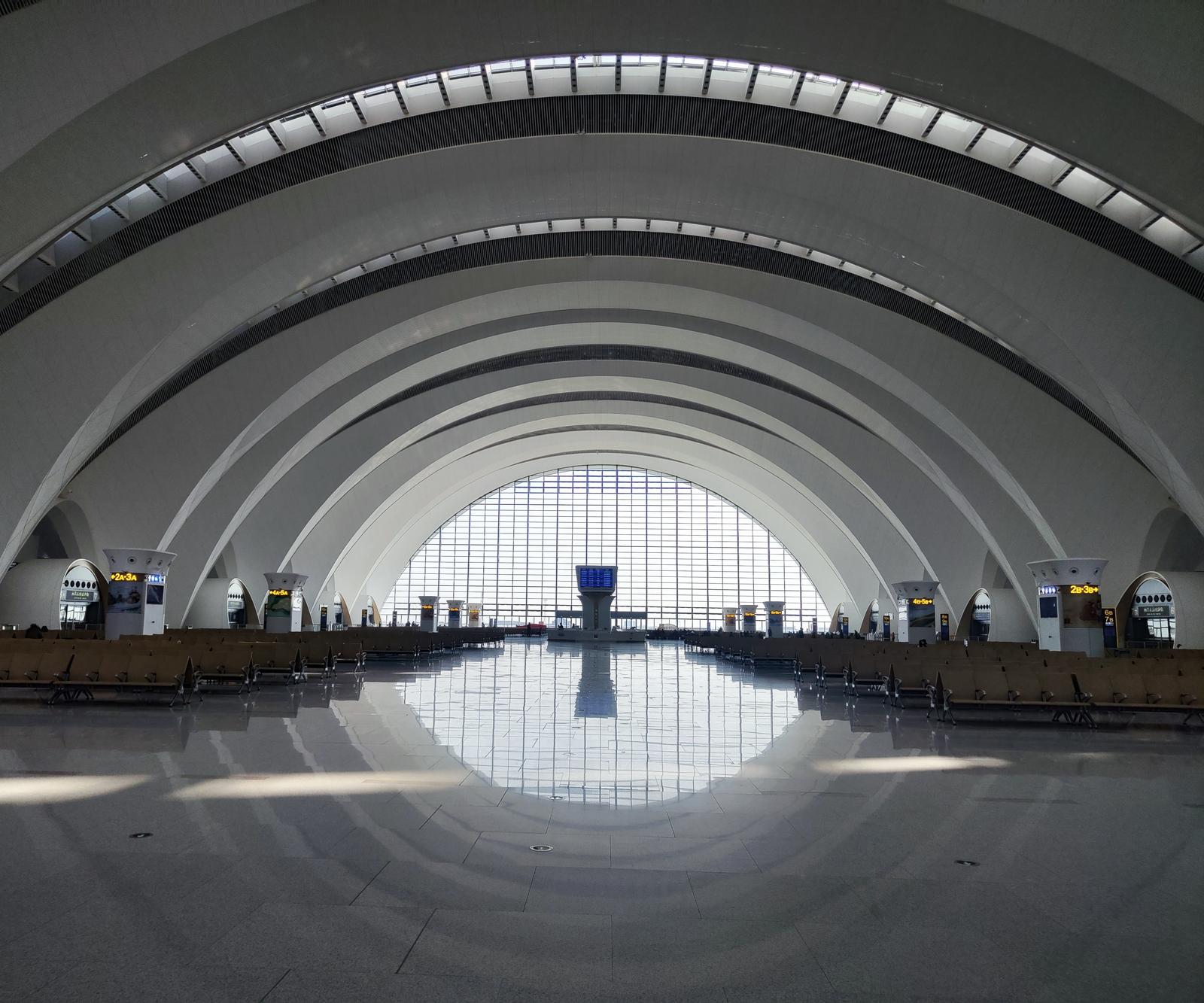
You feel a new city before you understand it. In Nanchang, that first impression arrives through one of four doors: a swooping airport terminal shaped like a bird over Poyang Lake, a high-speed hub whose roofline flies an army flag, a grand new hall built as a line of Tang poetry, or the busy old central station that has watched the city grow since 1936. These are the gateways — Changbei International Airport and the Nanchang, West, and East railway stations — and choosing the right one, then getting cleanly from it into town, is the difference between a smooth arrival and an hour of confusion with your luggage.
This guide does two things. First, it tells you plainly which gateway to use for which trip and exactly how to reach the city center from each — metro lines, rough fares, journey times. Second, it treats these gateways as what they actually are: some of the most ambitious pieces of architecture in Jiangxi, worth a second look rather than a blur on the way to your hotel. Transit details change often, so treat every fare and time here as a starting point to confirm on the day. For the wider arrivals picture — visas, SIM cards, and payment setup — see our Plan Your Trip hub.
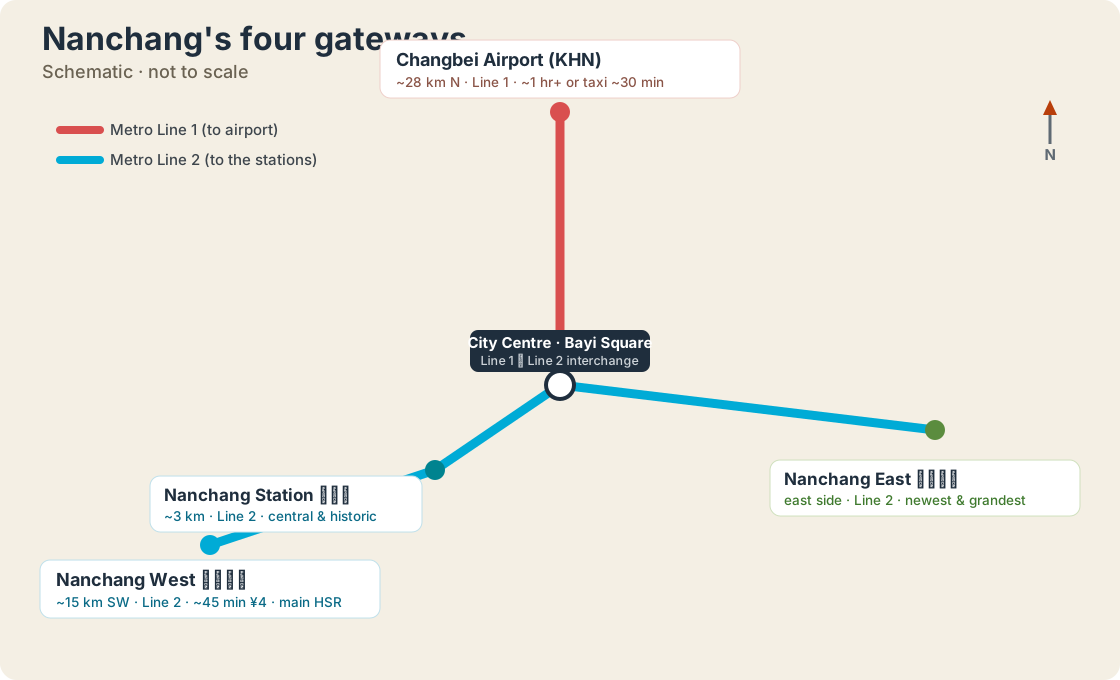 Nanchang's four gateways around the city center — the airport to the north, three stations to the west, south, and east.
Changbei International Airport (KHN): the door from the sky
Most first-time visitors from abroad arrive at Nanchang Changbei International Airport (南昌昌北国际机场, code KHN), which opened in September 1999 and sits roughly 28 km north of downtown — a drive of about 30 minutes in normal traffic. It is Jiangxi's main air gateway, handling around 11.3 million passengers in 2024 and crossing into China's "ten-million-passenger" tier of airports. The network is overwhelmingly domestic — roughly 60-plus mainland cities — with a smaller international slate that has grown since China's visa-free expansions (think Bangkok, Singapore, Kuala Lumpur, Osaka, and Macau, though routes shift seasonally, so check current schedules).
There are two terminals, and knowing which is which saves stress. Terminal 2 (opened 2011, and enlarged again with a new concourse in early 2025) handles domestic flights and is where most travelers pass through. Terminal 1 is the smaller international and regional terminal. If you are flying in from overseas you will likely clear immigration at T1; connecting onward within China usually means T2.
The terminal itself is worth a glance up. Its designers reached for Jiangxi's own imagery: two streamlined wings meant to suggest a bird in flight over Poyang Lake, side concourses that rise like the bamboo of Jinggangshan, and translucent skylights that echo the "rice-grain" translucency of Jingdezhen porcelain. It is a quiet primer on the province you are about to explore — lake, mountains, and a thousand years of ceramics, all before you reach baggage claim.
Change is coming here, too. A major Phase 3 expansion is under construction — a second runway, a large new T3 terminal, and an integrated ground-transport center designed to knit the airport together with the metro and a planned Nanchang-Jiujiang high-speed line into a true air-rail hub. Completion is targeted for around 2027, though big builds like this can slip.
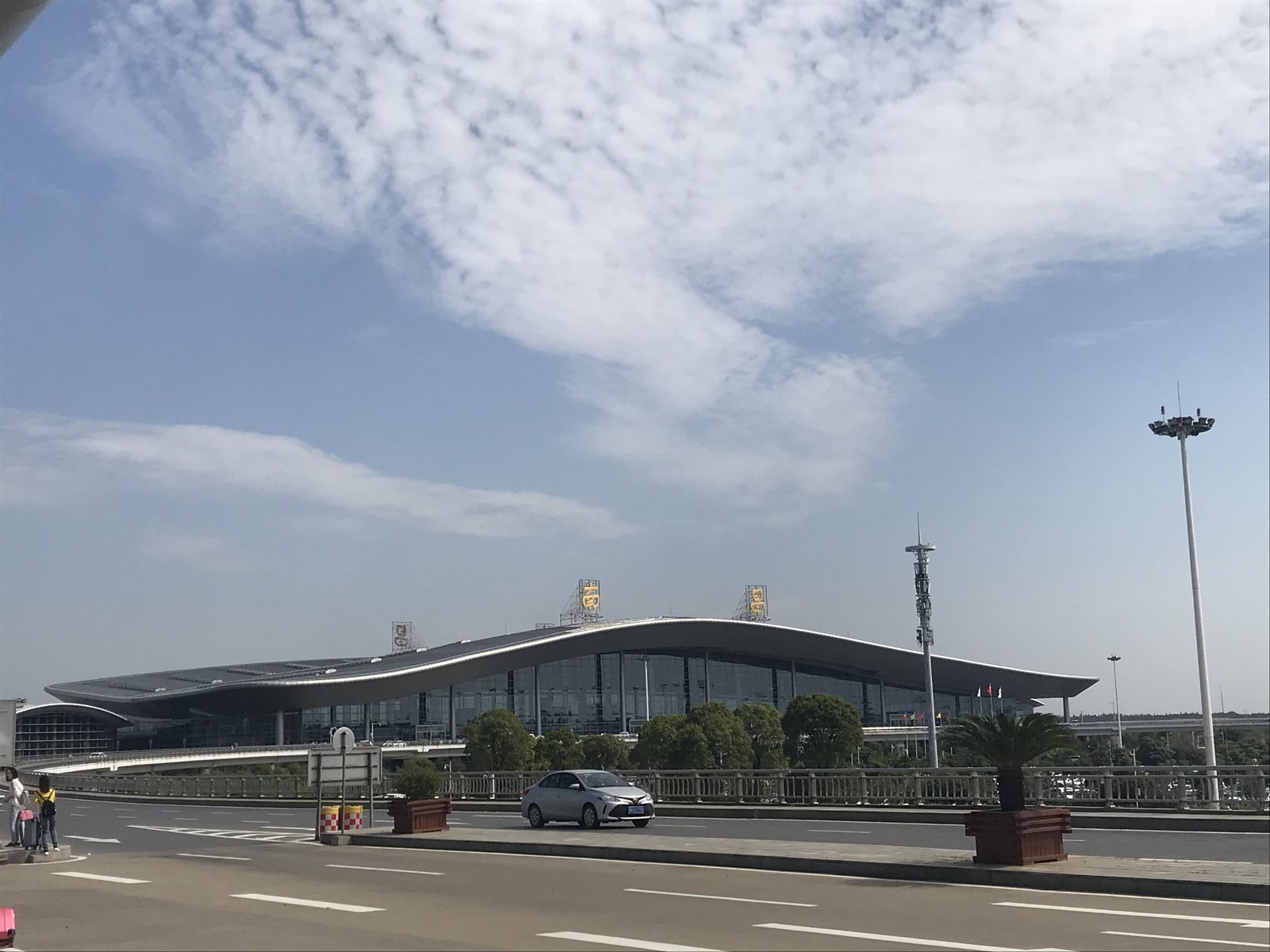 Changbei's Terminal 2 — a roofline meant to suggest a bird in flight over Poyang Lake. Photo: 丰泽一号 / Wikimedia Commons (CC BY-SA 4.0).
Getting to and from the airport
The single most useful thing to know — and the fact most older guidebooks get wrong — is that the metro now reaches the airport. On 28 June 2025, Nanchang Metro Line 1 extended north to Changbei Airport station at Terminal 2. Any source telling you there is "no metro" or an "airport express under construction" is out of date; disregard it.
- Metro (Line 1): From the airport, Line 1 runs directly into the city with no interchange needed to reach Bayi Square (八一广场), the central landmark and a Line 1 / Line 2 crossing. Fares run about ¥2-7; a covered walkway of roughly 300 m links the station to the terminal. The catch is time: because it is a city line, not an express, the ride to the center takes roughly an hour or a little more. It is the cheapest reliable option and it dodges traffic, but it is not the fastest. Service runs about 06:00-22:30 (later on Fridays, weekends, and holidays).
- Airport shuttle bus: A flat ¥15 gets you downtown in about 45-60 minutes, depending on traffic and stops. The most useful route runs to Nanchang Railway Station via stops near Bayi Square; buses board outside T2 Gate 7 and you pay by phone (WeChat / Alipay), transit card, or coins.
- Taxi or DiDi: The fastest door-to-door option — roughly 27-45 minutes depending on traffic, for something in the range of ¥90-120 to central districts (more to farther ones, and surge pricing applies). Pickup is outside T2.
Bottom line: for a short trip with luggage, take a taxi or DiDi. If you are counting yuan or arriving at rush hour, the metro is now a genuinely good backup, and the ¥15 shuttle is a fine middle path.
The three railway stations at a glance
If you are arriving by train — and in China you often should, since high-speed rail is fast, punctual, and central — Nanchang gives you three stations, and they are genuinely different animals. It is easy to end up at the wrong one, so here is the shape of it before the detail.
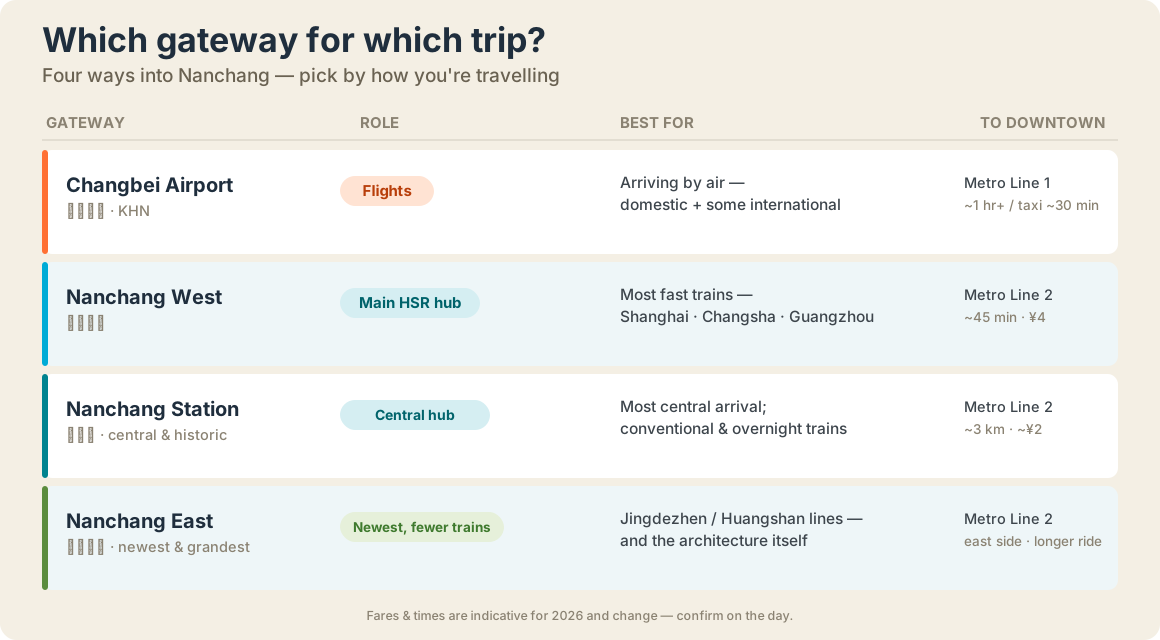 Which gateway for which trip: airport for flights, West for most high-speed trains, Nanchang for central arrivals, East for the newest lines.
- Nanchang Railway Station (南昌站) — the historic, central one. Opened 1936, close to downtown, mixing conventional (slower, cheaper) trains with some high-speed services. The easiest arrival if your hotel is near the old town.
- Nanchang West Railway Station (南昌西站) — the high-speed workhorse. Opened 2013, out to the southwest, and the busiest HSR hub, handling most fast trains to Shanghai, Changsha, Guangzhou, and beyond.
- Nanchang East Railway Station (南昌东站) — the grand newcomer. Opened December 2023 on the east side, architecturally spectacular, but serving fewer lines so far — mainly trains toward Jingdezhen and Huangshan.
All three now connect to the metro, which makes the city refreshingly navigable once you know which line you need. The rule of thumb: West for most long-distance high-speed trains, Nanchang station for the most central arrival, East only if your route specifically runs through it. For the bigger regional picture — how these stations link Jiangxi together — see our guide to getting around Jiangxi by train.
Nanchang West: the high-speed workhorse
Nanchang West Railway Station (南昌西站) opened on 26 September 2013 as the city's first high-speed station, and it remains the primary HSR gateway. It sits in the Honggutan district in the southwest, roughly 15 km from the center — farther out than the old station, but built for volume. This is a genuinely large hub: about 12 platforms and 26 tracks under some 250,000-plus square meters of building, designed to move thousands of passengers an hour on the up-in, down-out flow that modern Chinese stations use.
West is where the trunk lines meet. It anchors the Shanghai-Kunming high-speed corridor and connects onward toward Changsha, Guangzhou and Shenzhen, Beijing, and Fuzhou — so if you are riding an HSR train to or from a major city, chances are very good you will use West. Its architecture carries the city's revolutionary identity: the roofline is meant to evoke a fluttering army flag, and the facade hints at the characters "八一" (August 1st) — a nod to Nanchang as the birthplace of the People's Liberation Army in the 1927 uprising. The exposed branching steel columns inside are worth a look while you wait.
Into town: West sits on Metro Line 2, and you stay on that single line all the way to Bayi Square — roughly 45 minutes for about ¥4, no interchange. Since December 2023, arriving HSR passengers can transfer to Line 2 through a security-free connection, which saves a second bag scan. Taxis and DiDi are of course available out front; budget more time and money than from the central station given the distance.
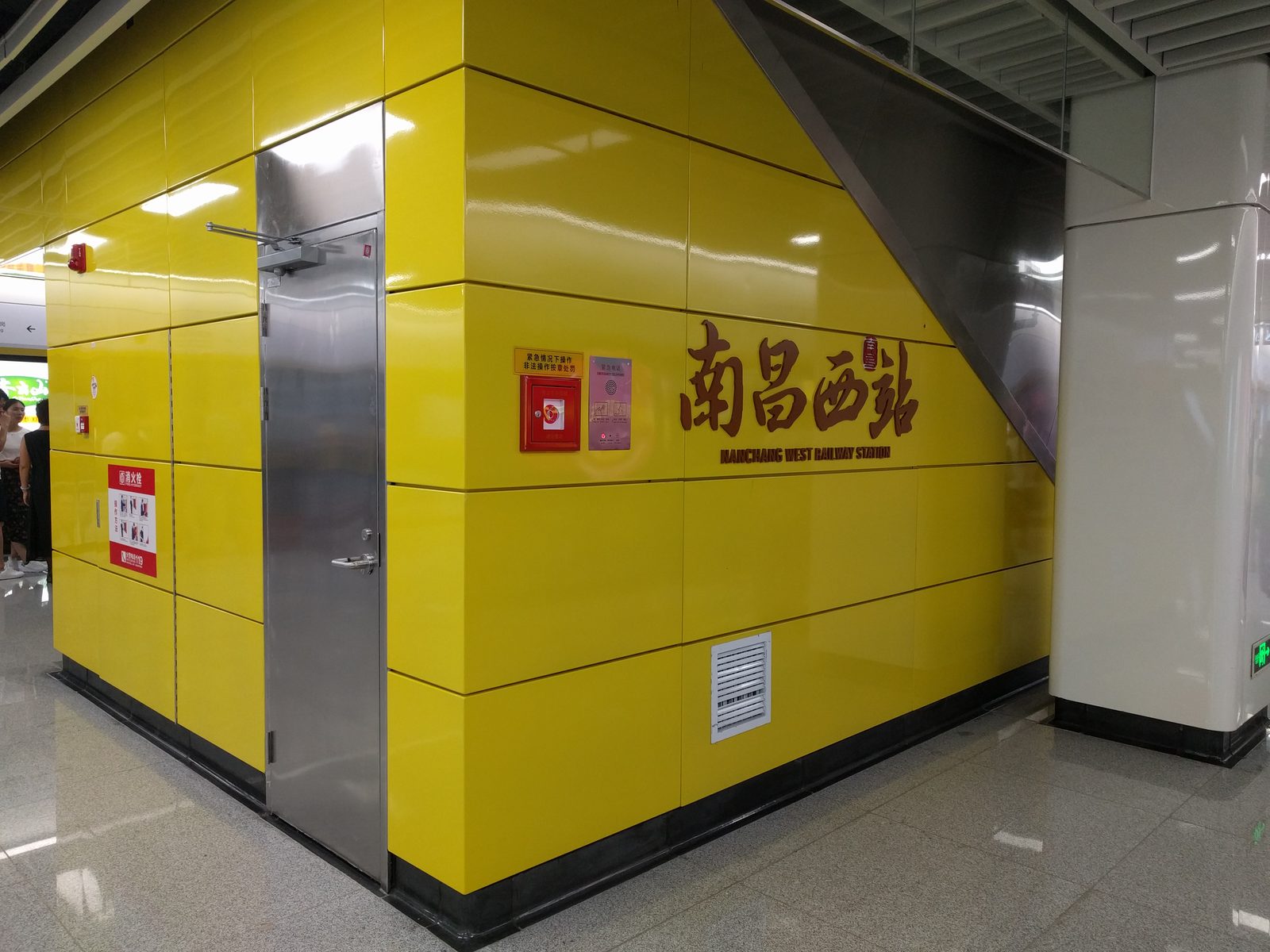 Nanchang West — the province's busiest high-speed-rail hub, where most fast trains to Shanghai, Guangzhou and beyond depart. Photo: Qa003qa003 / Wikimedia Commons (CC BY-SA 4.0).
Nanchang East: the grand newcomer
If any gateway rewards a curious traveler, it is Nanchang East Railway Station (南昌东站), which opened on 27 December 2023 alongside the new Hangzhou-Nanchang high-speed line. It is the newest and, in sheer architectural ambition, the grandest of the three — a province-capital-scale hub of around 223,500 square meters designed by the German firm gmp as the centerpiece of a whole new eastern district.
Here is the detail worth traveling to see. The station is, quite literally, a line of Tang poetry made into a building. Its designers took the most famous couplet in the Preface to the Pavilion of Prince Teng — "the setting sun and a lone wild duck fly together; the autumn waters share one color with the endless sky" — and built it. The great three-linked-arch steel roof reads as a wild duck soaring with its wings spread, a symbol of the city's rise, and the central arch spans an astonishing 96 meters to create a column-free hall nearly 50 meters tall. Inside, the motif shifts to Nanchang's city flower, the golden-edged daphne, with the hall shaped like enclosing petals, and a roughly 200-meter scroll drawn from that same Tang preface. If you have visited (or plan to visit) the Tengwang Pavilion itself, standing under this roof is a quiet thrill — the same 1,300-year-old line of verse, rendered once in a riverside tower and once in a modern rail cathedral.
The honest caveat: for all its scale, East currently runs a lighter schedule than West. It has 8 platforms and 16 tracks and serves a narrower set of lines — chiefly the Hangzhou-Nanchang HSR reaching Jingdezhen, Huangshan, and Hangzhou, plus some Beijing-Hong Kong services. The Nanchang-Jiujiang high-speed line meant to feed it is still being built (targeted for around 2027). So unless your route specifically runs through East — most often that means you are heading to or from Jingdezhen or Huangshan — you may not pass through it at all. That is precisely why it is worth a detour if grand transit architecture is your thing: it is rarely crowded.
Into town: East is the eastern terminus of Metro Line 2, connected since June 2025 (before that it was taxi or bus only). You stay on Line 2 to reach Bayi Square; given the distance it is a longer ride than from West. Taxi and DiDi are available but pricier from this side of the city.
Inside Nanchang East (opened 2023) — a soaring column-free hall, its arched roof evoking a wild duck taking flight. Photo: Yuuki / Wikimedia Commons (CC BY 4.0).
Nanchang station: the central classic
The original Nanchang Railway Station (南昌站) opened on 15 January 1936 and is still, for many travelers, the most convenient. It straddles two districts near the heart of the city — only about 3 km from the Bayi Square area — and it is the one station where you might step off the train and simply take a short taxi hop or a couple of metro stops to your hotel. It is also the only provincial-capital station on the historic Beijing-Kowloon (京九) trunk line, and it was fully rebuilt between 2015 and 2021.
This is a mixed-traffic station: it handles both conventional trains (the slower, cheaper overnight and regional services) and some high-speed and intercity trains, with destinations reaching as far as Beijing West, Shenzhen, and Hong Kong West Kowloon. If your journey is a conventional sleeper, a regional train, or an HSR service that happens to route through the center, this is where you will land — and its central position is a real gift after a long trip.
Into town: Nanchang station sits directly on Metro Line 2 (the platform is downstairs inside the station). From here it is a very short hop to Bayi Square — the Line 1 / Line 2 interchange for central hotels — for around ¥2 in ten to fifteen minutes. Because the station is only ~3 km from the core, a taxi is cheap too; the meter starts at ¥6-8 and covers the first couple of kilometers. More than 20 bus routes also serve it.
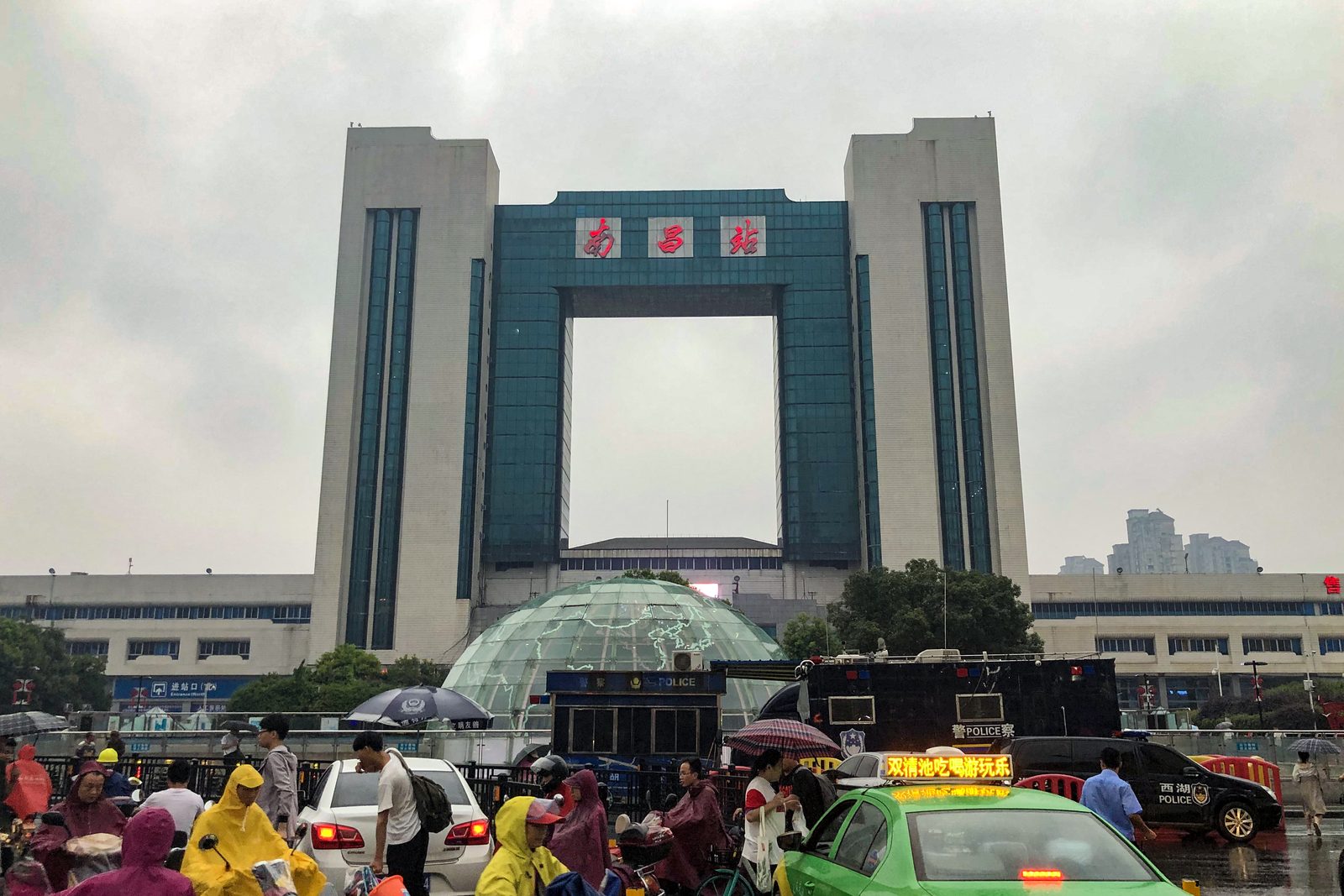 Nanchang Railway Station — the historic central hub, only about 3 km from Bayi Square. Photo: N509FZ / Wikimedia Commons (CC BY-SA 4.0).
Getting from each gateway to downtown
Here is the whole picture in one place, using Bayi Square as the downtown reference point since it is the Line 1 / Line 2 interchange where most central hotels cluster. Confirm live times in a maps app (Amap or Baidu Maps) on the day — schedules and traffic shift.
- Airport (KHN): ~28 km north. Taxi/DiDi ~27-45 min, ~¥90-120 · Metro Line 1 (no change) ~an hour-plus, ¥2-7 · Shuttle bus ¥15, ~45-60 min.
- Nanchang station: ~3 km, central. Metro Line 2 a few stops, ~¥2 · Taxi very short and cheap.
- Nanchang West: ~15 km southwest. Metro Line 2 (no change) ~45 min, ~¥4 · Taxi longer and pricier.
- Nanchang East: east side. Metro Line 2 (no change) to the center, a longer ride · Taxi from the far east side.
The happy pattern: every gateway now feeds one metro line that reaches the center without an interchange — Line 1 from the airport, Line 2 from all three stations. If your Chinese is minimal, the metro is the lowest-stress option once you are through the gate, because you never have to explain a destination to a driver.
Tickets and practical tips for foreign travelers
Chinese rail and airports run largely on your phone and your passport. A little setup before you arrive removes almost all the friction.
Buying high-speed rail tickets with a passport
- Book ahead online. Trip.com (English) and the official 12306 app both now accept foreign passports; tickets typically release about 15 days out. Booking in advance is cheaper and spares you the queue.
- Self-service machines are hit-or-miss with foreign passports. Many big stations have machines with an English interface and a passport scanner, but they often fail to read foreign documents. Do not rely on them.
- The staffed ticket window always works. Show your passport and your train number, date, and destination (a translation app helps). Windows take cash, Alipay, and WeChat Pay — not foreign cards.
At the station and airport
- Your passport is your ticket. China runs on e-tickets: expect a passport-and-face check at the entrance, then security screening. Foreign passport holders generally use the staffed/manual lane (not the automatic gates) both at entry and at the boarding gate.
- Arrive early. Give yourself about 40-60 minutes before a train, and 60-90 minutes at large stations or during holiday peaks, to clear security and manual passport checks. Boarding gates typically close about 5 minutes before departure.
Mobile payment (do this first)
- Set up both Alipay and WeChat Pay before or on arrival and link an international card (both now accept Visa, Mastercard, and others). When one wallet is refused at a small vendor, the other often works.
- Carry some cash anyway — around ¥200 in small notes — as a fallback for tiny vendors and the airport shuttle. Foreign physical cards work mainly at upscale hotels and some tourist shops, not at street level.
So which gateway should you pick?
You usually will not have a free choice — your flight or train dictates it — but when you do, or when you are planning a route, here is the logic:
- Flying in from abroad or a distant Chinese city? The airport is your door. For a short stay, take a taxi or DiDi downtown; the metro is now there as a cheaper, traffic-proof alternative if you have time.
- High-speed train to or from Shanghai, Changsha, Guangzhou, Shenzhen, or Beijing? Almost certainly Nanchang West — plan on a ~45-minute Line 2 ride to the center.
- Want the most central arrival, or riding a conventional/overnight train? Nanchang station, a short hop from the old town.
- Heading to or from Jingdezhen or Huangshan, or simply curious about the grandest new station in the province? Nanchang East — go for the architecture even if the schedule is lighter.
Whichever door you come through, these gateways are not just infrastructure. They are the city introducing itself — in porcelain skylights, an army-flag roof, and a line of Tang poetry spread across a hall like the wings of a wild duck. Ready to build the days between arrival and departure? Browse our Nanchang and Jiangxi itineraries, or let us shape a trip around your dates with Plan With Us.
FAQ
Does Nanchang airport have a metro to the city?
Yes. Since 28 June 2025, Nanchang Metro Line 1 runs directly from Changbei Airport station (at Terminal 2) into the city with no interchange to reach central Bayi Square. Fares are about ¥2-7. It is the cheapest reliable option, but the ride takes roughly an hour or a little more, so a taxi (~27-45 min, ~¥90-120) is faster. Older guides saying "no metro" are out of date.
Which Nanchang station do I use for high-speed trains to Shanghai or Guangzhou?
Almost always Nanchang West Railway Station (南昌西站), the main HSR hub on the Shanghai-Kunming corridor, with the densest schedules to Shanghai, Changsha, Guangzhou, and Beijing. It is on Metro Line 2, about 45 minutes and ¥4 from the center.
What is the difference between Nanchang station, West, and East?
Nanchang station (南昌站) is the central, historic one — closest to downtown, mixing conventional and some high-speed trains. West (南昌西站) is the main high-speed hub to the southwest. East (南昌东站) is the newest and grandest, on the east side, but serves fewer lines so far — mostly toward Jingdezhen and Huangshan.
Which station is closest to downtown Nanchang?
Nanchang Railway Station (南昌站), only about 3 km from the Bayi Square area. It sits on Metro Line 2, so central hotels are a few stops (around ¥2) or a short, cheap taxi away.
Can foreigners buy train tickets at the station in Nanchang?
Yes. Book ahead on Trip.com or the 12306 app (both accept foreign passports), or buy at a staffed ticket window with your passport — windows take cash, Alipay, and WeChat Pay, but not foreign cards. Self-service machines often can't read foreign passports, so use the staffed window if the machine fails.
Is Nanchang East station worth visiting just to see it?
If you like architecture, yes. Opened in December 2023, it was designed as a built version of a famous line from the Preface to the Pavilion of Prince Teng, with a 96-meter column-free arched hall shaped like a wild duck in flight. It is rarely crowded because it serves fewer lines. It is on Metro Line 2 (connected since June 2025).
Last verified: 2026-07 — transit facts (metro hours, fares, taxi costs, schedules, and station roles) change frequently, and the Changbei airport metro link and Nanchang East metro connection are both recent (2025). Confirm current times and fares in Amap or Baidu Maps, or with the 12306 app, before you travel.