Jiangxi Red Tourism Itinerary (2–3 Days)
A 2–3 day red-tourism itinerary through Jiangxi: Nanchang's Bayi Square & Uprising Memorial, then Jinggangshan, the "cradle" of China's Red Army.
By Hello Nanchang · Last updated
Nanchang & Jinggangshan, Jiangxi Province, China · 2–3 days · pairs Nanchang's revolutionary sites with Jinggangshan; best in spring or as a summer cool-escape
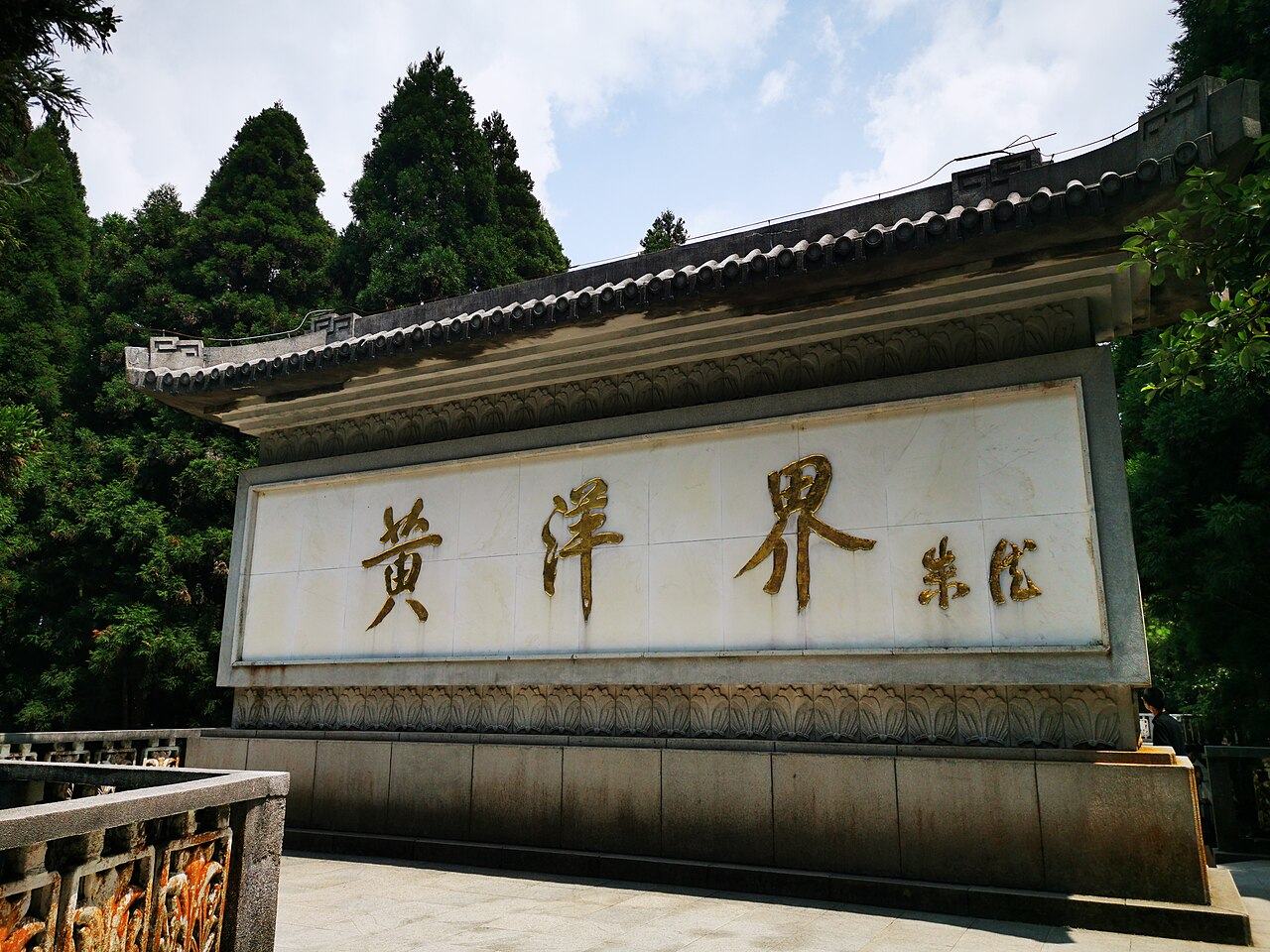
At two in the morning on 1 August 1927, the soldiers who were about to take Nanchang tied red cloth bands around their necks and white towels around their left arms, and stuck red paper crosses on their lanterns and torches — because in a dark city street, in the same uniform, that was the only way to know who was on your side. The password was héshān tǒngyī: rivers and mountains, united. Four hours of fighting later they held the city. Within days they had lost it and were marching south.
Those four hours are why this route exists. It links the two places at the heart of Jiangxi's red-tourism trail — Nanchang, where China dates the founding of its army, and Jinggangshan, the remote mountain base where the survivors of that night regrouped the following spring — and it works because they sit three hours apart on the same railway line, with a good provincial capital at one end and a genuinely beautiful mountain at the other.
What follows is the sequencing: which site on which morning, which train, how long each leg actually takes, and where the schedule will bite you if you don't plan around it. For the mountain's own tickets, shuttle lines, seasons, food and hotels, our Jinggangshan destination guide is the reference — we've kept the prices in one place so they don't drift.
The route at a glance
- Shape: Nanchang (1 night) → Jinggangshan / Ciping (1–2 nights) → back through Nanchang.
- Length: 3 days is the comfortable version; 2 works if you cut the second Nanchang stop; 4 gives you a second mountain morning.
- The one fixed leg: Nanchang to Jinggangshan by rail, about 3–3.5 hours direct, plus 40–60 minutes from the station up to Ciping.
- Cost shape: the Nanchang half is essentially free (all three main sites charge nothing); the mountain half is one gate ticket plus a sightseeing-bus pass — budget around ¥250 a head — plus optional ropeways, with rail at roughly ¥120 each way in second class. Itemised in the questions at the end.
- Watch out for: Monday museum closures at both ends, real-name booking, and arriving in Ciping after dark.
Who this route is for
History-curious independent travellers; anyone doing a themed or roots trip; visitors who want to understand a story that's central to how modern China sees itself — and who'd also like two days of mountain air out of the deal. No particular politics required at the door. What you're buying is a front-row seat at a founding myth being told, in two attractive corners of a province most foreigners fly over. (The longer plain-English primer on what "red tourism" is, and what you'll see other visitors doing, lives in the Jinggangshan guide.)
It is not a good fit if you have two days total and want mountains — go straight to Wugongshan. It's also not the route for a first trip to China with limited patience for Chinese-only signage; outside Nanchang's flagship museums, English is thin.
Before you book: three scheduling rules
Get these three right and the rest of the trip plans itself.
- Museums close one day a week — usually Monday. Nanchang's August 1st Uprising Memorial Hall, the Jiangxi Provincial Museum and Jinggangshan's Revolutionary Museum have all run Tuesday-to-Sunday, shutting Mondays outside public holidays. Two of the three closing on the same day is exactly the trap this route sets. If your trip includes a Monday, make it a travel day or an outdoor day — the mountain's passes, waterfalls and trails don't close.
- Free doesn't mean walk-in. Most of the sites here cost nothing, but several have used real-name reservation with a daily cap, booked through a WeChat mini-program a few days ahead. The rules keep changing in both directions — Jinggangshan's museum dropped advance booking for individuals in 2024 — so carry the passport you'd book with, check each site's official channel a few days out, and don't assume last year's rule still holds.
- Book the train before the hotel. The Nanchang–Jinggangshan leg is the fixed point of the whole itinerary, and the useful departures fill up in spring and around public holidays. Sort the seat, then build the days around it.
Day 1 — Nanchang: the four hours that started an army
Everything you need on this day sits inside about a square kilometre of old Nanchang, and you can walk it. Metro Line 1 has a station called Bayi Memorial Hall (八一馆), which tells you how central this history is to the city's sense of itself.
Morning — August 1st Nanchang Uprising Memorial Hall (八一南昌起义纪念馆), 380 Zhongshan Road. The anchor, and Line 1 has a stop named after it. The old building here was the Jiangxi Grand Hotel (江西大旅社), and in the last week of July 1927 the uprising's command took over its rooms; the modern exhibition hall next door lays out the days either side with photographs, weapons and a good deal of context. Entry is free, it has closed on Mondays, and it has generally wanted an advance real-name reservation. Doors have opened at 9am, with the closing time varying between late afternoon and evening depending on the season — check before you set out. Give it 90 minutes to two hours, and go early, because the school groups land mid-morning.
Late morning — He Long's headquarters (贺龙指挥部旧址), 165 Zigu Road. Ten minutes' walk, and the best five minutes of the day. This was Hongdao Hall, a mission-school building, and it's where He Long and Liu Bocheng ran their part of the operation in the small hours of 1 August. Stand across the street and look up at the third-floor windows: three white arrows mark bullet holes left from that morning. After two hours of curated exhibition, three chips in the brickwork do something the displays can't.
The memorial hall administers five sites in all — the headquarters, He Long's, Ye Ting's, Zhu De's officer-training corps and Zhu De's former residence. Ye Ting's headquarters (叶挺指挥部旧址) at 1 Supu Road is worth knowing about but sits inside a working middle-school campus, so access can depend on the day; ask at the memorial hall rather than turning up hopefully.
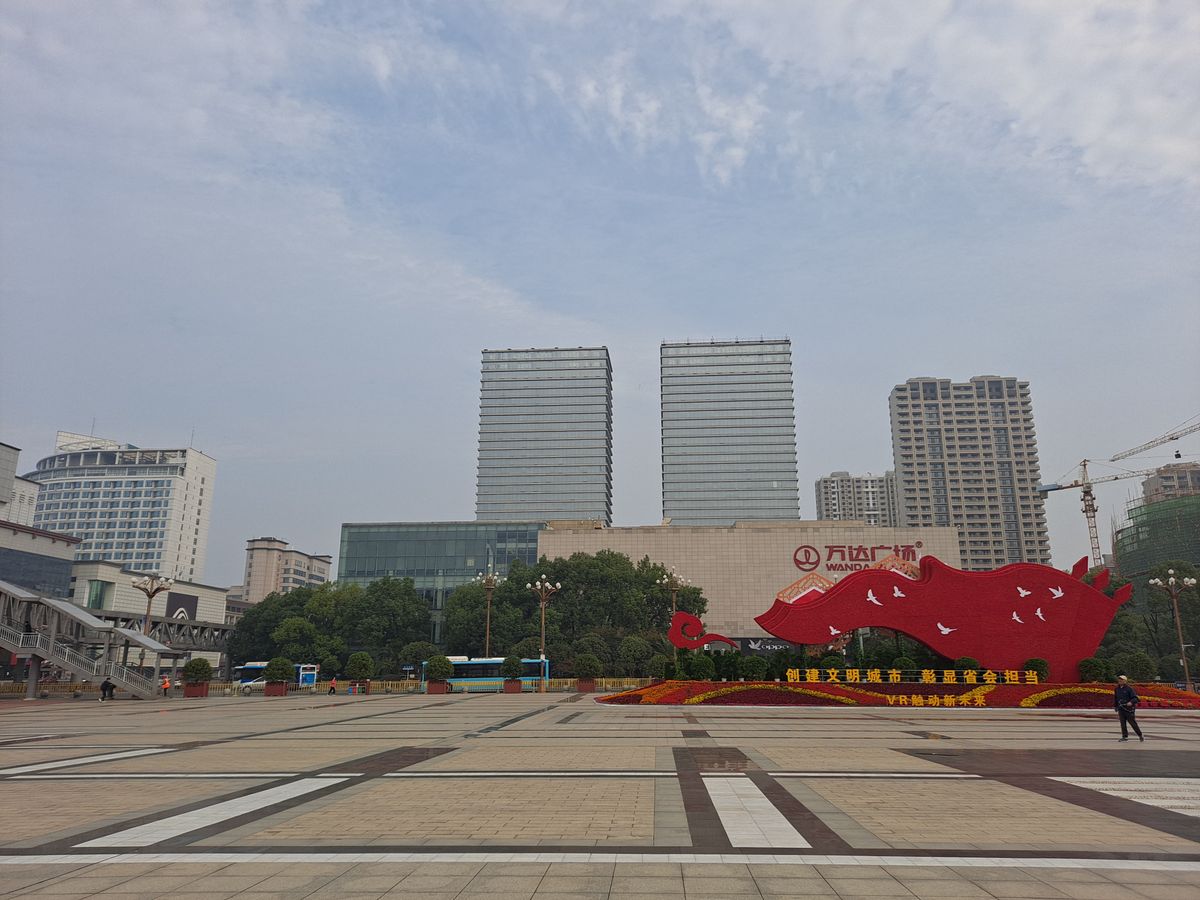
Bayi Square looking north — the Monument to the August 1st Nanchang Uprising stands behind this view, at the square's southern end. Free, open all hours, and directly above the Line 1 / Line 2 interchange. Photo: 钉钉 / Wikimedia Commons (CC BY-SA 4.0).
Midday — Bayi Square (八一广场). One metro stop, or ten to fifteen minutes on foot, and the place the whole city orients itself around. The granite spire at the south end is the Monument to the August 1st Nanchang Uprising: originally 45.5 m, raised by exactly 8.1 m during the 2001–04 rebuild to its present 53.6 m, with "1927·8·1" carved at eye level and nine gilded characters running down the north face — Ye Jianying's calligraphy, added when the tower went up between 1977 and 1979. He was not one of the uprising's commanders: in July 1927 he was chief of staff of the Nationalist Fourth Army, and his part in the story was a tip-off passed in a rowing boat on Jiujiang's Gantang Lake, telling He Long and Ye Ting to skip a meeting on Lushan where they were to be detained and take their troops to Nanchang instead. In the centre circle, set into the granite, is a bronze disc marking Nanchang's official City Origin Point. Free, no booking, and Lines 1 and 2 surface directly underneath. We've written the square up in full in Nanchang's City Origin Point.
For lunch and air-conditioning, Wushang MALL is on the square's edge — the most reliable bathroom, coffee and cold air within two minutes on a summer day.
Afternoon — pick one. Three days of unbroken revolutionary history is a lot, even for enthusiasts, so this slot is deliberately flexible:
- More context, less politics: the Jiangxi Provincial Museum out in Honggutan — free, spectacular on the Han-dynasty Haihunhou tomb finds and on Jiangxi porcelain. Closed Mondays, needs a free booking, and it's Line 1 to Qiushui Square plus a short taxi. Allow 2–3 hours.
- A complete change of register: Tengwang Pavilion, the riverside tower that is Nanchang's other, much older claim to fame. Best in the last hour of daylight.
- Nothing at all: a nap. You have a mountain tomorrow.
Evening — eat properly, then go to the river. Nanchang's signature is banfen (拌粉), cold-tossed rice noodles with chilli oil, pickled radish and peanuts, usually eaten with a small earthenware pot of waguantang (瓦罐汤) beside it. At a neighbourhood counter that's about ¥3–6 for the noodles and ¥5–10 for the soup — see our guide to Nanchang rice noodles for how to order and where. Jiangxi food is among the spiciest in China; wēi là (微辣, mild) or shǎo là (少辣, less chilli) is the phrase you want. Afterwards, walk down to the Gan River for the One River, Two Banks light show, which runs across kilometres of tower facades most evenings and costs nothing to watch.
Sleep: near Bayi Square. It's the Line 1 / Line 2 interchange, it's a walk from everything on today's list, and it's a straight metro run to the station in the morning. Honggutan across the river has the newer hotels and the better views, but you'll commute for them.
Day 2 — up the line to Ciping
Today is a travel day with a museum on the end of it. Don't over-programme it.
Morning — the train. Two ways up, both covered in detail in the Jinggangshan guide: a direct service to Jinggangshan Station, about three to three and a half hours, or the faster high-speed hop to Ji'an West — about an hour from Nanchang West — followed by a coach up the mountain road. The direct train is one seat and less thinking; the Ji'an route gives you far more departure times to choose from.
Two timing notes that matter more than the route you pick. First, the station is not the mountain: Jinggangshan Station sits some 35 km below Ciping (茨坪), the town at the centre of the scenic area, and that transfer takes another 40 minutes to an hour on winding road. Second, don't arrive in the dark. A mid-morning departure gets you into Ciping in the early afternoon with the day still usable; the late train gets you in tired, hungry and unable to see where you are. Check which Nanchang station your ticket says — the city has several, and they're nowhere near each other (our stations guide sorts it out).
On arrival — buy your tickets before you do anything else. Jinggangshan runs on a single multi-day gate ticket plus a separate sightseeing-bus pass, both bought at the Ciping visitor centre. Do it this afternoon rather than at 7:30 tomorrow morning with everyone else. Current prices, what's included and the ropeway options are all in the destination guide.
Afternoon — the Ciping museums, on foot. The Revolutionary Museum on Hongjun South Road is free, has English on the main panels, and includes a relief model of the whole base area that makes tomorrow's geography suddenly obvious. Ninety minutes. Mao's Ciping residence is a few minutes away, and the Revolutionary Martyrs' Cemetery climbs the north hill above the town — leave that for the golden hour if you can, when the steps are quiet. All three are walkable from any hotel in Ciping and all three are free. Note the Monday rule again: the museum closes; the hill and its steps don't.
Evening — Ciping. A lake with a nine-turn bridge in the middle of town, a torch monument on a terrace at the south end with the main peak behind it, and a pedestrian street selling bamboo-tube rice and Red Army caps. It takes an hour and it's the right speed after a train day. Eat where your guesthouse eats; the smoked bamboo shoots with pork belly (烟笋炒肉) is the local dish to order, and the destination guide has the rest of the menu.
Day 3 — the mountain, in one efficient loop
One well-sequenced day covers the essentials. The shuttle buses leave the Ciping terminus from about 7:30am and the trick is to ride past everything first and work backwards, ahead of the coach groups.
- 7:30 — first bus on the A line, all the way to Huangyangjie (黄洋界). Ride past everything and start at the pass; on a clear morning the valleys below sit under a floor of cloud that burns off as the day warms. Give the monument ten minutes — the calligraphy on it, and the story of the three mortar shells, are worth arriving informed about.
- Mid-morning — work back down the line. The Bamboo Garden is a twenty-minute stop. Then Longtan (龙潭), the waterfall valley: walk down through the pools in about an hour, take the ropeway back up. Wear shoes with grip — the steps stay wet.
- Early afternoon — Xiaojing (小井). Ten minutes at the Red Army's first field hospital and the grave behind it. Quiet, unglossy, and the part of the day people remember.
- Late afternoon — your choice. The Main Peak stop on the C line for Wuzhifeng, the ridge printed on China's old ¥100 note; or, between mid-April and mid-May, the Dujuanshan ropeway and its ten-li corridor of wild azaleas. Outside bloom season, skip the second one.
- Leave two clear hours to get from Ciping back down to the station or the airport. The road is slow and unforgiving of optimism.
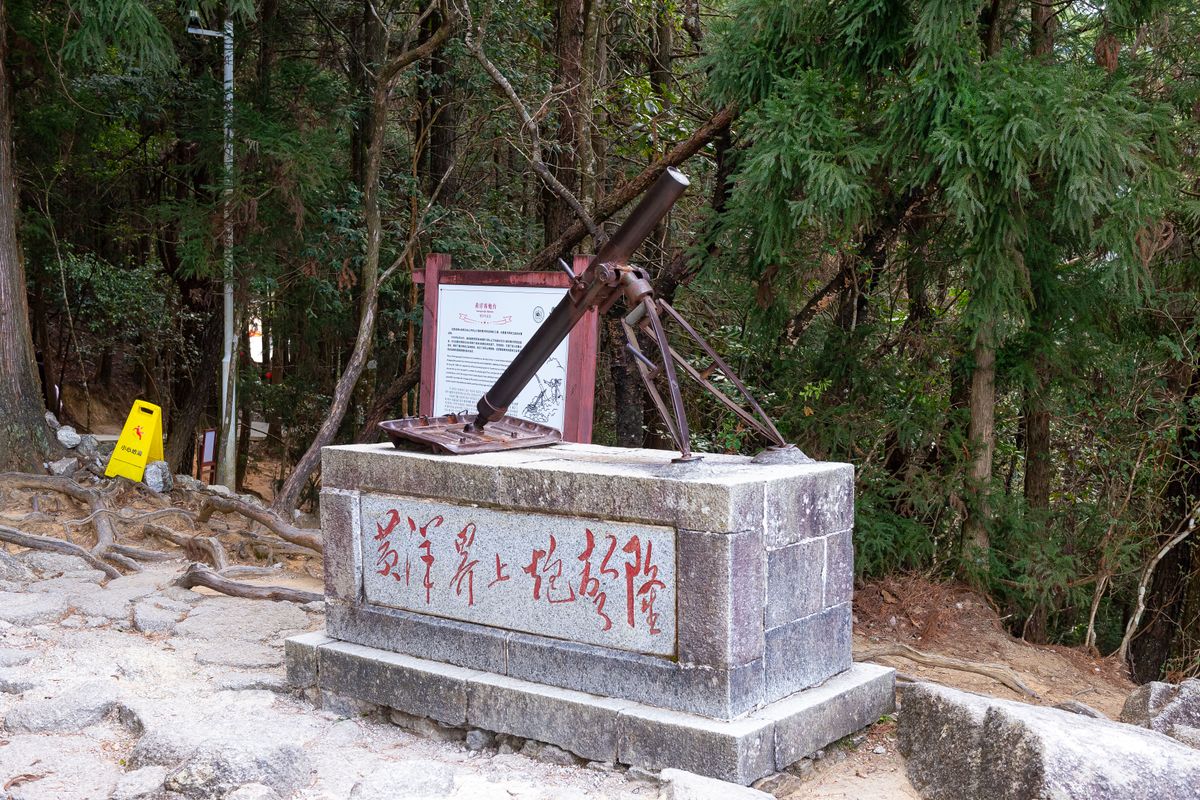
The gun emplacement at Huangyangjie, with a mortar on a plinth carved with Mao's line about the roar of guns — first stop of the mountain day, before the coaches arrive. Photo: N509FZ / Wikimedia Commons (CC BY-SA 4.0).
Two days, three days, or four
- Two days (tight, but it works). Day 1: Nanchang's uprising sites in the morning, an early-afternoon train, tickets and the Ciping museums on arrival. Day 2: the mountain loop above, minus the late-afternoon choice, then travel home. That's the best part of nine hours on trains and buses across two days, and you will feel it. Skip the Provincial Museum entirely.
- Three days (the version we'd choose). Exactly as laid out above: a relaxed Nanchang day, a travel-and-museums day, a full unhurried mountain day. Nothing is rushed and nothing is padding.
- Four days. Add a second mountain morning — the B line to Dajing (大井), where the burnt wall of Mao's house was built into its own replacement, and the grain-carrying trail up from below. Or spend the extra day back in Nanchang doing the non-revolutionary city properly with our two days in Nanchang route.
Flex notes: rain, Mondays, kids and shoulder seasons
- If your trip includes a Monday, make it the travel day. Trains run, the ticket office is open, the mountain is open, and both museums you'd have wanted are shut.
- Rain plan. Nanchang has enough indoor material to absorb a wet day (the two museums plus Wushang MALL). On the mountain there is no indoor plan beyond the Ciping museums, and Longtan's steps in heavy rain are genuinely slippery — that's a day to swap for the town and the cemetery.
- With children. The Nanchang day is heavy on reading; the mountain day carries it. Bamboo-tube rice, the cable car, the waterfalls and the shuttle buses all land well. See also Jiangxi with kids.
- Best window. April–May for the azaleas, though it's also the busiest; July–August because the mountain is a recognised heat escape and the city is not; autumn for clear, quiet walking. Full season-by-season notes are in the destination guide.
- Continuing on. Jinggangshan sits in the south-west of the province, so it chains awkwardly with Jingdezhen and Wuyuan in the north-east — you'd come back through Nanchang. If you want both halves, see the 5–7 day Jiangxi loop.
Honest notes before you commit
This route is a lot of transport for two destinations. That's the deal, and it's worth taking with three days rather than two. English is good at the Nanchang memorial hall and the Provincial Museum, adequate at the Jinggangshan museum, and largely absent everywhere else — download an offline translation app. Set up Alipay or WeChat Pay before you fly; ticket windows on the mountain will not take a foreign card. Carry your passport every day, because free museum entry runs on real-name registration. And go midweek if you have the choice: in the first week of May or October these sites carry crowds on a scale that changes the experience entirely.
Common questions
Is two days enough for Nanchang and Jinggangshan? Enough to see the essentials, not enough to enjoy them. Three days is the version that works — one city day, one travel-and-museums day, one full mountain day.
Do I need a guide or a tour? No. Both ends are straightforward independently: metro and walking in Nanchang, a numbered shuttle system on the mountain. A guide helps if you want the deeper history narrated on site, since most of it is in Chinese.
Is it awkward to visit these sites as a foreigner? Not in our experience. Foreign visitors are uncommon enough to be a mild curiosity and are treated with straightforward friendliness. Nobody asks what you think; you're expected to be respectful at the memorial sites, which is easy enough to manage.
What does it cost? Less than most people expect, because the history is free. In Nanchang the memorial hall, Bayi Square and the Provincial Museum all charge nothing, and breakfast is a ¥3–6 bowl of banfen with a ¥5–10 pot of soup beside it. The mountain is where the money goes: about ¥250 a head for the Jinggangshan gate ticket plus the sightseeing-bus pass, which in practice you cannot skip, both valid for several days. Ropeways are extra — roughly ¥70 return at the Longtan waterfalls, ¥150–160 at the azalea cableway. Add about ¥120 each way for a second-class seat on the direct train, ¥8 for the local bus between Jinggangshan Station and Ciping, and ¥60–100 a day for food, and three days land somewhere around ¥750–900 a person before beds; simple Ciping guesthouses have started at about ¥260 a night. We keep every one of those figures in the Jinggangshan guide rather than here, so check them there before you budget.
Can I do Jinggangshan as a day trip from Nanchang? No. Roughly four hours door to door each way. Sleep in Ciping.
Want this shaped around your dates, your pace and how much history you actually want in a row — or extended into a longer Jiangxi loop? Plan this trip with us. For the wider province, browse all our Jiangxi itineraries or start with the Nanchang guide.
Cover photo: "井冈山黄洋界石碑 03" by Liuxingy (CC BY-SA 4.0) via Wikimedia Commons. In-article photos: "Bayi Square, Nanchang" by 钉钉 and "Huangyangjie Cannon Monument" by N509FZ, both CC BY-SA 4.0 via Wikimedia Commons.
Last verified: 2026-08 — train times, museum hours, closing days and reservation rules change often, and Jinggangshan's ticket structure is maintained in our destination guide. Please double-check official sources before you travel.