Nanchang Weekend Trip from Shanghai
A weekend in Nanchang for expats in Shanghai, Hangzhou or Guangzhou: high-speed-rail times, a Friday-night-to-Sunday plan, where to stay & what to eat.
By Hello Nanchang · Last updated
Nanchang, Jiangxi Province, China · Fri night–Sun · a high-speed-rail weekend from Shanghai / Hangzhou / Guangzhou
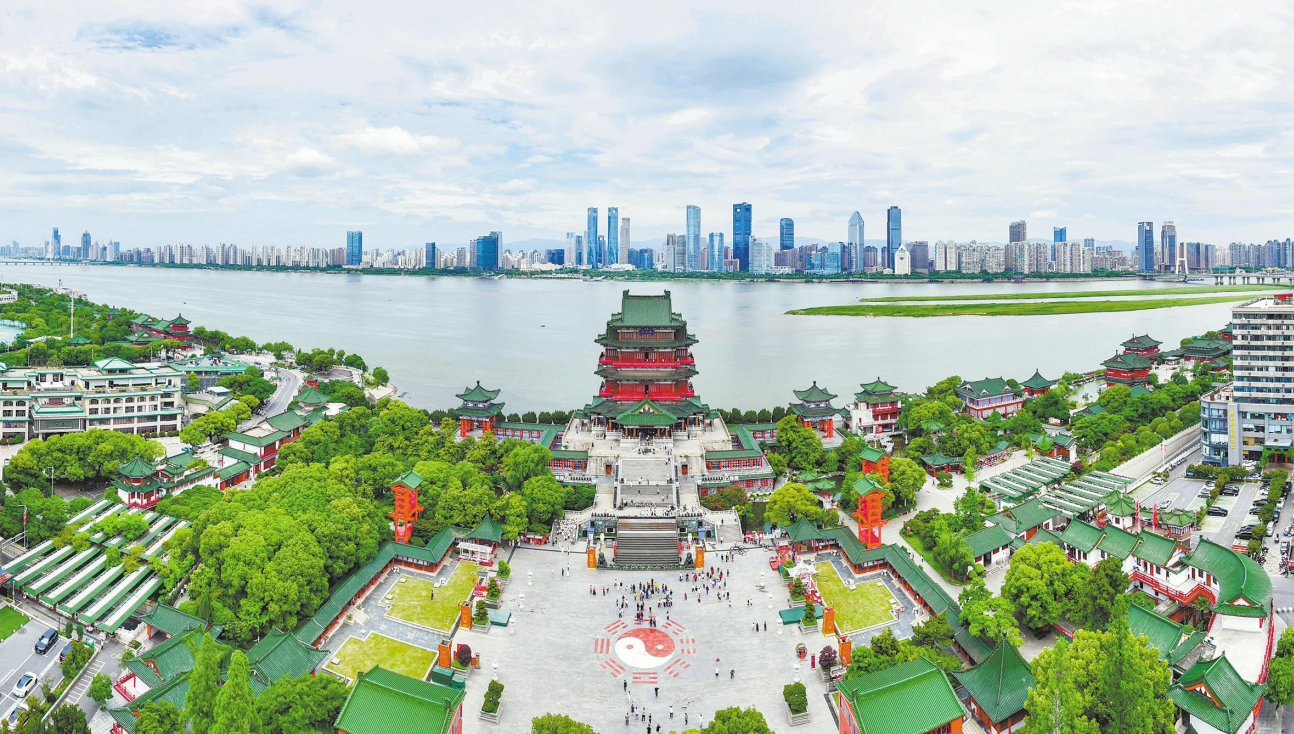
The 6pm train is real — but only just
Here is the fact this whole trip turns on, and it is in nobody's brochure: on recent timetables the last high-speed train from Shanghai Hongqiao to Nanchang West leaves at about a quarter past six in the evening. Not nine. Not ten. Quarter past six. From Guangzhou South the board thins out earlier still. Only Hangzhou lets you eat dinner first.
Make that train, though, and the arithmetic is very good. G1395 has recently run Hongqiao 18:13 to Nanchang West 21:45 — three hours thirty-two minutes, ¥403 in second class — which puts you on a plastic stool with a bowl of rice noodles in front of you before the counters close, in a provincial capital where two days on the ground cost less than a Saturday lunch in Jing'an.
That's the pitch for anyone already living in China. Nanchang (南昌) is not a curated weekend. It's a working city with a Tang-dynasty tower on the river, a free provincial museum that would justify the fare on its own, one of the hottest chilli kitchens in the country, and an entire skyline that animates over the water — on Friday and Saturday nights specifically, which is the best single reason to come when you were coming anyway.
This page is the weekend engineering: the trains, the station you must not get wrong, the Friday arrival clock, the Sunday departure maths, what six meals buys you, and what the whole thing costs. For the stop-by-stop version of the city — every ticket price, opening time and metro exit — use 2 Days in Nanchang. This one assumes you know how China works and just wants your plan to survive contact with the departure board.
The departure board, city by city
Three numbers decide a rail weekend: how fast the quick one is, how much slower the rest are, and when the last one goes. Everything below is for the high-speed services you'd actually book, and every figure moves with the timetable season — treat them as the shape of the thing and check 12306 for your date.
- Hangzhou East → Nanchang West (杭州东 → 南昌西), about 580 km. The easy one, and it isn't close. Quickest services run just under two hours; most land between two and two and a half. Second class sits around ¥220–320. Roughly sixty-plus high-speed pairs a day, with departures spread from early morning to about 20:20 — so you can finish work, eat at home, and still be in Nanchang before midnight. Nanchang is closer to you than half of Zhejiang.
- Shanghai Hongqiao → Nanchang West (上海虹桥 → 南昌西), about 740 km. Fastest scheduled runs are 2h45–3h; the bulk are three to four hours. Second class runs roughly ¥340–405. Something like 35–45 services a day, first out around 06:10. The catch is the tail: the main evening departures stop at about 18:15–18:30, with only the odd late extra after that. A five o'clock finish is comfortable; a six o'clock finish is a sprint.
- Guangzhou South → Nanchang West (广州南 → 南昌西), about 1,050 km. The long one, and the one people misjudge. Timetable sources disagree about the fastest service — we found everything from 3h18 to 3h44 quoted across four of them — so plan on 3½ to 3¾ hours at best, and 4 to 4½ for an ordinary train. Second class is ¥470–565, comfortably the priciest of the three. Roughly 35–55 high-speed pairs a day, first out around 07:30, and the last direct departures fall anywhere between mid-afternoon and about 19:20 depending on the season. This is the one route where you build the weekend around the train rather than the other way round.
Flying from Guangzhou is the obvious counter-argument: about an hour and a half in the air, a handful of direct flights a day, fares in the same band as second class. Add Baiyun at one end and Changbei at the other and you save perhaps ninety minutes door to door in exchange for more friction and a much thinner schedule. Worth pricing. Not the default.
Booking, briefly. The official 12306 app and Trip.com both accept a foreign passport, seats typically release around 15 days out, and the passport is your ticket at the gate — bring the physical document, not a photo of it. Allow 20–30 minutes inside the station for security and the real-name check, and more than that at Guangzhou South on a Friday evening. Onward legs across the province are in our guide to getting around Jiangxi by train.
One character on your ticket: 西, 东, or neither
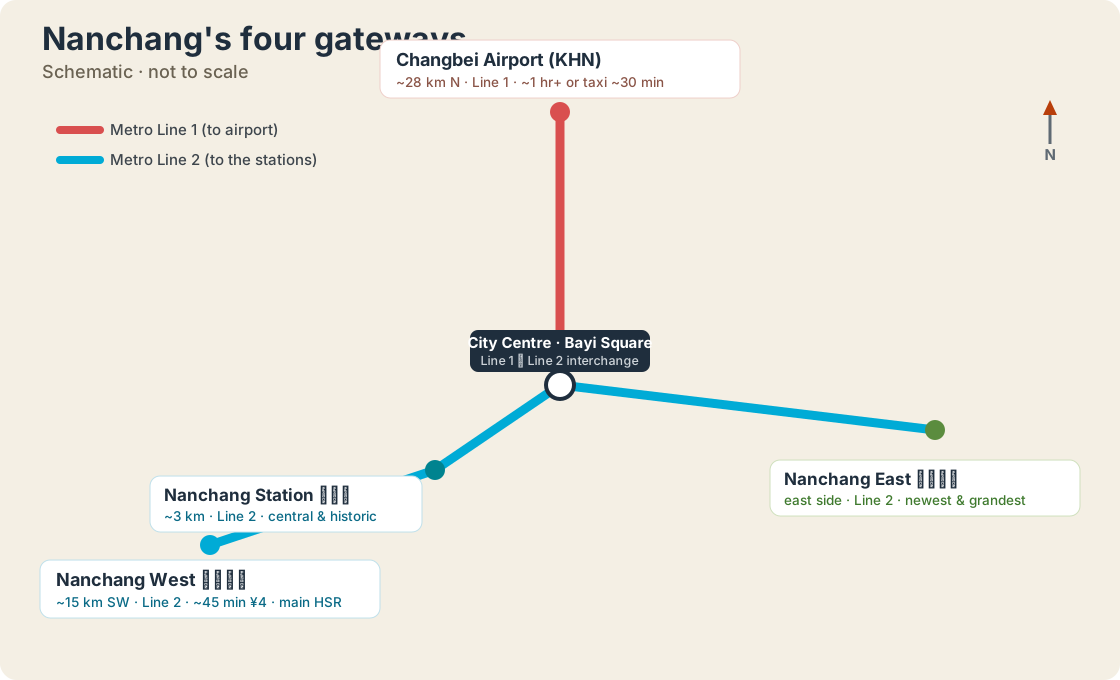 Nanchang's three stations sit west, south-central and east of the city. All three are on Line 2; none of them is near the others.
Nanchang has three railway stations, they are nowhere near each other, and the difference between them on your ticket is one Chinese character. Booking apps romanise them run-together — Nanchangxi, Nanchangdong, plain Nanchang — which is precisely the sort of thing you skim past at eleven at night while booking on your phone.
- Nanchang West (南昌西站) — the high-speed workhorse, about 15 km southwest, and where nearly every fast train from Shanghai, Hangzhou and Guangzhou arrives. Metro Line 2 runs straight to Bayi Square with no interchange: roughly 45 minutes, about ¥4. Arriving high-speed passengers can drop onto Line 2 through a security-free connection, which spares you a second bag scan.
- Nanchang (南昌站) — the central, historic one, about 3 km from Bayi Square and also on Line 2. A couple of stops, around ¥2, or a short cheap taxi. Before you book the ride home, look for a departure from here rather than West — it buys back the better part of an hour in bed.
- Nanchang East (南昌东站) — the newest, out on the far east side at the end of Line 2 (metro-connected since June 2025). Mostly serves the Hangzhou line toward Jingdezhen and Huangshan. A longer ride into town from here.
What getting it wrong costs. Land at West when you're sleeping downtown and you've bought yourself 45 minutes on the metro, or a metered taxi: Nanchang's meter opens at ¥6 for the first two kilometres, then ¥1.90 a kilometre to eight and ¥2.85 beyond, which works the West run out at roughly ¥40–55, more on the 23:00–05:00 night tariff. Survivable on Friday. Do it in the wrong direction on Sunday, with 25 minutes of security still ahead of you, and it's the difference between catching the train and buying another one.
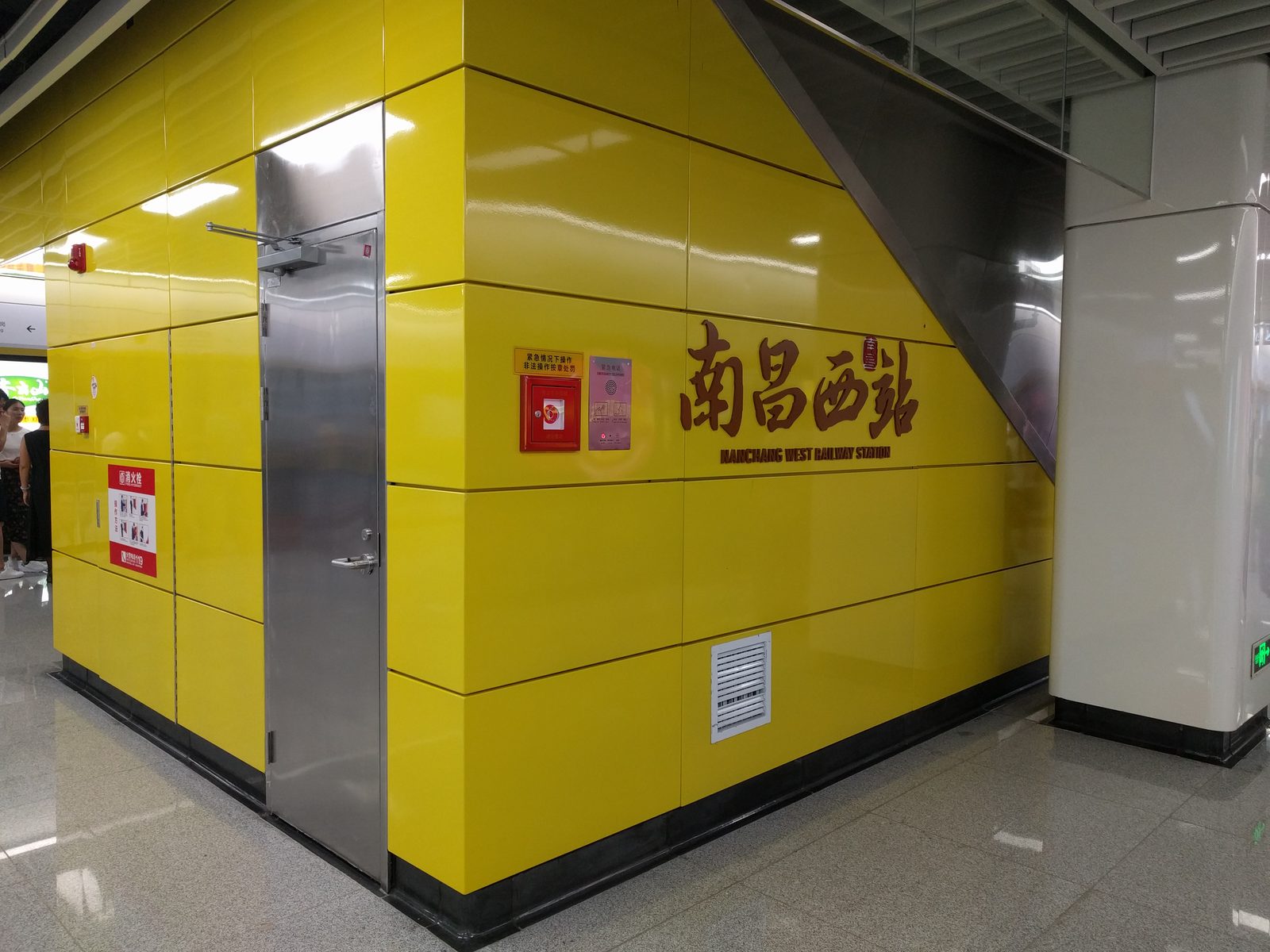 The character to look for is 西. Nanchang West is the hub most fast trains use — and 15 km from wherever you're sleeping. Photo: Qa003qa003 / Wikimedia Commons (CC BY-SA 4.0).
If your route runs through Nanchang East, give it twenty minutes. Its designers took the most famous couplet in the Preface to the Pavilion of Prince Teng — the setting sun and a lone wild duck flying together — and built it: a triple-arch steel roof spread like wings, the central arch spanning 96 metres over a column-free hall. See it after the actual pavilion on the river and the effect is quietly excellent — the same 1,300-year-old sentence, once in timber and once in steel. Which station suits which trip, in full: our Nanchang airport and train stations guide.
Friday night: the arrival clock
What's still possible depends entirely on when the doors open. Three brackets, and they are genuinely different evenings.
- In by about 20:30 — the good one. Drop the bag, take Line 1 to Qiushui Square (秋水广场) and look back east across the Gan at the lit skyline; the buildings stay on until roughly 22:30. Ten minutes on that boardwalk explains the city faster than any introduction.
- In around 21:45 — the standard Shanghai and Hangzhou arrival. You have time for exactly one thing, and it should be dinner.
- In after 22:30 — the Guangzhou arrival on a slower service. Assume the metro is finished and walk straight to a DiDi.
The last-train trap. Nanchang's metro broadly runs 06:00 to about 22:30, commonly stretched to around 23:00 on Fridays, weekends and holidays. But the number you see quoted is the last departure from the terminus, which means the last train through your station is earlier — sometimes by the better part of an hour. Read the board on your own platform rather than the network figure, and don't discover this at the bottom of an escalator. Full detail in our Nanchang metro guide.
The first bowl. Whatever the hour, eat before you sleep. Banfen (南昌拌粉) — round rice noodles rinsed cold and tossed with chilli oil, pickled radish, mustard greens and peanuts — runs about ¥3–6, and locals never order it alone: a small clay-pot soup (瓦罐汤), ¥5–10, goes beside it. The pairing has a name, 一粉一汤, one noodle and one soup. Ordering the noodles without the soup gets you a look. Fair warning on the chilli — Gan cooking treats fresh chilli as a vegetable rather than a seasoning, and 少辣 is still warm work. (The full story of the bowl.)
Before bed, book Saturday's museum slots. The Jiangxi Provincial Museum and the August 1st Uprising Memorial Hall are both free, both real-name, both capped daily, and both accept foreign passports. Five minutes on Friday night saves a closed door on your only full day. Neither shuts at the weekend — it's Mondays that close them.
Saturday: pick one track and commit
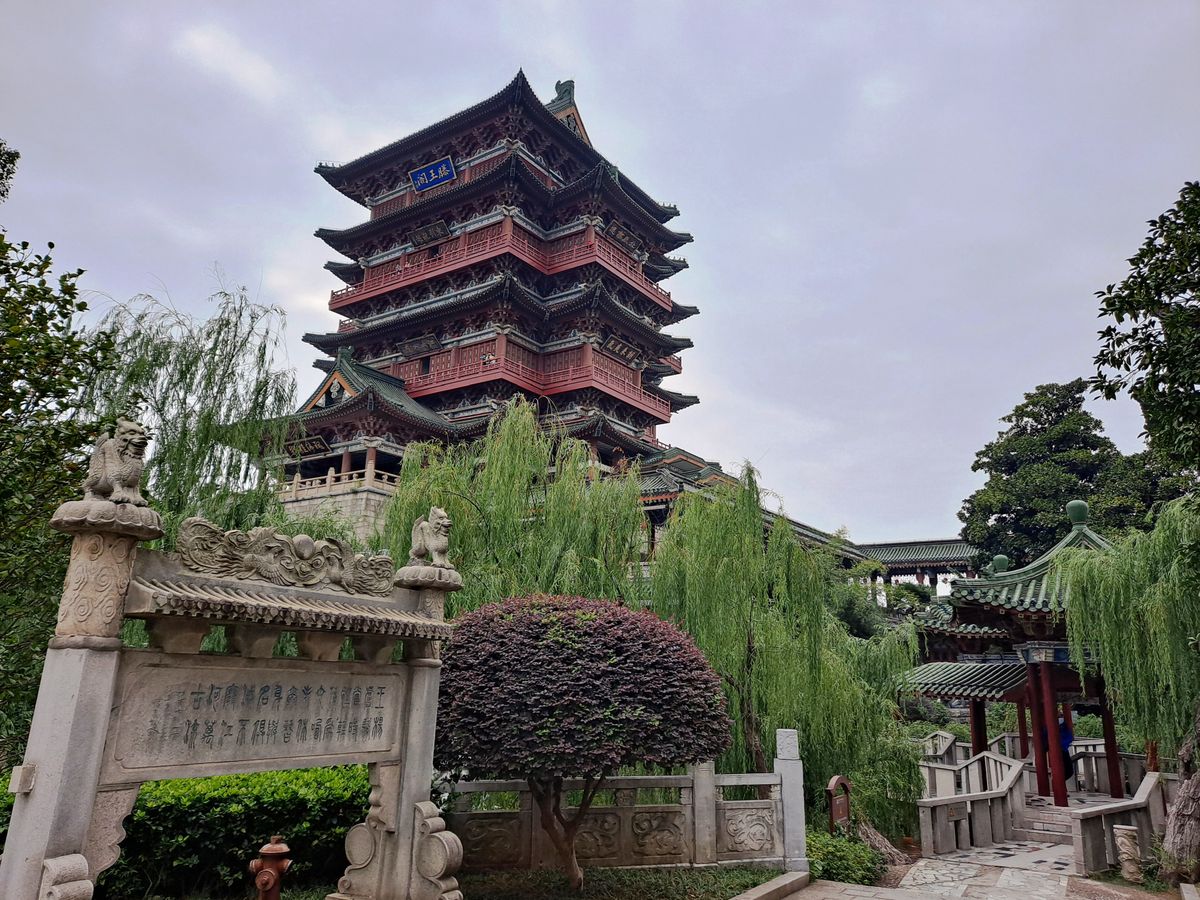 Tengwang Pavilion on the Gan — the anchor of the classic Saturday, and best in the last hour of light. Photo: 钉钉 / Wikimedia Commons (CC BY-SA 4.0).
You get one full day. Don't spread it. Pick one of these three and run it properly — each ends on the riverfront, because on a Saturday that's where the evening is. Every stop is opened up properly in the 2-day itinerary; here they're one line each so you can choose fast and go.
- Track 1 — the classic. Tengwang Pavilion at opening (Line 1, Tengwangge Station, Exit 2; adult day ticket ¥50, and barely less booked online) → lantern lanes and snacks at Wanshou Palace → Bayi Square and the Uprising Memorial Hall → cross the river for sunset.
- Track 2 — eat your way through it. Breakfast noodles at a neighbourhood counter → a xiaochao (小炒) lunch, ordered by pointing at the display fridge → an afternoon grazing the food street under Shengjin Tower, where most plates land between ¥5 and ¥12 (Shengjinta Station, Exit 3, on Lines 3 and 4) → night market for dinner.
- Track 3 — camera day. Morning at Fish Tail Park (Line 4 east to Yuweizhou, free) for cypresses standing in water → the classical garden at Bada Shanren on Line 3 → blue hour at Bayi Square → the riverfront after dark. Light and timing for each: Nanchang photo spots.
One honest warning about the museum. The Jiangxi Provincial Museum wants two or three unhurried hours, and on a two-night trip that means dropping something else. Drop something else. The Haihunhou hoard — the grave goods of a marquis who was emperor for 27 days before being deposed, the richest Western Han burial ever excavated — is the most interesting thing in the province, and it costs nothing.
Saturday night is the reason you came on a weekend
This is the scheduling detail that makes Friday-to-Sunday strictly better than midweek, and almost nobody mentions it.
The Honggutan (红谷滩) skyline is lit every night, roughly 19:10 to 22:30, along a stretch of riverbank that holds a Guinness World Record for the number of buildings synchronised into a single display. One headline act does lean to the weekend: the big animated sequence across the tallest twin towers runs Friday and Saturday, roughly 19:30–21:30. The Qiushui Square musical fountain, though, runs nightly — two shows of about fifteen minutes, around 19:30 and 20:30. So a Wednesday still buys you a lit skyline and the fountain; a Saturday adds the towers, and all of it is free.
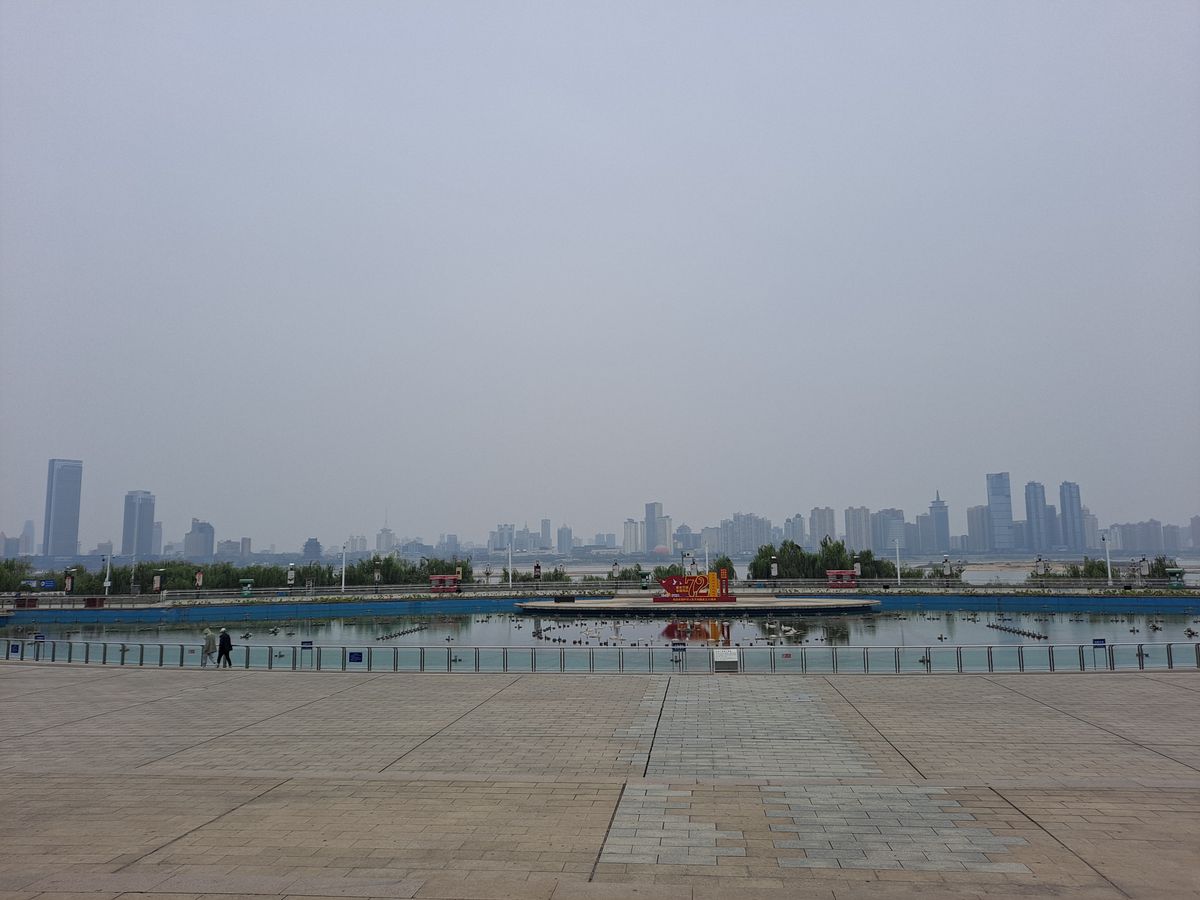 Qiushui Square on a flat weekday afternoon, basin still and the apron empty — worth seeing so you know how much the evening changes it. Photo: 钉钉 / Wikimedia Commons (CC BY-SA 4.0).
Claim a spot on the curved riverside platform 15–30 minutes early; the front railing goes three deep in the last ten minutes. Wind or high water cancels the fountain with very little warning, so check the same-day schedule — how it works and where to stand is in our Qiushui Square fountain guide, with viewpoints on both banks in the One River, Two Banks guide.
Then eat late, because that's the local habit and Saturday is when the stalls run deepest. Hama Jie (蛤蟆街), downtown near Tengwang Pavilion, is the gritty original: forty-odd stalls, most things ¥5–30. Zijing Night Market (紫荆夜市), out by the university campuses in the Jingkai zone, is the big modern one — a hundred-plus stalls under red canopies, younger and cheaper. Either way, ¥30–60 a head, eaten standing up.
Afterwards the drinking is small-scale and entirely local, which is the point. Fuzhou Road (福州路) near Bayi Square is the cheap, loud end at around ¥50 a head; the restored blocks at Wanshou Palace and Shengjin Tower do live Chinese indie, folk and rock for roughly ¥70–90. Listings are Chinese-only — check Dianping or ask your hotel who's playing. Streets and names: our night markets and after-dark guide.
Sunday: work backwards from the gate
Don't plan Sunday around sights. Plan it backwards from the departure board. From a central hotel to the gate at Nanchang West, budget 45 minutes on Line 2 plus 20–30 minutes for security and the real-name check — call it an hour and three-quarters from bed to boarding with a sane buffer. From the central Nanchang station it's more like 45 minutes all in. The metro starts around 06:00, which covers even an ugly early train.
The trick that buys back your morning. Nanchang Metro runs a free left-luggage service (阳光寄存) — smart lockers at around a dozen tourist-heavy stations, plus a staffed counter at Bada Shanren. The list includes the ones you'd actually want: Tengwang Pavilion, Qiushui Square, Wanshou Palace, Bayi Square, Bayi Memorial, Nanchang Railway Station and West Station South Square. It's free, up to eight hours, bags go through the scanner first, and you must collect before the posted daily cut-off (recently around 22:00). So: check out at nine, stash the bag at Tengwang Pavilion station, do the pavilion and the riverside unencumbered, collect it on your way to Line 2. Availability and the station list do change, so keep a plan B for a big suitcase.
- Train before noon. One thing only: breakfast noodles near the hotel, then the metro. Don't gamble on a museum slot you might not clear in time.
- Mid-afternoon train. A proper morning. The Provincial Museum if you skipped it on Saturday — it opens around 9, and you booked it on Friday night — or the Bada Shanren garden, or the boardwalk with a coffee. Lunch, bags, go.
- Evening train — the best version. Effectively a second full day. Add the Haihunhou Tomb Site Museum out in Xinjian district: a DiDi ride, a genuine half-day, ticketed and real-name booked, so read that guide before you commit. Or take a slow lunch, one last graze along the Shengjin Tower food street, and a final clay-pot soup.
Worth carrying home: dried Jiangxi rice noodles from any supermarket, camellia tea oil (茶油, the cooking fat under most Gan dishes and hard to find well outside the province), and Jiangxi green tea. If Jingdezhen ends up on the trip, porcelain — obviously, and much better bought there than anywhere else in China.
Six meals: can you actually eat enough in forty-eight hours?
Honest answer: no. Gan cuisine (赣菜) is a full regional kitchen and a weekend hands you six or seven slots, one of which you'll waste on a hotel breakfast you didn't need. So treat the meals as rations and spend them in this order. Prices are per person and yes, they really are that low.
- Friday, late. Banfen and clay-pot soup, ¥10–15 for both together. The default Nanchang meal, and the fastest way to be in the city rather than next to it.
- Saturday, 6–9am. Banfen again, at a different counter — the tossing is the whole craft and no two shops do it the same way. Add fried rice noodles (南昌炒米粉, ¥8–15 at a street counter) if you woke up hungry.
- Saturday lunch. The one you must not skip: a proper xiaochao table. Three or four dishes plus rice for two comes to about ¥50–65 a head even in a busy city restaurant. Order stir-fried pork with green chilli (青椒炒肉, ¥28–38) as the benchmark — if a place can't do that one, leave — and three-cup chicken (三杯鸡, ¥48–78) as the mild escape hatch. Ask for the rice; it doesn't always arrive by itself.
- Saturday, mid-afternoon. Not a meal, a graze: white sugar cake (白糖糕) straight out of the fryer at roughly ¥1 a piece, plus whatever the queue in front of you is buying.
- Saturday, late. Night market — ¥30–60 a head across a dozen small things. This is the meal that earns the train fare.
- Sunday breakfast. Last bowl. Order the soup with it again, drink the broth, get on the train.
What you will not get to in two days: the river fish, the smoked and cured dishes, the countryside cooking, most of the province. That's what the longer Jiangxi loop is for. Dish by dish, with meal slots and prices: what to eat in Nanchang.
What the weekend actually costs
The train is the budget; almost everything after it is rounding. Return second class, per person:
- From Hangzhou: roughly ¥440–640.
- From Shanghai: roughly ¥680–810.
- From Guangzhou: roughly ¥940–1,130.
Two nights of hotel is the second line, and the one you control. Booking platforms put a Nanchang four-star at around US$60–75 a night on a weekend — an average dragged upward by the international brands in Honggutan — while solid domestic mid-range chains list from roughly US$25–40. Both bases work: Bayi Square for walking distance to the old town and the Line 1 / Line 2 interchange, Honggutan for newer rooms and the fountain on your doorstep. The honest comparison is in the 2-day itinerary's where-to-stay section. Bring the physical passport for check-in — it gets registered, not glanced at — and book through a mainstream platform, because smaller local hotels often aren't set up to register foreign guests at eleven at night.
Then the ground game, which is where this city shows off:
- Metro, all weekend: ¥2–7 a ride, so ¥20–30 covers everything you'll do.
- Food: ¥120–200 a day if you eat the way this page suggests.
- Tickets: Tengwang Pavilion ¥50 (booking online saves almost nothing); both museums free; the riverfront light show and the fountain free. Optional extras — the Star of Nanchang wheel around ¥50, a night river cruise roughly ¥80–170.
Call it ¥400–700 a head on the ground for two days, hotel excluded. From Hangzhou, train and ground together land around ¥850–1,350 before the room, which is the cheapest genuine change of scene available to you at that distance.
Is it worth the fare? The honest version
It depends where you're leaving from, and the answer is not the same in all three cities.
- From Hangzhou — yes, without much argument. Two hours and ¥220–320 each way is a shorter, cheaper journey than plenty of Zhejiang weekends, and Nanchang is a far bigger change of scene than any of them.
- From Shanghai — yes, if you're coming for the eating and the river. Three hours each way for two nights is a fair trade. It is not a fair trade if what you want is a preserved old town: Nanchang's history survives in fragments — a pavilion, a pagoda, two restored blocks — not in one walled quarter.
- From Guangzhou — marginal as a two-nighter, good as a three. Seven to nine hours of train and about ¥1,000 in fares for one full day on the ground is thin. Take the Monday, or wait for a public holiday and go long.
Who shouldn't come at all: anyone who needs English menus (there are almost none outside hotels), anyone spice-averse without a fallback order, and anyone who wants the weekend to look like a magazine spread. Nanchang is a working provincial capital with construction cranes and eight-lane roads. Its case rests on the pavilion at golden hour, the river at eight o'clock, and the ¥6 bowl. That's plenty; it just isn't picturesque.
Got Monday off? Two ways to use it — and one Monday trap
A long weekend turns this into the best-value three days in central China, and the geography does the work for you. Nanchang East → Jingdezhen North runs 42 minutes at best, most services 45–60, around 35 a day, second class about ¥86–94. Jingdezhen North sits about 10 km out of town; a taxi in is roughly ¥17–25 and takes about fifteen minutes.
The trap: Monday is the worst day of the week in Jingdezhen. The major museums — the Imperial Kiln Museum and the China Ceramics Museum — close on Mondays, and the Taoxichuan market, which is the best thing in the city, runs Friday to Sunday evenings from about 16:30. A Monday day-trip still gets you the Ancient Kiln park (recently around ¥95 at the gate) and the working studios, which is a good day. It just isn't the day people describe when they come home.
- Better: go on Sunday, sleep there, come home Monday. Sunday catches both the museums and the last night of the market, and guesthouses are cheap. Full plan: our Jingdezhen ceramics trip and the Jingdezhen destination guide.
- Or break the journey home — for the Hangzhou crowd, with a caveat. Direct trains from Jingdezhen North to Hangzhou East are thin on the ground: recent listings show about three a day, close to three hours, second class roughly ¥155–255, and most other combinations change at Huangshan North. Check the timetable before you build a Monday around it.
Four things that catch weekenders out
- The Friday departure board, not the Friday clock. Shanghai's last fast train goes around 18:15; Guangzhou's tail is earlier and thinner. Book before you decide what time you're leaving the office.
- The character on the ticket. 西 is 15 km out. 东 is further. Neither is where you assume you're going.
- The last metro isn't the posted last metro. That figure is the terminus departure; your own station's is earlier. DiDi is the cheap fallback — budget for it rather than being ambushed by it.
- Free doesn't mean walk-in. Both museums are free, capped and real-name. Book them on Friday night with your passport number, or arrive at a closed door on your only full day.
Rather not organise it yourself? We can book the seats, hold the museum slots and put a Monday in Jingdezhen on the end — plan this trip with us and just get on the train. Building it yourself: the stop-by-stop version is 2 Days in Nanchang, the city at a glance is the Nanchang destination guide, and the rest of the province is in our Jiangxi itineraries.
FAQ
How long is the train from Shanghai, Hangzhou or Guangzhou to Nanchang?
Fastest scheduled services run about 2 hours 45 minutes to 3 hours from Shanghai Hongqiao, just under 2 hours from Hangzhou East, and — depending which timetable source you read — somewhere between 3 hours 20 and 3 hours 45 from Guangzhou South. Ordinary services are slower than all of those: three to four hours from Shanghai, two to two and a half from Hangzhou, four to four and a half from Guangzhou. Check the specific train rather than the headline number. Almost all of them arrive at Nanchang West.
What time is the last Friday train to Nanchang?
On recent timetables the main evening departures from Shanghai Hongqiao stop around 18:15–18:30, arriving Nanchang West about 21:45. Hangzhou East runs later, to roughly 20:20. Guangzhou South is the tightest: listings put the last direct departures anywhere from mid-afternoon to about 19:20 depending on the season. Timetables change every season, so confirm on 12306 before you build a Friday around one.
Which Nanchang station will I arrive at?
Usually Nanchang West (南昌西), the main high-speed hub, about 15 km southwest of the centre and on Metro Line 2 — roughly 45 minutes and about ¥4 to Bayi Square with no change, or ¥40–55 in a metered taxi. Some trains use the central Nanchang station (about 3 km out) or the newer Nanchang East on the far east side. All three sit on Line 2, but they are a long way apart, so read the character on your ticket.
Is it better to visit Nanchang at the weekend than midweek?
Yes, and specifically for the riverfront. The Honggutan skyline is lit every night, roughly 19:10–22:30, but the big twin-tower animation runs Friday and Saturday. The Qiushui Square musical fountain, by contrast, runs nightly — two shows of about 15 minutes, around 7:30pm and 8:30pm. Museums are open at weekends too — it's Mondays that shut them, along with Jingdezhen's if you add a day there.
What does a weekend in Nanchang cost?
Return second class is roughly ¥440–640 from Hangzhou, ¥680–810 from Shanghai and ¥940–1,130 from Guangzhou. On the ground, reckon on ¥400–700 a head for two days: metro ¥2–7 a ride, food ¥120–200 a day, Tengwang Pavilion around ¥50, and the museums, the light show and the fountain all free. Hotels are on top, from roughly US$25–40 a night for a domestic mid-range chain.
Inline photos: Nanchang West Railway Station by Qa003qa003 (CC BY-SA 4.0) and "Pavilion of Prince Teng" and "Qiushui Square" by 钉钉 (CC BY-SA 4.0), all via Wikimedia Commons; gateways map by Hello Nanchang.
Last verified: 2026-08 — train times, station assignments, fares, metro hours, opening times and the fountain and light-show schedules all change; please double-check 12306 and official sources before you travel.