Jiangxi with Kids: A 5–7 Day Family Trip
A relaxed 5–7 day Jiangxi family itinerary: Nanchang's fountain & Ferris wheel, hands-on pottery in Jingdezhen, and cool, cable-car-easy Lushan with kids.
By Hello Nanchang · Last updated
Nanchang, Jingdezhen & Lushan, Jiangxi Province, China · 5–7 days · family-friendly pace · best late spring or summer (Lushan is a cool summer escape)
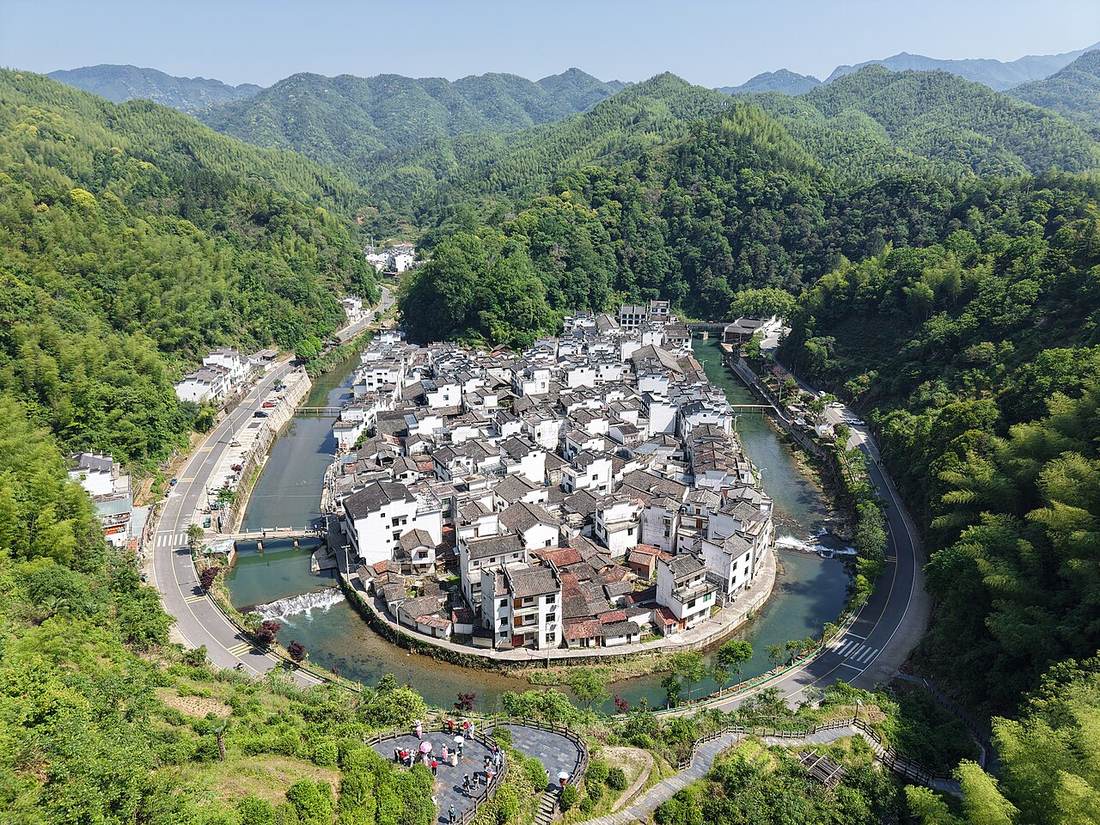
Somewhere in a Jingdezhen studio, a teacher will fold her hands over your child's on a spinning lump of clay, and for about ninety seconds nobody in your family will look at a phone. That is the centre of this trip. Everything else — the trains, the fountain, the mountain you ride up instead of climbing — exists to get you there without a meltdown.
Jiangxi does three things unusually well for families: flat pedestrian streets, trains that leave to the minute, and a cool mountain with a bus network running along the top of it. It also has three dependable ways to wreck a family day: summer heat, thousands of stone steps, and chilli hiding in a dish you assumed was plain. This route leans on the first three and ducks the second three.
Who this trip is for
This is a week of Jiangxi built around one question every parent asks: will it actually work with kids? It's aimed at families travelling with children (roughly ages 4–12) and at overseas-Chinese families bringing grandparents and little ones back to see the homeland — so the pace is gentle, the walks are short, and wherever a mountain would normally mean a stair-grind, we take the cable car instead. You'll mix a hands-on city (Nanchang), a make-your-own-pottery day (Jingdezhen) and a cool, green mountain you ride up rather than climb (Lushan). Everything connects by fast, comfortable high-speed train — no long car days, no white-knuckle switchbacks.
Plan on 5 days minimum, 7 if you can. The extra two days are pure breathing room: an unhurried morning here, a pool afternoon there. With kids, slack in the schedule is the difference between a holiday and a route march. Travelling without children and only chasing cool air? Our Jiangxi summer escape covers some of the same mountains at an adult pace; this one is slower on purpose.
The thing nobody tells you: China prices children by height
Not by age. By a line painted on the wall beside the ticket window, and a staff member's eye. It catches out almost every foreign family, because a tall seven-year-old can cost full adult price while a small nine-year-old walks in free. Thresholds vary site to site, but the pattern across Jiangxi looks like this:
| Your child measures… | What it usually means |
|---|---|
| Under 1.2 m | Free at most scenic areas, including the Lushan gate and — reportedly — the Lushan sightseeing bus. Free on the Nanchang metro (one adult may bring two children of 1.3 m or under). Free on trains if under 6 and sharing your seat. |
| 1.2–1.4 m | The awkward band. Half price on the Ferris wheel; at Lushan the gate ticket is reportedly still free, but you buy a half-price bus ticket at the window, not online. |
| Over 1.4–1.5 m | Adult price nearly everywhere, however old they are. |
Two things soften it. Many sites now accept age as an alternative — Lushan's published policy gives free entry to under-6s or under-1.2 m — and for a foreign child the proof of age is their passport, so keep it in the day bag, not the hotel safe. And the best indoor days on this route are free museums anyway.
Trains follow a different rule. Children with ID are priced by age: under 6 travels free (one per adult, sharing your seat — buy a child ticket if you want them to have their own), 6 to under 14 pays a child fare, 14 and up pays full. The discount formulas get tinkered with, so treat any figure here as the shape of the rule, not a quote.
Before you go — the family-logistics bit
A little prep makes China genuinely easy with children. Sort these before you fly, because they're all harder once you're on a mainland network:
- Set up Alipay or WeChat Pay and link a foreign card — you'll pay for everything (snacks, taxis, tickets) by QR code, which is brilliant with sticky-fingered kids in tow.
- Install a VPN at home if you need Google, Gmail, WhatsApp or YouTube to keep small people occupied.
- Download Didi (ride-hailing — you can request bigger cars). For maps use Apple Maps: local AutoNavi data, accurate, and downloadable for offline use when the kids have eaten your data. Google Maps doesn't work in mainland China; Amap (Gaode) is sharper on live transit but mostly Chinese.
- Carry every traveller's passport — needed for hotel check-in, train tickets, museum reservations and age checks at ticket windows, including the kids'.
- Pack tissues and hand sanitiser everywhere — public and attraction toilets often don't stock paper, which matters a lot more with a six-year-old.
- Book free museum slots the night before. Reservations open a few days ahead through Chinese mini-programs; if that defeats you, ask the hotel front desk to do it — a normal request, and they're good at it.
Strollers and stations. A folding stroller rides free on Chinese trains and doesn't count against your baggage allowance (the general limits: 20 kg an item, and on high-speed services 130 cm for the sum of its three dimensions). It won't fit an overhead rack — use the large-luggage bay at the end of the carriage. Tell the station service desk your train number if you need a lift or a step-free gate; big Jiangxi stations are set up for it, and Nanchang West has a staffed service area with a nursing room, a children's corner and a family accessible toilet. Nanchang's metro has lifts, and some stations now have a low child gate little ones walk straight through.
Two family rules that save the week: (1) most Chinese museums close on Mondays and nearly all need a free advance reservation, so do museums on non-Mondays; (2) Jiangxi food is seriously spicy — learn "不要辣 (bú yào là)" for "no chilli" and order plainer dishes (rice, steamed fish, egg, tofu, noodles) for the children.
Day 1 — Land, settle, and catch the evening fountain
Legs today: two flat walks of about 20 minutes. No steps that matter. Stroller: easy.
Ease in. Fly or take the high-speed train into Nanchang, check into a central hotel near the river, and let everyone reset. Metro Line 2 is the rail line — Nanchang West, Nanchang Railway Station and, since the east extension, the new Nanchang East; Line 1 runs up to Changbei Airport and along the Honggutan riverfront. They cross at Bayi Square, which is why families base themselves a stop or two from it. (Detail in our airport and stations guide and the Nanchang metro guide.)
- Afternoon: a gentle wander through the Wanshou Palace historical district (万寿宫) — free, flat, pedestrianised, and wall-to-wall snacks the kids will actually eat. Buggy-friendly, and nothing needs a ticket, so you can leave the moment attention runs out.
- Evening — the crowd-pleaser: the Qiushui Square musical fountain (秋水广场) on the Honggutan bank, skyline lit behind it. The published pattern is two roughly 15-minute shows a night, around 7:30pm and 8:30pm, and it's cancelled outright in thunderstorms, rain, fog or strong wind. Times shift with the season and holidays, so check the board on site — and take the earlier show with small children, because the later one pushes bedtime past 9:30pm. Our fountain guide covers where to stand.
- Dinner: Nanchang mixed rice noodles (拌粉) and a mild clay-pot soup (瓦罐汤) — ask for "微辣" (mild) or "不要辣" (none) for the kids.
Day 2 — A tower, a wheel, and a nap that actually happens
Legs today: one stair climb you can't dodge, then step-free everything. Stroller: fine outdoors, awkward in the pavilion.
A classic Nanchang day, picked for short legs and big "wow" moments — with a deliberate hole in the middle of it.
- Morning — Tengwang Pavilion (滕王阁): the city's signature riverside tower, 57.5 m of reinforced concrete dressed as a Tang pavilion, with sweeping Gan River views from the upper galleries. Day tickets run around ¥50 for adults, slightly less booked online a day ahead, and the child threshold is one of the ones that varies by listing — carry passports and check the board. Plan it as a climb: there are lifts, but travellers report them reserved for over-70s and visitors with disabilities and hard to get staffed. With a toddler that means a carrier, not a buggy. Allow 1–2 hours, and go early, before the marble underfoot turns into a sun trap.
- Afternoon (pick one, don't do both): the "Star of Nanchang" Ferris wheel — a giant, slow, fully-enclosed wheel, usually around ¥50 for an adult, half that in the 1.2–1.4 m band, free below 1.2 m (typically up to two free children per paying adult). One rotation takes roughly 30–40 minutes, which is a long time in a sealed capsule with no toilet: do the loo run first. It generally runs from morning to about 10pm, last tickets around 9:30pm. The alternative is a Gan River sightseeing boat — lower effort, and easier with a stroller.
- The nap window: roughly 1pm to 3pm, go back to the hotel. It isn't a wasted afternoon; it's the reason the fountain works at 7:30pm.
- Optional, for an older, museum-tolerant child: the Jiangxi Provincial Museum in Honggutan is free and holds the Han-dynasty Haihunhou gold. Tuesday to Sunday, roughly 9am–5pm with last entry an hour before, closed Mondays, free named reservation required — though children under 1.2 m reportedly don't need one, and taller children are booked on their own ID number, which for your family means their passport. The ground-floor cloakroom is the useful bit: free bag storage, hot water, charging, directions to the baby-care room, and loan strollers and wheelchairs against a deposit (reported at ¥300 with ID, more without). Bring the ID; collect the deposit on the way out.
Getting around with kids is painless. Nanchang's metro has English signage and reaches all of the above, one adult may bring two children of 1.3 m or under free, and the lines have lifts. For door-to-door with a buggy and a bag of snacks, use Didi.
Day 3 — Jingdezhen: hands in the clay
Legs today: a short train, then flat factory-yard walking. The best stroller day of the trip.
Take a morning high-speed train from Nanchang East (南昌东) to Jingdezhen North (景德镇北) — the fastest services run it in about 50 minutes, so you're there before anyone gets restless. Check your departure station carefully: Nanchang East, Nanchang West and Nanchang Railway Station sit far apart on Line 2, and the wrong one costs you 40 minutes. Jingdezhen has been making porcelain for over a thousand years, and for children the magic is doing it themselves.
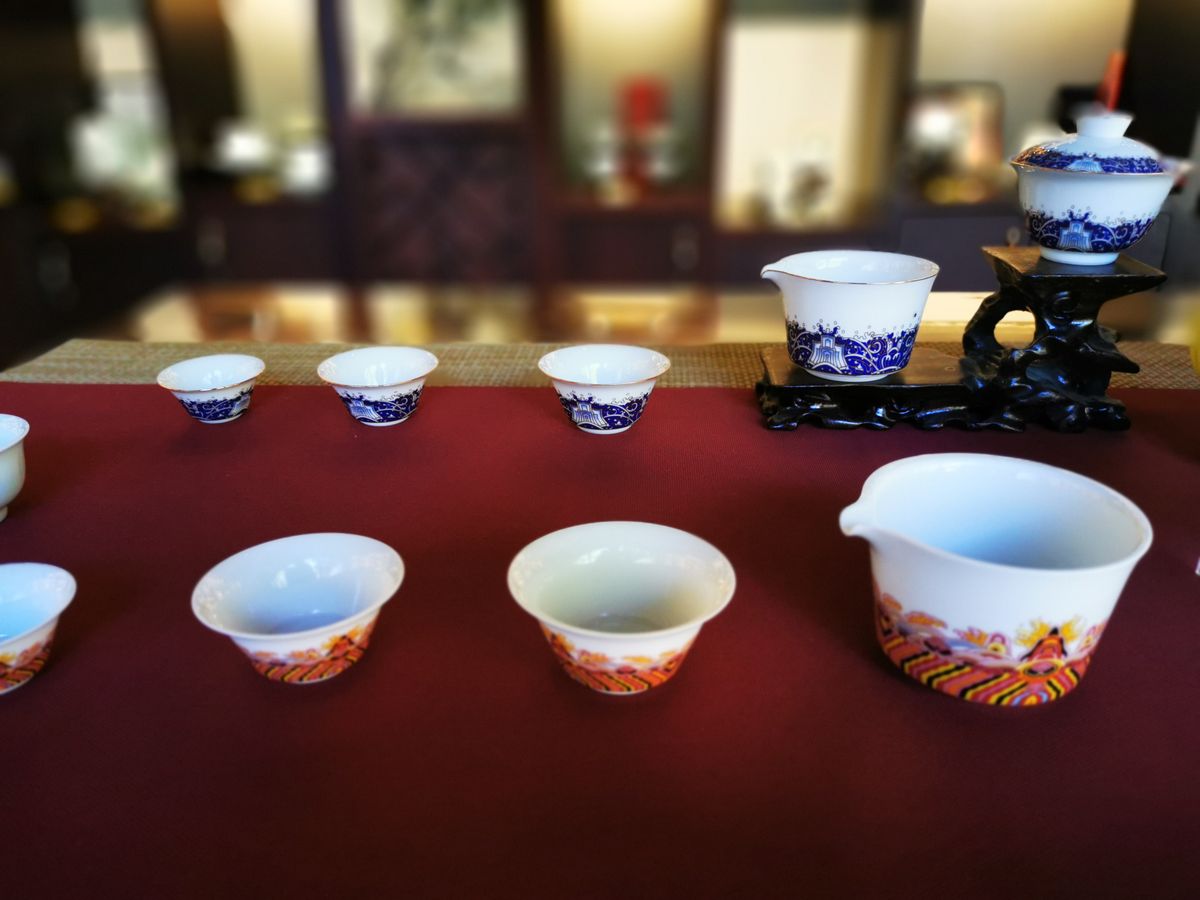
Finished porcelain in Jingdezhen — roughly what your child's lopsided bowl is aspiring to. Photo: Liuxingy / CC BY-SA 4.0 via Wikimedia Commons.
- The main event — hands-on pottery: throwing, hand-shaping or painting your own piece is available all over town with a teacher guiding small hands, and studios around the arts district will generally take children from about three. Prices vary by studio and by what you make (some guesthouses include it), so ask locally rather than expecting a fixed rate, and book ahead at weekends and in the school holidays. Ask before you start how firing works — a piece usually has to be fired after you leave, and someone has to post it to you.
- Easy culture alongside it: the Taoxichuan (陶溪川) district — a former porcelain factory turned open, walkable arts campus of cafés, galleries and small museums. Entry is free, the ground is flat, and the creative market runs Friday to Sunday, late afternoon into the evening, with hundreds of makers' stalls. It's the rare night market where a five-year-old can wander without you gripping a wrist.
- Rain plan: the China Ceramics Museum (中国陶瓷博物馆) is free, indoor and air-conditioned — Tuesday to Sunday from 9am, last entry around 4:30pm, closed Mondays, reservation through its mini-program. Two hours is plenty, bag storage is free, and it does the collectable stamp thing Chinese museums do: hand a child a blank notebook and the stamp desks become a treasure hunt.
- If you have energy left: the Ancient Kiln & Folk Customs Museum (古窑) fires reconstructed historic kilns with live demonstrations and stages short porcelain-music performances at fixed times through the day — musicians playing tuned porcelain bells and flutes, which lands better with children than any display case. Tickets are quoted anywhere from about ¥45 to ¥95 depending on season and channel, under-1.2 m reportedly free, gates roughly 8am–5:30pm. Check the day's performance times on the way in and build the afternoon around one.
- Stay or return? With kids, spending the night in Jingdezhen (near Taoxichuan) beats a long same-day round trip — no rushing the pottery, and a relaxed evening at the market.
Day 4 — Up to Lushan without climbing anything
Legs today: mostly sitting. A couple of changes, one folded stroller, and a payoff of about 10°C.
Now the masterstroke for a family summer trip: Lushan (Mount Lu), a UNESCO-listed mountain that runs roughly 10°C cooler than the baking lowlands — and, crucially, one you experience by strolling and riding, not by hauling children up endless steps.
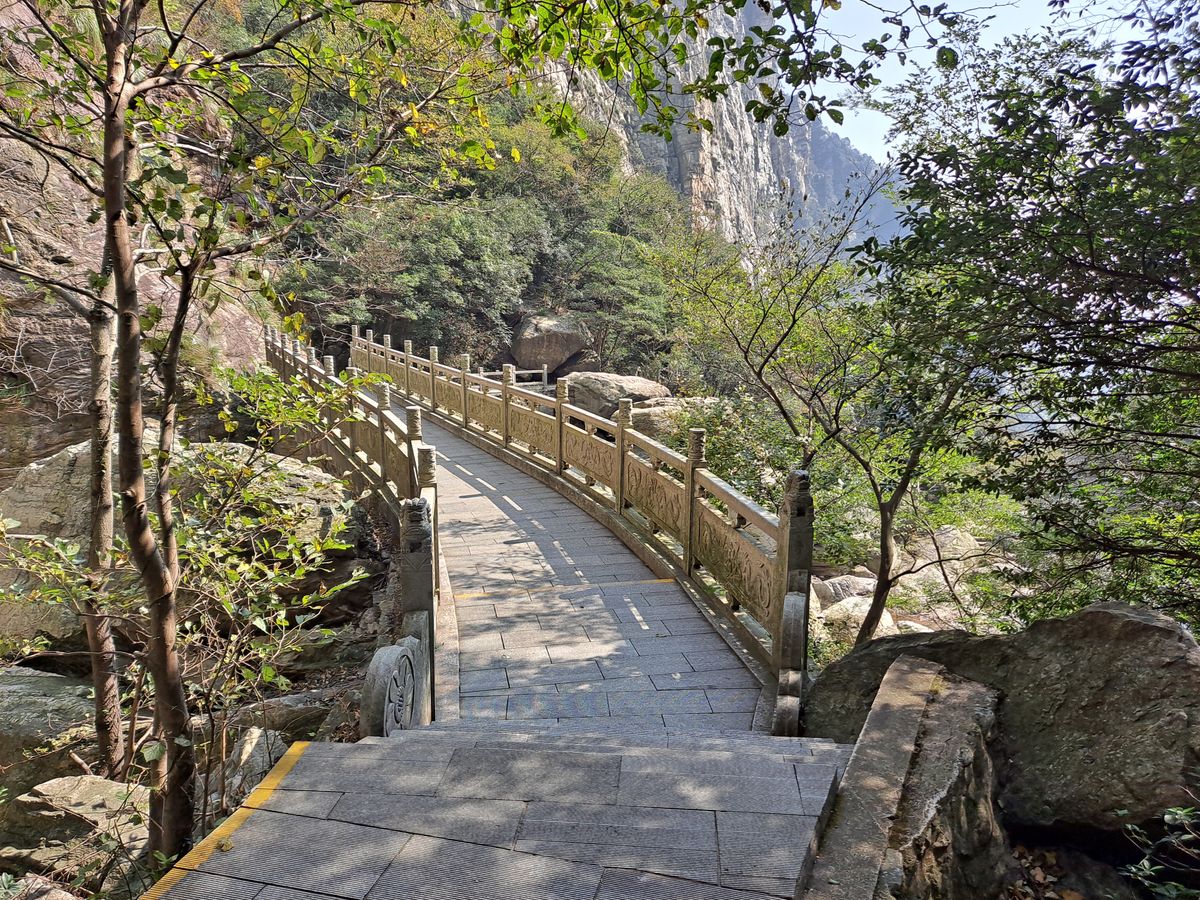
Lushan's ridges and valleys — the sightseeing buses run along the top, which is what makes this mountain workable with children. Photo: 钉钉 (Dingding) / CC BY-SA 4.0 via Wikimedia Commons.
- Getting there: high-speed train from Nanchang to Jiujiang (九江) — the practical gateway, roughly 45 minutes to an hour — then the scenic-area shuttle up the mountain (about 1–1.5 hours of switchbacks, around ¥15–20) or a shared taxi (around ¥80), easier with luggage and little ones. Aim for Jiujiang, not the awkwardly-placed "Lushan Railway Station." Travel-sick child? Take the ropeway: about ten minutes up to the ridge, quoted recently at roughly ¥65–80 a leg or around ¥120 return.
- The clever twist: you don't camp or climb — you sleep on top, in Guling town (牯岭镇), a cool, leafy hill town at around 1,100 m with hotels, restaurants, pharmacies and mini-marts. Kids sleep in proper beds in cool air, and nappies, snacks and instant noodles are all buyable on the main street.
- Buy the right tickets: the scenic-area entrance (recently around ¥160, valid about 7 days) and the hop-on sightseeing bus pass (around ¥70–90, depending on whether it includes the ride up and down). Viewpoints are kilometres apart; the bus is what makes Lushan doable with children. Services reportedly run about every 15 minutes from the main gate and town stops, covering the east and west loops.
- The child lines here are unusually generous: under 1.2 m or under 6 reportedly gets the gate and the bus free; 1.2–1.4 m gets in free but needs a half-price bus ticket bought at the window rather than online. Bring the passports and let them measure.
- Afternoon: nothing ambitious. Walk Guling's stone streets and old villas, buy an ice cream, let everyone acclimatise. The main street is broadly level; the lanes off it slope, which is why a carrier beats a stroller up here.
Pack a warm layer for everyone, even in July. Dawn and dusk on top can drop to barely above 10°C while Nanchang sweats — bring fleeces and a rain shell. That temperature gap is the entire point of coming.
Day 5 — Lushan slow: a flat lake loop, and the staircase to skip
Legs today: one gentle lakeside loop, one roadside viewpoint, a lot of bus.
- Morning — Ruqin Lake and Huajing (如琴湖 / 花径): the gentlest corner of the mountain. A small violin-shaped lake with a zigzag bridge, an island and a walled garden, shaded enough to make a hot day pleasant. Mostly level with a few slopes; a determined parent can push a buggy round it. There's a sightseeing-bus stop at the entrance, so you can bail the moment legs give up.
- Late morning — Hanpokou (含鄱口): the big view over Poyang Lake, reached by bus with a short climb to the platform. Ten minutes of effort, a whole horizon of reward, everyone back on a bus before the whining starts.
- What to skip: Three Step Spring (三叠泉). The most spectacular thing on the mountain and the worst possible idea with small children. Gate to falls is reported at roughly 2,600–2,800 stone steps each way; the rail car covers part of the descent and still leaves 1,400-odd, and a round trip from Guling is widely quoted above 3,000. Teenagers who hike, yes. Under-tens, no. Nobody's holiday improves by carrying a seven-year-old out of a gorge.
- Also worth knowing: Jinxiu Valley (锦绣谷) is a cliff-edge path with railings, steps and real drops — fine for sure-footed older kids holding a hand, stressful with a runner. The Botanical Garden and the lakeside Lulin area are the flatter alternatives.
- Afternoon: back to Guling for a long lunch and an actual nap. Evenings up here are cool enough that children sleep well — bank it.
Day 6 — The buffer day (or: what to do when it rains)
Legs today: whatever you have left. If you've got the full week, resist adding a sixth headline sight. With kids the best "activity" now is doing less — and a wet-weather plan you never needed beats the reverse.
- Option A — a slow second Lushan day: late breakfast in Guling, one easy viewpoint, the hotel pool or just playing in the cool air, then the Botanical Garden or the lakeside villas.
- Option B — back to Nanchang, indoors: the Jiangxi Science and Technology Museum (江西省科技馆) in Honggutan is free, air-conditioned and built for exactly this. Its Children's Science Park runs in two sessions — mornings roughly 9am to noon, afternoons about 1pm to 4:30pm, the hall cleared over lunch, capacity capped (recently several hundred per session) — so book a slot and arrive at the start of one. Tuesday to Sunday, closed Mondays, free named reservation through its WeChat account a few days ahead. Metro Line 1 to Zhujiang Road (珠江路), Exit 1, then about ten minutes on foot.
- Option C — the full wet-day fallback: the big indoor aquarium at the Sunac mall complex in Jiulonghu (南昌融创茂; older listings still call it Wanda) is a paid ticket but genuinely large, with mall food, toilets and buggy space around it — metro Line 2 to Jiulonghu South (九龙湖南), Exit 4 comes out essentially at the door. Any big mall works in a pinch: MixC in Honggutan is the reliable sort of place for a clean baby-care room and a high chair, and Sam's Club Nanchang is the one-stop restock for nappies and formula.
Day 7 — Back to Nanchang and out
Legs today: a train, a park, and an airport run.
- Train back down via Jiujiang, spend a final easy day on the riverfront parks, and do the last gift shopping around Bayi Square. Porcelain travels badly in a suitcase — buy the fragile things last, or have the studio post them.
- Flying out? From central Nanchang allow 40–60 minutes to Changbei Airport (KHN). Easiest with kids is a Didi; metro Line 1 now runs to the airport station, which sits with the terminal in a single interchange complex. With a stroller the metro is step-free the whole way; with three suitcases and a sleeping toddler, take the car.
- Onward by rail instead? Nanchang West and Nanchang East both sit on Line 2, and both have staffed service desks that will walk a family with young children to the right waiting area if you ask.
Eating with kids in Jiangxi
Jiangxi cooking is chilli-forward in a way that surprises people who've only eaten Cantonese food abroad — local pride is 小炒, fast-fried and fierce. Children eat extremely well here anyway, as long as you order deliberately.
- Say it every time: 不要辣 (bú yào là) — no chilli; 微辣 (wēi là) — mild. Ordering "not spicy" once for the table isn't enough; say it dish by dish.
- Safe, genuinely local orders: plain rice noodles, steamed egg custard, clay-pot soup (瓦罐汤), steamed fish, tofu, garlic greens, plain congee at breakfast.
- Hot water is free and everywhere. Restaurants bring a jug for the asking — 热水 (rè shuǐ) — which covers bottles, formula and the child who will only drink warm things. Hotel rooms have kettles; shops sell bottled water on every block.
- Don't count on children's tableware. Malls and chain restaurants often have high chairs (宝宝椅, bǎobao yǐ) and small bowls; a two-table noodle shop will not. Asking for 小碗和勺子 — a small bowl and a spoon — gets you most of the way, and a packable travel set earns its space.
- Baby-care rooms: ask for 母婴室 (mǔyīngshì). Museums, malls and big rail stations generally have one; street-food lanes do not, so change the baby before you head out.
Where to stay (family notes)
- Nanchang: base centrally near the river/Bayi Square or in modern Honggutan (newer international-brand hotels, fountain on the doorstep). Pick somewhere on a metro line, and ask when booking for a cot (婴儿床) or an extra bed rather than assuming.
- Jingdezhen: near Taoxichuan, so the market and cafés are walkable after a pottery session and nobody has to be carried home.
- Lushan: in Guling town for the cool air and short walks — book early for July–August weekends and the school holidays, when the whole province comes up here. Check how far the hotel is from a sightseeing-bus stop; "five minutes" on a slope with luggage is not five minutes.
What to skip with children
- Three Step Spring. Thousands of steps, little shade, no real shortcut.
- Sunrise at Hanpokou, unless your kids genuinely wake happy at 4:30am. The same view at 10am costs nothing and no tears.
- Two museums in one day. One free museum, one nap, one outdoor thing is a full day at this age.
- Any Monday museum plan. The provincial museum, the science museum and the ceramics museum all close on Mondays. Make Monday a train day, a market day or a pool day.
- A fifth destination. Jiangxi's other headline sights deserve their own trip; adding one here turns a holiday into logistics.
Quick tips for families
- Build in slack — half a day of "nothing" beats a fifth attraction with melting-down kids.
- Cable cars and the Lushan sightseeing bus are your friends: ride, don't climb.
- Carry tissues/sanitiser; toilets at sights rarely stock paper.
- Measure your child before you go and keep their passport in the day bag — height and age both decide what you pay.
- Order "不要辣" (no chilli) for the children — Jiangxi food is genuinely fiery.
- Most museums close Mondays and need a free reservation — plan around it.
- New to the city first? Pair this with our 2 Days in Nanchang plan for more city detail.
Family FAQ
What's the best age for this trip?
Four to twelve is the sweet spot. Under four, the pottery still works but train days dominate — cut it back to Nanchang plus Jingdezhen. Over twelve, add Three Step Spring and a hiking day, and you're on a different itinerary.
Do we need a stroller or a carrier?
Both, if you can. A folding stroller travels free on the trains and is perfect for Nanchang's riverfront, Wanshou Palace and the flat yards of Taoxichuan. Up at Lushan, and inside Tengwang Pavilion, a carrier wins.
Is Jiangxi too hot for children in summer?
Nanchang in July and August is punishing in the afternoon — which is exactly why this route empties the middle of the day and finishes on a mountain about 10°C cooler. Treat 1pm to 3pm as indoor or hotel time and the heat stops being the story.
Can we do it in five days instead of seven?
Yes — run Days 1 to 5 as written and fly out of Nanchang on the morning of Day 6. You lose the buffer, so one wet afternoon dents the trip; if the forecast looks bad, front-load the pottery and the fountain.
Want this dialled in for your family's exact dates, ages and pace — including kid-friendly hotels, cot requests, and a slower or faster version? Plan this trip with us.
Cover photo: Chensiyuan / CC BY-SA 4.0 via Wikimedia Commons (cropped & resized).
Last verified: 2026-08. Ticket prices, child height thresholds, train times, cable-car fares, show times and opening hours change often, and Jiangxi periodically runs limited-time free-entry promotions for Lushan — please double-check official sources and the boards on site before you travel.