Poyang Lake Nature Reserve: See the Cranes
See Siberian cranes at Poyang Lake: a free lotus field near Nanchang, or the reserve proper at Wucheng. Season, sites and what to expect.
By Hello Nanchang · Last updated
Poyang Lake — Wuxing (Nanchang), Wucheng (Yongxiu County) and Nanji, Jiangxi
The short answer
If you only want the decision:
- Season — roughly November to March, with mid-December to February the reliable window. Outside it there is nothing to see.
- Closest, free, and genuinely good — the Wuxing crane sanctuary (五星白鹤保护小区) at Liyuzhou, on the eastern edge of Nanchang's High-Tech Zone. Cranes feed in lotus fields, sometimes within metres of the path.
- In the birding season, book first — Wuxing's core viewing zone runs on booked, capped slots, and you will probably need someone local to make the booking for you. Do not drive out without one.
- The reserve proper — Wucheng (吴城) in Yongxiu County, headquarters of the Jiangxi Poyang Lake National Nature Reserve. Further, colder, wilder, better.
- Bring — binoculars, and more layers than you think. The lakeshore has no shelter and no windbreak.
- Do not bring — a drone, a dog, or any expectation of walking up to a bird.
Why one lake
Some orientation first, because Poyang is a Jiangxi story before it is a Nanchang one — our guide to why Jiangxi is worth the detour puts the lake in the province it belongs to.
Start with the thing that makes Poyang unlike other lakes: it is not the same size twice.
Swollen by the summer rains it runs to 3,500 square kilometres or more, which makes it China's largest body of fresh water. By late winter it has drained back to under a thousand. What is left is not a smaller lake so much as a different landscape — a maze of channels, grass flats and mudbanks, with shallow water standing over the whole of it.
That draining is the entire reason the birds come. A deep lake feeds nothing; a vast shallow one, drawn down to ankle depth over hundreds of square kilometres of soft mud, is one of the richest winter feeding grounds in Asia. The lake breathes out, and half a million waterbirds arrive to eat what the water leaves behind.
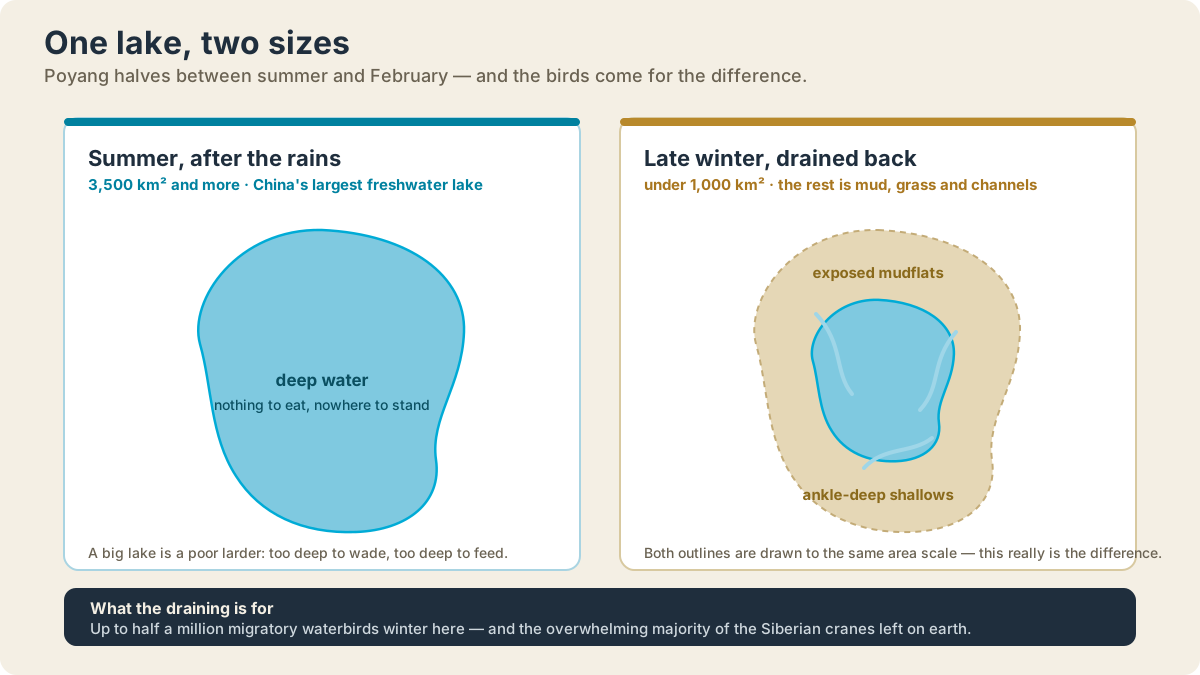 The lake halves between summer and February — and the birds come for the difference. What drains away is depth; what is left behind is food.
The bird that made it famous
The Siberian crane (白鹤, Leucogeranus leucogeranus) is a tall, snow-white bird with a bare crimson face, and it is one of the rarest cranes on earth.
How rare is a question with two answers, and it is worth knowing which one you are being given. The number attached to this bird for most of the past decade — under 4,000 — comes from an IUCN Red List assessment last revised in 2018, which rests on counts made at Poyang and at the Momoge stopover between 2008 and 2012. Field counts have since run higher: the International Crane Foundation lists the species at more than 5,500, and in autumn 2024 Russian researchers counted 6,728 cranes passing a single migration bottleneck on the Aldan River in Yakutia — the largest total ever monitored there. Researchers at the Jiangxi Academy of Sciences put the world population at 6,000–6,500 for the 2024–25 wintering season. That is the most recent figure we could source; the 2025–26 counts were not published when we checked.
It is still listed Critically Endangered, and that is not a contradiction. The listing rests on projected future damage to the wintering grounds — dams upstream on the Yangtze, and a proposed sluice at the outlet of Poyang Lake — rather than on a population currently collapsing.
Every autumn they leave the Yakutian tundra in the Russian Arctic and fly roughly 5,000 kilometres south. They are doing it on the last of three migration routes their species used to have: the western and central populations have effectively gone. This one flyway, ending on this one lake, is what the species has left.
Almost the whole species winters in one basin. The western flyway is finished in all but name: its last known wild bird, a male called Omid who wintered in northern Iran, did not return in 2023, and the only bird released there since was captive-bred. The central route has not been recorded since 2002, which leaves a single eastern route ending in the middle and lower Yangtze — with Poyang Lake as its largest concentration by a wide margin.
The published shares differ, and it is worth knowing which kind of number you are being handed. Chinese state media put the Poyang share above 95%; older official figures said 98% and are still in circulation. Neither comes with published workings, so read them as official estimates. The one figure that does show its arithmetic is lower: a nationwide drone survey in January 2022, led by Beijing Forestry University and published in Acta Ecologica Sinica, counted 4,813 of the 5,616 wintering cranes it found at Poyang — 85.7%. The shape of it is not in dispute either way: stand on the right patch of mud in January and you are looking at a large fraction of every Siberian crane alive.
Jiangxi made the crane its provincial bird in 2019, which tells you how the province thinks about this. You will see it on municipal signage, on bus liveries, and painted on walls in villages that are nowhere near the water.
They are not the only reason to come. In a good year the lake draws up to half a million migratory waterbirds in total — storks, tundra swans, wild geese, egrets, common cranes and a long tail of ducks and waders. At the Wuxing sanctuary alone the running tally reached 113 species by July 2026, of which eight are under China's first-class state protection and seventeen under second-class.
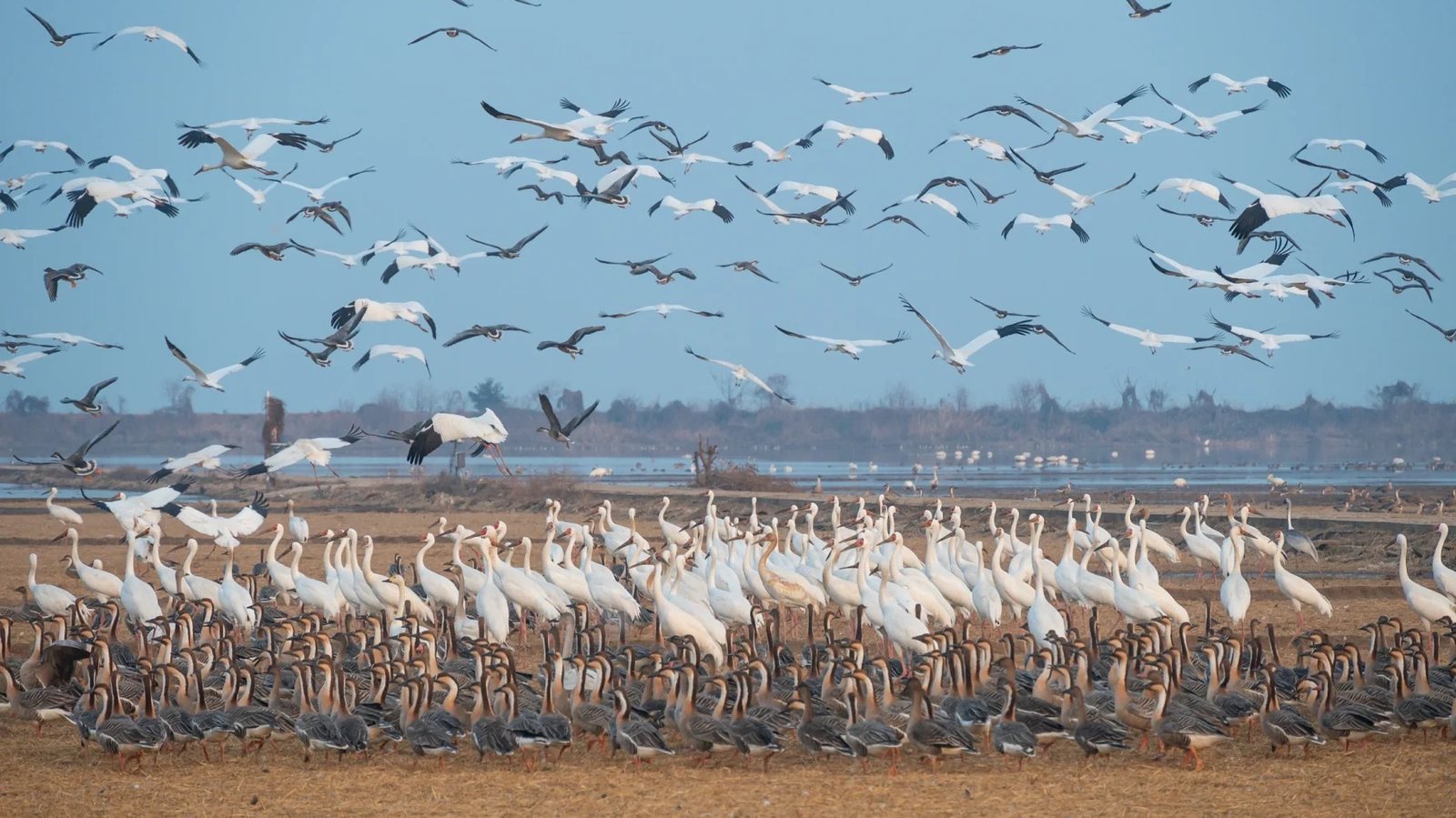
Look again at the photograph at the top of this page, because it carries the whole argument of this article. The tall white birds are Siberian cranes; the brown-grey mass in front of them is geese — several species working one field. In the air you can see the thing that identifies a crane at distance: white body, black wingtips. And the ground they are all standing on is harvested farmland, not lakebed. That is not a compromise shot. It is increasingly where the birds are.
Where you actually go
Here is where a lot of English-language planning goes wrong: treating "Poyang Lake" as a destination. It is not. It is a lake the size of a small county, with reserves and viewing points scattered around a shoreline that moves with the season — and in recent years a great deal of the wildlife has moved with it, off the open water and onto surrounding farmland. Three sensible answers, in the order we would actually do them.
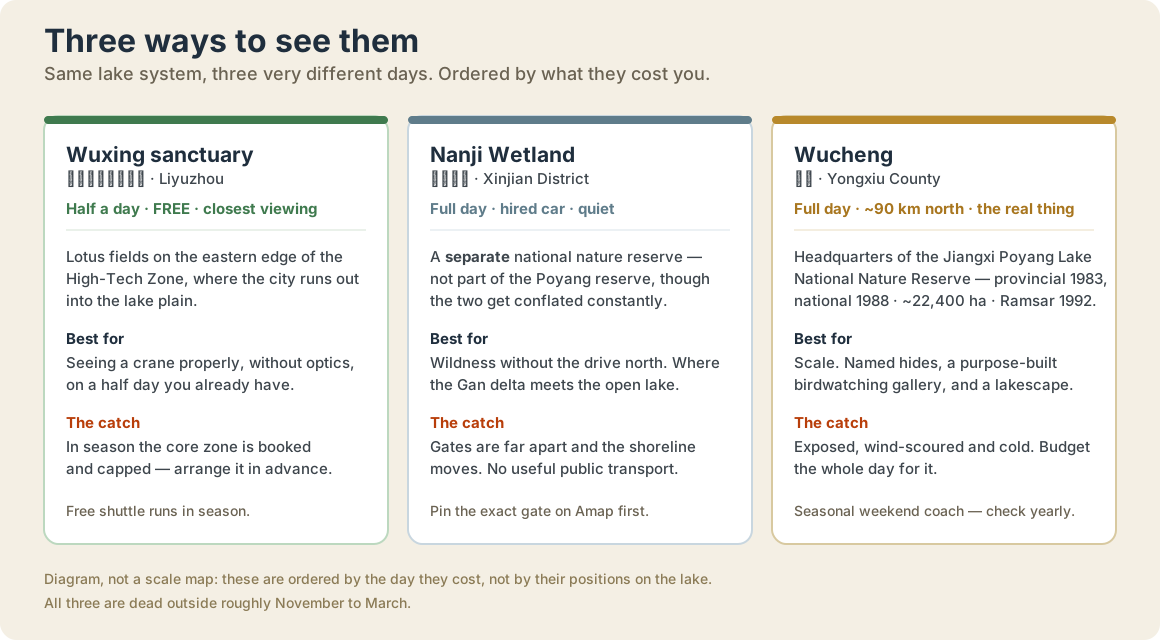 Three tiers, all on the same lake system. The further you go, the wilder it gets and the more of the day it costs. This is a comparison rather than a map — none of these are drawn to position.
1. Wuxing crane sanctuary 五星白鹤保护小区 — closest, free, and not the consolation prize
Start here, and not because it is convenient. In the winter of 2024 the reserve administration monitored 2,820 Siberian cranes on the Wuxing farmland — a substantial share of every bird of the species alive, on a block of lotus fields you can reach from central Nanchang in a morning. The old assumption that the cranes are out on the remote lake and the city site is a lesser version of them is no longer safe: a great many of them now feed on farmland, and this is the farmland.
It exists because somebody bought it a meal. In January 2017, a birder named Zhou Haiyan got roughly five hundred bird photographers to chip in and rent a block of lotus paddy at Liyuzhou (鲤鱼洲) so the cranes would have something to eat; by that April, after three rounds of negotiation, the Nanchang Wildlife and Plant Conservation Association had turned it into a formal tenancy with provincial and municipal backing and about ¥2 million raised. The birds had been coming to dig lotus roots out of a working farm; the deal simply stopped the farm from minding.
What that buys you as a visitor is the shortest viewing distance anywhere on the lake system — close enough that people watch without optics, though you will still want them. It is free, there is a free shuttle in season, and it is popular in a way you should plan around: one recent season the sanctuary counted more than 120,000 visitors between December and the end of February. That figure is for the site as a whole rather than the booked core zone, whose cap sits far below it — but it tells you what the approach roads and the car park are like. Go on a weekday morning.
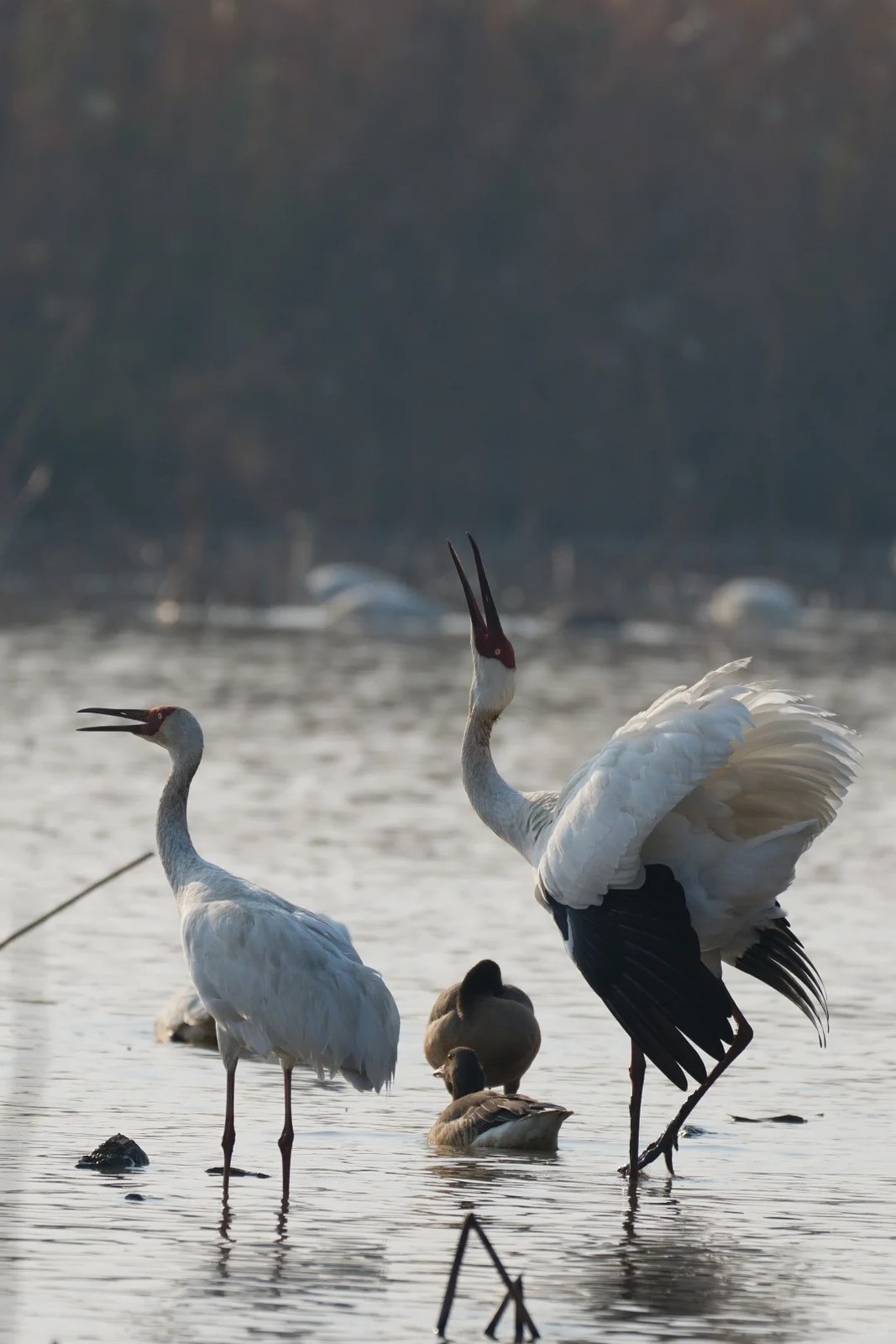 Close enough to see the face. A Siberian crane has a bare crimson mask rather than feathers on the front of the head, and black primaries that stay hidden under the folded wing until it opens — as the right-hand bird is doing here. Those two marks are what tell it apart from the other big white birds out there.
In the birding season you cannot simply turn up. The core viewing zone runs on a booked, capped, timed-slot system, set out in a notice published for that season rather than as a standing year-round policy. The site's management body was only established in 2025, so there is exactly one season's notice on record — and this is what it laid out: booking is free, the daily cap is small, at a few dozen people per half-day slot, less than one coachload; there is a morning slot and an afternoon slot rather than an open day; and you show photo ID at the gate. Whether the coming winter repeats any of that is not something anyone can tell you yet. Find the current season's notice before you plan around it, and do not assume it appears at the same time of year.
And you probably cannot do the booking yourself. It goes through the city's Changtongma app (昌通码 — search 观鹤预约 on the home screen), and that app wants a Chinese mobile number to register. This is the same wall you hit booking a table at the two Black Pearl restaurants, and the answer is the same: hand it to someone local. Ask your hotel front desk the day you arrive, give them the date and the half-day slot you want, let them register on your behalf, and turn up with your passport for the gate check. There is also a free park-and-ride shuttle from car parks outside the reserve during the season — it runs on its own schedule, usually shorter than the booking window, so ask when you book rather than assuming it covers your day.
Outside the birding season you can get in — the gate rules above belong to the winter. That is not, however, a reason to come: between April and mid-October there are no cranes here at all, and what you would be looking at is a working lotus farm.
Getting there. No metro, no rail, and no bus route we could confirm. The reserve is about 45 km east of Bayi Square; allow an hour, up to ninety minutes with traffic or a car-park diversion. That puts it in the far bracket of our countryside day-trip guide — 60–90 minutes and well over ¥100–150 one way — and on Nanchang's published metered tariff, including the empty-return surcharge beyond 8 km, our own calculation comes out at roughly ¥120–170 each way. Budget ¥250–350 for the round trip and agree the return before you are dropped, because you will not flag one down out there.
Forget the dawn shoot — it is not on offer here. Sunrise in Nanchang shifts by about an hour across the birding season, from around 07:11 in mid-January, the latest morning of the winter, to just after 06:00 at the end of March. The gate does not follow it. The morning slot opens well after first light — on the one notice on record, more than an hour after it — and once you add the drive out and the shuttle in, you are at the paddies in mid-morning rather than at dawn. If you have read that cranes are best in the first two hours after sunrise, that advice belongs to reserves you can walk into. Get the morning slot booked for you, be in the car park before the posted opening time, and take the first shuttle. Winter light at that hour is still low and side-on, and warmer on the hands than seven would have been.
What you do not get: silence, or the feeling of being somewhere remote. This is a working agricultural landscape with a car park.
2. Nanji Wetland 南矶湿地 — the reserve inside the city limits
A separate national nature reserve — this is worth saying clearly, because the two get conflated constantly — sitting on the lake's south-western shore in Nanchang's own Xinjian District, out at Nanji township. It is where the Gan River's delta meets the open lake, and it is a genuine wetland reserve rather than a viewing platform.
It is quieter than Wuxing and wilder, but harder: the gates are spread far apart along a shoreline that changes with the water level, and there is no useful public transport. Drop a pin on Amap or Baidu Maps for the specific gate you want and hire a car for the day.
3. Wucheng 吴城 — the reserve proper
The reserve began in 1983 as a provincial one and was raised to national status by the State Council in 1988. It covers roughly 22,400 hectares of the lake's western arm in Yongxiu County — and that is a detail worth holding onto, because when China joined the Ramsar Convention in 1992 and designated its first six Wetlands of International Importance, the site on the list is called Poyang Lake but its boundary is the nine sub-lakes inside this reserve, not the whole lake. Its headquarters, and the place visitors go, is the old river town of Wucheng.
Wucheng was named China's first "Migratory Bird Town" by the China Wildlife Conservation Association in 2019 and rated a national AAAA scenic area in 2020. The viewing is organised around several named lakes and hides — Changhu Chi (常湖池), Zhushi Hu (朱市湖) and the ground below Shizi Shan (狮子山) among them — linked by a purpose-built birdwatching gallery (观鸟长廊) and served by a monitoring station.
This is the real thing: an enormous, exposed, wind-scoured lakescape with birds on it in numbers that do not photograph well and do not need to. It is also a long day. Budget the whole of it.
Getting there: Wucheng is about 90 km and roughly an hour and a half north of Nanchang by car. The route leaves the Chang-Jiu expressway at Yongxiu and runs in on the Yongwu Highway (永吴公路), which opened in 2013 and is the only road in. One stretch of it, about 5 km across Dahu Chi, is the reason the town used to be reachable only by boat: when the lake rises past 18.67 m the water goes over the road, and the county closes it — usually for around two months in the summer flood season. That will not affect a crane trip, which happens at the opposite end of the year, but it is the single best illustration of what this lake does.
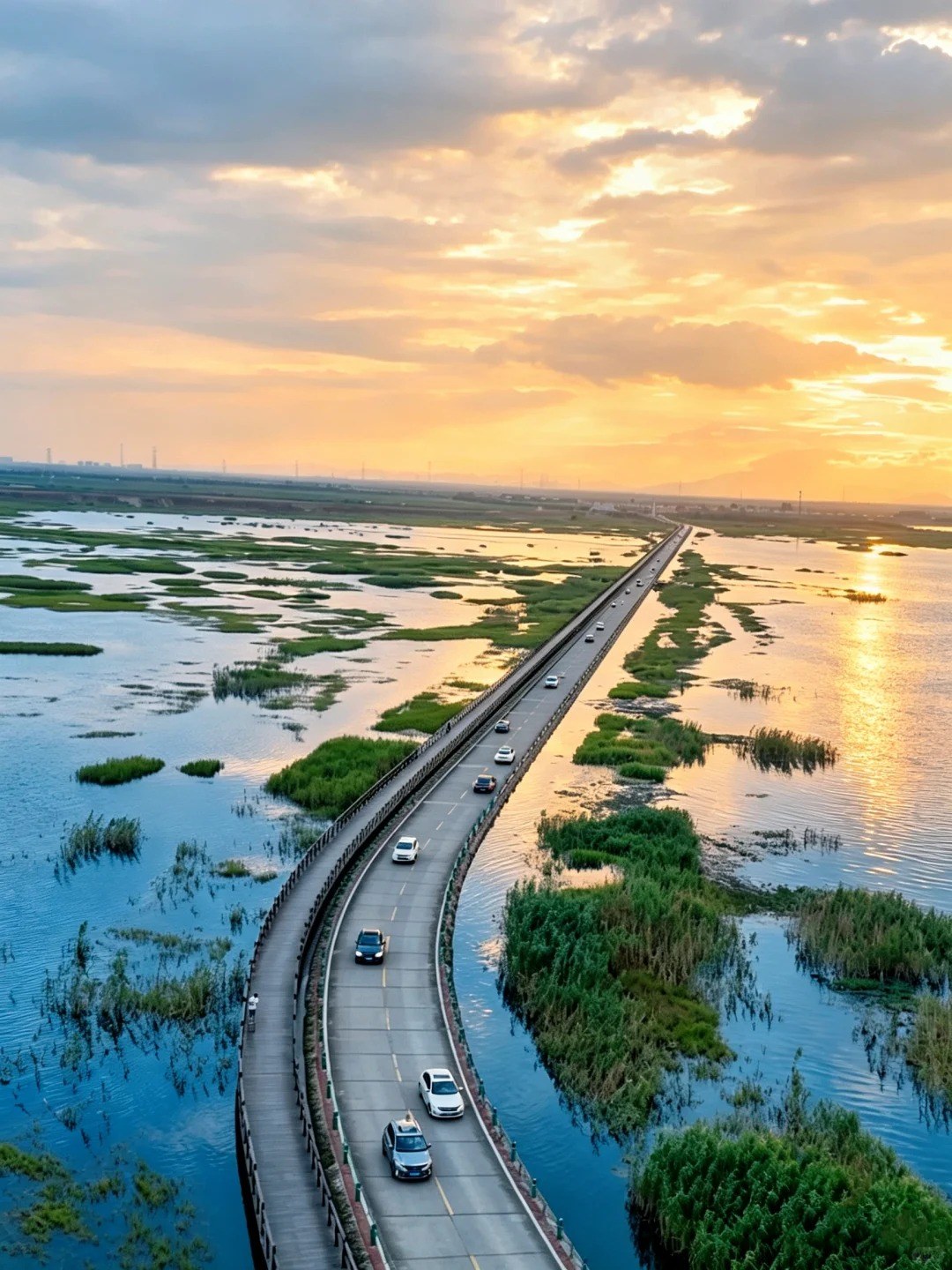 The only road into Wucheng, from above, with the water already at the shoulder. Push the lake up another metre or so and this surface goes under — which is why it is known locally as the water road, and why the county closes it for around two months most summers.
A weekend tourist coach has run from Nanchang directly to the Wucheng visitor centre, taking about an hour and three-quarters each way with an afternoon return. It is new — one season so far — and announced year by year, so treat it as something to check rather than something to count on, and have a hired car as your fallback. Last verified: 2026-08.
When to come
The birds run to a calendar, and it is tighter than most people expect.
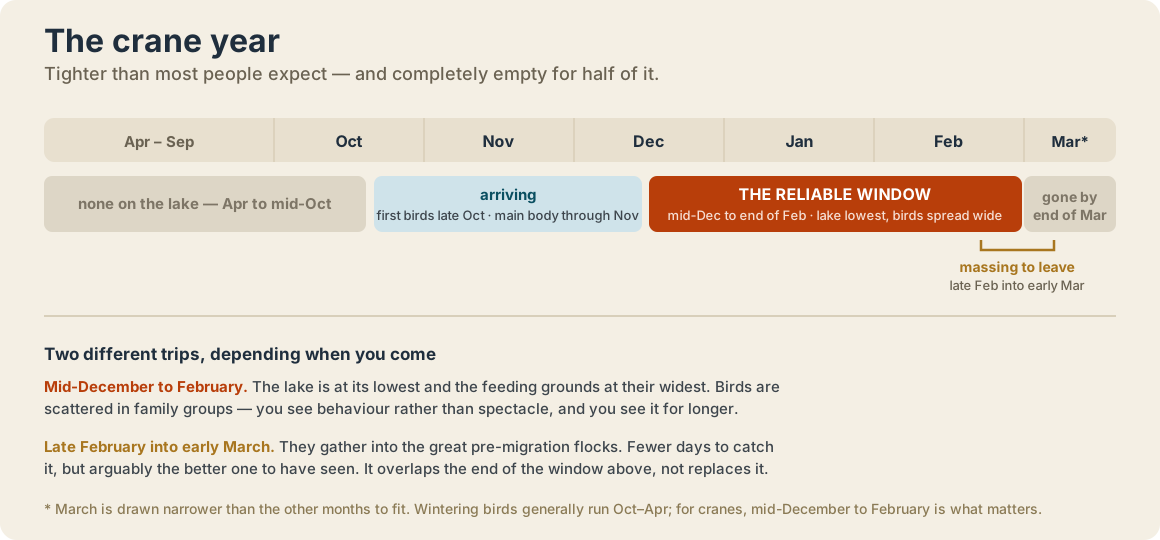 The season, month by month. Note the two different experiences: scattered family groups in midwinter, and the great pre-migration gatherings at the end.
- Late October — the first arrivals come down out of the north.
- Early November — the main body arrives. Numbers build quickly.
- Mid-December to February — the reliable window, and the same one our countryside day-trip guide gives. Birds spread out across the shallows in small family groups and feed. This is when the lake is at its lowest and the feeding grounds are at their widest.
- Late February to early March — they mass into large flocks before heading north. A different spectacle from midwinter, and arguably a better one.
- End of March — the last of them gone.
Wider bird interest runs a little longer at either end — local birding guidance treats October to April as the wintering season generally — but for cranes specifically, the middle of that range is what matters.
What it is actually like, and what it is not
Some honesty, because this is a trip people build expectations around.
It is cold in a way inland China is not supposed to be. Jiangxi winters sit a few degrees above freezing and are wet, and the lakeshore has nothing between you and the wind — no trees, no buildings, no shelter of any kind. Dress as you would for a coast in February, not for a city.
The birds are far away, and that is correct. Wuxing is the exception rather than the rule. At the reserve you are looking across water and mud at flocks that may be several hundred metres out. Binoculars are not optional; a phone camera will produce a photograph of some grey and a few white specks. If you own a long lens this is the trip for it, and if you do not, borrow a pair of 8×42s and enjoy yourself more than the photographers will.
Drones are out. These are protected feeding grounds for critically endangered birds and flushing a flock is a serious matter, not an inconvenience. The same goes for playback, dogs, and walking off the marked routes to get closer.
English is thin on the ground. Signage at the reserve is improving but interpretation is largely in Chinese, and Wucheng is a small river town rather than a resort. Have your destination written in characters, and have an offline map.
If you cannot get out to the lake
Nanchang itself is on a major flyway, and a surprising amount lands inside the city. None of it is a substitute for the reserve, but if you are here in winter with half a day and no car:
- Tianxiang Garden (天香园), 333 Qingshanhu South Avenue — note the road name, there is a separate Qingshanhu Avenue and a metro station named after it. A garden famous for its egrets, which is the point: they do not fly south, so there are birds here through the winter. Free only if you hold a Nanchang culture-and-tourism annual pass (南昌文旅一卡通), which gets you in by face scan — a local product, and not something a visitor will have. Everyone else pays: ¥50 at the gate, or about ¥40 if you buy online in advance — both worth checking before you go, since this garden's published prices have changed more than once. Concessions are a half-price rule rather than a fixed fare, so quoted student prices differ — expect ¥20–25, and ignore the ¥30 you will still see on older Chinese pages, which comes from a pre-2019 schedule. Open 08:00–18:00, with longer hours advertised on public holidays. Published last-entry times disagree — both 17:00 and 17:30 are in circulation and we could not establish which is current — so give yourself well over an hour before closing rather than trusting either. No metro to the door — Line 1 to Qingshanhu Avenue, Exit 4, then 200 m south to bus 31; or Line 2 to Xinjia'an and a short ride.
- The Bada Shanren scenic area (八大山人梅湖景区) in Qingyunpu — a classical garden around a lake, and on the local birding lists in its own right. It also happens to be the best cultural half-day in the city; see our guide to the Bada Shanren memorial hall.
- Xianghu Wetland Park (象湖湿地公园) and Aixi Lake (艾溪湖) — city lakes with boardwalks and winter waterfowl.
- Fish Tail Park — the flooded cypress forest on the eastern edge is a working piece of wetland infrastructure and holds birds; our Fish Tail Park guide explains what it is doing there.
And if the lake's wildlife is what draws you rather than the birds specifically, the Gan River running through the middle of Nanchang has its own headline species: read the finless porpoise story.
Practical, in one box
- Season: cranes roughly November–March, best mid-December to February. Wintering birds generally October–April.
- Cost: Wuxing is free, though in the birding season the core zone has to be booked. Wucheng is a ticketed AAAA scenic area; check the current price when you book transport.
- Opening hours and access: Wuxing's core zone runs on a booked, capped, timed-slot system that is reissued each season — and you will probably need your hotel to do the booking, so ask the day you arrive rather than after you have fixed the date. Outside the birding season you can get in; what you will be looking at is a working lotus farm with the cranes gone north. Nanji and Wucheng also set their own arrangements by season; confirm the day before.
- Getting there: no metro and no high-speed rail reaches any of these sites. Hired car is the default; a seasonal weekend coach to Wucheng may be running.
- Time needed: Wuxing, half a day from central Nanchang. Nanji Wetland, a full day with a hired car. Wucheng, a full day.
- Bring: binoculars, windproof outer layer, warm hat, gloves, and something waterproof for your feet.
- Good for: birders, photographers with reach, anyone who likes a landscape that does something rather than just sits there.
- Less good for: small children with short patience, anyone hoping to get close, and anyone visiting between April and mid-October — there is genuinely nothing to see.
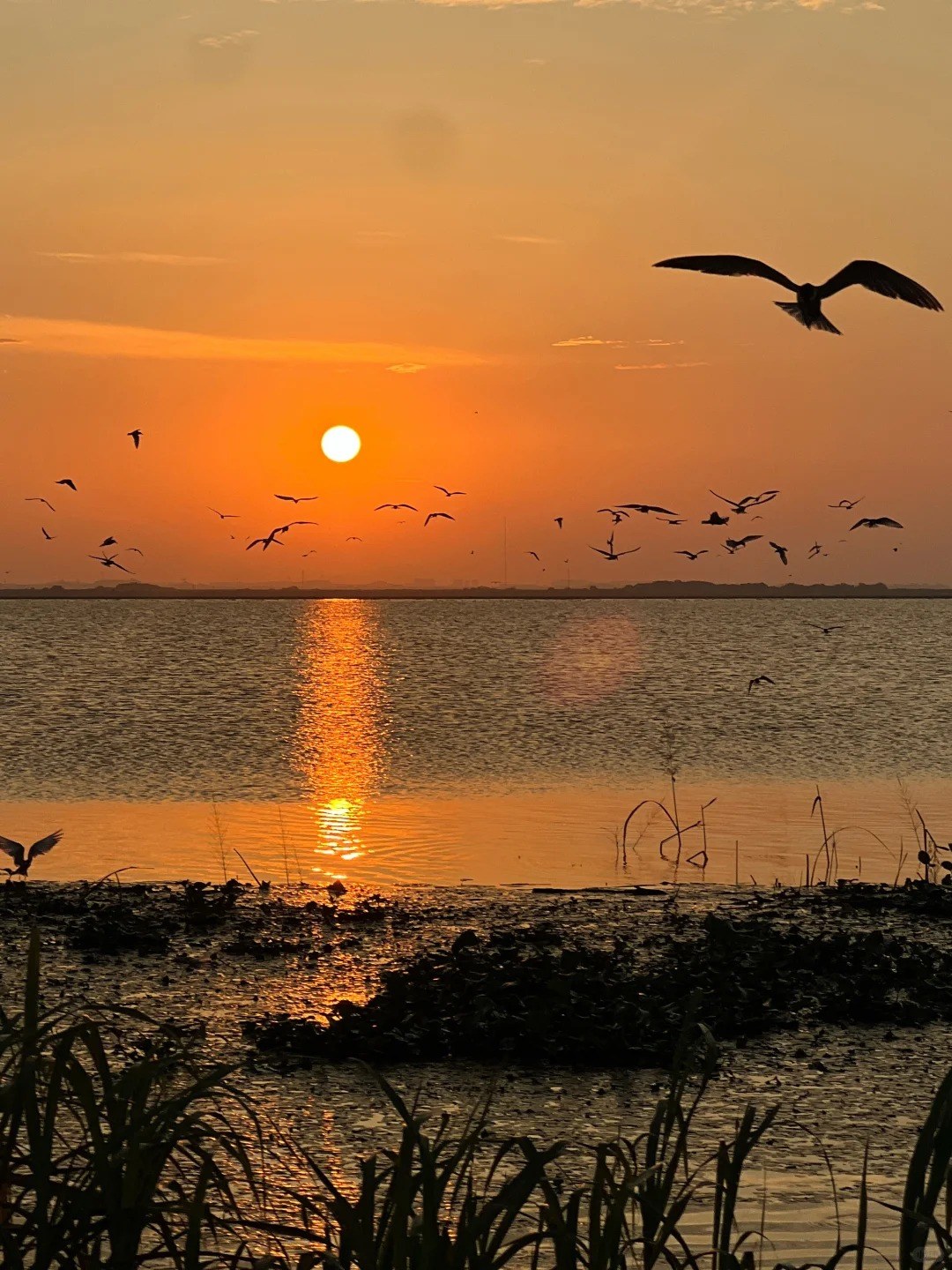 And this is the other half of the year: high water, green reeds, and a scatter of resident birds. Handsome, and completely beside the point if you came for cranes.
- If you would rather not drive it yourself: the reserve is the kind of day that works far better with a car and someone who knows which gate is open this week. We can put that together — see Plan With Us.
Frequently asked questions
When is the best time to see cranes at Poyang Lake?
Mid-December to February is the reliable window. The first birds arrive in late October, the main body in early November, and the last leave by the end of March. Between April and mid-October there are no wintering cranes on the lake at all.
Can you visit Poyang Lake from Nanchang in a day?
Yes. The Wuxing crane sanctuary at Liyuzhou is a half-day trip from central Nanchang and is free — though in the birding season the core viewing zone has to be booked ahead. Wucheng, the headquarters of the national nature reserve, is about 90 km north — roughly an hour and a half by car — and needs a full day.
How many Siberian cranes are left, and how many are at Poyang?
Depends who you ask, and the gap matters. The IUCN Red List assessment — last revised in 2018, on counts from 2008–2012 — says 3,500–4,000. More recent field counts run higher: the International Crane Foundation lists more than 5,500, 6,728 were counted passing one Siberian migration bottleneck in autumn 2024, and researchers at the Jiangxi Academy of Sciences put the world population at 6,000–6,500 for the 2024–25 wintering season. Of those, Chinese official sources put more than 95% on Poyang in winter; a 2022 nationwide survey measured 85.7%. In the winter of 2024 the reserve administration monitored 2,820 on the Wuxing farmland alone.
Do you need binoculars to see the birds?
At the reserve, yes — flocks are often several hundred metres out across mud and shallow water. The Wuxing sanctuary is the exception, where cranes feed in lotus fields close to the viewing paths, but even there binoculars turn a white speck into a bird.
Is Nanji Wetland the same as the Poyang Lake reserve?
No. They are two separate national nature reserves on the same lake. Nanji Wetland sits on the south-western shore inside Nanchang's Xinjian District; the Jiangxi Poyang Lake National Nature Reserve is centred on Wucheng in Yongxiu County, further north.
What else lives on Poyang Lake?
In a good year the lake hosts up to half a million migratory waterbirds — storks, tundra swans, wild geese, egrets, common cranes and large numbers of ducks and waders. At the Wuxing sanctuary alone the running tally reached 113 species by July 2026, eight of them under China's first-class state protection and seventeen under second-class.
Before you go
Reserve access, ticket prices and the seasonal Nanchang–Wucheng coach are all set year by year and change between seasons. Confirm the current arrangements before you commit a day to it, and if you are travelling specifically for the cranes, check that the birds have actually arrived — the calendar above is the pattern, not a guarantee. Last verified: 2026-08.
You Might Also Like
- Lushan (Mount Lu): China's Summer Escape
- Nanchang Travel Guide: Jiangxi's Capital
- Nanchang Countryside: Villages & Day Trips
Explore Nanchang & Jiangxi itineraries · Plan a custom trip with us