Bada Shanren Memorial Hall, Nanchang
A Ming prince lost a dynasty, shaved his head and stopped speaking. His memorial hall sits in a Nanchang Taoist temple — free, and on Line 3.
By Hello Nanchang · Last updated
Qingyunpu, Nanchang
Start with the bird
Before you read another word, look at this.
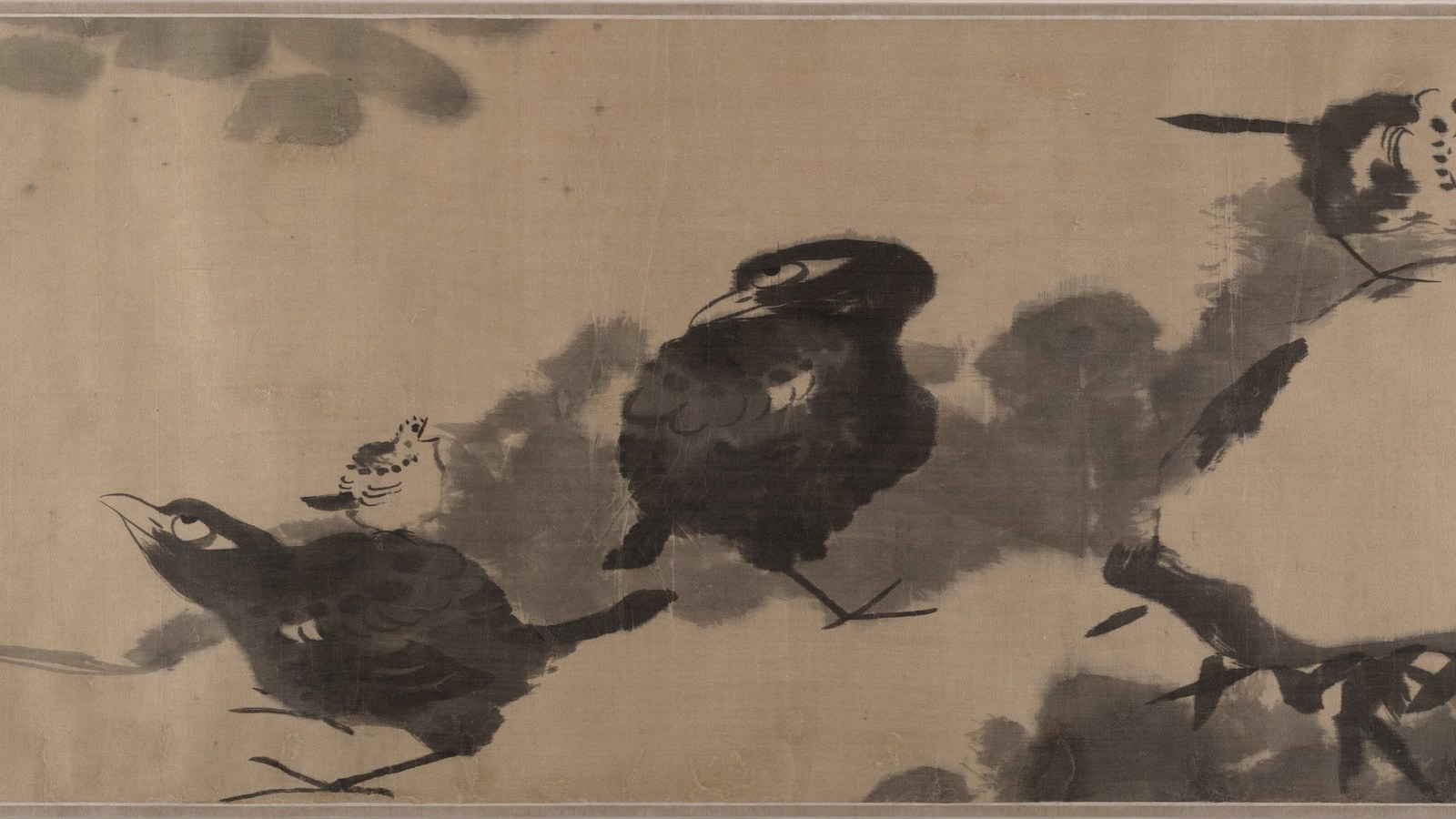 Bada Shanren, Birds in a Lotus Pond, about 1690. Metropolitan Museum of Art, 1989.363.135 (CC0).
Each bird is a dozen strokes of wet ink on silk, with most of the surface left alone. And each is looking up and away from you, out of one eye, with an expression that viewers have been calling contempt for three centuries.
Very little in Chinese painting looks like this before him, and a great deal does after. Two of the twentieth century's best-known Chinese painters said so out loud.
Qi Baishi wrote a quatrain naming the three masters he would have followed at any cost — Xu Wei, Bada Shanren and Wu Changshuo — and ended it by saying he would gladly return from the grave to be a dog at their gate. That last line is not modesty and it is not an insult: Qi Baishi's own note on the manuscript explains he was echoing a seal traditionally attributed to Zheng Banqiao, who had made the same extravagant gesture a century earlier. It is the strongest thing one Chinese painter can say about another. His handwritten copy is in the Beijing Fine Art Academy's collection, and in 2025 the academy and this museum used the poem's last line as the title of a joint exhibition.
Zhang Daqian, running through the great painters of fish — Yuan Yi in the Five Dynasties, Liu Cai and Fan Anren in the Song, all of them meticulous — stopped and said that the one he admired most was Bada Shanren, who got there with almost nothing: "a truly astonishing sympathy with the fish." He told students to take him as a teacher permanently, and then warned them not to copy him, because copying makes you a servant of painting rather than a painter.
Zhang Daqian is a complicated witness here, and the complication is worth having: he was also one of the twentieth century's most accomplished forgers of precisely the painters he admired. Take the admiration as real and the warning as hard-won.
He was born in Nanchang, the city has been arguing about him ever since, and his memorial hall is twenty minutes from Bayi Square on the metro.
Who he was
Zhu Da (朱耷), who signed himself Bada Shanren (八大山人), was born in Nanchang around 1626 into the Ming imperial clan — a ninth-generation descendant of Zhu Quan, a son of the dynasty's founder who had been given Nanchang as his princely seat. That made Zhu Da, at birth, a minor aristocrat in a city his family had held for two centuries, in a country his family had ruled for nearly three.
In 1644 the Ming collapsed. He was about eighteen.
What followed is the part that everyone remembers. He shaved his head and entered a Buddhist monastery, and by most accounts refused to speak for years — one story has him hanging the character for "dumb" (啞) on his door and communicating by gesture and laughter. Later in life he suffered a documented breakdown, tore up his monk's robes, and returned to Nanchang to live as a painter, largely poor, until his death around 1705.
Two things about that biography matter when you are standing in front of the work.
The first is that his silence was not only grief — it was safety. A surviving member of the deposed imperial family, in a new dynasty, with the wrong surname. Muteness and madness are both excellent reasons for the authorities to leave a man alone. Historians differ on how much of his was real and how much was worn; the honest answer is that it is not recoverable, and that the ambiguity was probably the point.
The second is his signature. He wrote 八大山人 in a running hand where the four characters run together, and the resulting shape can be read two ways: as 哭之, "weeping over it", or as 笑之, "laughing at it". That double reading is the traditional interpretation and it is how the museum itself presents it. A man who would not say what he thought found a way to put it on the paintings instead.
And then there is the portrait. Almost everything above has to be reconstructed from fragments, because contemporary written records of him are thin. There is one large exception, and it lives in this museum.
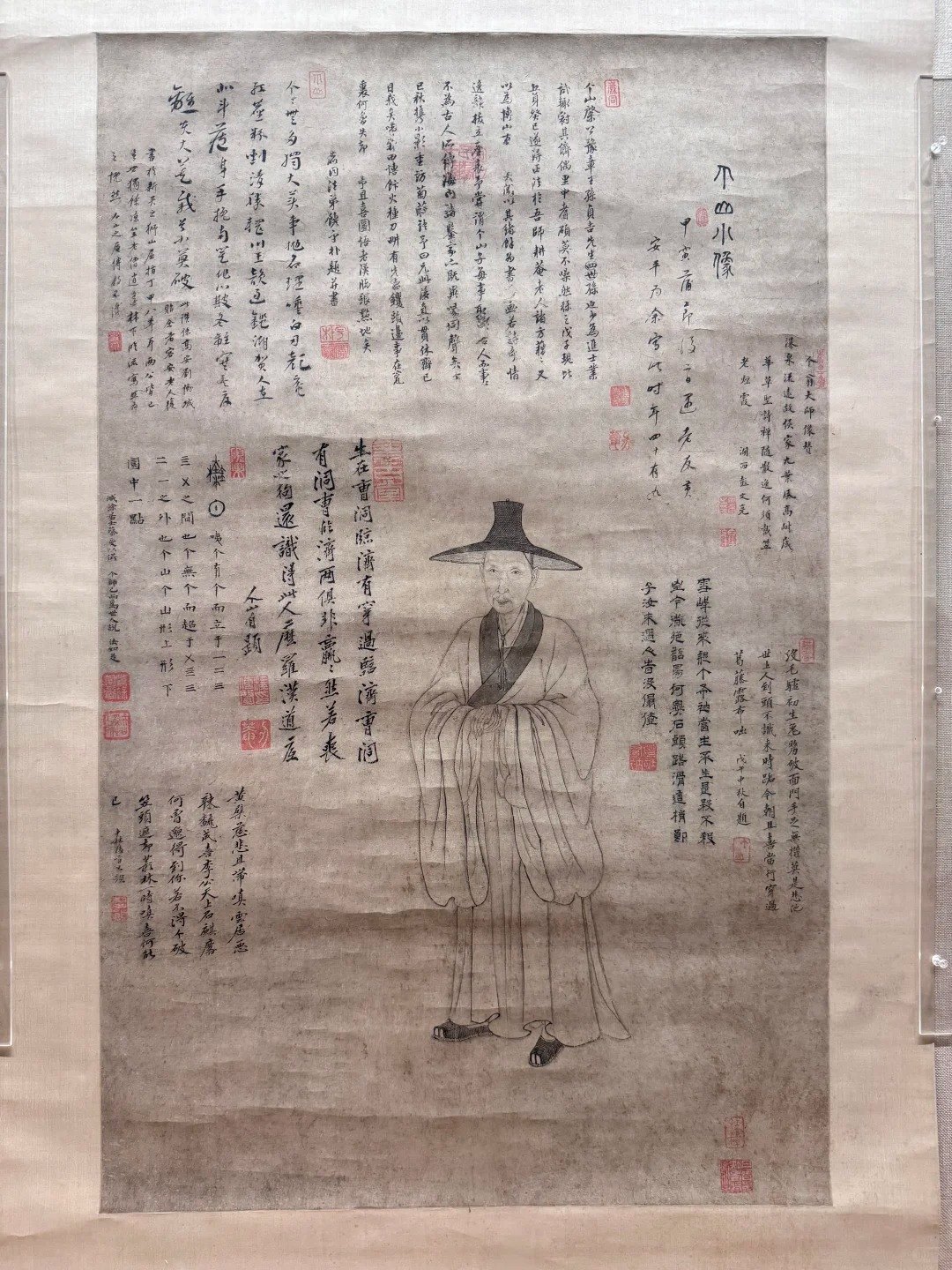 Geshan Xiaoxiang (个山小像), 1674 — the only surviving portrait of Zhu Da made from life, and the reason we know what he looked like at all. Note how much of the paper is writing rather than picture.
Geshan Xiaoxiang — "a small portrait of Geshan", Geshan being one of the names he was using at the time — was painted in 1674 by an old friend, Huang Anping. Zhu Da was 49. It is ink on paper, roughly 97 by 60.5 cm, and a National First-Grade Cultural Relic. His own hand records the occasion on the scroll: 安平為余寫此,時年四十有九 — "Anping painted this for me; I was then forty-nine."
What lifts it above a likeness is everything written around it. Nine inscriptions crowd the paper, six of them added by Zhu Da himself over the years that followed, in four different scripts. Because the documentary record of his life is so thin, those inscriptions are not decoration — they are a primary source for his descent, his movements and his beliefs, set down by the one person who was there. The man who would not speak wrote his own biography onto his own portrait.
One caution before you plan a trip around it: this is a first-grade relic on light-sensitive paper, and museums show such things selectively. Ask at the desk whether the original is out.
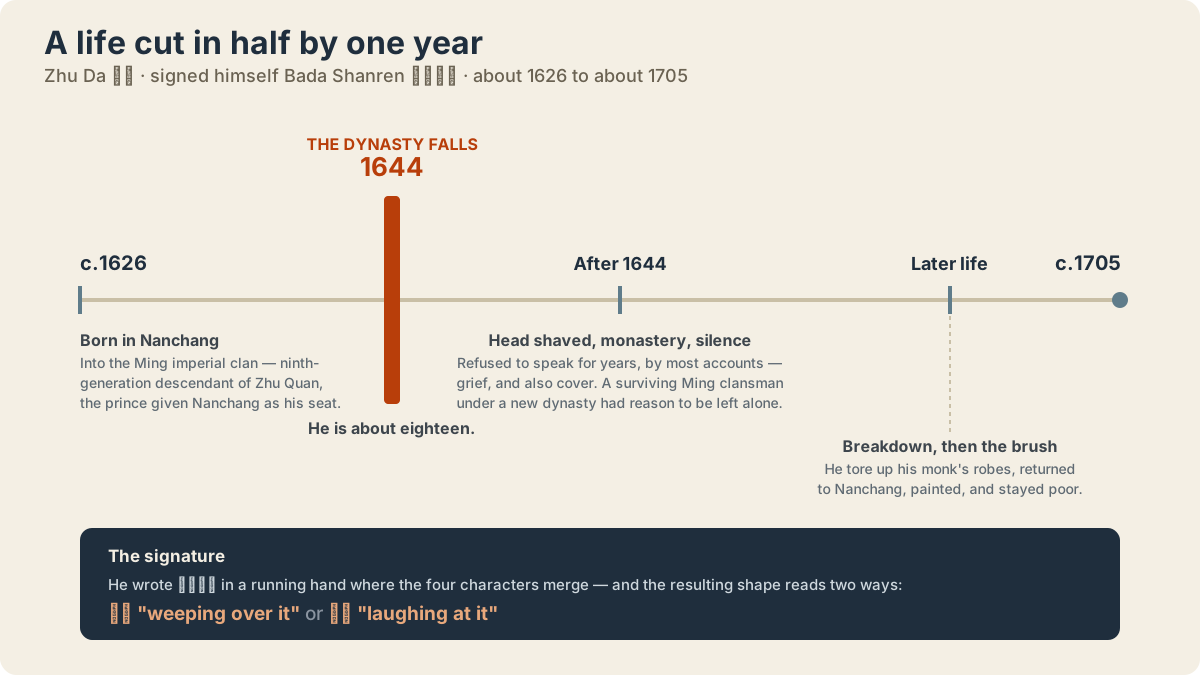 A life cut in half by one year. Everything before 1644 is a minor prince in a provincial capital; everything after is the painter.
The temple he ended up in, and the ancestor who got there first
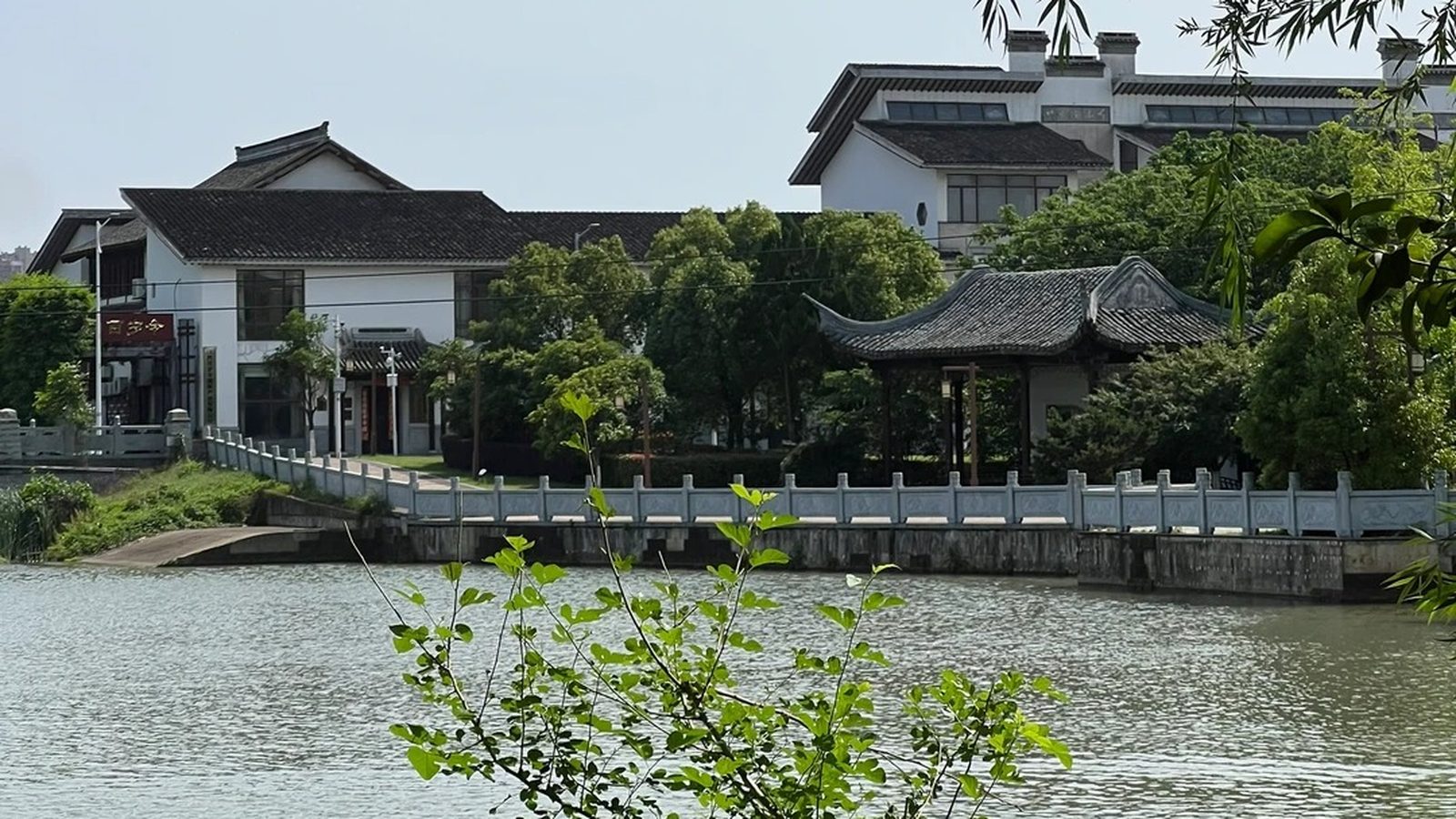
The memorial hall occupies Qingyunpu (青云谱), a Taoist temple compound on Nanchang's southern edge — and the site is considerably older than the painter who made it famous.
Local tradition puts religious use here 2,500 years ago, with a Zhou-dynasty crown prince said to have practised alchemy on the spot. But the figure who matters is Mei Fu (梅福), and he matters for a reason that will sound familiar in about four paragraphs' time.
Mei Fu was a county commandant of Nanchang at the end of the Western Han. When Wang Mang seized the throne, he resigned his post and disappeared into retirement here rather than serve. A shrine, the Mei Xian Ci (梅仙祠), went up on the spot; the water beside it has been called Meihu — Plum Lake — ever since. In the Eastern Jin, Xu Xun (许逊) built a temple here and founded the Jingming school of Taoism. The Tang renamed it, the Song renamed it again, and in 1661 it was rebuilt under a name that mutated, during the Kangxi reign, into the one it still has.
So: a man walks away from office because the dynasty has gone wrong, and takes shelter on this ground. That is Mei Fu, at the very end of the Western Han. It is also, almost exactly sixteen centuries later, Zhu Da. Nobody arranged that.
You can see both of them on the signage today. The scenic area's official name is 八大山人梅湖景区 — the Bada Shanren Meihu Scenic Area — which puts the painter first and the Han official's lake second. The metro station drops the lake altogether and is simply Bada Shanren.
There is a further echo, and it deserves the hedge it gets. Zhu Quan — the prince given Nanchang, and Zhu Da's direct ancestor — is described in local accounts as having practised Daoism at this temple in the early Ming. What is solidly attested is thinner than that: he held Nanchang, and he took Daoism seriously enough to write on it. If the local version is right, then two and a half centuries later his descendant took shelter on ground the family had already used for the same purpose.
Take that one as tradition. The Mei Fu parallel above needs no such hedge, and it is reason enough to stand on the actual site rather than look at the paintings in a book.
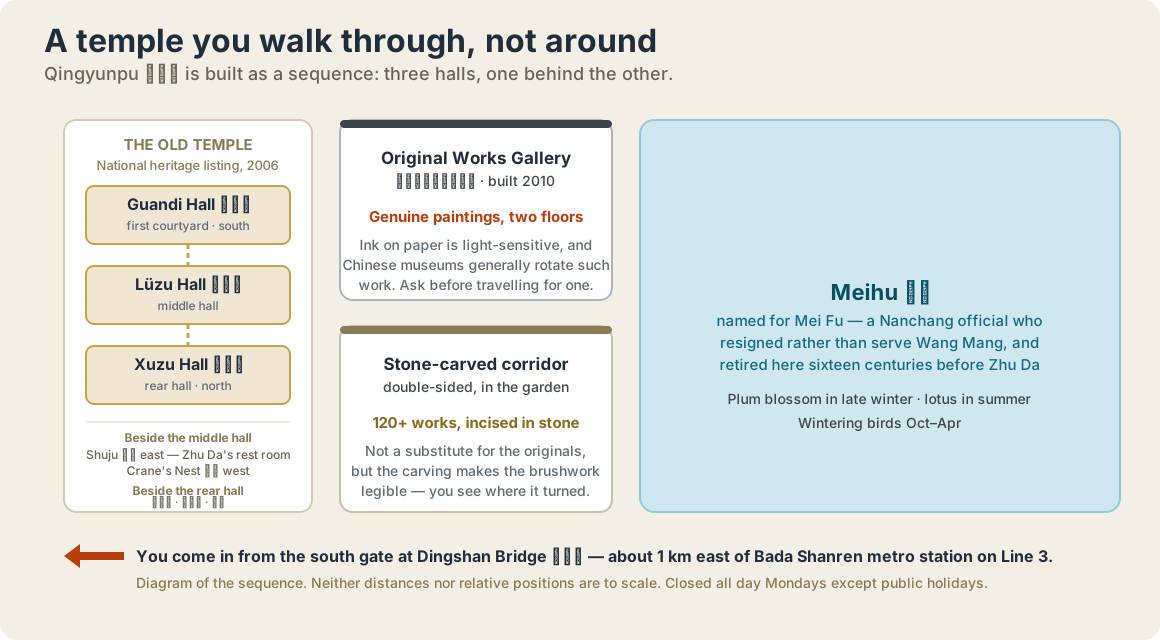 The compound is built as a sequence, not a block: three halls one behind the other, linked by covered corridors, with the small side courts Shuju and the Crane's Nest flanking the middle one. The modern gallery holding the originals sits separately.
What you actually see
The site has two halves and they do different jobs.
The old temple is the reason to come for atmosphere. Three halls run south to north one behind the other — dedicated to Guandi, to Lü Dongbin and to Xu Xun — with courtyards and light wells between them and a covered walkway running round. Two small side courts flank the middle hall, and the eastern one, Shuju (黍居), is where Zhu Da is said to have rested; the western one is the Crane's Nest (鹤巢). Behind, beside the rear hall, sit the Doumu pavilion, the Hall of the Three Officials and a garden called Qiaoyuan. It is whitewashed walls, dark timber, very old trees, and the lake immediately outside the gate. It was listed as a provincial heritage site in 1957 and made a National Key Cultural Relic Protection Unit in 2006.
The Original Works Gallery (八大山人真迹陈列馆), completed in 2010 as part of a two-year restoration and expansion, is where the actual paintings hang. Two floors, modern museum lighting, and — this is the part worth travelling for — genuine works rather than reproductions.
One honest caveat: ink on paper is light-sensitive, and Chinese museums generally rotate fragile works rather than hang them permanently. What is on the wall on any given day is not fixed. If you are coming for one specific painting, ask before you travel.
In the garden between them runs a double-sided stone-carved corridor reproducing more than 120 of his paintings and pieces of calligraphy in incised stone. It is not a substitute for the originals, but it is the only place you will see that much of his output in one walk, and the carving makes the brushwork legible in a way that is genuinely instructive — you can see exactly where the brush turned.
The museum describes itself as China's first memorial museum dedicated to an ancient painter, founded in 1959. Take the superlative as the institution's own claim, but the date is solid, and it explains the slightly old-fashioned, curatorial seriousness of the place.
How to look at the paintings
You do not need any background in Chinese art to get something out of this, but three things will help.
Count the strokes. The whole argument of his painting is subtraction. A fish is four or five marks. A bird is a dozen. Where a Song academy painter would render every feather, he gives you the minimum that still reads as a living animal — and then stops. The empty paper is not background; it is most of the picture.
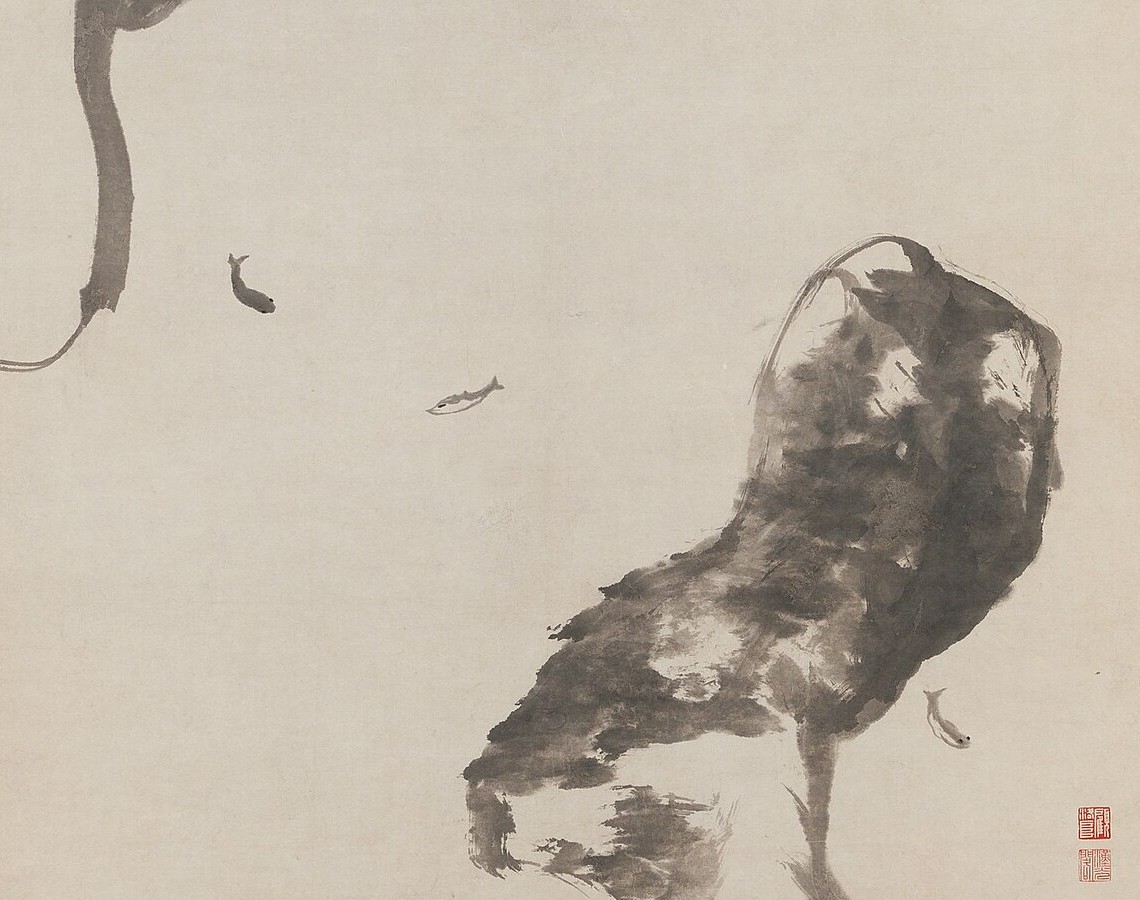 Fish, four or five marks each, and an enormous amount of nothing — and this is a band across the middle-lower part of the sheet, with more of both above and below. It is the kind of picture Zhang Daqian meant when he said nobody else got there with so little. Detail from Fish and Rocks, 1699. Metropolitan Museum of Art, 1989.363.137 (CC0).
Look at the eye. His birds and fish have eyes that are square-ish, set high in the head, with the pupil pushed to the top corner so the animal appears to be looking up and away from you. This is his signature move and it is entirely deliberate. Once you see it you cannot unsee it, and it is where the word "contempt" keeps coming from.
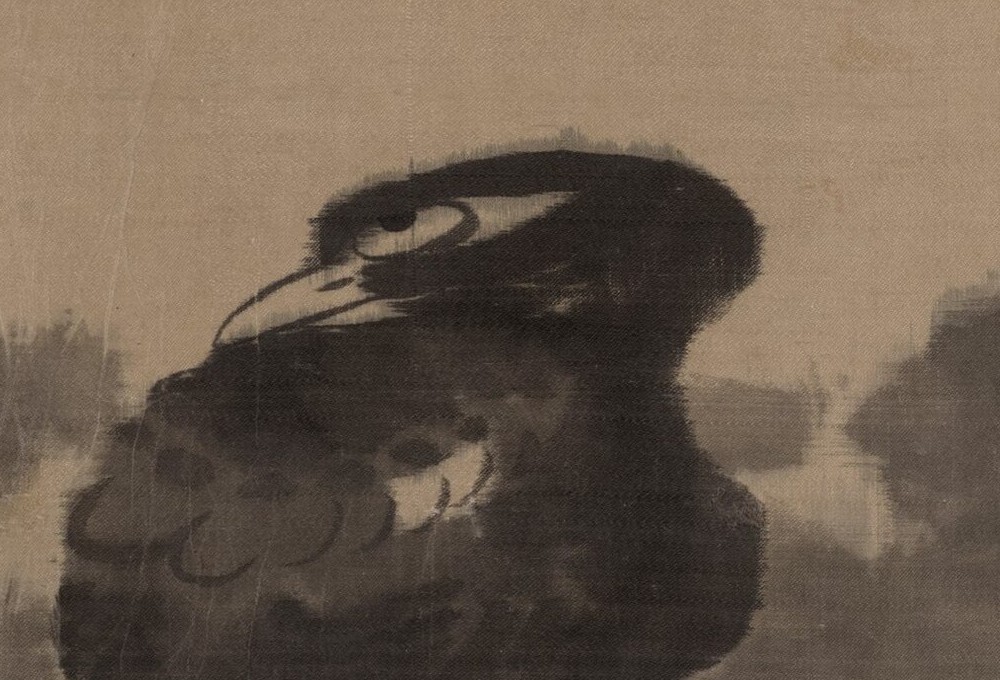 The move, close up. The eye socket is a pale angle high on the head and the pupil sits jammed in the top corner of it — so the bird is never looking at you, always past you. Detail from Birds in a Lotus Pond, about 1690. Metropolitan Museum of Art, 1989.363.135 (CC0).
Read the seals and the signature. He used a series of assumed names across his life, and the shifts track the shifts in his circumstances. By the time he settled on Bada Shanren he had found the one that could be read as weeping or laughing depending on how you looked at it.
One last thing, and it is not evidence. The written record of him is thin enough that people keep trying to fill the gaps, and the newest attempt is a short film assembled with AI.
《八大山人Bada Shanren》, a short film by 半生瓜AGUA. Every image in it is generated — the face, the rooms, the brushwork. The one likeness of Zhu Da made from life is the 1674 portrait higher up this page. Watch this for the mood it is reaching for, not for the record.
Getting there, and what it costs
Where: 青云谱路 259 号, Qingyunpu District (the wider scenic area carries a different street number — go by the museum's). Enquiries on 0791-85273565.
Metro Line 3 to Bada Shanren station, Exit 2 — the painter has a station named after him, which is a fine outcome for a man who would not speak. From the station it is about 1 km east along Dingshan Road to the south gate at Dingshan Bridge, which is the visitor entrance. Buses including 20, 158, 179 and 218 stop at Yingbin North Avenue / Dingshan Road.
Opening hours: doors open at 09:00, last admission 16:30, closing 17:00. Closed all day on Mondays except on public holidays. This catches people out — do not build a Monday itinerary around it.
Admission has been free since 1 July 2011 — the date is in the museum's own chronology, and it came the year after the 2010 rebuild. It has been a National First-Grade Museum since December 2020, when the Chinese Museums Association placed it in the fourth national batch; it was the first of Jiangxi's six on that list.
Booking, and the bit that catches foreign visitors. Individual visitors no longer need a named reservation: the gate takes either an ID scan or a QR code pulled up on WeChat or Alipay. The scanner reads Chinese national ID cards, and a passport will not scan. That is the whole problem in one sentence, and the solution is the same as at every other Chinese museum — get the QR code on your phone before you join the queue, or go to the staffed window and let someone register you by hand. Groups of up to fifty book 48 hours ahead. Last verified: 2026-08.
One more piece of layout you want in advance: the site runs one way, south to north. The south gate at Dingshan Bridge is the entrance and the north gate is the exit only, so do not plan to come back out where you went in.
One small piece of local knowledge: Bada Shanren is one of the metro stations with the free left-luggage service, and it has a staffed counter rather than lockers. If this is your last stop before a train, that is genuinely useful — the Nanchang metro guide has the rules.
Making a half-day of it
The memorial hall itself takes about an hour, or two if you read everything. The scenic area around it takes as long as you let it.
Go early. The garden is at its best in the first hour after opening: soft light, unbroken water, and the reflections that make it worth the early start. Our guide to Nanchang photo spots has the frames worth walking to.
Come in late winter if you can choose. The plum trees the lake is named for blossom then, which is both the prettiest the garden gets and a pleasing thing to know about while you are standing in it. Lotus takes over in summer.
Bring binoculars if you have them. The lake is on Nanchang's local birding lists, and between October and April there are wintering birds on it — a very small taste of what is happening an hour east on Poyang Lake.
Stay on Line 3. It is the culture line: the same train runs to Shengjinta (绳金塔) for the seven-tier pagoda and its food street, which makes an easy and unforced pairing for the rest of the day. If you would rather eat properly afterwards, our guide to what to eat in Nanchang is the place to start.
For where this sits in a longer stay, the Nanchang travel guide puts the city's headline sights in order — and if you would rather someone else worked out the order, that is what Plan With Us is for.
Practical, in one box
- Hours: 09:00–17:00, last entry 16:30. Closed Mondays except public holidays.
- Cost: free since 1 July 2011. National First-Grade Museum since December 2020.
- Booking: no named reservation needed, but the gate scanner does not read passports — have the WeChat or Alipay QR ready, or use the staffed window. Groups of up to fifty book 48 hours ahead.
- Getting there: Line 3 to Bada Shanren, then about 1 km east on Dingshan Road to the Dingshan Bridge south gate — which is the only entrance; the site runs one way. Buses including 20, 158, 179 and 218 stop at Yingbin North Avenue / Dingshan Road.
- Time needed: one hour for the memorial hall, half a day with the garden.
- Language: interpretation is largely Chinese; the museum offers a phone-based guide over the on-site wifi via its WeChat account.
- Good for: anyone with any interest in painting, anyone who likes a garden, and anyone who wants the one story in Nanchang that stays with you afterwards.
- Less good for: a Monday. Also for anyone expecting a large museum — this is a small, concentrated site, and its power is in the concentration.
Frequently asked questions
Who was Bada Shanren?
Zhu Da (朱耷), born in Nanchang around 1626, a descendant of the Ming imperial clan. When the dynasty fell in 1644 he shaved his head, entered a monastery and by most accounts refused to speak for years. He became one of the most influential painters in Chinese history, known for ink birds and fish rendered in a handful of strokes. He died around 1705.
Is the Bada Shanren Memorial Hall free?
Yes — admission has been free since 1 July 2011, and it has been a National First-Grade Museum since December 2020. It is closed all day on Mondays except public holidays, opens at 09:00 and stops admitting visitors at 16:30. You do not need to book, but the entry scanner reads Chinese ID cards rather than passports, so have a WeChat or Alipay QR ready.
How do you get to the Bada Shanren Memorial Hall?
Take Metro Line 3 to Bada Shanren station, then walk about 1 km east along Dingshan Road to the south gate at Dingshan Bridge. Buses including 20, 158, 179 and 218 serve the area.
Are there original paintings on display?
Yes. The Original Works Gallery, completed in 2010, holds genuine works over two floors. Ink on paper is light-sensitive and Chinese museums generally rotate such pieces, so what is hanging varies — check before travelling for one specific painting. A stone-carved corridor in the garden reproduces more than 120 works in incised stone.
How long do you need at Bada Shanren?
About an hour for the memorial hall itself, or half a day if you also walk the Bada Shanren Meihu Scenic Area around it. Early morning is best for both the light and the crowds.
What does the signature mean?
He wrote his name 八大山人 in a running hand where the characters merge, and the result can be read either as 哭之 ("weeping over it") or 笑之 ("laughing at it"). This double reading is the traditional interpretation and the one the museum presents.
Before you go
Opening hours, the booking requirement and the rotation of works on display are all set by the museum and change from time to time. Confirm the current arrangements the day before, and remember the Monday closure. Last verified: 2026-08.