Why Visit Jiangxi? China's Underrated Gem
Why visit Jiangxi? Porcelain-capital Jingdezhen, UNESCO peaks, Wuyuan's canola villages, red-tourism Jinggangshan and fiery food — minus the crowds.
By Hello Nanchang · Last updated
Jiangxi Province, China · Province overview · spring (canola) & autumn (clear skies) are the sweet spots
Turn over a plate in your kitchen. Whatever's stamped on the back, the English word for the material it's made of — china — traces to one river town, and that town is a 42-minute bullet train from a provincial capital you have probably never considered stopping in. Jingdezhen has been firing porcelain for more than a thousand years — first for the imperial court, then for everyone else — and it is still at it: the kilns get lit, young potters rent benches in the old state-factory yards, and the weekend markets sell whatever came out of the last firing.
That is the shape of this whole province. Jiangxi (江西) holds a surprising number of things you already half-know about China — the porcelain, the granite peaks floating in cloud, the gold terraced villages, the mountain where the Red Army learned to fight — parked an hour or two apart on a high-speed rail network, with almost nobody in the queue ahead of you.
The one-line version: Jiangxi is the province that gave the world the word "china," and then quietly fell off the itinerary. It sits in the soft middle of the country just south of the Yangtze, ringed by the neighbours everyone else flies to — Anhui's Huangshan, Fujian's coast, Hunan, Zhejiang, Guangdong. Being surrounded by famous places is exactly why it stayed cheap, uncrowded and unbothered.
Who Jiangxi is for — and who it isn't
Come if your idea of China is bigger than Beijing and Shanghai; if you like mountains, craft, small towns and eating well for very little; if the phrase "you will be the only foreigner in the room" sounds like a feature rather than a bug.
Think twice if you need English-language everything, if you are chasing skyline-and-nightlife China, or if you have four days and want to see it all — Jiangxi's sights are spread around the edges of the province and it punishes greedy itineraries. This is a place to pick two or three things and do them properly.
How to read the map
Jiangxi covers roughly 167,000 square kilometres — call it Florida-sized — with around 45 million people, most of them in the flat middle. Picture a bowl: mountains around the rim, a great lake in the north, and the Gan River (赣江) running up the centre into it. The provincial capital, Nanchang, sits in the belly of that bowl with high-speed lines fanning out in every direction, which is why almost every sensible Jiangxi trip is built as spokes off Nanchang rather than a straight line across the map.
Rough rail times from Nanchang, so you can picture distances: Longhushan around 35 minutes, Jingdezhen about 45, Jiujiang (for Lushan) 45 minutes to an hour, Wugongshan's railhead 1 to 1.5 hours, Wuyuan about 1 hour 20 from Nanchang East, Sanqingshan's gateway town 2 to 2.5 hours, Jinggangshan 3 to 3.5. Nothing is far. The transfers at the far end are what eat your day — see getting around Jiangxi by train before you book anything.
The world's porcelain capital, still working
For over a millennium Jingdezhen (景德镇) was the imperial kiln town, the source of the blue-and-white that conquered dinner tables from Isfahan to Amsterdam. What makes it worth a day now is that it never became a museum piece. The dragon kilns still get lit; the brick-vaulted Imperial Kiln Museum is one of the best pieces of new architecture in China; and thousands of young potters, designers and overseas "Jingdezhen drifters" have moved into the old factory compounds, so you get galleries, weekend creative markets, and studios where you can sit down and throw your own wonky bowl for an afternoon.
Practically: fastest trains from Nanchang East to Jingdezhen North do it in 42 minutes, most in 45–60, with second class about ¥86–94 depending on the service — the fast G-trains cost a little more than the slower D-trains, not less (Chinese rail fares float, so treat that as a band, not a price). It is the easiest day out in the province, and a better overnight. Full Jingdezhen guide, or go deep with the ceramics itinerary.
Mountains that would be mobbed anywhere else
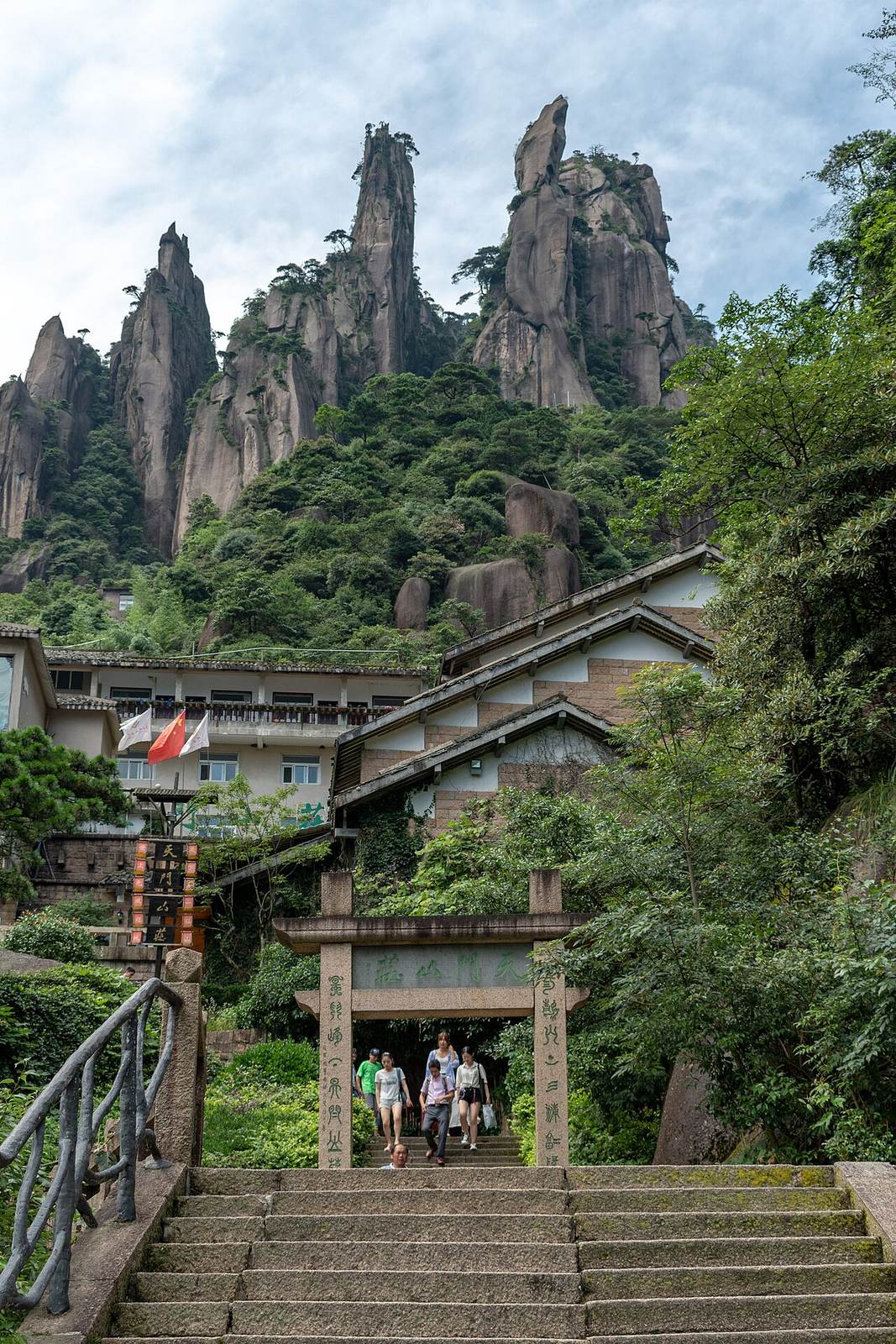 Sanqingshan's granite spires at cloud level — the mountain that looks like a Song-dynasty scroll and is two and a half hours from Nanchang · Photo: xiquinhosilva / CC BY 2.0 via Wikimedia Commons
Four very different mountains, none of them Huangshan-busy. Pick by temperament rather than by list.
- Lushan (庐山) — the civilised one. UNESCO-listed as a cultural landscape, and the twist first-timers miss is that you don't really climb it: there's an actual town on top, Guling (牯岭镇) at around 1,100 m, with hotels, shops and bus stops, and summer temperatures roughly 10°C below the plains. Poets, monks and, later, a whole hillside of early-1900s stone villas. Reckon 45 minutes to an hour by rail to Jiujiang, then 1 to 1.5 hours on the mountain bus (about ¥15–20); the gate ticket runs around ¥160 and is valid about a week. More on Lushan.
- Sanqingshan (三清山) — the dramatic one. Granite needles and pillars standing out of a sea of cloud, UNESCO-listed in 2008, laced with cliff-edge plank walkways. If you have ever admired a photo of an impossibly thin Chinese peak with a single pine clinging to it, a lot of those were shot here. Around 2 to 2.5 hours by train to Yushan, then about an hour by shuttle; entrance in the region of ¥120. More on Sanqingshan.
- Wugongshan (武功山) — the cult one. You climb through bamboo onto rolling alpine grassland along the ridgeline, pitch a tent (rentals everywhere at the top), and wake up above the clouds. It picked up UNESCO Global Geopark status in 2024. Not a temple-and-cable-car mountain; a windswept overnight with a young Chinese crowd and a lot of headtorches. Train 1 to 1.5 hours to Pingxiang North, then a bus of about an hour for roughly ¥27; entrance around ¥70. More on Wugongshan.
- Longhushan (龙虎山) — the easy one. Red Danxia sandstone cliffs, a Taoist holy mountain, and a bamboo-raft float of about 10 km down the Luxi River past coffins wedged into the rock face some 2,600 years ago. Barely 35 minutes from Nanchang by fast train, which makes it the province's most under-rated day trip. More on Longhushan.
The villages that break the internet
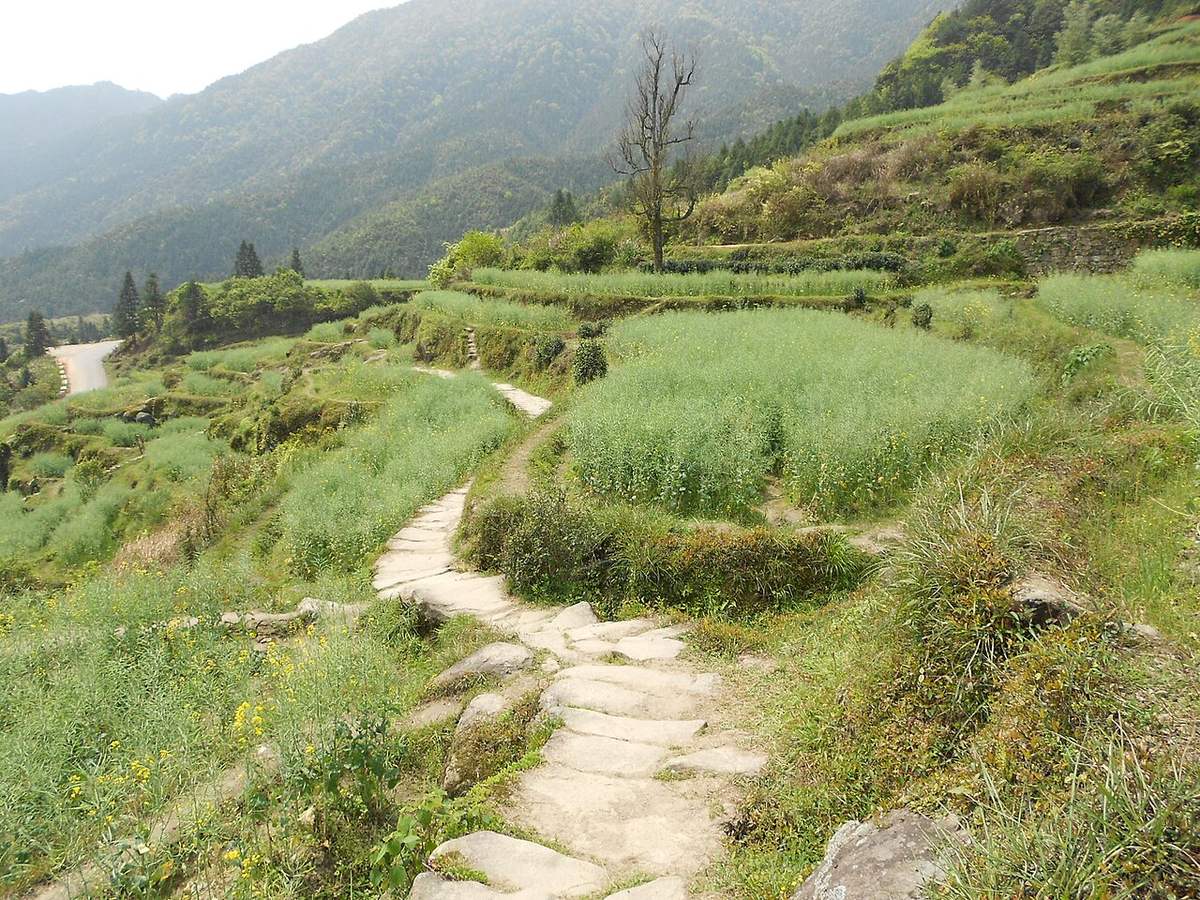
Wuyuan (婺源), in the province's northeast corner, gets called "the most beautiful countryside in China" so often that it should be insufferable, and then for two or three weeks each spring it goes ahead and earns it: whitewashed, grey-tiled Huizhou-style villages standing in a sea of golden rapeseed, terraces stacked up the hillsides. The headline viewpoints are the terraces at Jiangling (江岭) and the hilltop village of Huangling (篁岭), where farmers sun-dry chillies, corn and persimmons on circular racks hung off the eaves — the shaiqiu (晒秋) drying scene, which is a whole second photo season in autumn.
Timing is the entire game. The bloom is roughly mid-March to early April, with the fullest all-at-once peak usually in the second half of March — but it moves a week or two every year with the weather, so check a current local update a few days out rather than trusting any fixed date, including this one. Come outside the bloom and Wuyuan is still lovely: old bridges, tea slopes, empty lanes, and rooms at half the price. Full Wuyuan guide.
Where the People's Liberation Army was born
Jiangxi is the cradle of Chinese "red tourism," and you don't need any particular politics to find it gripping — a large chunk of twentieth-century China genuinely happened here. At 2am on 1 August 1927, some 20,000 troops launched an uprising in the streets of Nanchang; it is treated as the founding moment of the People's Liberation Army, and the date is now stamped all over the capital — see the Nanchang guide for that half of the story. The survivors regrouped in the mountains at Jinggangshan (井冈山), where Mao Zedong had established the first rural base, and the strategy worked out there — surround the cities from the countryside — went on to win a civil war.
Today Jinggangshan is a dense, well-preserved site of revolutionary buildings and memorials among genuinely beautiful forested peaks, three-odd hours south of Nanchang, and it belongs to Chinese tour groups rather than foreign ones — expect loudhailers, matching red caps and almost no English. Go for the mountain and the history; bring your own context. More on Jinggangshan, or follow the whole thread on our red-history itinerary.
A lake that doubles in size, and the birds that follow it
Spread across the north of the province is Poyang Lake (鄱阳湖), China's largest freshwater lake and a body of water that refuses to hold still: swollen by summer rain it can run to 3,500 square kilometres or more, and by late winter it has drained back to under a thousand, leaving a maze of channels, grass flats and mudbanks.
Those mudbanks are the point. Every autumn, Siberian cranes — tall, snow-white birds with crimson faces, and one of the most endangered birds on earth — leave the Yakutian tundra and fly some 5,000 km down the last surviving migration route their species has, to land here. The overwhelming majority of the world's population winters on this one lake — Chinese official sources put the share above 95%, and a nationwide survey in January 2022 measured 85.7% — which in a good year draws up to half a million migratory waterbirds in total. Jiangxi made the crane its provincial bird in 2019, which tells you how seriously it's taken locally. The season runs roughly November to March, with mid-December to February the prime window; Wucheng (吴城), the old "migratory bird town" on the lake, is the classic base. It is a bucket-list wildlife sight that most people who have travelled China extensively have never heard of. Logistics and other lake-edge day trips are in our Nanchang countryside guide.
One of China's spiciest cuisines — and it isn't showing off
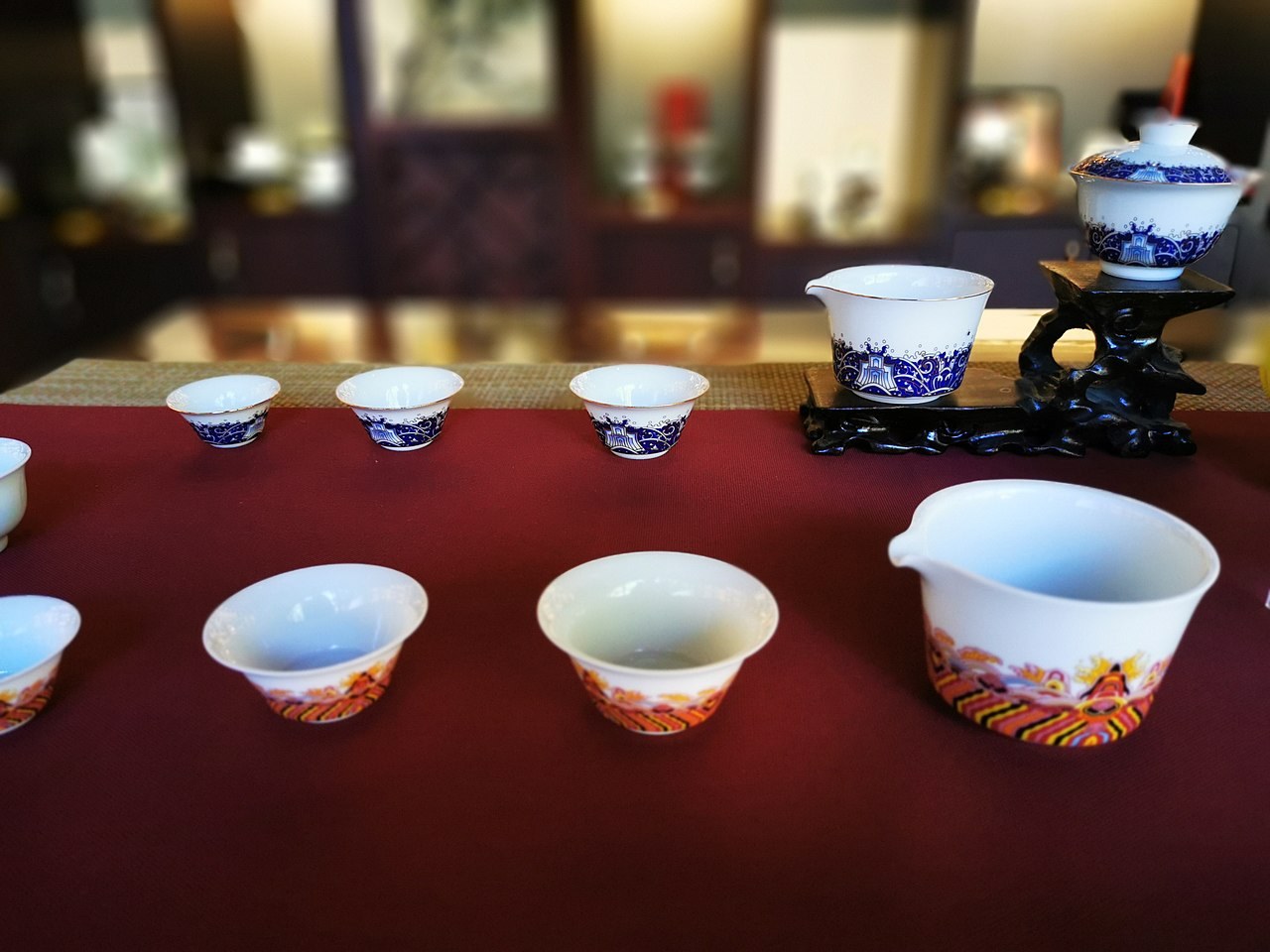 Blue-and-white and famille-rose wares in Jingdezhen, where the kilns have been running for over a thousand years · Photo: Liuxingy / CC BY-SA 4.0 via Wikimedia Commons
Fighting words, but locals will back this up: Gan cuisine (赣菜) is among the spiciest cooking in China, and regularly out-burns its more famous neighbours in Hunan and Sichuan. The character of it is different, though. There's no Sichuan numbing and none of Hunan's theatre. Fresh red and green chillies are treated as a vegetable rather than a seasoning — a plate of stir-fried pork can be half pork, half chilli — and the base flavours come from tea oil, lard, cured meat and pickles rather than heavy sauce. A modest-looking dish will quietly take the roof off your mouth.
- Rice noodles, tossed not soupy (拌粉, bànfěn) — the province's default breakfast, eaten standing up at a counter for around ¥6–10. Mild by local standards and the gentlest possible way in. The full story of the bowl.
- Clay-pot soup (瓦罐汤, wǎguàntāng) — sealed crocks stacked inside a giant charcoal urn overnight and ladled out to order, roughly ¥5–10. Not spicy. Order one alongside anything fiery and treat it as the fire extinguisher.
- Lihao with cured pork (藜蒿炒腊肉) — a crunchy wild marsh herb pulled off the Poyang Lake flats and fried with smoky cured pork, best in spring. It's on every list of the province's ten defining dishes, and it tastes like nowhere else in China.
- Xiaochao (小炒) — the point-at-the-display-case, cooked-in-four-minutes stir-fry format that has spread from Jiangxi across the country in the last few years. Lunch or dinner, about ¥50 a head, and the best-value meal you'll eat here. Why xiaochao is suddenly everywhere.
- Three-cup chicken (三杯鸡) — a Gan-cuisine classic, usually traced to Jiangxi's Ningdu county and named for its three cups: rice wine, soy sauce and oil, no water at all, braised with ginger in a covered pot until the sauce turns to glaze. Dinner; not chilli-hot; the safe order for a table that includes someone who has given up.
Learn two phrases before you sit down: 微辣 (wēilà) for mild, 不要辣 (bú yào là) for no chilli. Order them anyway — a Jiangxi kitchen's idea of "mild" is still a workout.
The capital is where most visitors do their eating, and there's a street-by-street version of all this in things to do and eat in Nanchang.
The quiet literary superpower
Here's the thing that surprises people who assume a low-profile province must have a low-profile past. Of the eight writers canonised as the great prose masters of the Tang and Song dynasties — the eight every Chinese schoolchild memorises — three were from Jiangxi: Ouyang Xiu from Yongfeng, Wang Anshi from Linchuan, and Zeng Gong from Nanfeng. Two of those three came from the same small prefecture, Fuzhou (抚州).
Fuzhou also produced Tang Xianzu (汤显祖, 1550–1616), who wrote The Peony Pavilion and died in the same year as Shakespeare — a coincidence the two towns have since turned into a sister-city tie with Stratford-upon-Avon. Three centuries earlier, at the foot of Lushan, Zhu Xi revived the White Deer Grotto Academy and effectively set the intellectual syllabus of imperial China for the next seven hundred years. A thousand years before that, the poet Tao Yuanming quit his post near Jiujiang, went home to farm, and wrote the lines about chrysanthemums and the southern hills that literate Chinese readers can still finish for you.
None of it is on a plaque in English. But it explains why Chinese visitors treat a trip through Jiangxi as closer to a pilgrimage than a holiday — and why the rocks on these mountains are covered in carved poems.
The honest case — the good half and the hard half
Two good things follow from flying under the radar. The crowds are almost entirely domestic: outside the Wuyuan bloom fortnight and the big national holidays (Lunar New Year week and the first week of October — avoid both if you can), you are rarely fighting for a view, and foreign faces are scarce enough that people are curious and warm rather than jaded. And it is cheap — short high-speed hops, street-food meals for pocket change, comfortable hotels for a fraction of Shanghai prices. Exact figures move, so treat every number here as a ballpark.
The hard half, stated plainly. English is thin outside hotel front desks; you will lean on a translation app and on Chinese place names saved in your map. Everything runs on QR payment — set up Alipay or WeChat Pay before you land, and note that Google's maps don't work here while Amap does. Signage and interpretation are written for domestic visitors, so a lot of the history arrives uninterpreted. Some restored old streets are more restoration than old. Scenic-area ticketing stacks in layers — gate, then shuttle bus, then cable car — and catches people out. And the distances that look trivial on a rail map get longer at the far end, where a bus or taxi transfer is usually waiting. Plan two or three places, not eight. Our Plan Your Trip section covers the practicalities, including current visa-free entry and transit rules.
When to go
- Autumn (late September to early November) — the best all-rounder. Clear, dry, comfortable across the whole province; good for mountains and cities alike; Wuyuan's drying racks are out.
- Spring (mid-March to April) — for the rapeseed gold and fresh-green hills. Book well ahead; this is the one genuinely crowded window.
- Summer (June to August) — hot, humid and wet in the lowlands, which is precisely why the mountains are the season's whole point: Lushan and Wugongshan are what locals do in July. See the summer escape route.
- Winter (December to February) — cool, damp, quiet, cheap, and the only time you can stand on a lake shore and watch several thousand cranes. Pack layers for unheated rooms.
How to string it together
Base yourself in Nanchang and run spokes. Fly or train in, get your bearings and your first bowl of noodles, then peel off to one or two regions and loop back.
- A long weekend: Nanchang plus Jingdezhen plus one mountain. Two hotels, no backtracking.
- Five to seven days: the classic arc — Nanchang, Jingdezhen, Wuyuan, a mountain, back to Nanchang to fly out. Mapped day by day in our Jiangxi loop.
- Travelling with children: shorter hops, more lakes and parks, fewer stair-climbs — see Jiangxi with kids.
- First read before booking: why Nanchang works as your base, and then the Nanchang city guide for the city itself.
Every route we've mapped, from a 48-hour city break to the full provincial arc, is in the itineraries hub.
FAQ
Is Jiangxi worth visiting? Yes, if you want a version of China that is still mostly for Chinese people: a working porcelain city, four distinct mountains, some of the country's prettiest villages, serious food, and prices well under the first-tier cities. It rewards travellers who pick two or three places and go slowly, and frustrates anyone trying to tick a list.
How many days do you need in Jiangxi? Five to seven is the sweet spot — enough for Nanchang plus two or three regions without a punishing pace. A long weekend covers the capital plus Jingdezhen plus one mountain. Under three days, just do Nanchang and one day trip.
What is Jiangxi province famous for? Jingdezhen porcelain (the origin of the word "china"), UNESCO-listed Lushan and Sanqingshan, the rapeseed villages of Wuyuan, revolutionary history at Jinggangshan and Nanchang, Poyang Lake and its wintering Siberian cranes, and Gan cuisine — one of the spiciest regional cuisines in the country.
When is the best time to visit Jiangxi? Late September to early November for clear, comfortable weather province-wide. Mid-March to early April for the Wuyuan rapeseed bloom, which shifts a week or two every year. Summer for the mountains, winter for the cranes.
How do you get around Jiangxi, and do people speak English? High-speed rail out of Nanchang for everything between cities, then a local bus, shuttle or taxi for the last leg to a mountain or a village — read getting around Jiangxi by train first, because which Nanchang station you leave from can change your journey by more than an hour. English is rare outside hotel reception desks; metro and major-sight signage is bilingual, menus and drivers are not. A translation app and Chinese place names saved on your phone cover the rest.
Ready to turn this into an actual trip? Tell us what you're into and we'll plan it with you — dates, pace, spice tolerance and all. Or browse every destination in the province from the Destinations hub.
Images: "Terraces at Jiangling" by Raki_Man (CC BY 3.0); "19194-SanQingShan" by xiquinhosilva (CC BY 2.0); "景德镇古窑民俗博览区 精美瓷器 02" by Liuxingy (CC BY-SA 4.0) — all via Wikimedia Commons.
Last verified: 2026-08 — train times, fares, ticket prices, bloom dates and opening hours change often; please double-check official sources before you travel.
Cover photo: Raki_Man / CC BY 3.0 via Wikimedia Commons (cropped & resized).
You Might Also Like
- Lushan (Mount Lu): China's Summer Escape
- Nanchang Travel Guide: Jiangxi's Capital
- Poyang Lake Nature Reserve: See the Cranes
Explore Nanchang & Jiangxi itineraries · Plan a custom trip with us