Finless Porpoises in Nanchang's Gan River
Wild Yangtze finless porpoises came back to Nanchang's Gan River in 2020 after forty years. Where to watch them free, the best hours, and how it happened.
By Hello Nanchang · Last updated
Yangzizhou island, Gan River, Nanchang, Jiangxi · Year-round; sightings are most reliable in the early morning and from mid-afternoon
On a bright, still winter morning the Gan River (赣江) north of central Nanchang goes the colour of weak tea and barely seems to move. You are on a grass levee at the top end of a river island, hands in your pockets, watching nothing in particular. Then a seam opens in the water — a slick black back, curved like the top of a bicycle tyre, rolling up and under in under a second. Barely a splash. By the time you register it there is a second, then a third, and for a few minutes the flat brown surface keeps breaking into small silver arcs.
Nobody says much. A retired man with a tripod adjusts his lens by a millimetre. That is the standard reaction here, because on this stretch it happens most days.
The animals are Yangtze finless porpoises (长江江豚) — small, wild, critically endangered, the last cetaceans in the river system. They were gone from this part of the Gan for forty years. In August 2020 they came back — a conservation turnaround you can walk up to for free, on a riverbank almost no visitor knows exists.
The animal that lost its fin and kept its smile
Start with what it is not: not a dolphin, and it does not leap or spin. The Yangtze finless porpoise (Neophocaena asiaeorientalis asiaeorientalis) is a stocky little cetacean, generally 1.2 to 1.9 metres long and 50 to 70 kilograms — about the size of an adult human, packed into a torpedo. Reported lifespans run to 20 to 25 years.
Two things make it look odd. It has no dorsal fin: where a dolphin carries a triangle, this animal has a low ridge studded with small bumps, so a surfacing porpoise reads as a smooth dark curve rather than a blade. And it has no beak — the forehead round and steep, the mouth line turned up at the corners, the result a face that appears to be quietly enjoying itself. Hence the nickname it is universally known by in China, the "smiling angel" (微笑天使).
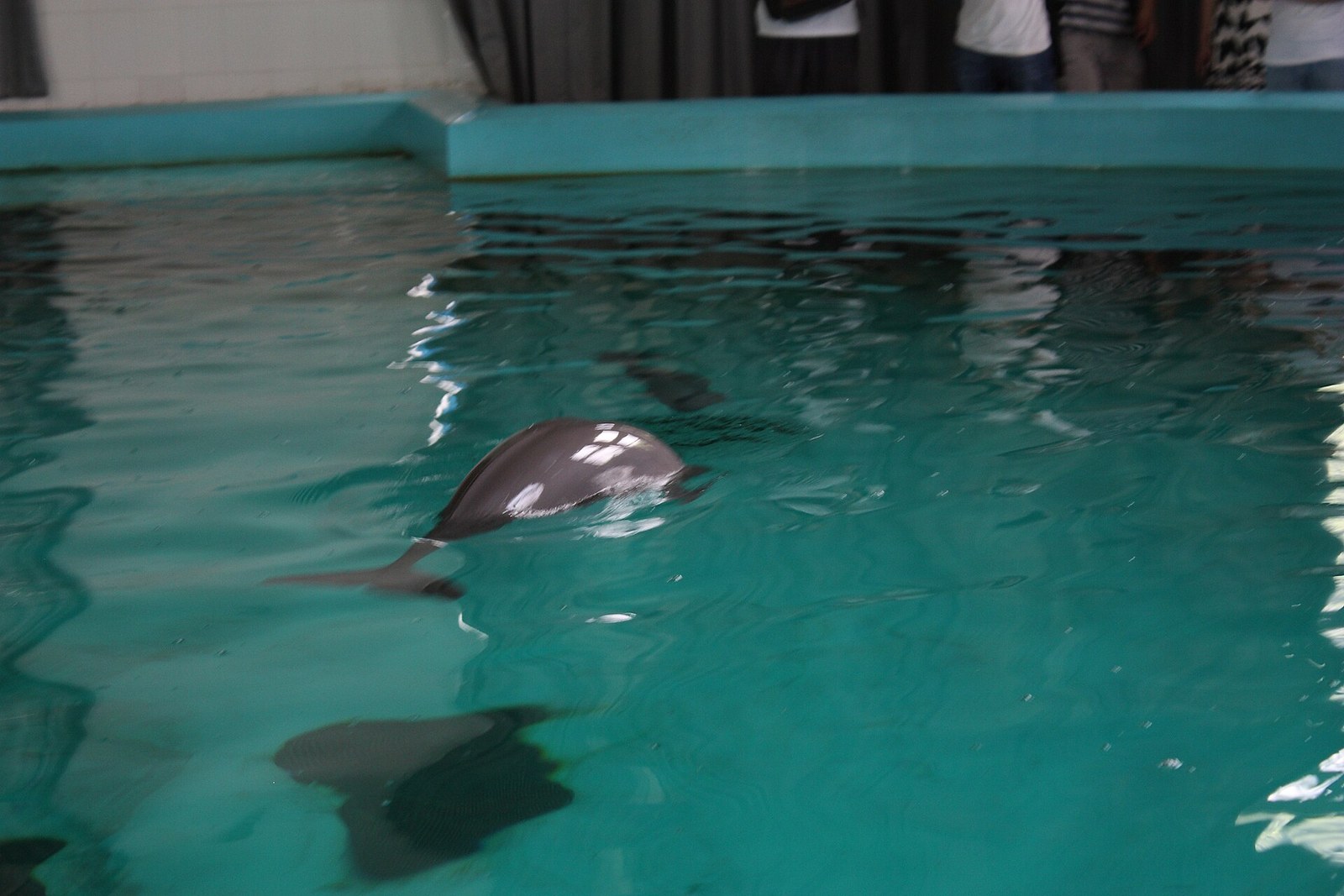
What the animal actually looks like close up: a round, beakless head, the mouth line lifting at the corner, and a low ridge instead of a dorsal fin. Be clear about what you're seeing, though — this is a captive porpoise in a tank at the Institute of Hydrobiology in Wuhan, shot from the poolside with visitors standing at the rim. The animals at Yangzizhou are wild, and you will never see one at anything like this range. Photo: Huangdan2060 / CC BY 3.0 via Wikimedia Commons
The smile is anatomy, not mood. The animal hunts small fish and shrimp in water so silted you could not see your own hand, so it feeds by sound, firing ultrasonic clicks and reading what comes back. Gestation runs to about a year and a female carries one calf — slow arithmetic that explains both the crash and how incremental the recovery has been. It is Critically Endangered on the IUCN Red List, and since February 2021 a National First-Class Protected Wild Animal in China, upgraded from second class.
There is an empty chair at this table. The Yangtze used to hold two cetaceans; the other was the baiji (白鱀豚), a pale, nearly blind river dolphin. A six-week international survey in 2006 swept its entire range and found none — the first large vertebrate humans had driven off the planet in over half a century. Everyone working on the porpoise today works in that shadow.
Why a Yangtze animal swims past a provincial capital
Look at a map of Jiangxi and the logic falls out. The province is one enormous bowl draining north into Poyang Lake (鄱阳湖), China's largest freshwater lake, which empties into the Yangtze at Hukou. The Gan is the biggest of the five rivers feeding that bowl — 766 kilometres from the southern hills to the lake, draining some 83,500 square kilometres, over half the entire Poyang catchment. Nanchang sits on it, where the river fans out into the delta channels that enter the lake.
To a porpoise, then, lake and river are not two places. They are one system with no door in it, and Poyang is the most important habitat the species has left. The 2022 basin-wide survey put 492 porpoises in Poyang Lake — around 40% of every one alive — against 595 in the Yangtze main channel and 162 in Dongting Lake. Jiangxi counts roughly 600 in the province year-round, about half the world total.
Nanchang's own share of the lake is bigger than most visitors realise. The Nanji Wetland National Nature Reserve (南矶湿地国家级自然保护区), where the Gan's three branches spill into open water, covers about 33,300 hectares almost entirely inside the city's boundaries, and is both a main porpoise habitat and a headline site for wintering waterbirds — that bird story lives in our guide to the countryside and lake edges around Nanchang, and the wider lake in why Jiangxi is worth the trip. What is new is not that porpoises are in the Poyang system, but that they now swim up a channel past a city of several million, and stay.
The long fall, and the ten-year silence
The numbers tell it better than adjectives. In the early 1990s researchers estimated around 2,700 Yangtze finless porpoises. By 2006, roughly 1,800. By 2012, about 1,040 — more than halved in under two decades, with the decline accelerating. The 2017 survey recorded 1,012, the lowest count ever made.
The causes were not exotic. Industrial-scale fishing stripped the fish out from under them. Gillnets and hooks drowned them. Cargo traffic hit them with propellers and filled their acoustic world with engine noise, which for an animal that hunts by sonar is like flooding a room with strobe lights. Sand dredging tore up the shallow bays they favour, and pollution did the rest.
Then China did something drastic. From 1 January 2020 fishing stopped across 332 aquatic conservation areas, and from 1 January 2021 a full ten-year moratorium on commercial fishing took effect on the Yangtze main stem, its estuary, seven major tributaries, and the only two lakes still freely connected to the river — Dongting and Poyang. Roughly 231,000 fishers came ashore and around 111,000 boats were withdrawn; the Yangtze River Protection Law followed on 1 March 2021.
What the ban actually did
It worked, which was not guaranteed — freshwater cetacean populations rarely recover once they start sliding. The 2022 survey counted 1,249 porpoises, up 23% on 2017 and the first increase since monitoring began. Then, at a State Council Information Office briefing on 30 January 2026, the Ministry of Agriculture and Rural Affairs announced the 2025 result: 1,426 animals — 177 more in three years, and 414 above the 2017 floor.
The ecosystem moved with them. Across 2021–2025 monitoring recorded 351 fish species in the basin, 43 more than before the ban, and the long trend towards ever-smaller fish reversed. Porpoises eat fish. More fish, more porpoises — not complicated, just expensive.
What happens next
Eight government departments have jointly issued a Yangtze Finless Porpoise Rescue Action Plan for 2026–2035, targeting a wild population of 1,700 by 2030 and 2,000 by 2035. Backup populations already exist: over 150 porpoises live in five semi-natural reserves — the flagship being Tian'ezhou (天鹅洲) in Shishou, Hubei — producing more than ten calves a year. Keep it in proportion, though. At 1,426 this is still a critically endangered animal, and the honest scientific position is that the crisis has been interrupted, not solved.
How Nanchang got its river back
The city-level version is unusually clean. Nanchang closed its own stretches of the Gan and Fu rivers to commercial fishing in 2020, ahead of the national ban. In the city's 2025 environmental bulletin, the Gan mainstem, the Fu and the Liao had held Class II water quality for four consecutive years, with two-thirds of Nanchang's 33 surface-water monitoring sections in Class II. The city has rebuilt its relationship with water in other ways — the flood-absorbing cypress forest at Fish Tail Park is the photogenic example — but for the porpoises the decisive change was that the nets came out.
Within months the fish returned, and behind the fish came the porpoises. In August 2020, photographers on the Yangzizhou (扬子洲) stretch got clear images of a group rolling through: the first confirmed return to this part of the river in close to 40 years.
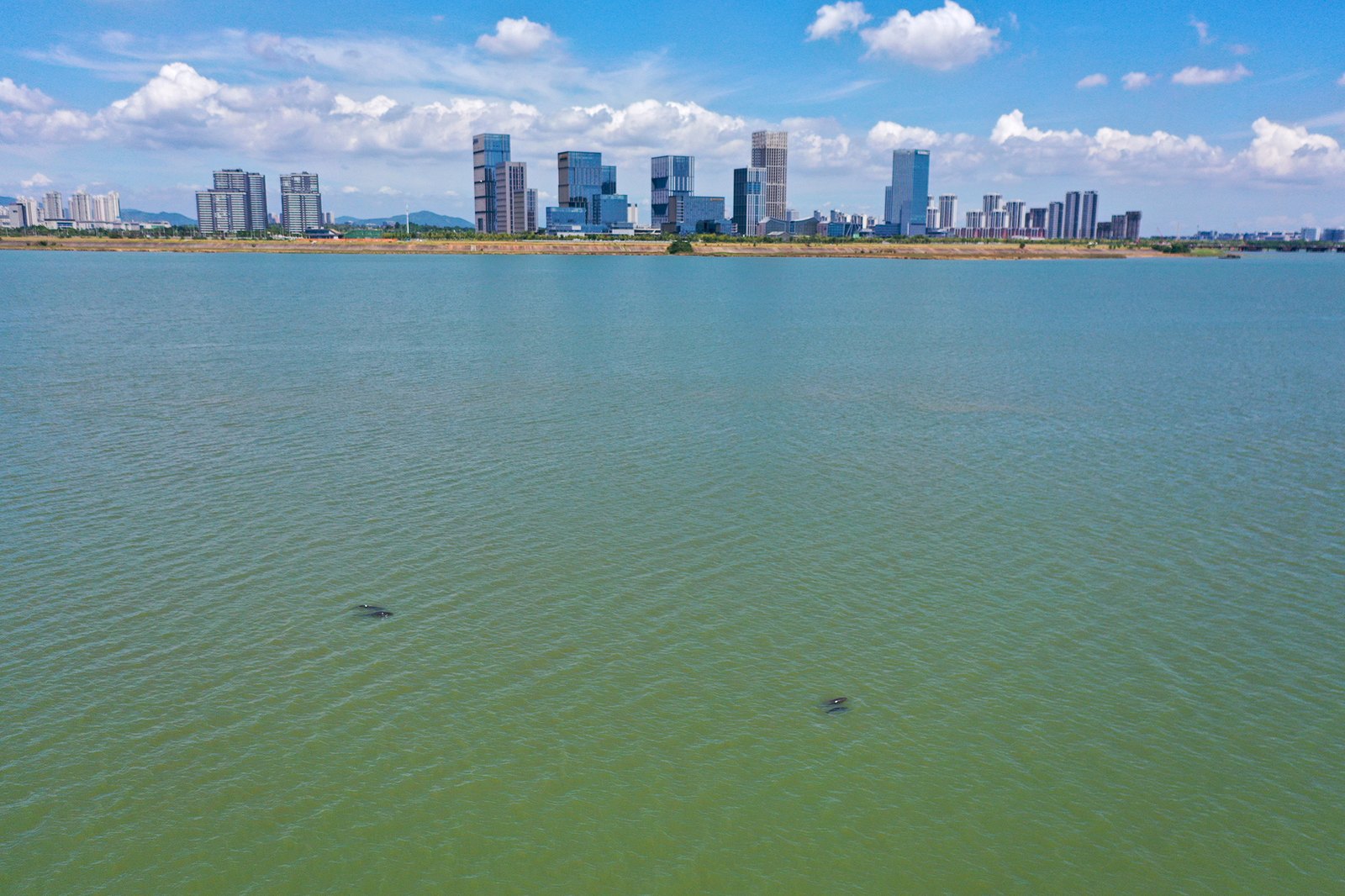
Two of them on the Gan at Nanchang, towers along the far bank — the entire point of this story in one frame: an animal absent for forty years, surfacing in sight of a provincial capital. Two caveats, because they matter. This is a drone frame shot from around 34 metres up, which is emphatically not what we are suggesting you do — see the watching rules below, where keeping drones out of the habitat is rule four. And it is not the Yangzizhou viewpoint: the file's own GPS puts it on the river some kilometres away. From the bank, where this guide sends you, the animals are far smaller than this. The frame further down is the honest version.
The village that stopped fishing
Yangzizhou is a river island of about 18 square kilometres in Donghu District, wrapped by the north and south branches of the Gan and reached by bridge rather than metro. Near its northern edge is Fishery Village (渔业村), which has done exactly what its name says for more than 350 years — official accounts trace its boats back to the early Qing.
In 2020 that ended. Over 600 fishers came ashore; by that September some 140 fishing boats and the village's entire stock of gear had been bought back and withdrawn. Whatever the compensation ledger said, three and a half centuries of household economy stopped inside a year.
What happened next makes this a story rather than a policy summary. An ecological patrol was formed, drawn mainly from the men who had just lost their livelihood, and they now spend their days on the same river stopping other people fishing it — Guo Xigen (郭细根), in his late sixties and once one of the village's best fishermen, among them. Three enforcement patrol boats work the reach alongside them. In September 2021 it was formalised as the Yangzizhou Finless Porpoise Protection Association. And at one restocking here, close to ten million young black, silver and bighead carp went into the water to keep the food supply up: the men who used to take fish out now, in a manner of speaking, put them back.
Going to look for them
Set expectations first, because this is where travel writing usually starts lying. These are wild animals in a working river and there is no guarantee you will see one. No show, no feeding, no boat out to them, no ticket that buys a sighting — just a stretch of bank where they are resident, and reasonable odds if you turn up at the right hour and stand still.
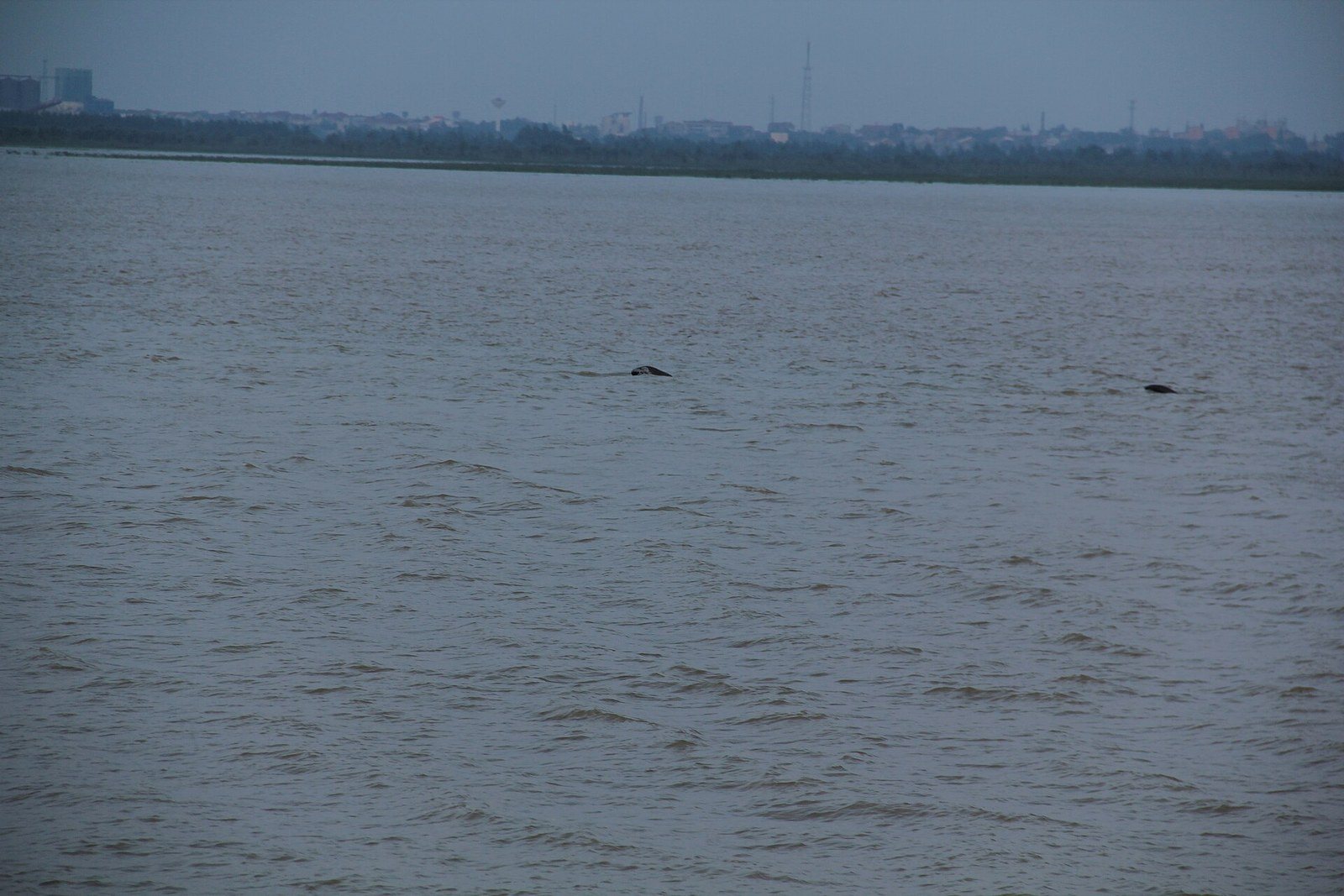
And this is what a real sighting looks like: two dark curves on flat grey water, several hundred metres out, gone inside a second, with a town smudged along the far bank. This particular frame is Dongting Lake in Hunan rather than the Gan, but the Yangzizhou version is the same picture — which is why the kit that matters here is binoculars and a spare hour, not a long lens and ten minutes. Photo: Huangdan2060 / CC BY 3.0 via Wikimedia Commons
Where they actually are
The reliable stretch is the bend of the Gan's north branch by Fishery Village, Yangzizhou, in Donghu District — roughly two kilometres of river holding a channel about 200 metres wide, near a spot local sources call Huilongbai (汇龙摆). Locally and in Chinese media it is "Jiangtun Wan" (江豚湾), Porpoise Bay.
Be clear on what that name is and is not. It is a popular coinage picked up by official bodies — the Supreme People's Procuratorate has published on the area under it, as has the Donghu District government — but Chinese sources consistently write it in quotation marks. It is not a gazetted national nature reserve and not a formal place name. Legal protection comes from elsewhere: the fishing ban, Nanchang's designated no-fishing zones, and a municipal notice on porpoise habitat prohibiting capturing, killing or harming the animals, angling in their waters, damaging or littering the habitat, and trading in porpoises or their parts. Enforcement is real — district officials run night patrols, and in 2024, after footage emerged of men using anchor hooks in a Nanchang no-fishing area and an injured porpoise was photographed, the local agriculture bureau said the conduct was suspected of being unlawful and opened enquiries.
How many live here depends on who counted and when. The Nanchang fisheries administration put 21 to 31 in these waters in 2021; a dry-season survey in Acta Hydrobiologica Sinica counted around 20 in the Yangzizhou reach in late 2021; recent reporting describes about 15 settled residents. "Somewhere between a dozen and thirty, moving in and out" is the honest answer.
The village has built for visitors in a low-key rural way. As last officially described: an observation area of some 1,300 square metres levelled along the embankment in 2021, 2.6 kilometres of bankside cleared and replanted, parking for around 32 vehicles, and a set of direction signs and porpoise-education panels, plus a station monitoring water quality and picking the animals up acoustically. Facilities are village-grade — no visitor centre, no café, no English signage.
When to go
Time of day is the lever that works, and the guidance comes from the village committee rather than a brochure: the porpoises are active and feeding around 8am, and again from mid-afternoon into early evening, roughly 3pm to 5:30 or 6pm. Midday is the dead zone. Mild spells when the water sits in the low-to-mid twenties Celsius are described locally as the sweet spot.
Season matters less than you would expect. Sightings are reported over the National Day holiday in early October, in May during the breeding-active months (roughly April to September), and through winter — that late-2021 dry-season survey was done in November and December, when low water concentrates fish and porpoises into the deeper channel. Calm, softly lit days beat windy ones: you are looking for a small dark curve against a moving surface, and chop hides it completely. Give it a proper hour, and bring binoculars — the difference between "was that a log?" and a confirmed sighting is about eight times magnification.
Getting there
There is no metro to Yangzizhou, and we could not verify a public bus route that lands you at Fishery Village, so plan on a taxi or DiDi. The island is not far in a straight line — it sits between the two halves of Nanchang, reached over Bayi Bridge, Hero Bridge or the Ganjiang North Bridge — but the last stretch is township and village roads, so budget 30–45 minutes each way from the city centre and let your map app set the real number rather than trusting the distance. Navigate to 扬子洲镇渔业村 or "江豚湾"; showing a driver the Chinese saves a conversation.
Getting out of the car is the part nobody explains. Ask to be dropped at the observation area rather than in the village — there's a small car park, around 32 spaces, put in with it. From there you go up onto the levee and turn to face the water: what's in front of you is the Gan's north branch, a channel roughly 200 metres across, and the animals work the bend along it. If your driver leaves you among the houses instead, head for the river and ask for 江豚湾, or for the 护渔队 — the patrol — who are on this water most days and will point you at the right stretch of bank. There's no gate and no ticket office to look for, so don't waste time hunting for an entrance.
The one thing worth planning is getting back. This is a farming village on a river island, not a taxi rank: arrange a return with your driver, or budget time for a ride-hailing app to find you. Expect no English, and have mobile payment set up. It pairs well with the river itself — spend an evening on the two banks and the riverfront light show, then come out next morning to see what lives in the same water.
How to watch without wrecking it
- Watch from the bank. Do not hire a boat to get closer — engine noise interferes directly with how these animals hunt and communicate.
- Do not chase, feed or bait them. Feeding wild cetaceans changes their behaviour and draws them towards boats and hooks.
- No fishing, at all. Angling is prohibited in the porpoise habitat waters, patrols enforce it, and hooks are a documented way these animals get hurt.
- Keep drones out of it without specific permission — low passes over wildlife are harassment, and this airspace is monitored.
- Keep the noise down, take your rubbish home, and do what the boards and patrollers say. If a volunteer asks you to move back, move back: they gave up their boats for this.
Don't go to the wrong Porpoise Bay
This trips people up, so check before you book. At least three places in Jiangxi are called "Jiangtun Wan".
- Nanchang's — the free, undeveloped riverbank at Yangzizhou described above, reachable in well under an hour from the city centre.
- China · Jiangtun Wan (中国·江豚湾), Hukou County (湖口县), Jiujiang — a ticketed aquatic-life and science base near where Poyang Lake meets the Yangtze, built around a comprehensive freshwater fish museum. Museum-based, paid, and roughly 165 kilometres from Nanchang: a completely different day out. Check current tickets and hours before travelling.
- Yugan County (余干县), Shangrao — a stretch of Poyang Lake itself, out at Kangshan, designated porpoise habitat and sold as a coach day trip from Nanchang. Be honest with yourself about which trip you want: local reporting has porpoises massing at Kangshan from March each year, 200-plus of them, described as around half of everything in Poyang Lake. That is an order of magnitude more animals than the dozen-to-thirty at Yangzizhou. If maximising your odds matters more than a free morning close to the city, and you don't mind a long day on a coach, Kangshan in spring is the better bet.
If an operator offers you "porpoise watching", ask which one they mean, and be sceptical of anything promising a guaranteed sighting or putting you in a boat among wild animals. If you would rather someone handled the driver, the timing and the Chinese, that is what our plan-with-us trip service is for.
Practical recap
- Where: the Gan River north branch at Fishery Village (渔业村), Yangzizhou (扬子洲), Donghu District.
- Getting there: no metro, no verified bus; taxi or DiDi over Bayi Bridge / Hero Bridge / Ganjiang North Bridge, 30–45 minutes each way. Ask for the observation area, not just the village. Arrange your return ride.
- Cost: the bank is open and free; no ticket, no official tour. Don't pay anyone for "access".
- How long: an hour of watching plus travel — half a morning, realistically.
- Best timing: around 8am, or roughly 3pm–6pm. Skip midday. Calm beats windy.
- Bring: binoculars, layers, water, patience, mobile payment. No café, no English signage.
- Good for: wildlife and photography people, slow travellers, anyone curious how conservation works on the ground.
- Less good for: tight schedules, small children who can't stand still, anyone who needs a guaranteed sighting.
The city adopted it
Somewhere in the last few years the porpoise stopped being a conservation story in Nanchang and turned into a civic mascot. The city has its own homegrown "smiling angel" character, and on 7 February 2025 it built that character at sixteen metres and seven tonnes, as an inflatable, and floated it off the bank at Qiushui Square on the Honggutan side. Tun Bao (豚宝) — "porpoise baby" — sat in the water in a yellow sun hat and a rubber ring, grinning at the skyline, and people queued along the embankment to photograph it.
It was the first time the city had scaled its own porpoise character up to that size and set it against what residents half-jokingly call Nanchang's sea view — the Gan is wide enough here to earn the joke. The stated aim went past Spring Festival decoration: the display was pitched as a way to get the city looking at its own river and at what lives in it. Tun Bao was announced for Qiushui Square until 12 February, then for a long-term riverside home somewhere on the Gan. We could not confirm where it stands now, so treat the permanent siting as unverified — enjoy it if you come across it, but do not plan an afternoon around finding it.
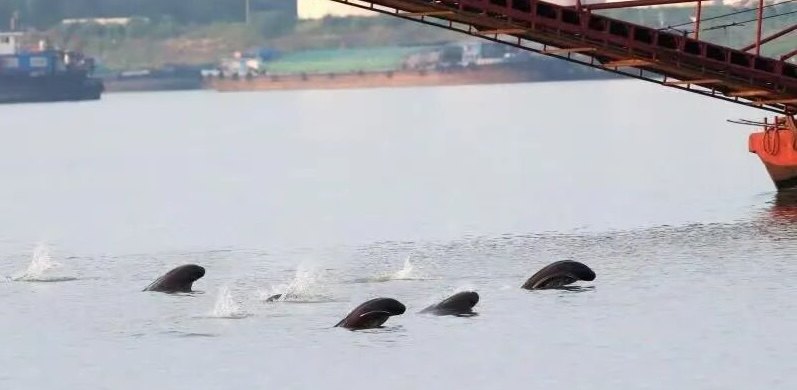
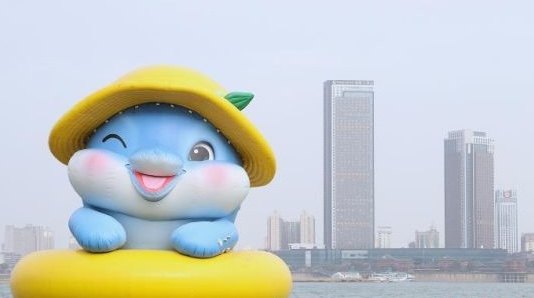
The animal and the icon, both at Nanchang. Porpoises move in small groups, so on the rare occasions you do catch them it tends to be several dark curves at once rather than one. The right-hand frame is Qiushui Square, and it is the clearest evidence of the shift this article is really about — a city that spent decades with its back to the Gan now using what swims in it as a mascot.
A city that got a second chance
What stays with you on that levee is not the animal. It is the arithmetic behind it: a fishing village three and a half centuries old stopped fishing, a country pulled a quarter of a million people off a river system, and within months something gone for four decades came back on its own — because the only thing it had ever needed was for us to stop. Most conservation news arrives as a slower decline. This one arrived as black curves in brown water, watched by a retired fisherman who used to catch things here and now counts them instead.
Nanchang doesn't sell itself on this yet, and the bank at Fishery Village will impress nobody as tourism infrastructure. Go anyway — early, quietly, with binoculars and no expectations. To build the rest of the trip around it, start with our full Nanchang travel guide.
Frequently asked questions
Can you really see wild porpoises in Nanchang? Yes — a small resident group lives in the Gan River at Yangzizhou, Donghu District, and locals see them most days. They are wild, with no feeding and no shows, so nothing is guaranteed. Come around 8am or between roughly 3pm and 6pm, bring binoculars, and give it an hour.
What is a Yangtze finless porpoise? A small freshwater cetacean, about 1.2–1.9 m and 50–70 kg, with no dorsal fin and an upturned mouth line that makes it look like it is smiling — hence "smiling angel". It is Critically Endangered on the IUCN Red List, a National First-Class Protected Wild Animal in China since February 2021, and the last cetacean in the Yangtze after the baiji dolphin was declared functionally extinct following a 2006 survey.
How many Yangtze finless porpoises are left? The 2025 basin-wide survey, announced by the Ministry of Agriculture and Rural Affairs on 30 January 2026, put the population at 1,426 — up from 1,249 in 2022 and 1,012 in 2017, the lowest count on record. The 2022 survey placed 492 in Poyang Lake, roughly 40% of the world total. Check for a newer survey before quoting these.
Why did the porpoises come back to the Gan River? Nanchang closed its Gan and Fu river waters to commercial fishing in 2020, ahead of China's ten-year Yangtze fishing ban that took full effect on 1 January 2021. Fish stocks recovered and the porpoises followed, photographed at Yangzizhou in August 2020 — the first confirmed sighting there in close to 40 years.
Is there a ticket or a tour for porpoise watching in Nanchang? No. The riverbank is open and free, with a village-built observation area, parking and information boards, but no ticket office, no guides and no boats. Anyone selling a guaranteed sighting or a boat trip among the animals is not acting in their interest.
How do I get to Yangzizhou from central Nanchang? No metro, and no bus route we could verify to Fishery Village — take a taxi or DiDi over Bayi Bridge, Hero Bridge or the Ganjiang North Bridge, navigating to 扬子洲镇渔业村 or "江豚湾". Reckon on 30–45 minutes each way, ask to be dropped at the observation area rather than in the village, and arrange your return ride before you set out; cars are not waiting out there.
Is Nanchang's "Jiangtun Wan" the same as the one in Hukou? No, and confusing them will cost you a day. Nanchang's is a free riverbank at Yangzizhou. China · Jiangtun Wan in Hukou County, Jiujiang, is a ticketed museum-based freshwater-fish science base roughly 165 km away. A third stretch, at Kangshan in Yugan County on Poyang Lake, uses the name too — and it holds far more animals, 200-plus from March each year, if sightings matter more to you than convenience.
Before you go
Wildlife keeps no timetable, and neither do rural facilities. Watch quietly, keep your distance, do what the on-site boards and volunteer patrollers say, and treat a sighting as a gift rather than a purchase.
Last verified: 2026-08 — population figures, protection rules, access arrangements and drive times change; please double-check official sources before you travel.
You Might Also Like
- Why Visit Jiangxi? China's Underrated Gem
- Nanchang: Your Gateway to All of Jiangxi
- Nanchang Fireworks: When & Where to Watch
Explore Nanchang & Jiangxi itineraries · Plan a custom trip with us