Nanchang Rice Noodles: Banfen (拌粉) Guide
What banfen is, how to order it (and ask for less chilli), where to find it, and why Nanchang eats rice noodles morning, noon and night.
By Hello Nanchang · Last updated
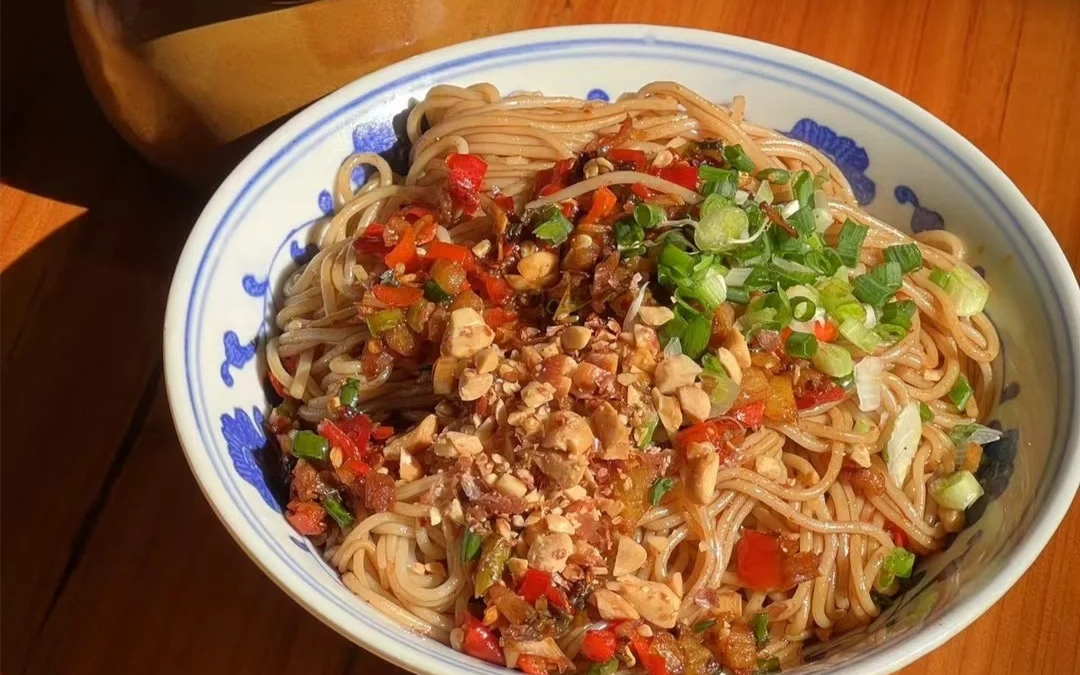
The bowl that starts every Nanchang morning
By seven the little breakfast shops are loud and steamy. Plastic stools full, elbows on shared tables, everyone bent over a bowl of banfen (南昌拌粉) — round rice noodles tossed slick with chilli oil, pickled radish, mustard greens, crushed peanuts and scallion. Gone in about four minutes. Around ¥6. Beside the bowl, almost always, sits a small earthenware pot of soup, lid off, steam curling up. This is not a snack a traveller stumbles into. It is the way an entire province wakes up.
There's a line you'll see all over Jiangxi (江西) writing, and locals mean it literally: 每一个赣人的一天,都是从一碗米粉开始的 — every Jiangxi person's day starts with a bowl of rice noodles. Not toast, not congee, not a bun. Noodles. Cold-tossed, fiery, nutty, gone before the tea's cool enough to drink. Nanchang alone, by one industry estimate, gets through something on the order of 100 tonnes of fresh wet rice noodles a day across its urban districts. That is a lot of mornings.
This is the story of that bowl — where it comes from, why Jiangxi of all places became noodle country, and exactly how to walk into a steamy little shop and order like you've done it your whole life.
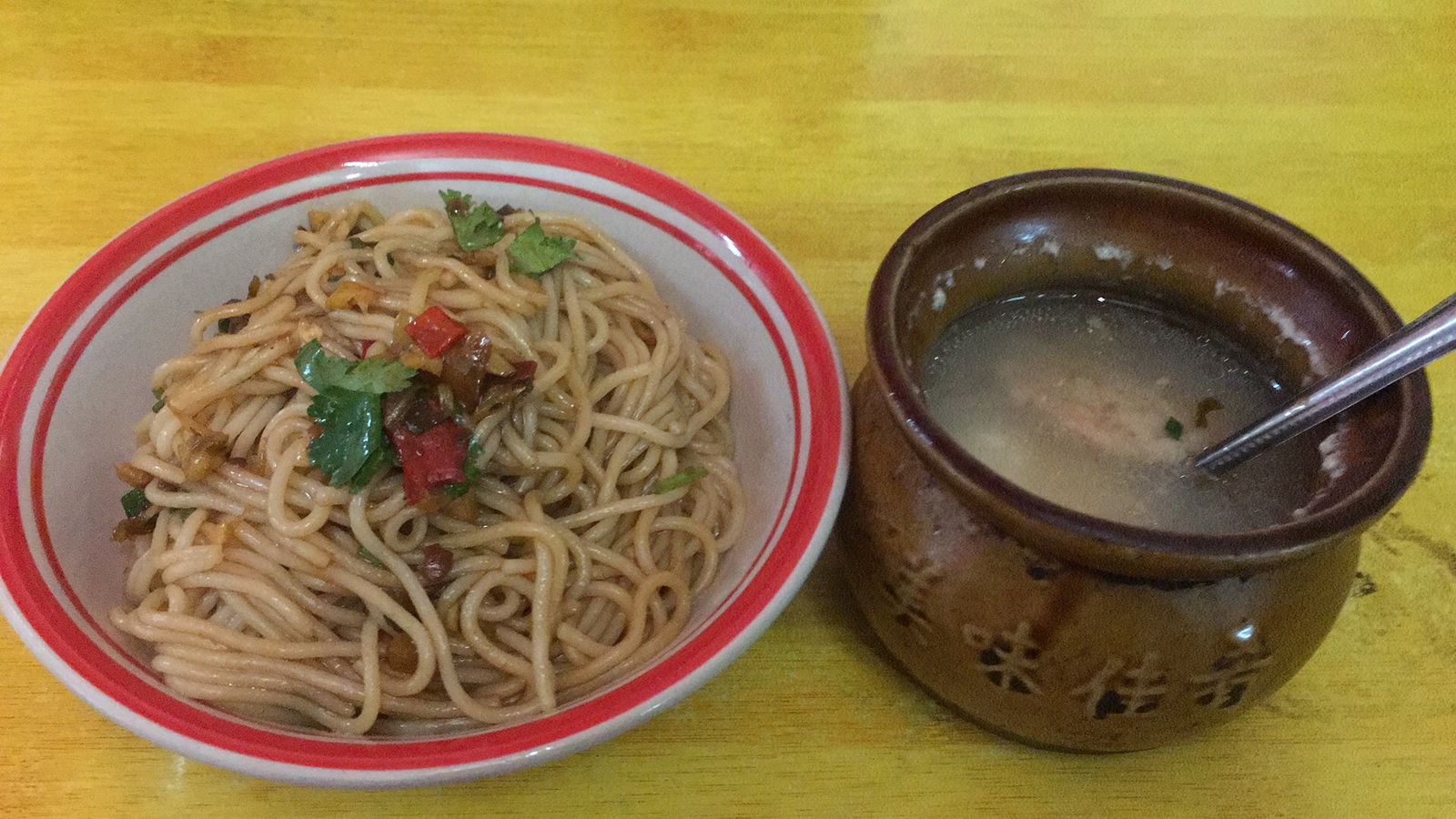 The classic Nanchang breakfast: a bowl of banfen and a clay pot of soup — 一粉一汤, one noodle and one soup. Photo: 吴光耀 / Wikimedia Commons (CC BY-SA 4.0).
Why Jiangxi is noodle country
Start with the map. Jiangxi sits around Poyang Lake (鄱阳湖), China's largest freshwater lake, fed by the Gan River (赣江) and its tributaries. For thousands of years those rivers have laid down silt across a broad, low basin, and the result is exactly the kind of place rice loves: flat fertile plains, a warm damp subtropical climate, a long frost-free growing season, rain when the crop wants it. This is the classic 鱼米之乡 — land of fish and rice. Jiangxi doesn't just grow rice; it grows enough, and cheaply enough, that turning surplus grain into something you can dry, store and sell made obvious sense.
The rice matters as much as the quantity. Jiangxi grows indica rice (籼稻), and the noodles specifically want late-harvest indica (晚籼米) — a hard, oily grain high in amylose (直链淀粉). That chemistry is the whole point: high-amylose rice yields a noodle that won't dissolve into paste when you boil it and stays springy under the tooth. Nanchang cooks describe the good stuff with a three-part boast — 久泡不烂、久炒不碎、韧而不硬: won't fall apart with long soaking, won't break with hard stir-frying, chewy but never hard. A wheat-noodle city could never.
Because rice grows everywhere here and every county had its own grain and its own habit, the noodle splintered into a hundred local dialects. There's a saying: 乡乡有米粉,县县不同味 — every township has rice noodles, every county its own flavour. Each of Jiangxi's eleven prefectures has a signature. Fuzhou (抚州) does beef-offal soaked noodles; Jiujiang (九江) and Pingxiang (萍乡) love their fried noodles; Jingdezhen (景德镇) eats them cold; Xinyu (新余) pickles them; Yichun (宜春) has thick "bundled" noodles; Shangrao (上饶) simmers them with mandarin fish. Nanchang's contribution — the one that travelled furthest and became shorthand for the whole province — is banfen, the cold-tossed bowl.
An old, old habit
How far back does this go? Further than you'd guess. The earliest text usually cited is a late-Eastern-Han work from around 184–189 CE, in which an official of Jiujiang (then part of this region) described 煮米为索 — rice cooked into strands, into cords. Read as a rice noodle, that gives the tradition roughly 1,800 years of documented history, older than the famous agricultural manual Qimin Yaoshu by a couple of centuries. Treat it as the earliest cited record rather than a settled first — the text survives only in fragments and scholars are still reconstructing it — but the age is consistent across sources.
The habit deepened over the dynasties. By the Song, artisans in Chongren county (崇仁, in Fuzhou) were skilled enough that their rice noodles were sent up as tribute, under the name 米缆, "rice cables." Nanchang's cold-tossed breakfast form as we know it took its recognisable shape over the Ming and Qing, and the modern street version — the ¥6-bowl-on-a-plastic-stool era — really became the city's breakfast signature in the 1980s. In 2021 Nanchang hosted the first China Rice Noodle Festival (首届中国米粉节), reportedly the largest expo of its kind in the country, drawing hundreds of thousands of visitors — the city leaning hard into the noodle as its own. None of which you need to know to enjoy the bowl. But it does explain why a local will defend their noodles with the fervour of someone defending a family recipe: it more or less is one, scaled up to a city.
Scholars from Jiangxi press the point harder, arguing the region has one of the strongest claims to being the birthplace of Chinese rice noodles — most of the surviving early records trace back here. Guangxi and Hunan would raise an eyebrow at that, and it isn't settled consensus, so take it as a proud regional case rather than a closed one. What's beyond argument is that Jiangxi eats, exports and lives its rice noodles at a scale few places match: the province turns out well over a million tonnes a year and accounts for more than half of China's rice-noodle exports, with Huichang county (会昌) a major export hub.
How the noodle is actually made
You'll taste the difference between a good bowl and a lazy one, so it helps to know what's happening upstream. Rice noodles begin with rice, not flour. Good Nanchang noodles start from that premium late-harvest indica, which is washed, soaked (浸米), ground to a wet slurry (磨浆), drained, then steamed so the starch gelatinises. From there the shape divides the family in two.
Round noodles (圆粉) — the kind in your banfen — are made by kneading the cooked rice mass into a dense ball and forcing it through a die under pressure. That extrusion is called 榨粉, and it's a craft: too raw and the strand is weak and snaps; too cooked and it won't push through cleanly and clumps. Done right, the noodle comes out dense, smooth, bubble-free and springy. Flat noodles (扁粉 / 切粉) take the other road — the slurry is steamed into thin sheets and sliced into ribbons, which is why they demand a good knife and a steady hand. Old artisanal producers still sun-dry noodles on bamboo sieves in a rhythm called 三蒸三晒 — three steamings, three sunnings — though most of what a city shop serves is fresh wet noodle, blanched to order that morning.
The takeaway for an eater: the round, springy strand is built for tossing and for the wok. It's why banfen holds its shape under a heavy dressing and why fried noodles here don't turn to mush. When a shop's noodles taste gummy or break apart, they've skimped on the rice or the process. The good counters, you'll notice, never do.
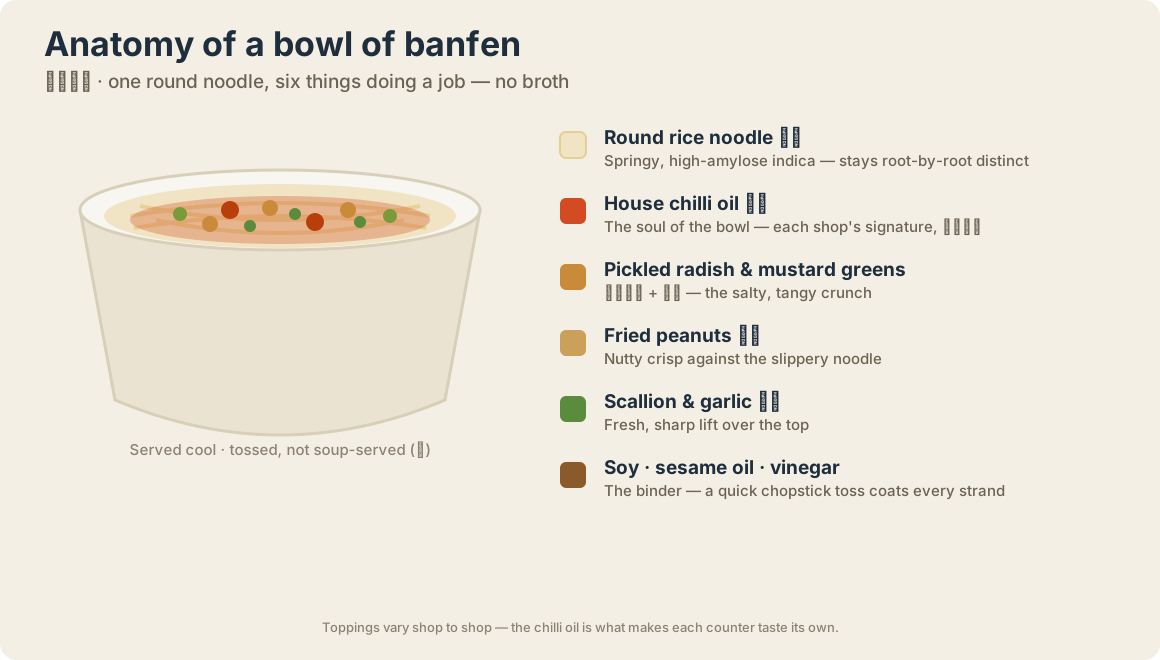 Anatomy of a bowl of banfen: the springy round noodle underneath, then the chilli oil, the pickles, the peanuts, the scallion — each doing a job.
Anatomy of the bowl: banfen, chaofen, tangfen
The same round noodle shows up three ways on a Nanchang menu, and knowing which is which is half of ordering well. Think of them as dry, fried and wet.
Banfen (拌粉) — the cold-tossed one, start here
Banfen is the icon. The noodles are boiled to order, then — crucially — rinsed in cold water (过冷河) to wash off surface starch and firm them up, drained, and tossed (拌, not soup-served) with the dressing. No broth. What you get is a bowl where every strand stays root-by-root distinct (根根分明), slippery and springy at once. The flavour is fresh-hot-savoury: the first bite is a bloom of chilli aroma, then the salty crunch of pickled radish, then the nutty crisp of peanuts, all bound by soy and sesame oil.
The soul of the bowl is the chilli. Each shop makes its own — dried or fresh chillies (often 朝天椒) ground to a powder or paste, then woken up with hot oil poured over the top, so it's red, bright and, as locals put it, 辣而不燥, spicy but not harsh. That house chilli is a shop's signature; two counters on the same lane will taste noticeably different because of it. Around it go the supporting cast: pickled dried radish (咸萝卜干), pickled mustard greens or "snow vegetable" (雪里蕻/雪菜), fried peanuts, chopped scallion, minced garlic, plus soy, sesame oil, salt, pepper and a little vinegar. It comes together fast — sauce, pickles, peanuts, a quick chopstick toss, under three minutes, every strand coated. And yes: it's served cool, closer to a warm salad than a hot noodle. That's authentic, not a mistake.
Chaofen (炒粉) — the wok-fried one, heavier and smoky
Chaofen is banfen's louder cousin. Same noodle, but par-boiled to about eighty per cent, rinsed, then thrown into a screaming-hot, well-seasoned old wok over open flame — cold-oil sear first, then fierce tossing. It comes out visibly oil-glossed (色泽油亮), noticeably shinier than fried noodles elsewhere, yet the good version is 油而不腻, oily but not greasy. The prize is 锅气 (wok-hei) — that faint scorched, smoky "breath of the wok" you only get from an aged wok, a big ladle, ferocious fire and a cook who knows the rhythm. The taste is salty-savoury, spicy and bright, carrying both rice fragrance and that smoke; the noodles still stay distinct and don't break (久炒不碎).
Chaofen is where you pick a topping. Common versions: pork (猪肉炒粉), egg (鸡蛋炒粉), beansprout (豆芽炒粉), three-fresh (三鲜), pig-intestine (肥肠炒粉) for the adventurous, and the crowd favourite beef fried noodles (牛肉炒粉) — shredded beef stir-fried loose with red chilli, garlic and ginger, then soy and a splash of stock, then the noodles tossed until the liquid fries off. It's heavier than banfen and just as often a late-night (宵夜) plate as a breakfast one.
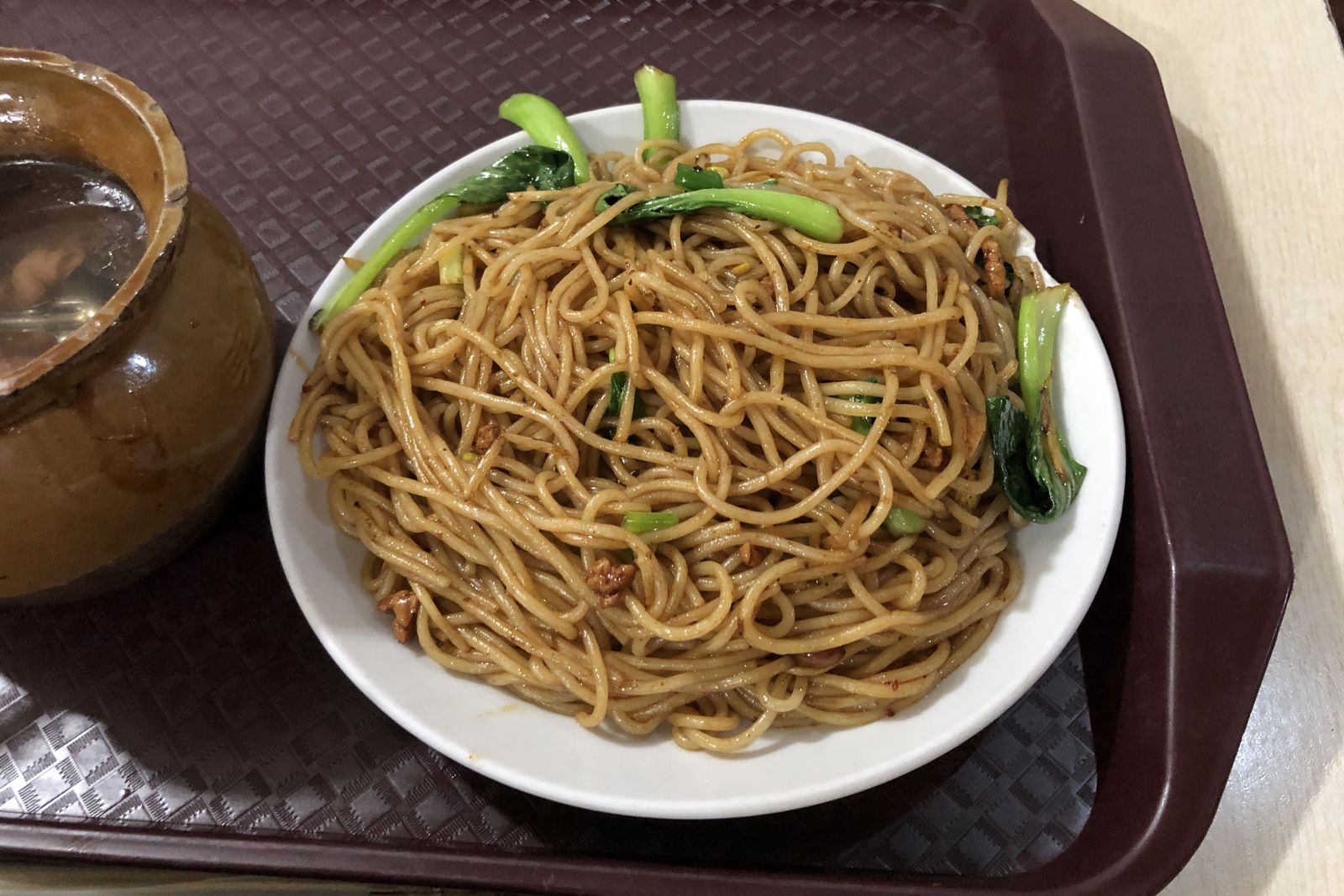 Chaofen: the same round noodle wok-fried until oil-bright and smoky with 锅气, here plated with its clay-pot soup. Photo: N509FZ / Wikimedia Commons (CC BY-SA 4.0).
Tangfen (汤粉) — the soup one, gentle and warming
Tangfen is the wet version, and the trick is what looks like a fussy step: the noodles are boiled separately first, then dropped into the broth. Skip that and the surface starch clouds the soup, dulls the flavour and — as cooks warn — makes it "taste like rice paste" (像喝米糊). Done properly you get a clear stock or a beef broth (清汤 or 牛肉汤), the springy noodle inside, usually a poached or fried egg, some greens, and light seasoning. This is the mildest of the three, the one to reach for on a cold morning or when the chilli of the day before is still with you.
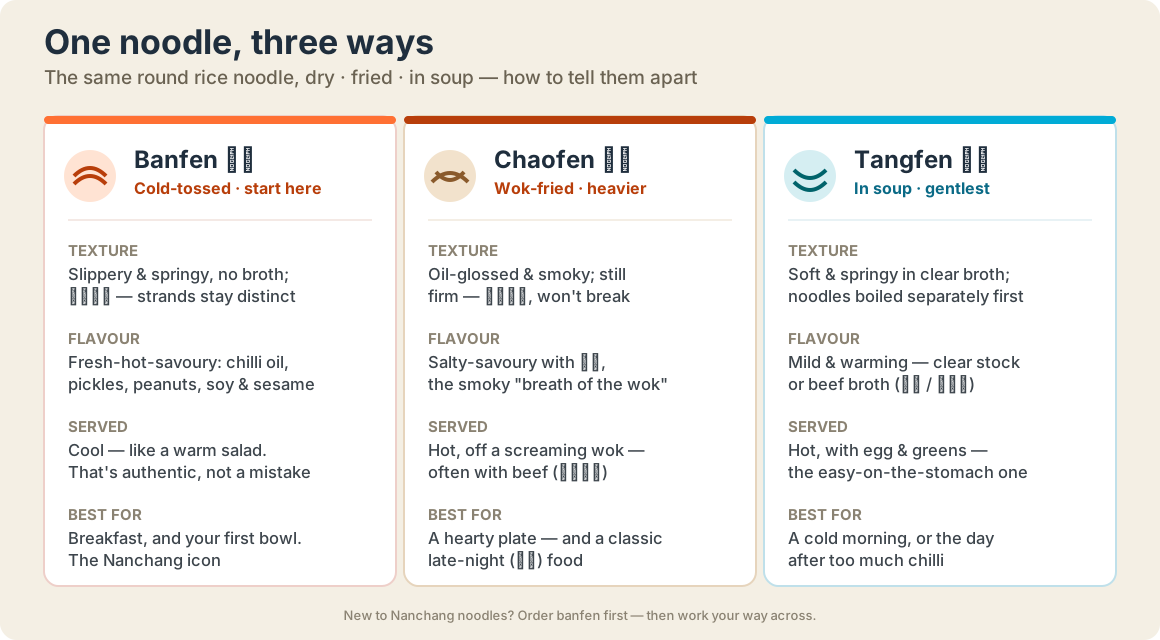 One noodle, three lives: banfen (dry, tossed, fiery), chaofen (fried, smoky, hearty), tangfen (soupy, gentle). Start with banfen.
The other half of breakfast: the clay-pot soup
A bowl of banfen almost never travels alone. Its lifelong partner is waguantang (瓦罐汤) — clay-pot or crock soup — and locals treat the two as an inseparable pair: 一粉一汤, one noodle and one soup. The fiery, dry noodles and the hot, restorative broth balance each other exactly. Order one without the other and the shop owner may look at you like you've asked for a sandwich with no bread.
Waguantang is a genuinely different cooking method, and worth understanding because it's why the soup tastes the way it does. Small sealed earthenware pots are packed inside a giant ceramic urn — often about a metre across — and heated not by direct flame under each pot but by radiant heat, all six sides at a steady temperature, from a bed of hard charcoal. Charcoal specifically, because coal smoke would taint the broth. The pots simmer long without boiling (久煨不沸): a typical schedule runs hot for the first few hours, then gentler, seven-plus hours total, some shops rotating pots overnight for up to twelve. Over that slow soak the ingredients surrender everything — collagen, marrow, sweetness — into a thick, deeply savoury broth you couldn't fake in twenty minutes on a stove. Nanchang's crock-soup technique is recognised intangible cultural heritage, listed at the city level in 2014 and the provincial level in 2017. Folk lore dates it back around a thousand years to the Song, though take the exact age as tradition rather than hard record.
The menu is organised by base. The most homely and common is 肉饼汤 — a pounded pork patty at the bottom of the pot whose natural gelatin makes the broth glossy and rich, often with an egg cracked in (鸡蛋肉饼汤). Beyond that: chicken (鸡汤), duck (鸭汤), rib (排骨汤, classically with lotus root, 排骨莲藕汤), offal (猪杂汤), and tonic pots (滋补) built on tea-tree mushroom (茶树菇), red dates, longan, lotus seed, cuttlefish and the like. Most shops offer only four or five kinds on a given day. Pick the pork-cake-and-egg if you can't decide; it's the one everyone grew up on.
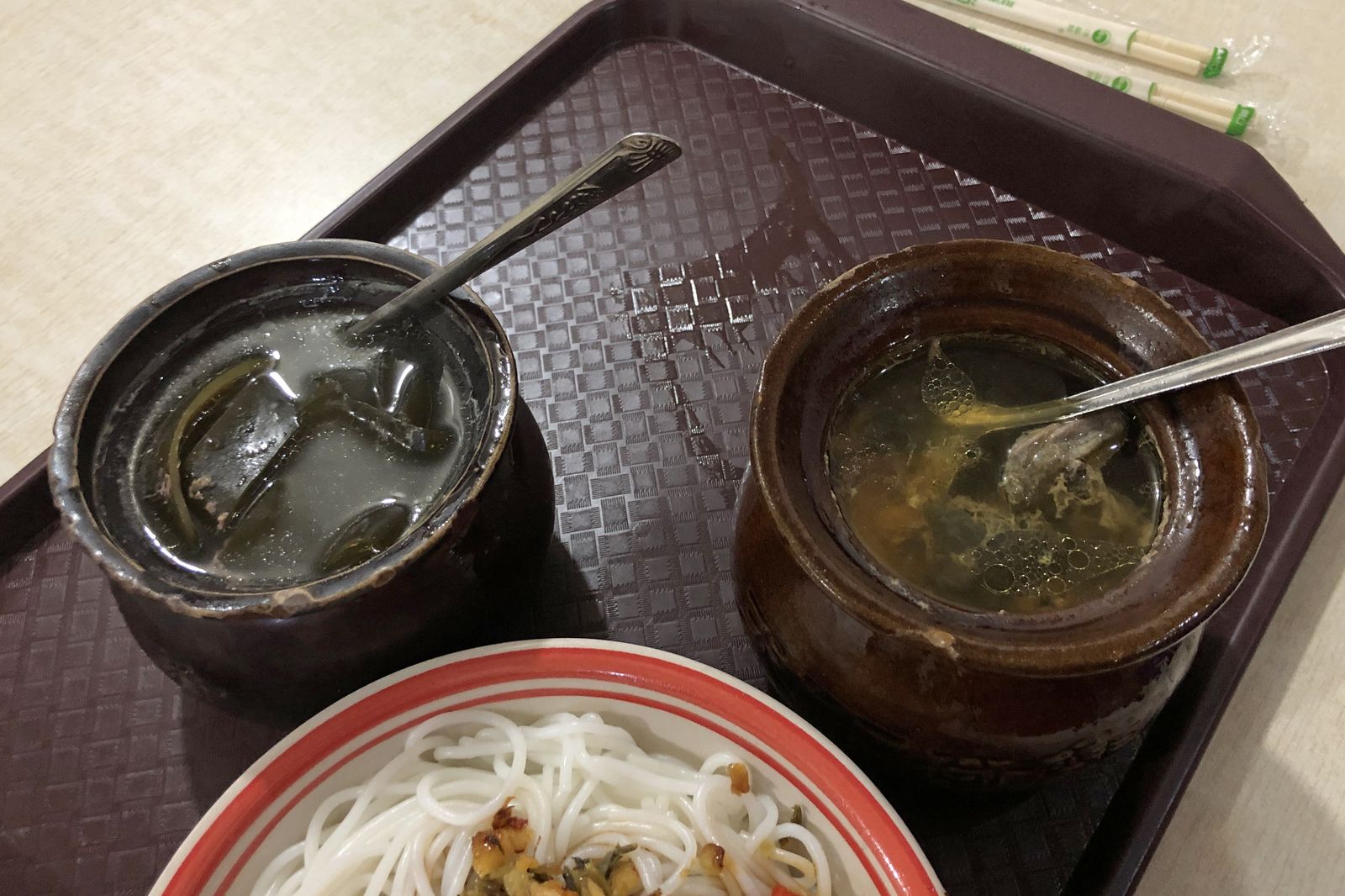 Waguantang in its earthenware crocks — each little pot slow-simmered for hours in a charcoal-heated urn, never quite boiling. Photo: N509FZ / Wikimedia Commons (CC BY-SA 4.0).
How to order like a local
Here's the whole ritual, start to finish, so you can walk in cold and get it right.
- The default order is literally "one bowl of banfen, one pot of soup" — 一碗拌粉,一罐汤. That combo is the move; the soup isn't an upsell, it's the other half of the meal.
- Spice. The standard is 正常辣 (normal spicy), and Nanchang's "normal" is real heat. Because the chilli goes on at the end by the spoonful, dialling it down genuinely works: say 少辣 (shǎo là) for less, 不要辣 or 不辣 for none. First-timers who don't love chilli should open with 少辣 and adjust up — it's easy to add, impossible to remove.
- Pick your style. 拌粉 (cold-tossed, the starter), 炒粉 (wok-fried, heavier — often 牛肉炒粉), 汤粉 (in broth, the gentlest). If you want your banfen warm rather than cool, tell them up front — it's not the default.
- Add-ons. An egg (加蛋) for a few yuan is common; not every tiny counter does tea eggs, so just ask. Adding a soup pot, again, is the standard local second half, not a splurge.
- Pay. Mobile QR (WeChat Pay / Alipay) is near-universal even at the smallest stall. Set up both before you travel, and carry a little cash in small notes as backup — some tiny stalls use a personal QR that can decline foreign-linked cards, and a vendor may not have change for a big bill.
One small local habit worth stealing: when the noodles are gone but there's good chilli oil pooled in the bottom of the bowl, some regulars ask for a little extra plain noodle to soak up the rest. It's not a rule, just the sign of someone who knows what the sauce is worth.
Where to eat it — and roughly what it costs
The honest best advice is the simplest: eat where locals queue. A counter with a morning line of people in work clothes is telling you more than any list can. That said, a few names are well enough attested to point you at, and two neighbourhoods are thick with the real thing.
The old-town lanes. The streets around Shengjin Tower (绳金塔) are dense with soup-and-noodle shops running a huge range of crock soups — egg-and-pork-cake, rib-and-lotus-root, pigeon, aged duck. It's one of the roots of Nanchang eating, and an easy hop on the metro: take Line 3 or Line 4 to Shengjinta (绳金塔) station — they interchange there — and the food street is a short walk out. The Wanshou Palace (万寿宫) block has its own cluster of small-eats counters — banfen, lotus-root dishes, offal soup (心肺汤) — cheap and atmospheric, and handy if you're already touring Bayi Square or Tengwang Pavilion; it's a few minutes' walk from Wanshougong (万寿宫) station on Line 1. Fair warning: Wanshou Palace is a restored, partly touristy block, so some stalls there skew tourist-facing; the plainer neighbourhood counters a street back are often better value. For fried noodles after dark, the city's night-market food streets are where chaofen and its wok-breath belong.
A few attested names. Near the railway station on Zhanqian West Road (站前西路), Long Lao Wu (龙老五汤店) has been ladling crock soup since 1989 and is a classic old-brand pick — a full range of waguantang plus spicy, oily banfen, with an egg-and-pork-cake pot around ¥7 and a full meal easily under ¥30. On Shitou Street (石头街) in the west of the city, Qin Pangzi (秦胖子) is a long-running, roughly quarter-century-old breakfast counter, mild and old-Nanchang in style, known for its 肉坨 (a pork lump, around ¥5, about ¥8.5 with noodles). Both are the "old counter" authenticity picks — expect an exact street rather than a precise door number, and check they're still open (and confirm the address on Amap or Dianping) before making a special trip.
If you'd rather a reliable chain, two Nanchang-born brands have grown large and are consistent and traveller-friendly: Zhou Zhenzhen (周真真南昌拌粉·瓦罐汤), founded 2015 and named to the Dianping 必吃榜 (Must-Eat List) for three years running (2019–2021), with roughly 300 stores including franchises overseas (greater Los Angeles, Milan, Singapore); it serves banfen from about ¥5 (beef banfen around ¥12) in enamel bowls. The other, Wanfangyuan (万方圆), is a large Nanchang chain with a flagship near Tengwang Pavilion on Rongmen Road (榕门路), doing a full spread of banfen and crock soups at reasonable prices (per person around ¥26). Chains are the safe bet for reliability and an easier menu; the old counters are where the soul is.
Rough prices, so you can spot a fair one. At a plain neighbourhood shop, banfen runs about ¥3–6 (a little more with beef or a big topping, up to ¥8–12), a crock soup about ¥5–10 a pot, and a plate of chaofen roughly ¥8–15. The classic 素拌粉-plus-one-soup breakfast comes in around ¥9–12 at a local counter. Tourist-area and out-of-town chain prices run higher — a ¥6 banfen and a ¥10 soup isn't unusual there, which locals quietly consider inflated. Prices drift with the year and the neighbourhood, so treat these as a range, not a promise.
When to go, and a warning or two
Banfen is above all a breakfast, and it's best between about 6 and 9 in the morning, when shops crank open at dawn and make each bowl to order. Many dedicated breakfast and soup shops wind down or run low by early afternoon — the freshest noodles and best broths go early — so don't roll up at 3pm expecting the full menu. But it isn't only breakfast: banfen, and especially chaofen, is also a beloved late-night (宵夜) food, so a fried-noodle plate at a night stall is entirely in keeping.
Two honest heads-ups for first-timers. First, the heat is real — the dish is built on chilli paste and pickled chilli, and a local "normal spicy" can genuinely surprise a visitor. If you're unsure, 少辣 is your friend. Second, banfen is meant to be served cool, not steaming; that's the authentic default, not a kitchen slip. Go in expecting a springy, room-temperature, chilli-bright bowl and you'll get exactly the thing generations of Nanchang people get up for.
Do that — a bowl of banfen, a pot of crock soup, a plastic stool, elbows on the table by seven — and you're not observing the city. You're in it. When you've got the breakfast down, the rest of Nanchang's kitchen is waiting: browse more of the city's dishes and food streets over on Eat & Play, or if you'd like a local to line up your mornings, markets and day trips for you, that's what Plan With Us is for.
FAQ
What is Nanchang banfen?
Banfen (南昌拌粉) is Nanchang's signature breakfast: round rice noodles boiled and rinsed, then cold-tossed (not soup-served) with house-made chilli oil, soy, sesame oil, pickled radish, pickled mustard greens, fried peanuts and scallion. It's savoury, tangy, nutty and hot, served cool, and usually eaten with a clay-pot soup on the side.
What's the difference between banfen, chaofen and tangfen?
They're the same round rice noodle three ways. Banfen (拌粉) is cold-tossed and dry with chilli and pickles — start here. Chaofen (炒粉) is wok-fried, heavier and smoky, often with beef (牛肉炒粉). Tangfen (汤粉) is served in a clear or beef broth and is the mildest of the three.
How do I order it less spicy?
Say 少辣 (shǎo là) for less chilli or 不要辣 / 不辣 for none. Because the chilli is added by the spoonful at the end, the request is genuinely honoured. The default is 正常辣 (normal spicy), and Nanchang's normal is real heat, so first-timers should start mild and add.
How much does a bowl of rice noodles cost in Nanchang?
At a local neighbourhood shop, banfen is roughly ¥3–6 (up to ¥8–12 with beef), a clay-pot soup about ¥5–10, and fried noodles around ¥8–15 a plate. A classic noodle-plus-soup breakfast comes in around ¥9–12. Tourist-area and chain prices run higher. Treat all figures as ranges, not fixed.
What is the soup that comes with it?
Waguantang (瓦罐汤), a clay-pot or crock soup slow-simmered for seven hours or more in a charcoal-heated ceramic urn. Common kinds are egg-and-pork-cake (鸡蛋肉饼汤), chicken, rib-and-lotus-root and tea-tree mushroom. Banfen and a pot of waguantang — 一粉一汤 — is the classic Nanchang breakfast pairing.
Last verified: 2026-07 — prices, shop names and opening hours change; treat figures as ranges and confirm current details before a special trip. Some historical claims (rice-noodle origins, the Song-dynasty age of crock soup) reflect regional tradition and scholarship rather than settled consensus.