Nanchang Night Markets: Best Food Streets
Where Nanchang really eats after dark: Toad Street, the giant student market and the lantern-lit blocks — what to order, and how to get home.
By Hello Nanchang · Last updated
Wazijiao Old Street, Xihu District, Nanchang · Daily 17:00–23:00 (Weekends until 24:00) · 30–60 RMB (Approx. $4–$8 USD) per person
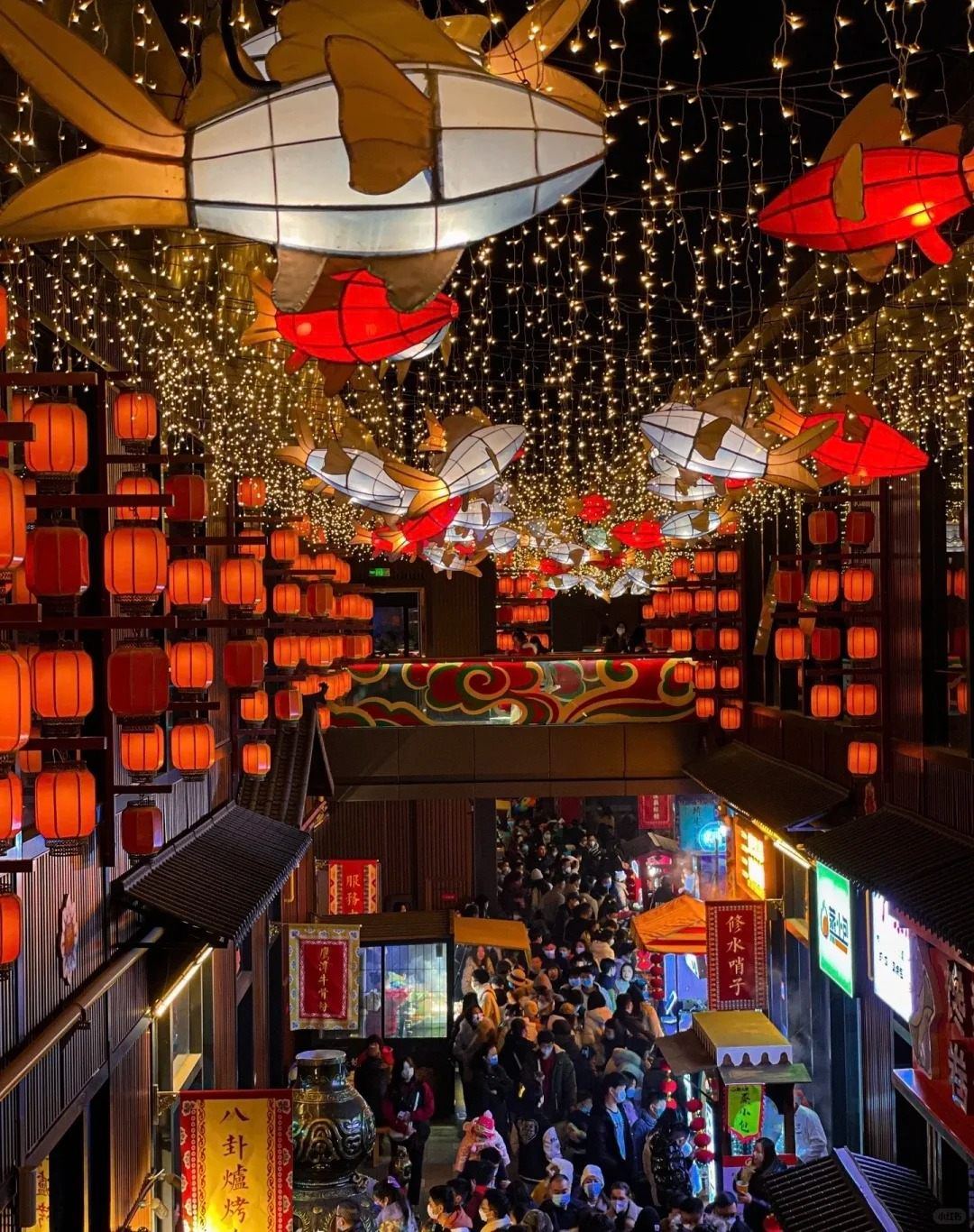
The city's real dinner table
Nanchang eats late, and it eats outside. Long after the restaurants have finished their main service, the city's night markets are only hitting their stride: plastic stools spilling across the pavement, woks roaring over portable burners, the smell of grilled skewers and stir-fried river snails, and crowds that don't thin out until well past midnight. The food is cheap, the chilli is serious, and the atmosphere is half the meal. If you do one thing after dark in Nanchang, make it this.
The honest positioning: Nanchang won't out-glamour Chengdu or Xi'an on anyone's street-food list, and there's no single engineered mega-lane with a queue built for the cameras. What it has instead is five distinct night markets, still mostly full of locals, at prices nobody has rewritten for visitors. Most plates land between ¥5 and ¥30, and two people can eat themselves stupid for ¥60–100. If Tengwang Pavilion is the city's postcard, this is its dinner table.
Plan a little, though. The five are scattered across the city, they peak at different hours, and — the detail that catches almost everyone out — the metro stops running before the stools do.
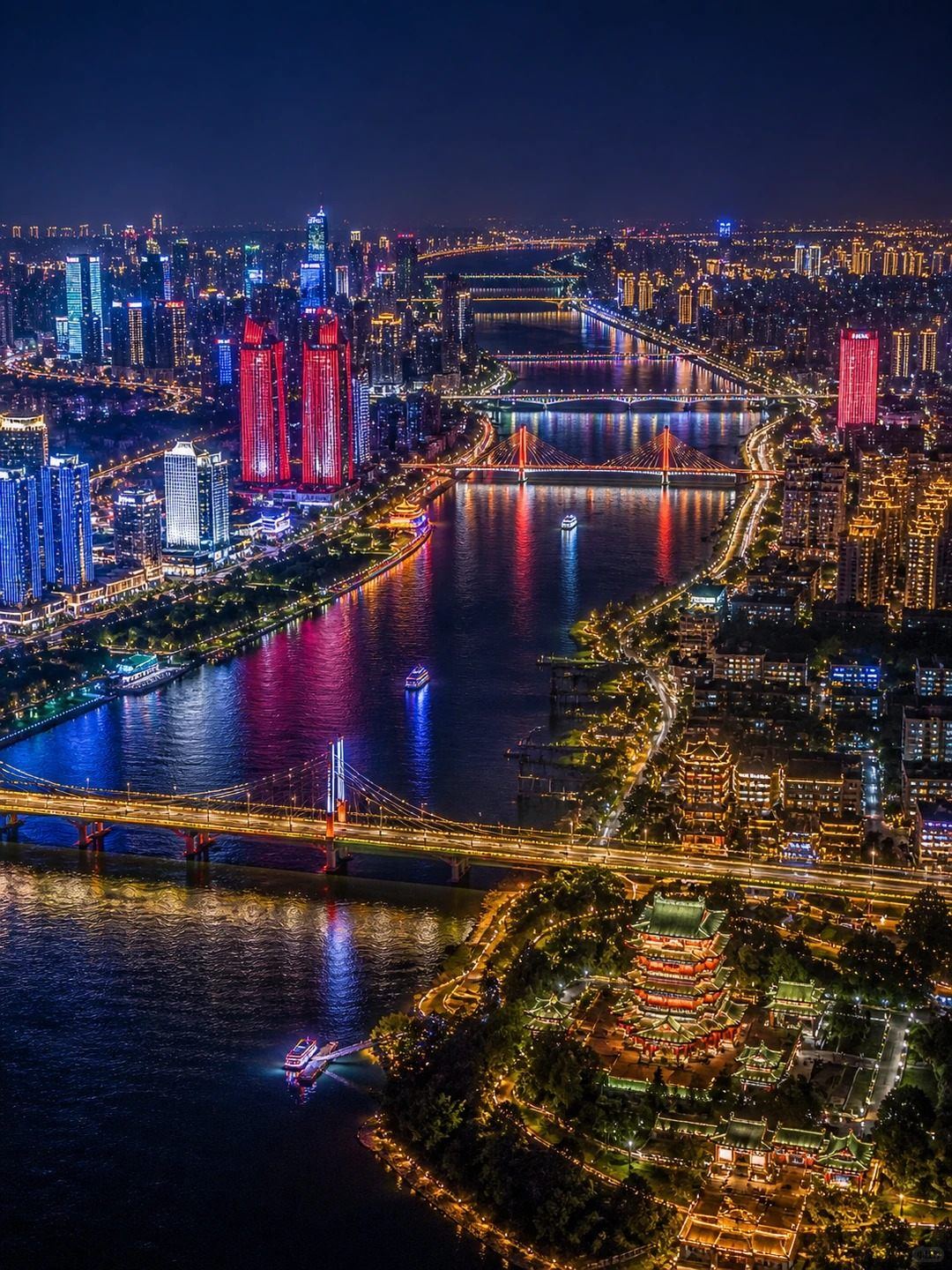
Nanchang after dark from above — lit bridges over the Gan, the Honggutan towers on the far bank, Tengwang Pavilion glowing bottom right. Somewhere in that grid: several thousand plastic stools.
Here are the food streets worth your appetite, from the old-town classic to the sprawling modern giant.
A two-and-a-half-hour old-town night crawl
Three of the five sit within about two kilometres of each other, and one nearly straight line strings them together — a lane, a pedestrian street, an old crossroads, a lantern-lit block, and a metro station underneath the last stop. Start at 18:30 and you get lanterns with some blue still left in the sky. Whatever you do, don't start this direction later than about seven: Wanshou Palace is the last stop and its shops and stalls wind up around 21:00. Leaving your hotel at nine? Run the route backwards — see below.
- 18:30 — Yangming Park (阳明公园) station, Line 2. This is the closest metro stop to Hama Jie. One warning that catches people out: the in-station signs point to Yuzhang Road (豫章路), which is not the same street as Yuzhang Houjie (豫章后街), the one the market is actually on. Drop 豫章后街 into your map app before you surface and follow that, not the signage. The lane announces itself by smell long before it does by sign.
- 18:40 — eat Hama Jie first, while the woks are fresh. Work along the strip rather than committing to the first stall: a plate of stir-fried river snails, a beef fried noodle, three or four skewers, split between you. Small orders at three stalls beat a big order at one.
- 19:10 — the photograph. Stand at one end of the lane and shoot straight down it, low, with the strung bulbs and the smoke catching the light. It photographs better than it looks in person, which is the opposite of most restored streets.
- 19:20 — walk south down Shengli Road (胜利路步行街). Hama Jie's western end runs into Nanchang's pedestrian shopping street; follow it south, traffic-free for its whole 960 metres, ten to fifteen minutes, until it meets Zhongshan Road (中山路).
- 19:45 — Wazijiao (瓦子角). The Zhongshan Road junction with Xiangshan North Road is the old commercial crossroads locals still call Wazijiao, and Bayi Guan (八一馆) station — where Lines 1 and 3 cross — sits directly underneath it. There's no market here, but there is a story and a grid of snacking lanes off it: see the section below.
- 20:00 — finish at Wanshou Palace (万寿宫), while the shops are still open. Turn west along Zhongshan Road, about ten minutes, and the grey-tiled lanes and red lanterns start. You have a full hour before the counters start shutting, so graze rather than sit; then Wanshougong station on Line 1 is directly underneath you.
Run it backwards if you're starting late, or if you'd rather finish loud than pretty: Wanshou Palace first while it's still trading, then Wazijiao, then Hama Jie — whose woks run to around three in the morning — and a DiDi home from there. Either way, budget about ninety minutes of walking and grazing, plus the hour you will want at the far end — call it two and a half hours, or three if you sit down anywhere.
Hama Jie (蛤蟆街) — the original
Start where Nanchang's night-market habit started. Hama Jie — literally "Toad Street," and the name is not a metaphor: from the 1960s onwards the residents here sold live toads off the pavement, and the red-braised toad the lane became known for stuck to it as a nickname — is the city's oldest and most down-to-earth night market. It's a 330-metre strip in the downtown Donghu district, officially Yuzhang Houjie (豫章后街), running west from Xiangshan North Road to Shengli Road, a short walk from Tengwang Pavilion. For decades this was simply the place Nanchang came to eat at night — the local press calls it the city's "late-night canteen" — and a rebuild of the whole lane tidied it up without killing the grit.
What to order: the legendary stir-fried river snails (炒螺蛳) — sucked straight from the shell, slippery, spicy and weirdly addictive — plus beef fried noodles (牛肉炒粉), skewers from a dozen BBQ stalls, crayfish in season, and the whole banfen-and-clay-pot-soup repertoire. The relaunch counted 41 traders in the lane, most things ¥5–30. Come hungry and a little adventurous.
Local food listings keep naming the same handful of pitches — 豫章猪手王 for braised pig trotters, 峡江佬 for skewers, 英嫂水煮 for the chilli-oil boiled tray, 蛤蟆湾粥铺 for congee. Treat those as a hint, not a booking: stalls on a street like this come and go, and the oldest signal is still the best one — join whichever queue is longest and full of people who clearly live here.
If you want a table and a proper wok dinner before the stalls take over, there are sit-down Jiangxi xiaochao places on and around the street — Dapinghuo (打平伙·鲜辣小炒, Hama Jie branch, in the Yuzhang food-court building — search “打平伙 蛤蟆街” rather than an address, since three streets here share the Yuzhang name) is the best-known, and listings put it at ¥67–80 a head for bullfrog, braised chicken feet and Jinggangshan smoked bamboo shoot. Eat there first, then graze; not the other way round.
Best window: the pitches light up from about 17:00 and the last woks go out around three in the morning, with the crowd at its thickest from 20:00 to midnight. Come at six and you'll eat faster with more elbow room; come at ten and you'll get the noise. It's a short DiDi from Bayi Square and about a twenty-minute walk from Tengwang Pavilion, so it slots neatly onto the end of a sightseeing day. Not the place for a quiet conversation or a clean shirt.
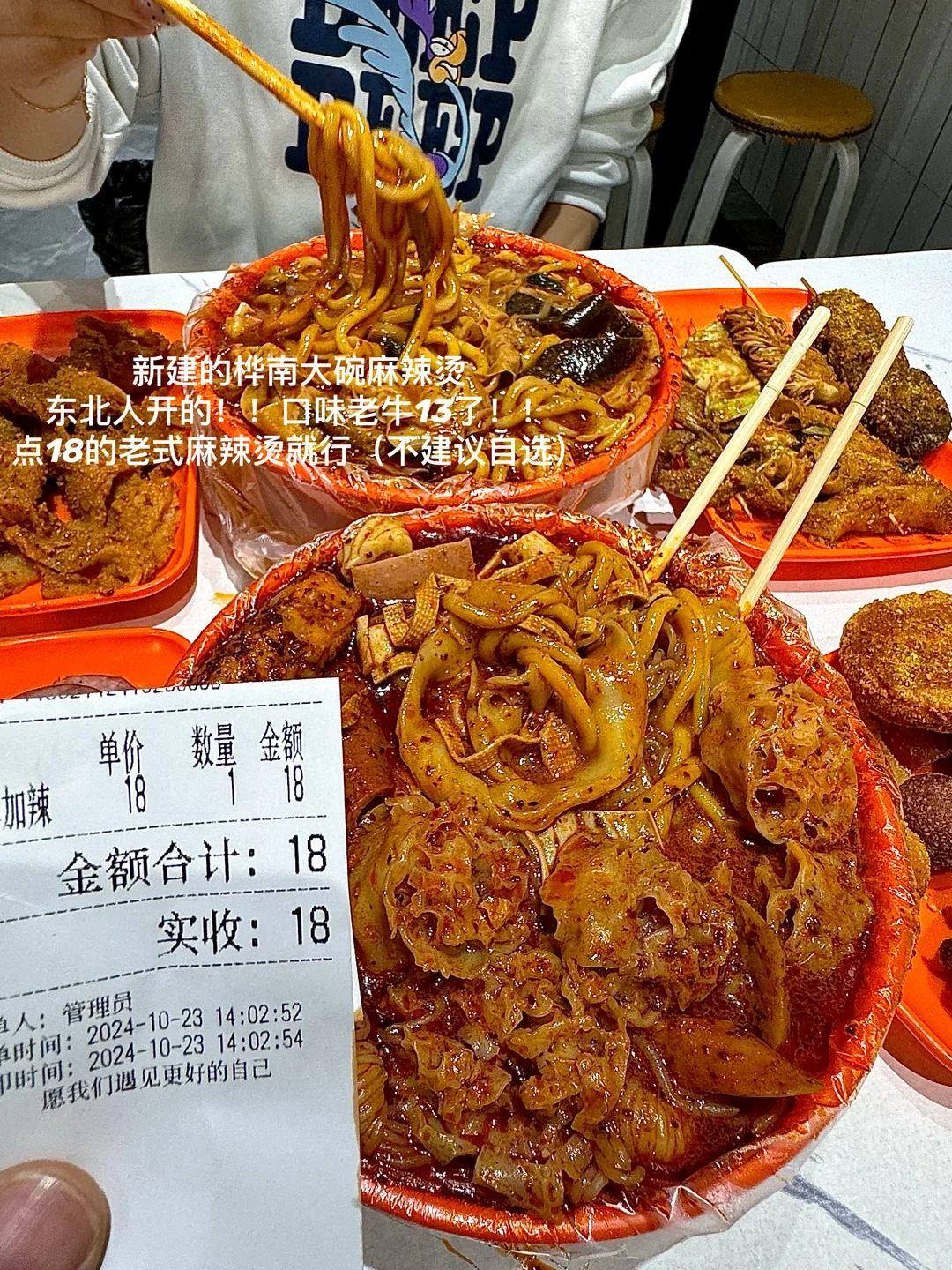
An ¥18 bowl of malatang with the receipt still on the table — the going rate for a fixed-price bowl. Order the set price, not the self-select tray, unless you enjoy surprises.
Zijing Night Market (紫荆夜市) — the big one
For sheer scale and variety, nothing beats Zijing Night Market (紫荆夜市), out in the Jingkai development zone on Zijing Road, hemmed in by four university campuses and something like 200,000 students — the shuttle bus that serves it loops via the Jiaoqiao campus of Jiangxi University of Finance and Economics — which is why locals half-jokingly call it "the university town of Nanchang's late-night food." Official counts put it at 112 shopfronts, 108 fixed stalls and another 46 temporary pitches, strung along roughly 500 metres of pedestrian street that links three plazas — north, centre and south — under tidy canopies. The menu is national: Harbin grilled cold noodles, Xinjiang lamb skewers, Indian roti, guo-bao-rou (sweet-and-sour pork), iced bingfen for dessert. The market's own tally of distinct dishes runs past 300, and most single items sit at the bottom of that ¥5–30 band.
It's a student market, which shapes everything about it. Stalls open from around 17:00 and the last of them don't pack up until nearly dawn, with the crush from about 19:00 to 23:00; expect it noticeably quieter when the campuses empty out for the long summer and Lunar New Year breaks, and shoulder-to-shoulder on a warm term-time Friday.
- Getting there: ride Line 1 to Shuanggang (双港) and take a taxi or DiDi for the last few kilometres. On Fridays, weekends and public holidays a flat-fare ¥2 shuttle bus has run an evening loop calling at Shuanggang metro station, the market's Fenglin West Street entrance and the Jiangxi University of Finance and Economics campus, roughly 20:30–22:30; worth checking on the day, because these services change. A DiDi straight from the east-bank centre takes roughly half an hour.
- Best window: 19:00–22:00, then leave — you need the return journey in hand before the metro closes.
- Who it's for: travellers with a serious appetite and a spare evening. Skip it on a first night, in heavy rain, or if you're travelling with anyone who tires of crowds.
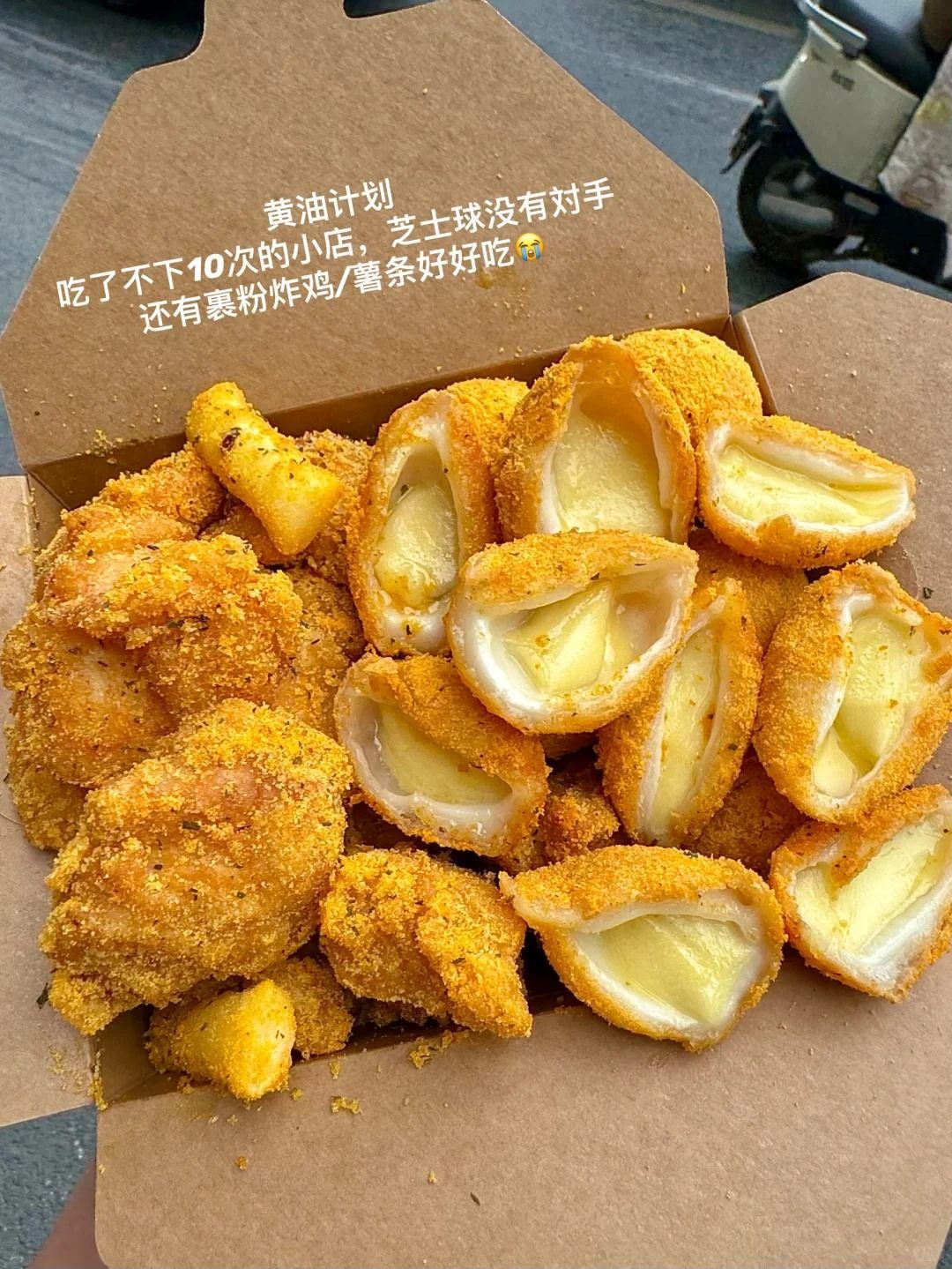
Fried cheese balls and battered chicken, boxed to eat standing up. This is the graze-as-you-walk end of the menu — one box between two, then move on.
Wazijiao and the old-town lanes (瓦子角)
Back in the old centre, the crossroads of Zhongshan Road and Xiangshan North Road has been called Wazijiao (瓦子角) — "tile shard corner" — for centuries. The name comes with a story locals still tell: this was the porcelain street, and somebody — the tellers never quite agree who — smashed its entire stock, then carted the shards away for seven days and seven nights and heaped them on low ground nearby. Hence the rhyme — 打碎瓷器街,堆成瓦子角, "smash the porcelain street, build up Tile Shard Corner." By the late Qing the crossroads mattered enough that the 1907 county gazetteer records a pavilion here for the public reading of imperial edicts. Today it's traffic and department stores, with no trace of the shards, and Bayi Guan (八一馆) station — the Line 1 / Line 3 interchange — opens straight onto the junction, which makes this the easiest place in the old town to start an evening or abandon one.
What you come for is the grid of lanes around it, which is a different animal from a lantern-lit market — no canopies, no signage in English, mostly shopfronts rather than carts:
- Yangzi Lane (羊子巷) — a 780-metre lane running north from Ruzi Road up to Zhongshan Road, a few minutes west of Bayi Square, named for the Hui mutton market that stood here under the Qing and recorded under this name in the county gazetteer of 1907; now a breakfast street that reopens as a late-night one. The thing to eat is shuizhu (水煮) — a self-select tray of tripe, tofu skin, lotus root, chicken feet and greens, boiled and drowned in chilli oil. Xiao Wu Shuizhu (小吴水煮, No. 84 Yangzi Lane) is the long-standing local pick at roughly ¥20–30 a head; there's a queue at meal times and the spice level is not a joke. The egg-burger carts (鸡蛋汉堡, about ¥5) work the same lane.
- Dashiyuan (大士院) — the densest old snacking lane in the city, at the Shengli Road / Dieshan Road junction, five minutes from Hama Jie. It peaks in the morning rather than at night, so treat it as the other half of the same neighbourhood; our guide to Nanchang street snacks covers it stall by stall.
- Around Chuanshan Road (船山路), on the Wanshou Palace side, is where old-school Gan cooking and late-night barbecue overlap. Zhou Ji Bawang Xia (周记霸王虾, 106–110 Chuanshan Road) is the locally beloved version: crayfish, skewers and small seafood from about 17:00 until three in the morning. It isn't street-stall money — listings put it at ¥80–120 a head — but it is the real late-night Nanchang table.
Prices at the stalls here are the plainest in the city: a bowl of banfen ¥3–6, a clay pot of soup ¥5–10, a full graze ¥20–40 a head. Nobody will speak English, and nobody will mind.
Wanshou Palace and Shengjin Tower — the pretty ones
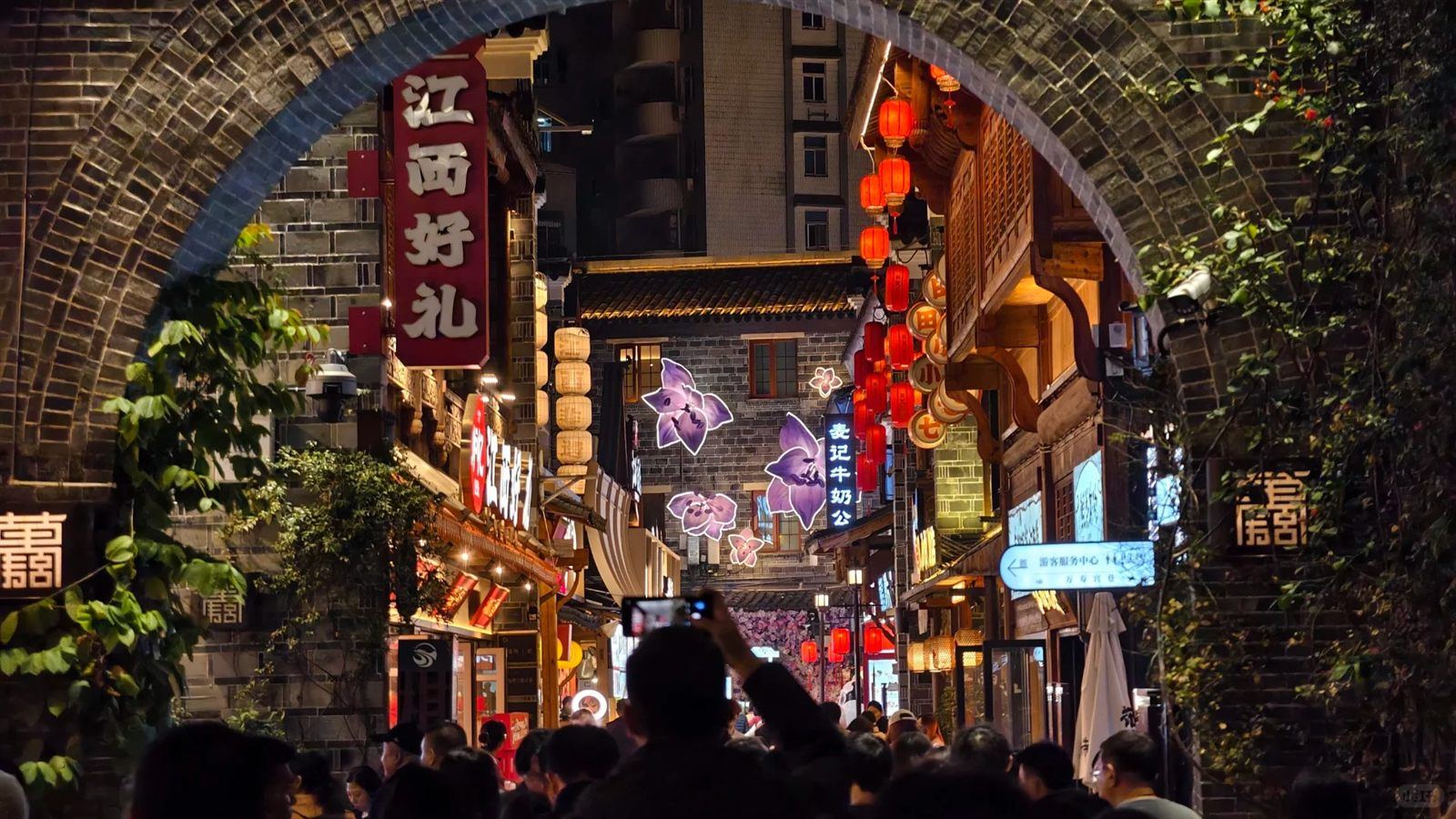
Wanshou Palace after dark — the most photogenic of Nanchang's night-food streets.
If you want your night-market food with a side of atmosphere, two restored quarters deliver. Wanshou Palace (万寿宫) is all red lanterns and grey-tiled lanes; the food street beneath Shengjin Tower (绳金塔) mixes hardcore local classics (rice noodles, clay-pot soup, BBQ) with a hundred-odd vendors from around the country. Both are prettier and more polished than Hama Jie or Zijing — better for a stroll, a little less raw — and both are easy to reach by metro.
- Wanshou Palace: Line 1 to Wanshougong (万寿宫) — the block sits essentially on top of the station, and Exit 1, on the south side of Zhongshan Road, is the one that opens into the historic district. (Exit 3 surfaces on the north side among the office blocks and side streets; it's the wrong side of the road.) Bayi Guan station, where Lines 1 and 3 meet, is a few minutes' walk east along the same road. Shops and stalls run roughly 10:00–21:00 while the lanes themselves stay open around the clock, so this is the market that suits an early dinner — turn up at ten at night and you'll have lanterns and very little to eat under them. There's a costumed night-watch act doing the rounds, live music most evenings, and — crucially for a wet night — a large purpose-built indoor food street, Wanshougong Haochi Jie (万寿宫好吃街), on Daizi Street about 200 m from the district.
- Shengjin Tower: Shengjinta (绳金塔) station, the Line 3 / Line 4 interchange, Exit 3 — it comes up on Jinta East Street with the seven-tiered pagoda behind it and the food street more or less at the top of the steps. Exits 2 and 4 land in the same block if 3 is closed. Older blog posts put this station on Line 2; they're wrong. Most of the grazing is open-air, so it's a fair-weather plan. Around Lunar New Year the quarter runs a temple fair that has been going since 2002 — lanterns down every lane, folk opera, lion dancers — with dates that shift annually.
One honest caveat about both: the stalls right at the gates are the most tourist-facing, and priced accordingly. Walk a lane deeper and the same food costs what it costs everywhere else.
One more, if you're on the west bank
Honggutan Gold Street (红谷滩金街) is the modern counter-argument to all of the above: a 527-metre, two-level shopping street wrapped around the Honggutan Wanda complex — 481 units, more than two hundred of them places to eat — mixing Nanchang snacks with Japanese, Korean and Southeast Asian counters, and by most local counts the busiest eating street in the city. It wires straight into Metro Line 1 at Weidong (卫东) station, and the mall at its back means shelter, air conditioning and a clean toilet are always thirty seconds away. Less atmospheric than the old town by a mile; the obvious plan if you're staying in Honggutan, arriving late, or travelling with anyone who has had enough of plastic stools.
What to eat, and what it costs
The canon repeats at every market on this page. Prices are street-counter prices and drift with the year — treat them as ranges, not promises.
- Stir-fried river snails (炒螺蛳) — thumbnail-sized river snails wok-fried with chilli, garlic and perilla, eaten by sucking the meat straight out of the shell. Late night. Properly hot; the sauce is the point, so 少辣 only tames it so far. In the ¥5–30 plate band. Adventurous pick — messy, loud, worth it. If a snail won't come out, you're sucking the wrong end.
- Charcoal skewers (烧烤) — lamb, chicken wings, aubergine, tofu skin, whole small fish, grilled to order all evening and at their best late. Priced by the stick; five or six between two people is a fair start. Say 微辣 (wēi là) if you want the cumin without the burn. First-timer safe.
- Beef fried noodles (牛肉炒粉) — wide rice noodles wok-fried hard with beef, egg and greens; the most reliable plate on any street. Dinner onwards. Roughly ¥8–15 at a street counter. Ask for 少辣 and it's genuinely mild. The safest first order there is.
- Clay-pot soup (瓦罐汤) — small earthenware jars of broth (egg-and-pork-cake, lotus root, tea-tree mushroom) slow-steamed for hours inside a big coal-fired drum. Any time of day. Not spicy at all, which makes it the fire extinguisher. About ¥5–10 for the standard egg-and-pork-cake pot; rib, lotus-root, cuttlefish and pig-trotter versions run higher. Everyone's friend.
- Banfen (拌粉) — cold-tossed rice noodles with chilli oil, soy, pickled radish and peanuts; a breakfast dish that never really leaves the street. ¥3–6 plain. Order 少辣 unless you've tested yourself. First-timer safe, and the single most Nanchang thing you can eat.
- Crayfish (小龙虾) — by the spicy bucketful, roughly late spring through summer. Sold by weight at market price, so ask before you order: this is the one item that can turn a ¥60 night into a ¥200 one. Hot, messy, brilliant.
- Egg burgers (鸡蛋汉堡) — batter and an egg cracked into a mould pan, a pork patty pressed on top, about ¥5, gone in four bites. All evening. Not spicy. Perfect walking food.
- Malatang, big-bowl style (麻辣烫) — noodles and skewered odds and ends in numbing chilli broth. Most counters offer a fixed-price bowl (often ¥18–25) or a self-select tray priced by weight. The tray is how a ¥20 dinner quietly becomes a ¥60 one.
To cool it all down: iced bingfen (冰粉), cold-skin noodles (凉皮), sugarcane juice and bubble tea, all ¥5–15, plus white sugar cake (白糖糕) at about ¥1 a piece from the old-town lanes. A cold beer from a stall cooler will not be what blows your budget.
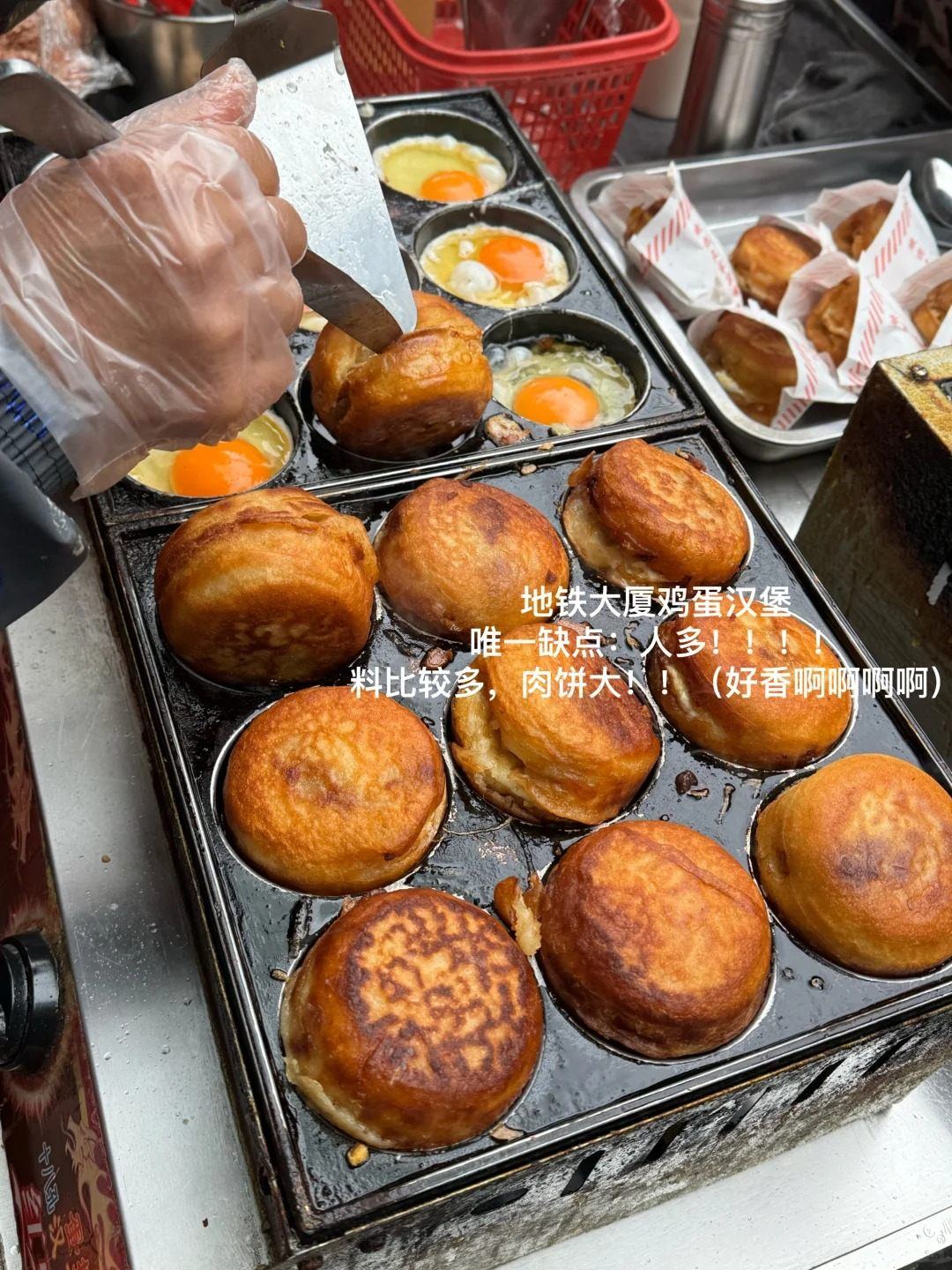
Egg burgers (鸡蛋汉堡) mid-production: batter in the well, egg cracked on, pork patty pressed in. About ¥5, and the queue moves fast.
Ordering, paying and not getting burned
- Chilli, in four words: 微辣 (wēi là) mild, 少辣 (shǎo là) less, 不要辣 (bú yào là) none, 多加辣 (duō jiā là) if you're showing off. Jiangxi heat is fresh-chilli heat, sharper and more relentless than Sichuan's numbing kind, and stallholders will happily dial it down.
- Ordering without Chinese: point at the ingredient, hold up fingers for how many, say 打包 (dǎ bāo) if you want it to go. Nobody expects you to speak Chinese and nobody minds that you don't.
- Paying: Alipay and WeChat Pay everywhere, including the smallest carts. Set the app up and bind your card before you fly — foreign-card verification has been taking anywhere from a day to three, and sometimes failing. Carry ¥100–200 in small notes as a fallback; refusing cash is against the rules here, but change for a ¥100 note is still a stallholder's least favourite request.
- Graze, don't commit. Order small from several stalls. The correct number of dishes from any one pitch is one.
- In the crush: keep your bag in front of you, and listen for electric scooters — they slip through the crowd almost silently.
When to go, and what to skip
Most stalls are lit by about 17:00, the crowd thickens after 20:00, and the street markets run well past midnight — Hama Jie to around three in the morning, Zijing later still. Arriving at 18:30 isn't too early; it just buys you elbow room instead of atmosphere. The restored blocks work the other way round — Wanshou Palace's shops shut around 21:00 — so do those before dinner, not after. Summer is peak season by a distance — Nanchang's heat is legendary and the whole city migrates outdoors after dark — while a damp January night thins the stalls out early. Weekends roughly double the crowd everywhere, and during Spring Festival, Labour Day and the October National Day holiday the restored blocks become shoulder-to-shoulder shuffles rather than places you eat.
What to skip:
- The photogenic queue. The longest lines are usually for novelty items — giant cheese-durian pastries, elaborate milk teas — not the best food on the street. The good queues are short, local and full of people who came for dinner.
- Zijing on a rainy or rushed night. It's a half-hour each way. Hama Jie and most of the Shengjin Tower grazing is open sky, so when it's properly wet the plan is the indoor Wanshougong Haochi Jie (万寿宫好吃街), or Gold Street with the mall at its back.
- The first stall at the gate of any restored block, for the reason above.
- Ordering crayfish without asking the price. Every year, someone doesn't.
- English menus. There aren't any, essentially anywhere. That's a feature.
If you only have an hour
Make it Wanshou Palace, and make it before nine. Ride Line 1 to Wanshougong, come up Exit 1 straight into the lanes, and spend the hour on four things: a clay pot of soup, a bowl of banfen, a stick of something grilled, and a white sugar cake eaten while walking. Photograph the lantern-hung gate from inside the lane looking up, keep an ear out for the night-watch drum, and you'll still make the last train comfortably. If your hour is a late one — after the shops here pull down around 21:00 — take a DiDi to Hama Jie instead and eat snails.
After the food: bars, KTV and live music
Street food is the main event, but Nanchang doesn't shut down once the woks cool. The drinking scene is small next to Shanghai's and almost entirely local — which is rather the point. Most of it clusters in two places: Fuzhou Road (福州路), over in Donghu district a couple of kilometres east of Bayi Square, for the loud end, and the restored blocks around Wanshou Palace and Shengjin Tower for music — the same lanes you came to eat in.
- Da Bing's Cabin (大冰的小屋, Wanshou Palace branch) — a tiny acoustic-music bar, part of a chain known across China for free live folk sets and no hard sell at the door. It sits by the Wanshou Palace lanes, so it's the easy move after eating there. Turn up, sit down, listen.
- Xiang Livehouse (響Livehouse) — one of a handful of livehouses in the city, and the only one you can walk to straight off a food street: it sits inside the Shengjin Tower historic block itself. Chinese indie, folk and rock in a room built for it. Listings are in Chinese only and door prices move with the act, so check Dianping or ask your hotel who's playing.
- Qunzhong Youth Tavern (群众青年酒馆, Fuzhou Road branch) — young, loud and big, at 169 Fuzhou Road. These are bar prices rather than night-market prices; local listings put the average nearer ¥100 a head, so eat first and drink afterwards.
- KTV — karaoke is the default group night here, and every commercial block has a complex with private rooms. You need no reservation and no Chinese: point at the room size, pay by the hour, order beer from the tablet.
Bars turn over faster than night markets do, and almost none keep English listings. Treat these as a starting point, check them on Dianping or Amap the day you go, and ask your hotel's front desk what's actually open — they'll know before any website does.
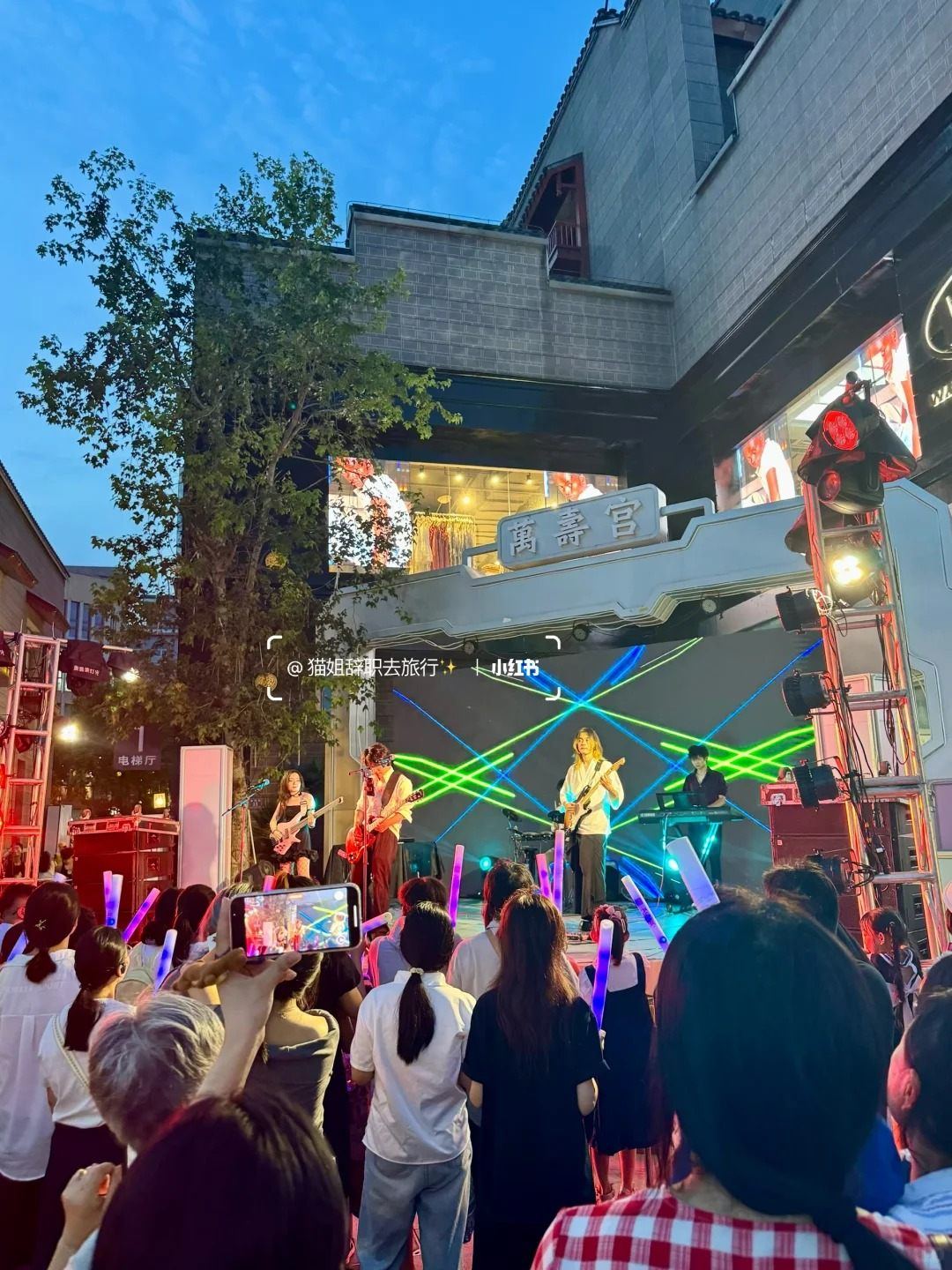
A free open-air set under the Wanshou Palace gate — the sort of thing you stumble into rather than book.
Getting home: the metro closes before the market does
This is the one piece of logistics that ruins otherwise perfect nights. Last trains leave the terminals around 22:30, commonly extended to about 23:00 on Fridays, weekends and public holidays. That's the terminus time, not yours: the last useful train out of your own station is earlier in one direction and later in the other, and every platform posts its own times on a board near the middle. Photograph yours on the way in, not on the way out.
- Still eating at 22:00? Assume you're taking a DiDi. In the old town that's a short, cheap ride to almost any central hotel; from Zijing it's a proper cross-city trip, so leave earlier or accept the fare.
- Hailing a car: DiDi works in English and is far easier than flagging a taxi at midnight outside a market, when demand spikes. Walk a block off the market street before you set the pickup pin — drivers can't get near the entrance.
- Pair it with something earlier: the riverfront light show runs before the markets peak, so do the river at dusk and eat afterwards. The metro guide has the line-by-line detail.
Practical info
- Getting there: Hama Jie — Line 2 to Yangming Park, then a short walk (search 豫章后街, not 豫章路). Wanshou Palace — Line 1 to Wanshougong, Exit 1, directly above. Shengjin Tower — Lines 3/4 to Shengjinta, Exit 3. Wazijiao and the old lanes — Lines 1/3 to Bayi Guan, at the crossroads. Zijing — Line 1 to Shuanggang, then a taxi or DiDi for the last few kilometres. Honggutan Gold Street — Line 1 to Weidong.
- Hours: the street markets run from about 17:00 and peak from 20:00 to midnight — Hama Jie to around 03:00, Zijing later still. The restored blocks keep shop hours instead: Wanshou Palace's stalls and shops are roughly 10:00–21:00, so do those before dinner rather than after. Check anything specific on the day.
- Cost: ¥30–60 a head for a proper graze; ¥100+ if crayfish and beer get involved. Individual plates ¥5–30, snacks ¥1–8.
- How long: about 90 minutes for one market, a whole evening for the old-town crawl, half a night for Zijing.
- Pay & language: Alipay/WeChat everywhere, ¥100–200 cash as backup; no English menus, no English signage, no problem.
- Facilities: the restored blocks have public toilets and seating; the street markets have plastic stools and not much else — use the metro station or a shopping centre before you commit to a second beer.
- Good for: solo travellers, food-first travellers, night photographers, anyone who eats chilli. Less good for: wheelchairs and strollers at peak hour, crowd-averse visitors, anyone who needs a written menu, and — at Hama Jie and Zijing — people expecting anything resembling a tourist facility.
Worth it?
More than worth it — the night markets are where you'll have your best, cheapest and most memorable meals in Nanchang, and where the city is most itself. With one night, head to Hama Jie for the old-school hit or Wanshou Palace for the prettier version; with an appetite and time to spare, make the trip out to Zijing and graze till you can't. Read what to order across the city in our guide to what to eat in Nanchang, browse the rest of Eat & Play, find the best angles in our photo-spots guide, or let us plan a food crawl for you.
FAQ
What are the best night markets in Nanchang? Hama Jie (蛤蟆街), the oldest and most local, downtown near Tengwang Pavilion; Zijing Night Market (紫荆夜市), the huge modern one near the universities; the old-town lanes around Wazijiao (瓦子角) and Yangzi Lane; and the atmospheric restored streets of Wanshou Palace and Shengjin Tower.
What should I eat at a Nanchang night market? Grilled skewers (烧烤), stir-fried river snails (炒螺蛳), summer crayfish (小龙虾), beef fried noodles (牛肉炒粉), banfen and clay-pot soup, with iced bingfen or bubble tea to cool down. Order 少辣 if you want it milder.
What time do Nanchang night markets open and close? Most stalls set up from around 17:00 and the crowd builds after 20:00. Hama Jie's woks run to about 03:00 and Zijing goes later still, but the restored blocks keep shop hours — Wanshou Palace's stalls and shops are roughly 10:00–21:00 — so do those first.
How do I get to Hama Jie night market? Take Metro Line 2 to Yangming Park (阳明公园) station, the closest stop, and walk. Search 豫章后街 in your map app rather than following the exit signage for 豫章路, which is a different street. The lane runs between Xiangshan North Road and Shengli Road, so the Shengli Road pedestrian street is the far end of it, not a sign you have overshot.
How much does a night market meal cost in Nanchang? Most plates are ¥5–30 and a full graze runs ¥30–60 a head. Crayfish is the exception — it's sold by weight at market price, so ask before ordering.
Can I get home by metro after a night market? Only if you leave in time. Last trains leave the terminals around 22:30, commonly to about 23:00 on Fridays, weekends and holidays — and your own station's last train differs from the terminus time. Check the board when you arrive, and plan on DiDi if you're staying out.
Which night market is easiest for a first-time visitor? Wanshou Palace — it sits directly on top of Wanshougong station on Line 1 (Exit 1), it's lantern-lit and easy to photograph, and there's an indoor food street nearby for bad weather. Go before 21:00, though, because that's when the shops pull down. Hama Jie is the rawer, more local hit and runs to about three in the morning; Zijing is bigger and better value but a long way out.
Before you go
Stalls change, prices creep, and a lane that was heaving last year can be half the size this one — check anything specific on Dianping or Amap the day you go. Then stop researching: the right way to use this page is to pick one market, turn up hungry, and let the queue that smells best make the rest of the decisions.
Last verified: 2026-08 — markets, stalls, transit, hours and prices change constantly here; please double-check before you travel.