Nanchang Fireworks: When & Where to Watch
Nanchang's Gan River fireworks fall on Lunar New Year's Day and 1 October — not 31 December. Where to stand, the metro closures, and how to get out.
By Hello Nanchang · Last updated
Laoguanzhou sandbar, Gan River, between Bayi Bridge and Nanchang Bridge, Nanchang · Lunar New Year's Day and 1 October, 8:00pm — dates confirmed only 2–3 weeks ahead
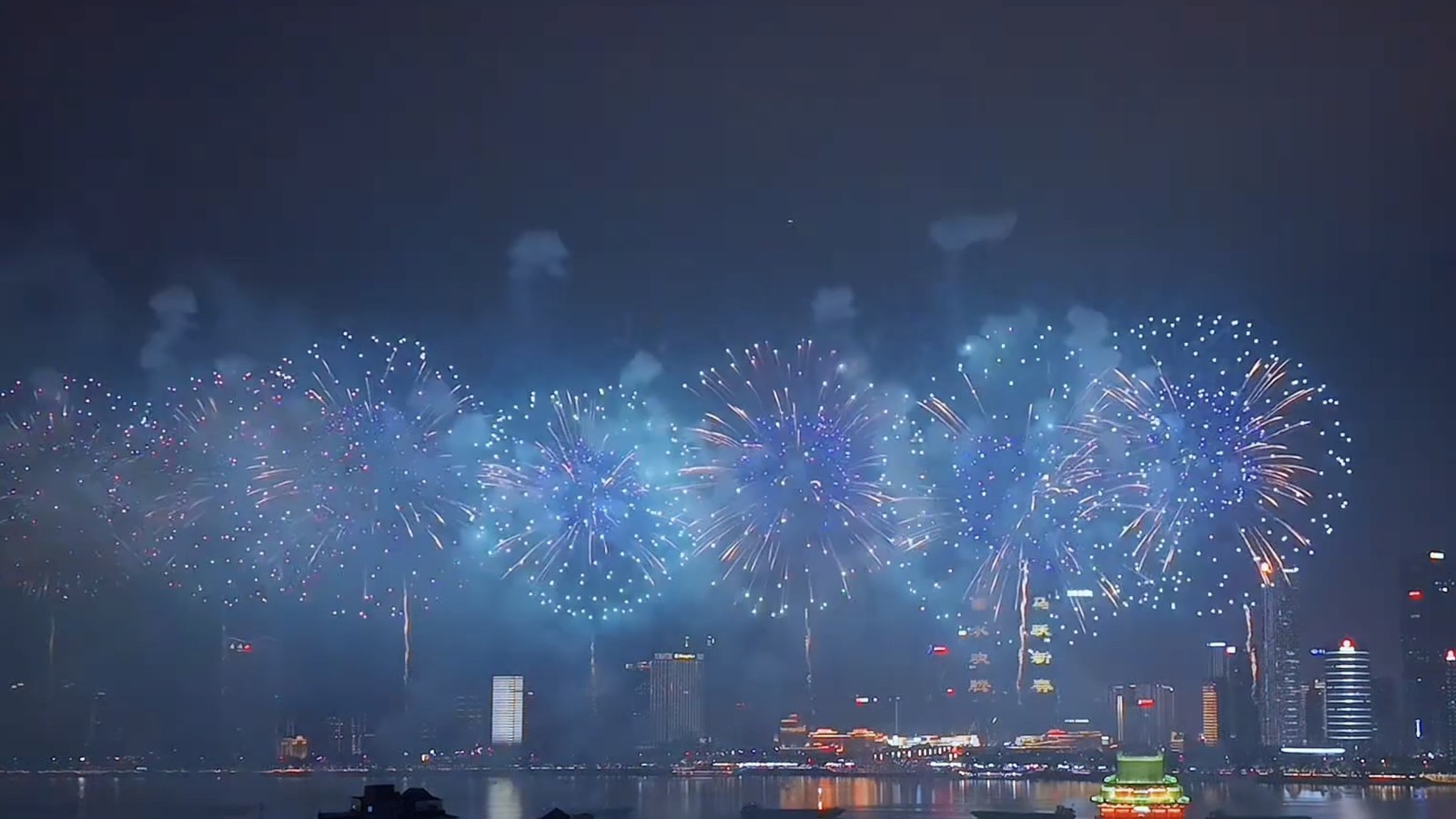
Watch thirty seconds of the video above before you read anything else. What you are looking at is not a display in a park. It is more than a kilometre of the Gan River (赣江) lit up from nine barges at once, while a 303-metre office tower fires from its roof on the far bank and the entire skyline behind it runs a synchronised light show. Nanchang stages this fireworks gala twice a year, and it does not do it quietly.
Here is the thing almost every foreign visitor gets wrong, and it is the one mistake that ruins the plan: these nights are not on 31 December. Nanchang's two river galas land on Lunar New Year's Day — the first day of the Chinese new year, which moves around late January and February — and on 1 October, National Day. On the Gregorian New Year's Eve the city does put on fireworks, but they are venue-scale: a midnight burst over Sunac Land, the theme park out in Honggutan, countdown screens at the malls, a costume party and a lantern ceremony at Wanshou Palace. The river stays dark.
So this is the best free spectacle in central China that hardly any foreign traveller has heard of, and also the hardest one to stumble into by accident. The date moves every year, it is announced only a couple of weeks ahead, and — the detail nobody warns you about — the two metro stations closest to the water are deliberately shut while it happens. Everything below is how to be in the right place anyway.
Nine boats, two towers, and a river closed for the night
The firing ground is a sandbar in the middle of the Gan called Laoguanzhou (老官洲), in the reach between Bayi Bridge (八一大桥) and Nanchang Bridge (南昌大桥). City literature has rebranded that stretch 赣江之心 — the Heart of the Gan — and on gala nights the whole width of it becomes the stage. Nine barges are moored across the water in a line roughly 1,300 metres long. The river between the two bridges is closed to normal traffic. Then the shells go up along the entire line, in sequence, so the effect is less "a firework" than "a wall of them unrolling sideways past your eyes."
The second launch point is the strange one. The Greenland Twin Towers (南昌绿地双子塔) — the matched 303-metre pair on the Honggutan bank, the tallest buildings in Jiangxi to date — are rigged with pyrotechnics on the 60th floor and the roof. Since the 2024 National Day show, the city has run what it calls a "boats plus buildings" format: the towers open the programme vertically, dropping fire down their own façades, and then the river takes over horizontally. The 2025 Lunar New Year edition put a sixty-metre heart on the towers and ran a two-minute sequence off them alone before a boat had fired a shot.
Drones have been the third layer, but treat them as a bonus rather than a fixture. Recent editions have flown flocks in the low thousands — around 5,000 over the river for the 2025 National Day show — holding formations above the water between fireworks chapters, which is when the crowd noise drops and you can hear the rotors. The most recent Lunar New Year gala flew none at all: the drone segment was dropped in the weeks beforehand and the night ran as fireworks, façade lighting and fountains only. Nobody announces that in advance, so do not build an evening around it. Last verified: 2026-08.
None of it would work as well as it does without the backdrop, which Nanchang already had. Every big tower on the Honggutan skyline is wired into a coordinated façade display; our guide to the One River, Two Banks light show covers how that runs on an ordinary evening. On a gala night it becomes the set dressing. The musical fountain at Qiushui Square (秋水广场) has been folded into the programme too — the 2023 National Day edition warmed the crowd up with half an hour of fountain and lights before the first shell, then closed with the fountain playing 《难忘今宵》, the song that ends CCTV's Spring Festival Gala every year and means, to most people standing there, that the party is over and it was a good one.
And then there is the waiting, which is half of it. By a quarter to eight nothing at all is happening. The barges are dark shapes on the water. The towers are just towers. Several hundred thousand people are standing very still on two riverbanks, phones already up, watching a stretch of empty river the way a crowd watches a diving board. At eight exactly, the towers go.
The two nights that matter, and how the city tells you
The pattern since 2023 has been consistent enough to plan a trip around, without being a schedule you can book against:
- Lunar New Year's Day (大年初一) — the 迎春烟花晚会, or Spring Welcoming Fireworks Gala. Held on 22 January 2023, and every Lunar New Year's Day since.
- 1 October, National Day — the 国庆烟花晚会. Held in 2023, 2024 and 2025.
- Start time: 8:00pm sharp, every single edition so far.
- Length: roughly half an hour to three-quarters of an hour. The 2026 Lunar New Year show ran 28 minutes 50 seconds; the 2024 National Day show 37 minutes; the 2025 Lunar New Year show 40 minutes; the 2025 National Day show about 45.
Neither date is guaranteed in advance. What happens instead is that the municipal government publishes the gala on nc.gov.cn — usually two to three weeks out. The 2023 National Day show was announced on 13 September; the 2023 Lunar New Year show on 5 January; the 2026 Lunar New Year programme was presented at a press conference on 30 January for a 17 February show. A separate and much drier document follows: the 焰火燃放许可公告, a fireworks permit notice from the municipal police, which is where the actual quantities get published. If you read Chinese, that notice is the most reliable thing you will find. If you don't, the local listings site 南昌本地宝 (nc.bendibao.com) mirrors everything within a day, and your hotel front desk will know by then too.
If your dates miss both, don't reshuffle the trip around it. The riverfront's nightly act — the coordinated skyline show, the fountain, the lit bridges — runs all year and is genuinely worth an evening on its own; the fireworks are that evening turned up to a volume the city can only sustain twice.
There is a small irony worth knowing. You cannot legally set off your own fireworks in urban Nanchang at all. The city's ban blankets the five central districts — Donghu, Xihu, Qingyunpu, Qingshanhu and Honggutan — plus the whole of the Wanli administrative area, and the penalty written into the rule starts at ¥100–200, rising if it is serious. The galas exist as licensed exceptions to that ban: the permit notice cites Article 33 of the national fireworks-safety regulation and Article 9 of Nanchang's own prohibition, and then lists the quantities. The city took the fireworks away from everybody and then started putting on a better show than any of them could have managed.
The scale, in numbers that were actually published
Chinese event copy inflates. The permit notices don't, because they are legal documents, so those are the figures worth quoting:
- 2025 Lunar New Year (29 January, 20:00–20:40). The police permit itemised 8,030 aerial shells from three to twelve inches, 16,848 single-shot bouquets, and 52,000 mid-air combination pieces, fired from Laoguanzhou and the Twin Towers.
- 2026 Lunar New Year (17 February). Published at 52,274 rounds total — 6,374 from the towers, 8,200 large aerial shells, 37,700 mid- and low-altitude — across nine boats and a 1,300-metre front.
- 2025 National Day. Nine barges, over 8,000 aerial shells including thirty twelve-inch ones, 5,000 drones, and a colour script the organisers described in four movements — ancient silver, revolutionary red, modern blue, future gold. The signature effects were a "Klein blue" waterfall poured off the towers and a flower-basket burst reported at over 200 metres tall.
Twelve inches is the top of the calibre range in the permit — the biggest shells the city licenses itself to fire. In 2025 it fired thirty of them in one night, over a provincial river, for free.
How big a deal is it, really?
Honestly: enormous domestically, barely visible abroad. It is worth separating those two things, because a lot of English-language copy about Chinese city spectacles blurs them.
Domestically, the evidence is solid. Nanchang Broadcasting & Television Station is the sole official live-signal source for the gala and pipes it to more than fifty outlets, including People's Daily, Xinhua, China Media Group, The Paper, Phoenix, Baidu and Toutiao — so on the night you can watch it on a national feed as easily as from the bank. In the station's own 2024 annual report, the hashtag #南昌烟花# reached number two on Weibo's national hot-search list during that year's National Day, which it called its best-ever result. Attendance is reported in the hundreds of thousands to "over a million" for the biggest editions; those are official crowd estimates rather than counted figures, so treat them as an indication that the banks are extremely full rather than a number.
Internationally, be sceptical of anyone claiming more than this. We looked and could not find a CNN, BBC, Reuters, AP or New York Times feature on Nanchang's fireworks, so we are not going to imply one exists. What does exist is narrower and verifiable: Xinhua's English-language photo wire moved a frame of the 1 October 2025 show — credited "Xinhua/Wan Xiang", captioned as fireworks over the Ganjiang River in Nanchang — into the international picture libraries, which is how the image turns up on stock sites worldwide. And the city runs its own overseas push: the Nanchang International Communication Centre livestreams the gala on X, Facebook and Instagram under the handle Nanchangchina, and Phoenix's Jiangxi channel reported total overseas-platform readership for the 2026 Lunar New Year edition at just over 200,000. That is a city broadcasting itself, competently, to a modest audience. It is not the world showing up.
Which is precisely the argument for going. You will be one of very few foreign faces on a riverbank with several hundred thousand Chinese families, and nobody will be selling you anything.
Where to stand: four free vantages, and what each one buys you
The city publishes a shortlist of recommended viewing points each year, and it has been broadly the same four. They are not interchangeable — pick by what you want out of the night.
- Wang Bo Square, below Tengwang Pavilion (滕王阁·王勃广场江畔) — east bank. The best frame in the city: you are facing the firing line head-on, with the tiered roofs of Tengwang Pavilion in the foreground and the fireworks behind them. The plaza is named for Wang Bo (王勃), the young poet who improvised the pavilion's famous preface at a banquet here in 675 — a line of which gave Qiushui Square across the water its name, so you are standing inside a very old joke about this exact stretch of river. Also the most crowded. Official guidance in recent years has been to be in position by 6:00pm. Note that on gala days the ticketed pavilion compound has closed early — in 2025 it stopped selling tickets at 3:00pm and cleared the grounds at 4:00pm — so plan to be outside it, on the free riverside plaza, not up the tower.
- Qiushui Square waterfront platform (秋水广场亲水平台) — west bank. The only spot where you get three things in one field of view: the Twin Towers firing above you, the musical fountain in front of you, and the river show across the water. Stand toward the western end of the platform for the cleanest sightline. Free shuttle buses have been laid on here after the show.
- Xinzhou Culture Square (新洲文化广场) — east bank. About fifteen minutes' walk along the riverside path from Tengwang Pavilion, in Donghu District. Wide open, far less crushed, and the one the city itself recommends if you have grandparents or small children with you. If you want to actually enjoy the evening rather than defend a square metre of railing, come here.
- The Bayi Bridge east-side platforms — east bank. These are the viewing decks by the black cat and white cat sculptures — hundred-tonne stone animals, one white marble and one black Fujian stone, put up with the present bridge in 1997, close to two decades after reform and opening up began. They are a monument to Deng Xiaoping's line about it not mattering what colour the cat is so long as it catches mice, and the black one has a mouse under its paw. Viewing platforms were built out around them in 2024, reached by pedestrian stairs on the bridge's east side and from Yangming Road through a community plaza and underpass. You get sculpture, fireworks and skyline in one frame. Access and capacity here can be controlled on gala nights, so have a fallback.
Two more, from the 2025 Lunar New Year list, if the headline spots are full: the lantern wall outside Zhangjiang Gate (章江门外灯笼墙) and the car park on the east side of Tengwang Pavilion. And more broadly, most of the open riverbank between the two bridges works — this is a city that has spent years opening up its shoreline, which is why there is so much of it to stand on. For daylight reconnaissance of the same frames, our Nanchang photo spots guide covers where the light falls.
If you would rather sit down indoors, there is one paid option worth knowing: the 303 Observation Deck on the 60th floor of the Twin Towers has run capped fireworks sessions — the 2025 National Day one was limited to 300 people at ¥299 a head including food and a small gift package, sold only through its own WeChat mini-programme. It sells out. Prices, capacity and whether it runs at all change year to year, so check rather than assume.
The trap: the two riverside metro stations close during the show
This is the single most useful thing on this page, and it is buried in Chinese-language transport notices every year.
From about 7:00pm to 10:00pm on gala night, Metro Line 1 runs straight through Qiushui Square station and Tengwang Pavilion station without stopping, and both stations close to the public. Those are the two stations everyone tells you to use for the riverfront. During the show, they do not exist. This was the arrangement for the 2025 National Day gala and again for the 2026 Lunar New Year one, so treat it as the standard playbook rather than a one-off.
What the city does instead, and it is generous:
- The whole metro network goes free from around 8:25–8:30pm until the end of service, with the gates released.
- Last trains are pushed back to about 11:30pm network-wide — roughly half an hour beyond the holiday-night norm, and a full hour beyond an ordinary night's last departure from the Line 1 termini, covered in our Nanchang Metro guide.
- Other Line 1 stations near the river get crowd control and may meter entry.
- Free dispersal bus routes have been laid on after recent editions to clear the banks toward the outer districts.
The practical translation: get to the water before 7:00pm and you can still use Qiushui Square or Tengwang Pavilion station. Before the cut-off, Exit 5 at Qiushui Square is the one that puts you at the water. Arrive later and you are walking in from one stop either side — Metro Building (地铁大厦), the Line 1/Line 2 interchange, on the Honggutan side; Wanshou Palace (万寿宫), Exit 1, and behind it Bayi Memorial (八一馆), on the old-town side. In Nanchang, one stop is a genuine walk, not a two-minute hop: put your chosen station into Amap and read the walking time before you commit to it, because you will be covering it against the incoming crowd.
The road situation is stricter still, and it escalates through the afternoon. In the most recent editions, cars were progressively banned from the core riverside blocks from about 4:30pm; bikes and e-bikes from 5:00pm; the riverside avenues (沿江北大道 / 沿江中大道) closed to cars around 6:30pm; pedestrians and bikes banned from the bridge decks of Bayi Bridge, Nanchang Bridge and the south side of Ganjiang Bridge from 7:00pm; and the bridges closed to cars entirely by about 7:30pm. Bus routes through the core stop running from around 5:00pm and resume after the show. Car parks operate on 早进晚出 — in early, out late — which means that if you drive, you will not be allowed to leave until the crowd has cleared. Don't drive.
Your night, in order
- Eat before 5:00pm, away from the river. Once the core zone locks down, your food options collapse to whatever you carried in. The old-town food lanes around Wanshou Palace sit a short walk inland from the east bank and are the obvious place to load up on rice noodles and a clay-pot soup first. Carry water; carry less of everything else.
- Be through the metro gates by 6:30pm at the latest. Aim for 6:00pm if you want Wang Bo Square; the city's own guidance says so.
- Claim your railing and then stop moving. By 7:00pm the banks are dense enough that repositioning means giving up your spot. Decide early whether you want the head-on frame (east bank) or the towers-plus-fountain frame (west bank) — you cannot have both, and you cannot swap once the bridges shut.
- Find the toilets before dark. The city posts 64 free public toilets along the two banks for gala nights, plus mobile units — three trucks with 30 stalls and around 600 portable cubicles for the 2026 edition. Locate one while you can still walk.
- 8:00pm: the towers open. The Twin Towers fire first, then the boats pick it up along the line. Phone cameras struggle badly with the scale here — shoot wide, expose for the highlights, and then put the phone down for the second half.
- Don't bolt at the last shell. Everybody does, and it turns the riverside paths into a slow-moving wall of people. Give it twenty minutes on the spot.
Getting out afterwards
Assume the exit takes longer than the show. Metro is free by then and running to about 11:30pm, so you have a real buffer — use it rather than racing for it. Walk away from the river for a few blocks before you look for a station or a car; the stations nearest the water will be metering entry, and the ones two or three blocks back will not. Free dispersal buses have been run in recent years and are worth looking for, but don't build the night around them.
DiDi is the fallback, as always in Nanchang, but be realistic: you will be one of several hundred thousand people ordering one inside the same square kilometre, and the pickup points nearest the bank are inside the closed zone. Walk out first, order second. Set up Alipay or WeChat Pay before you travel so the whole thing works without a card.
And don't count on a boat. Evening cruises normally leave from the Tengwang Pavilion pier, but the water between the two bridges is under traffic control while the barges are working — confirm directly with an operator rather than assuming a fireworks sailing exists.
What to skip, and who should stay home
- Skip the pavilion itself that day. The ticketed Tengwang Pavilion compound has closed early on gala days. Do the pavilion on a different afternoon and give the fireworks evening its own slot.
- Skip driving, and skip a hotel that isn't walkable. The most valuable thing you can own on gala night is a bed you can reach on foot. Honggutan puts you on the fountain side; the old town puts you on the pavilion side.
- Skip it entirely if crowds frighten you. This is a genuine mass-gathering event with anti-crush advisories printed in the official guidance. If you are travelling with a toddler in a pushchair or someone unsteady on their feet, either go to Xinzhou Culture Square, or watch the national livestream from a riverside restaurant window and enjoy your evening.
- Skip the superlatives. You will read that this is the biggest fireworks display in China, or Asia, or the world. No independent body ranks these. It is unquestionably one of the largest municipal displays in the country, and that is enough.
Practical info
- When: Lunar New Year's Day and 1 October, starting 8:00pm, running roughly 29–45 minutes. Dates are confirmed only two to three weeks ahead — check nc.gov.cn or nc.bendibao.com, and confirm with your hotel.
- Where: Laoguanzhou (老官洲) sandbar in the Gan River, between Bayi Bridge and Nanchang Bridge, plus the Greenland Twin Towers on the Honggutan bank.
- Cost: free. Metro is free from about 8:25pm on the night. The only paid option is the Twin Towers observation deck, when it runs a session.
- Getting there: Metro Line 1 to Qiushui Square (west bank) or Tengwang Pavilion (east bank) — but only before about 7:00pm, after which both stations are skipped. Later, use Metro Building, Wanshou Palace or Bayi Memorial and walk in.
- Getting back: last trains extended to about 11:30pm; free dispersal buses in recent years; DiDi only after you have walked clear of the closed zone.
- How long to allow: five to six hours door to door, most of it waiting and walking.
- Good for: photographers, anyone curious what a Chinese provincial capital does at full volume, travellers who like being the only foreigner in the crowd.
- Less good for: anyone crowd-averse, drivers, and anyone hoping to see it on 31 December.
FAQ: Nanchang fireworks
When are the Nanchang fireworks? Twice a year: on Lunar New Year's Day (the first day of the Chinese new year, which falls between late January and mid-February) and on 1 October, National Day. Both start at 8:00pm. They are announced by the city government roughly two to three weeks in advance rather than fixed on a published calendar, so check nc.gov.cn or the local listings site nc.bendibao.com before you commit to dates.
Are there fireworks in Nanchang on 31 December? Not the river gala. Gregorian New Year's Eve in Nanchang is a mall-and-venue affair — a midnight burst over the theme park in Honggutan, countdown events at the shopping centres, street parties at Wanshou Palace. The big Gan River show belongs to the lunar calendar and to National Day.
Where is the best place to watch the Nanchang fireworks? Four spots are recommended by the city each year. Wang Bo Square below Tengwang Pavilion on the east bank gives the head-on frame with the pavilion in the foreground and is the most crowded. Qiushui Square's waterfront platform on the west bank gives you the Twin Towers, the musical fountain and the river show together. Xinzhou Culture Square, fifteen minutes' walk north along the east bank, is the calmest and the one recommended for families. The Bayi Bridge east-side platforms, by the black-and-white cat sculptures, give sculpture plus skyline plus fireworks.
Is it free, and do I need a ticket? Free, with no ticket and no reserved seating anywhere on the riverbank. The metro is also free from around 8:25pm until the end of service on gala nights. The only paid viewing is the Twin Towers' 303 Observation Deck, which has run limited-capacity sessions — around ¥299 per person in 2025, sold only through its WeChat mini-programme, and not offered every year.
How do I get there and back if the metro stations are closed? Get to the river before 7:00pm and Qiushui Square and Tengwang Pavilion stations still work normally. After that, Line 1 skips both until about 10:00pm, so use Metro Building on the Honggutan side or Wanshou Palace and Bayi Memorial on the old-town side and walk in. Going home, last trains are extended to roughly 11:30pm, free dispersal buses have been laid on in recent years, and DiDi only becomes practical once you have walked several blocks away from the water.
How big is the show? Large by any standard. The police permit for the 2025 Lunar New Year gala listed 8,030 aerial shells, 16,848 single-shot bouquets and 52,000 mid-air combination pieces; the 2026 edition was published at 52,274 rounds; the 2025 National Day show flew 5,000 drones alongside the pyrotechnics. Nine barges fire along a 1,300-metre line, with additional launch points on the 60th floor and roof of the 303-metre Greenland Twin Towers.
Building it into a trip
If your dates happen to land on one of these nights, build the day around it rather than bolting it on: old town and the pavilion in daylight, an early dinner, then the river. Our Nanchang travel guide covers the rest of the city, and if you want somebody to work out which bank to sleep on, which train to take and what to do with the surrounding days, that is exactly what our team does — plan your trip with us.
Last verified: 2026-08 — gala dates, start times, metro arrangements, road closures, ticket prices and shell counts are set fresh for every edition and change year to year. Confirm the current announcement on nc.gov.cn or with your hotel before you build an evening around it.
You Might Also Like
- Why Visit Jiangxi? China's Underrated Gem
- Nanchang: Your Gateway to All of Jiangxi
- Nanchang Bridges: The Gan River Guide
Explore Nanchang & Jiangxi itineraries · Plan a custom trip with us