Nanchang White Sugar Cake (白糖糕): ¥1 Snack
Nanchang's crisp-outside, chewy-inside fried sugar cakes — what they are (not the Cantonese kind), how to eat them, and where to find them.
By Hello Nanchang · Last updated
On the corner where Banbu Street (半步街) runs into the Dashiyuan lanes, a shop roughly the size of a lift keeps a pot of oil going out front. A man drops in rings of pale, rubbery-looking dough. They sink, bob back up, swell, and come out about a minute later the colour of weak tea — at which point they go straight into a tray of fine white sugar and get tumbled until they're furred with it. Somebody hands over a coin. Somebody else burns their fingers.
That is baitanggao (白糖糕), Nanchang's white sugar cake, and almost everything a visitor assumes about it turns out to be wrong. It isn't a cake. It isn't batter. It isn't fermented. It is emphatically not the steamed Cantonese thing that shares its name. And it costs about one yuan.
Of all the cheap things you can eat in this city, baitanggao has the longest paper trail: Jiangxi lists it among five classic provincial pastries, Nanchang has written the technique into its heritage register, and a couple on a street corner still coil every one by hand. What follows is the close-up: the dough, the oil, the argument with Guangdong, and how to tell a good stall from a bad one at ten paces. If you want the wider crawl instead — which lanes, what else to point at, what time the carts come out — that lives in our Nanchang street snacks guide.
What you're actually holding
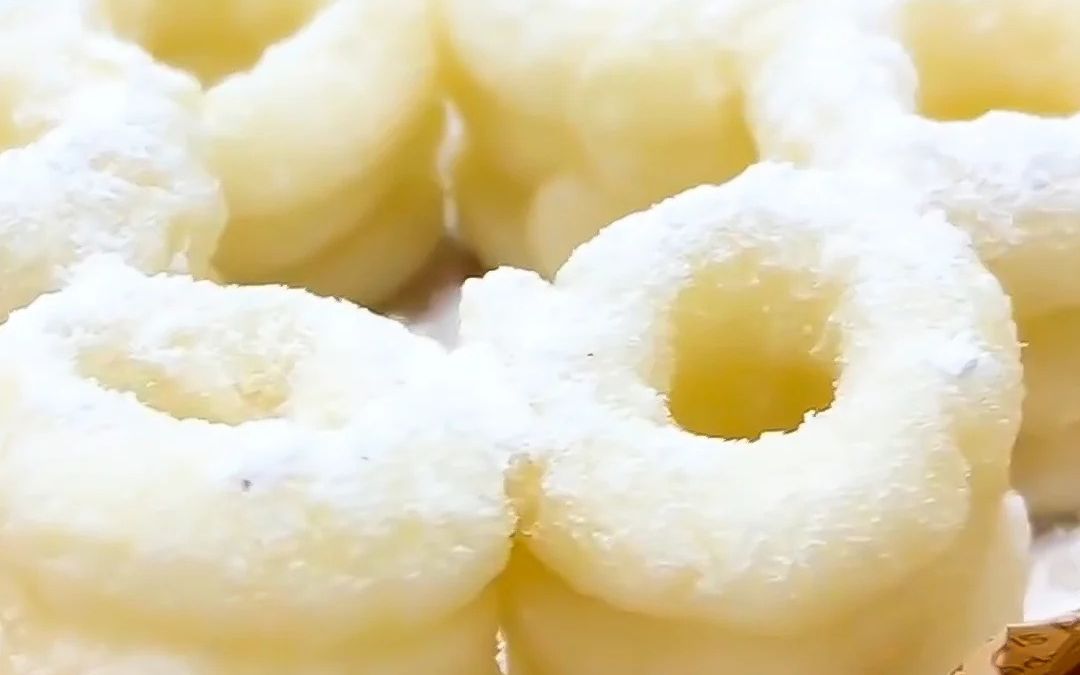
A baitanggao is a ring. Old Chinese descriptions call it 状如白玉环 — shaped like a white jade bracelet — and that's exactly right: about the diameter of a jam-jar lid, a finger-joint thick, with a hole in the middle you could slip a chopstick through. They come to you four or five deep in a paper bag, clacking faintly against each other.
The colour is the giveaway. A properly fried one is barely gold — the Chinese phrase is 微微金黄, "faintly golden" — not the deep brown of a doughnut. The shell is thin and shatters slightly on the first bite. Underneath it the middle is stretchy and mildly springy, closer to mochi than to sponge, and it pulls into short threads if you tear one in half. Locals call that 拉丝, and it's the thing they're checking for.
It is also barely sweet on the inside. The dough carries almost no sugar at all — one widely followed Nanchang recipe uses about five grams of it to a hundred grams of flour — so every bit of sweetness you taste comes from the coat applied after frying. That's why a baitanggao tastes clean rather than cloying, and why you can eat three without feeling sick.
Price: around ¥1 a piece at the famous Dashiyuan shop, and roughly ¥1–3 elsewhere depending on size and neighbourhood. Three yuan buys the whole experience. Prices do creep, so treat those as the shape of the thing rather than a quote.
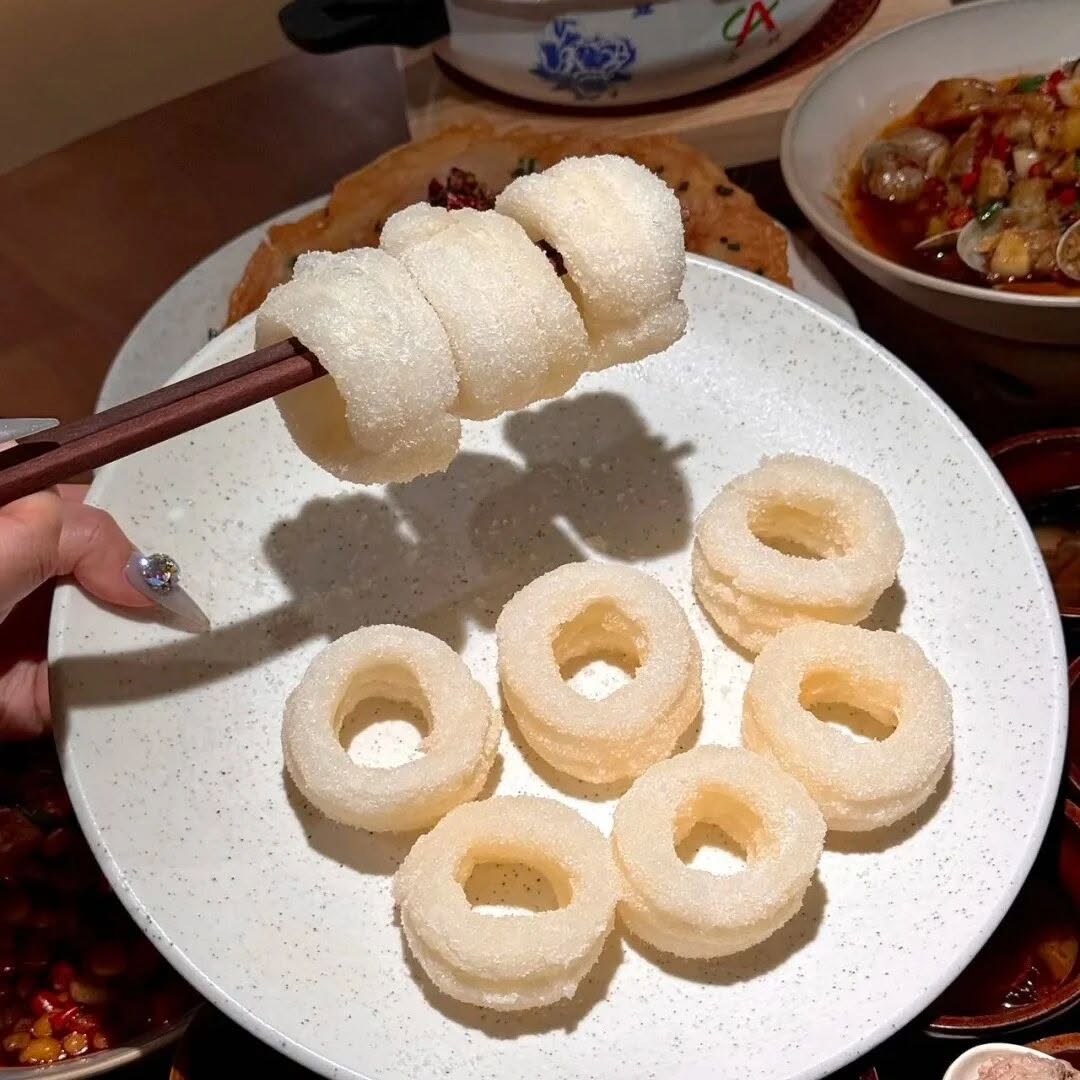
Baitanggao — glutinous-rice rings fried pale gold and tumbled in fine sugar while still too hot to hold. Gan-cuisine restaurants plate them like this alongside the braises; on the street you get them in a paper bag. · Photo: Hello Nanchang
How it's made — and why each step shows up in the eating
This is where the myths die. There is no yeast in a Nanchang baitanggao, no starter, no overnight rise. The lift comes from geometry and steam.
The heritage description of the technique reads almost like a recipe: good glutinous rice is soaked, washed and drained, pounded to a fine flour in a stone mortar, mixed with boiling water and kneaded, rolled into a thin rope, flattened into a sheet, stacked in layers, bent into a ring, and fried to a pale gold. Modern shops buy their flour milled rather than pounding it, but the sequence hasn't moved.
- Boiling water, not cold. Scalding the glutinous rice flour part-cooks the starch before the dough is even shaped. That's what makes it pliable enough to roll thin without cracking, and it's the origin of the chew. Cold-mixed rice flour would crumble.
- A little wheat starch and a spoon of lard. Home recipes for the Nanchang version add chengmian (澄面, wheat starch) and pork lard to the glutinous flour. The starch keeps it from turning gummy; the lard makes it tender and stops it clinging in the oil. It's a two-ingredient trick that separates a good one from a heavy one.
- The layers are the whole point. Rope, flattened to a sheet, folded over on itself, then coiled — one account of the Dashiyuan shop describes a three-strand twist bent into a circle. Those folded layers trap air. In hot oil the trapped moisture turns to steam and pushes them apart, which is why you get a hollow, blistered ring instead of a dense fried lump. No leavening agent required.
- Two heats, about a minute. In gently first, until it floats and puffs; then the heat goes up to set the shell. Pull it at faintly golden. Left in too long it browns, hardens and loses the stretch — and a browned baitanggao is a wasted one.
- Sugar last, while it's scalding. The rings go straight from the oil into fine soft sugar (绵白糖) and are rolled until coated. It has to be hot enough that the sugar half-melts and grips. Sugar sprinkled onto a cooled cake just falls off, which is one of the tells below.
One older detail worth knowing, because it's the most Jiangxi thing about the snack: traditional accounts describe the coating not as plain sugar but as a mixture of sugar and dongmi flour (冻米粉) — glutinous rice steamed, dried outdoors in the cold, then puffed in oil and ground. It's the same base ingredient as Fengcheng's puffed-rice candy, and it gives a faintly toasted note under the sweetness. Most street versions today use plain sugar. If you get one with a slightly nutty, cereal-ish dust, you've found the old recipe.
The other baitanggao — same name, opposite snack
If you've eaten dim sum in Guangzhou or Hong Kong, you already know a 白糖糕, and it is nothing like this one. The Cantonese version — properly Lunjiao cake (伦教糕), after the town in Shunde where it was born — is a cool, translucent, faintly springy slab of steamed fermented rice, cut into wedges and eaten at room temperature.
It even has a better origin story. The Chinese accounts credit a Ming-dynasty street vendor in Lunjiao, surnamed Liang, who botched a batch of steamed sponge cake: the batter sank in the mould. The accident sold better than the thing he'd been trying to make, and he kept making the mistake on purpose.
Its method is the mirror image of Nanchang's. Long-grain rice is soaked overnight and ground with water into a milk, sugar is dissolved in boiling water and stirred through, a yeast or an old starter goes in, and the whole thing ferments for five or six hours before it's steamed for twenty to thirty minutes. Cut it open and you find fine vertical air holes — the fermentation, made visible. And a note worth correcting while we're here: the sourness people romanticise isn't supposed to be there. Chinese sources on Lunjiao cake are firm that a well-made one is clean and sweet, and that a sour one has been over-fermented or has turned.
Set them side by side:
- Grain: Nanchang uses glutinous rice. Guangdong uses long-grain rice milled to a milk.
- Lift: Nanchang gets it from folded layers and steam in the fryer. Guangdong gets it from a five-to-six-hour ferment.
- Heat: deep-fried, about a minute. Versus steamed, about half an hour.
- Temperature served: scalding, in your hand, on the street. Versus cool, on a plate, with tea.
- Texture: brittle shell over a chewy middle. Versus one uniform bouncy crumb the whole way through.
- Shape: a sugar-dusted ring. Versus a pale translucent wedge.
One province apart, three shared characters, and no overlap whatsoever. The Nanchang one is the one you eat standing up.
Tea houses, temple fairs and a list of five
Baitanggao is usually dated to Ming and Qing Nanchang, and by the Republican era it had a fixed job: teahouse food. Chinese food registers describe it as the standard accompaniment kept on hand by tea shops up and down the city's lanes — something to eat with a pot of tea while somebody else did the talking. The street-cart life came later. It arrived as a sit-down snack and got demoted to a walking one, which is worth remembering next time you eat one in four bites without stopping.
It also carries an unusual amount of officialdom for a one-yuan snack:
- One of Jiangxi's five classic pastries (江西五大传统名点), alongside Guixi wick cake (贵溪灯芯糕), Fengcheng puffed-rice candy (丰城冻米糖), Jiujiang tea biscuits (九江茶饼) and Yingtan palace walnut shortbread (鹰潭宫廷桃酥). If you're travelling further into the province, that list doubles as a shopping list — see why Jiangxi is worth the detour.
- Named a "Chinese famous pastry" by the then State Bureau of Internal Trade in 2000, with a gold medal at the first China Food Festival — a credential repeated on every Chinese listing of the snack.
- Municipal intangible cultural heritage since 2021, when Nanchang added 白糖糕制作技艺 to its seventh batch of city-level heritage listings, bundled with a set of other local snack crafts — thick soup (糊羹), dressed lotus root, the city's boiled-snack technique, Wanshou Palace rice dumplings.
The temple-fair thread is still live. The Shengjin Tower fair (绳金塔庙会) has run for decades around the pagoda and is half religious observance, half street-food expo, with a dedicated local-snacks section and, in recent years, a heritage-crafts area; there's usually an autumn edition and, more recently, a Lunar New Year one. Dates, length and line-up change every year, so check the latest local announcement rather than planning a trip around it.
And beneath all of that is the reason it survives, which has nothing to do with registers. For a lot of people in Nanchang baitanggao is childhood — the after-school one yuan, the thing a grandmother fried in a wok at New Year. That is a hard thing for a snack to compete with, and it's why the queue forms.
How to pick a stall — the part that decides whether you like it
Baitanggao is a snack with a very small margin for error. The same object, made carelessly or sold ten minutes late, is dull. Here's the checklist:
- Find the pot, not the pile. The oil should be at the front of the shop, working. If the cakes are already stacked on a tray under a lamp, walk on — there'll be another fryer within a few hundred metres.
- Watch someone shaping. Rings coiled by hand in front of you mean the dough was mixed that morning. Pre-formed rings out of a plastic tub are a step down, though not a disaster if they're going straight into oil.
- Judge by colour, not by size. Pale gold is right. Deep brown means over-fried: hard shell, no stretch.
- Check when the sugar goes on. It should be rolled on immediately after the fry, while the ring is steaming. Sugar on a cold cake sits on the surface and sheds all over your shirt.
- Look at the oil. Clear amber is fine. Dark, thick and smoking is not — and at a good stall the turnover is fast enough that it never gets there.
- A stalled queue is good news. If nobody's moving, the batch is in the pan. That's the best moment to join.
- Buy two or three. Not ten. See the next section.
The one address worth writing down is Lao Nanchang Baitanggao (老南昌白糖糕), on Banbu Street at the corner of the Dashiyuan lanes in Donghu district — listings put it at 半步街65号, a 10–15 minute walk from Wanshougong station on Metro Line 1. Hu Meiyong (胡美永) and his wife Tang Jianhua (唐建华) have been making them since around 2008, first from a stall and then, from 2017, from a shop of two or three square metres with a pair of tables serving as the entire work surface. They have held the price at ¥1 for years. Local listings show it opening early — around 6am — and running into the evening, but regulars warn it sells out and shuts early, so treat it as a morning errand. At holiday peaks the queue runs down the street; one report has them selling something like six thousand cakes in a day and capping purchases at two per person. Hours, price and any purchase limit can all change, so go with a plan B.
Elsewhere: breakfast carts, wet-market corners, and the food lanes around Shengjin Tower and Wanshou Palace, usually next to the sesame balls. Some Gan-cuisine restaurants plate them as a table snack between the braises — that's the setting in the photo above. Paying is a phone job almost everywhere, with a few small notes as backup; the street snacks guide has the full drill on ordering, timings and which lanes reward an early start.
Baitanggao at a glance
- Cost: about ¥1 a piece at the Dashiyuan shop, ¥1–3 elsewhere. Three or four is a generous snack for two people.
- Best hour: breakfast through mid-morning, when every fryer in the city is working. Carts reappear on the late-afternoon shift; by late evening you're mostly looking at leftovers.
- Eat within: minutes. There is no version of this snack that keeps.
- Paying: phone payment almost everywhere; a few ¥1 and ¥5 notes cover the oldest carts.
- Dietary note: not reliably vegetarian. Nanchang recipes commonly work pork lard into the dough for tenderness, and fryers are shared with savoury snacks — ask if it matters to you.
- Good for: children, spice-averse eaters, anyone who wants a break from chilli. Less good for: anyone who wants to buy a bag and eat it later.
Why a cold one is a different, worse snack
You have roughly three minutes. This is not a stylistic preference; it's what the food does.
As the ring cools, three things go wrong at once. The oil held in the crust sets, so the shell stops shattering and starts bending. The sugar coat pulls moisture out of the air and out of the cake, and turns from a dry frost into a damp, tacky film. And the glutinous rice starch — the same starch that makes fresh mochi lovely — firms up as it cools, so the stretchy middle goes stiff and rubbery. Twenty minutes later you're eating something dense and faintly greasy that tastes mostly of sugar. Reheating gets a little of the shell back and none of the middle.
Which leads to three practical rules:
- Don't buy in bulk. Buy what you'll eat before you reach the end of the lane. A bag of ten is a bag of two good ones and eight disappointments.
- Don't carry them back to the hotel. Whatever you're imagining for later will not survive the metro ride.
- Don't take them home as gifts. Baitanggao is a bad souvenir. Mung-bean cakes (绿豆饼) are the Nanchang snack that actually travels — the snacks guide explains where to buy a box.
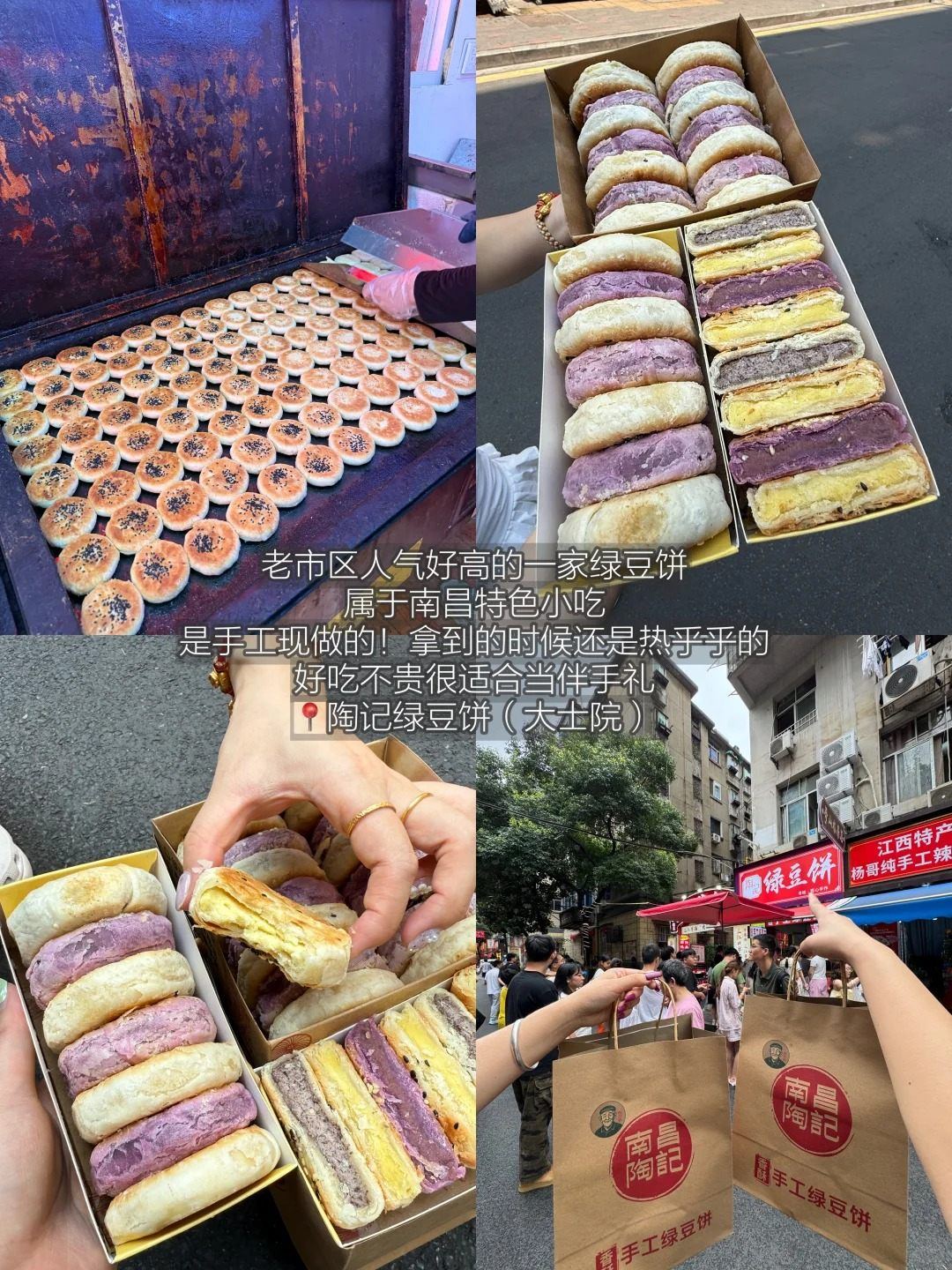
The souvenir alternative: mung-bean cakes at Tao Ji (陶记绿豆饼), a couple of minutes from the sugar-cake fryer at the mouth of Dashiyuan. These are the ones that survive the flight home. · Photo: Hello Nanchang
If you've had one and thought it unremarkable, there's a decent chance you ate it cold. Try again at a working fryer, with the sugar still melting, and see whether you change your mind.
Worth it?
Honestly: baitanggao is not the best thing you'll eat in Nanchang. A ¥6 bowl of banfen with a crock of soup beats it before breakfast is over, and the city's sizzling xiao chao is a bigger flavour by a mile. It's a plain snack — sweet, chewy, fried — and the pleasure is almost entirely texture and temperature rather than complexity.
But for one yuan you get a hand-made object built by a technique the city keeps on a heritage register, handed to you across two tables by the people who made it, still too hot to hold. Very little else in travel is priced like that. Buy two, eat them where you're standing, then go and have the noodles.
More ways to eat your way through the city are in our guide to what to eat in Nanchang and the wider Eat & Play section. Want a morning snack route built around where you're staying, with the timings worked out? Plan your trip with us.
FAQ
What is Nanchang baitanggao (白糖糕)? A ring-shaped snack of glutinous rice dough — scalded with boiling water, layered, coiled, deep-fried to a pale gold and rolled in fine sugar while hot. Crisp-shelled, chewy inside, faintly sweet, and about ¥1–3 a piece.
Is it fermented? No. Nanchang's version uses no yeast and no rising time — the puff comes from folded layers of dough and steam in the fryer. The Cantonese cake of the same name is the fermented one.
How is it different from Cantonese baitanggao? Almost completely. The Cantonese one (Lunjiao cake, 伦教糕) is long-grain rice milk, fermented five to six hours, steamed for half an hour and eaten cool and springy. Nanchang's is glutinous rice, unfermented, deep-fried in about a minute and eaten scalding.
Why does everyone say to eat it hot? Because a cold one is genuinely a different snack: the crust softens, the sugar goes tacky and the glutinous middle stiffens. Eat it within a few minutes of the fryer.
Where can I buy it? The best-known shop is Lao Nanchang Baitanggao (老南昌白糖糕) on Banbu Street, at the edge of the Dashiyuan lanes, open from early morning and prone to selling out. Otherwise: breakfast carts, market corners and the food lanes at Shengjin Tower and Wanshou Palace. Look for a stall frying to order.
Last verified: 2026-08 — stalls, prices, opening hours and festival dates change; please double-check locally before you go.