China Visa-Free Transit Guide
Everything you need to know about entering China and visiting Nanchang without a traditional visa.
Important: China's entry rules move faster than most travel guides. This page was last reviewed in August 2026 and is general information, not immigration advice. Country lists, port lists and permitted areas are all amended without much notice — confirm your own case with the National Immigration Administration or your nearest Chinese embassy or consulate before you book anything.
There is a number in most China travel advice that is four days out of date. Since 17 December 2024, the transit exemption that gets most foreign visitors into the country without a visa has been 240 hours — ten days, not 144. If you have been sketching a six-day trip because a forum post told you six days was the ceiling, you have been planning from a rulebook China retired.
Nanchang sits in the part of that policy people rarely read to the end of. Changbei is a listed port of entry, which is the good news. The small print is that Jiangxi's permitted area under transit rules is exactly two cities — and neither of them is Lushan. Get it right and ten visa-free days is a generous amount of China. Get it wrong and you are having a difficult conversation at a hotel front desk in a mountain town.
This guide sorts out which of China's visa-free routes applies to your passport, what the 240-hour rule actually permits in Jiangxi, and the arrival admin — the digital arrival card, the immigration counter, the police registration nobody warns you about — in the order you will meet it.
Three doors into China — work out which one is yours
China does not have "a" visa-free policy. It has several running in parallel, with different country lists, different lengths of stay and different conditions. Travellers get into trouble by mixing them up. Run down this list in order and stop at the first one that fits:
- Is your passport on the 30-day visa-free list? If yes, take it. It is the simplest route and has no onward-ticket condition.
- Does your country have a mutual visa-exemption treaty with China? Several do, mostly in Asia and the Gulf. Same idea, different legal basis, sometimes different limits.
- Neither — but you hold one of the 55 transit-eligible passports and you are flying onward to a third country? That is the 240-hour transit exemption.
- None of the above? Apply for a tourist visa at a Chinese embassy or visa centre. Do it early; it is not a same-week process.
Door 1 — the 30-day visa-free scheme
This is China's unilateral trial: ordinary passport holders from a list of roughly fifty countries may enter for up to 30 days per entry for tourism, business, visiting friends and family, exchanges or transit. There is no requirement to be going anywhere else afterwards — fly in, fly home, go wherever in China you like.
Two things to understand about it. First, it is a trial, renewed a year at a time; the current window runs to the end of December 2026, and Beijing has extended it every time so far without ever promising to. Second, the list grows in tranches: the UK and Canada were added from 00:00 on 17 February 2026, joining most of Europe plus Australia, New Zealand, South Korea, Malaysia, Brazil and others.
The absence that catches the most people out: the United States is not on the 30-day list. For an American passport, the visa-free way into Nanchang is Door 3.
Door 2 — mutual visa-exemption agreements
A smaller set of countries — Singapore, Thailand, Malaysia, the UAE, Qatar, Georgia, Kazakhstan and a couple of dozen others — hold reciprocal treaties with China covering ordinary passports. These are agreements rather than trials, so they are less likely to lapse, but the terms vary treaty by treaty: usually 30 days per entry, often with a cumulative cap of around 90 days in any 180. If you are travelling on one of these, read your own country's agreement rather than a general summary.
Door 3 — the 240-hour transit exemption
The workhorse, and the one this guide is mostly about. Citizens of 55 countries may enter China without a visa and stay up to 240 hours, provided they are passing through on the way somewhere else. The conditions are specific and immigration officers apply them literally:
- A valid passport from one of the 55 eligible countries — 40 in Europe, six in the Americas (the US, Canada, Brazil, Mexico, Argentina, Chile), Australia and New Zealand, plus Japan, South Korea, Singapore, Brunei, Indonesia, the UAE and Qatar.
- A confirmed onward ticket with a date and a seat to a third country or region — somewhere that is neither China nor where you flew in from. Hong Kong, Macao and Taiwan count as third regions. You must already hold it when you land.
- Entry and exit through listed ports. The policy launched with 60 of them across 24 provinces and municipalities (up from 39 ports in 19 regions under the old rules); the immigration administration's English page now lists 65. It keeps growing, so check the current table rather than an old one.
- Staying inside the permitted areas. This is the clause that bites in Jiangxi — see the next section.
Door 4 — 24-hour direct transit (and why it is no use here)
Any nationality can transit China within 24 hours without a visa if they hold an onward ticket to a third country — but the exemption keeps you inside the port area. It is a rule for making a connection, not for seeing a city. At Nanchang, treat it as irrelevant: if you want to leave the terminal, you need Door 1, 2 or 3.
What happened to the 144-hour rule
It was folded into the 240-hour policy on 17 December 2024, along with the 72-hour version. The old scheme covered 39 ports across 19 regions and pinned you to the single region you entered through. The replacement is longer, covers more ports, and — the change most people miss — lets you move between the permitted areas of all 24 participating provinces. If a website still says 144 hours, it has not been touched since 2024, and you should be suspicious of everything else on the page too.
What ten days actually buys you in Jiangxi
The two-city rule
Every province in the scheme declares a permitted area, and they are not all drawn the same way. Some list the whole province. Jiangxi does not. The official entry reads: port — Nanchang Changbei International Airport; permitted area — Nanchang City and Jingdezhen City.
Read that as a boundary, because that is how it is enforced. On transit rules, Lushan, Wuyuan, Wugongshan, Sanqingshan, Jinggangshan and Longhushan are all outside your permitted area — the mountains and the whitewashed villages that make up half of Jiangxi's appeal. Reaching them means a tourist visa, or a 30-day visa-free entry if your passport qualifies. It is the single most useful thing to know before you build an itinerary around this policy.
Picture how it goes wrong. You land on a Tuesday, you like the city more than you expected, and on Thursday somebody at breakfast tells you the mountain at Lushan is about two hours away and the cloud sea is worth the early start. Two hours is nothing. You go. The guesthouse up there scans your passport into the same national system every hotel uses, and now there is a record of a transit-exempt foreigner sleeping outside their permitted area. There is no checkpoint on a provincial boundary and no barrier at the station gate; the check is the registration, and the registration happens wherever you spend the night.
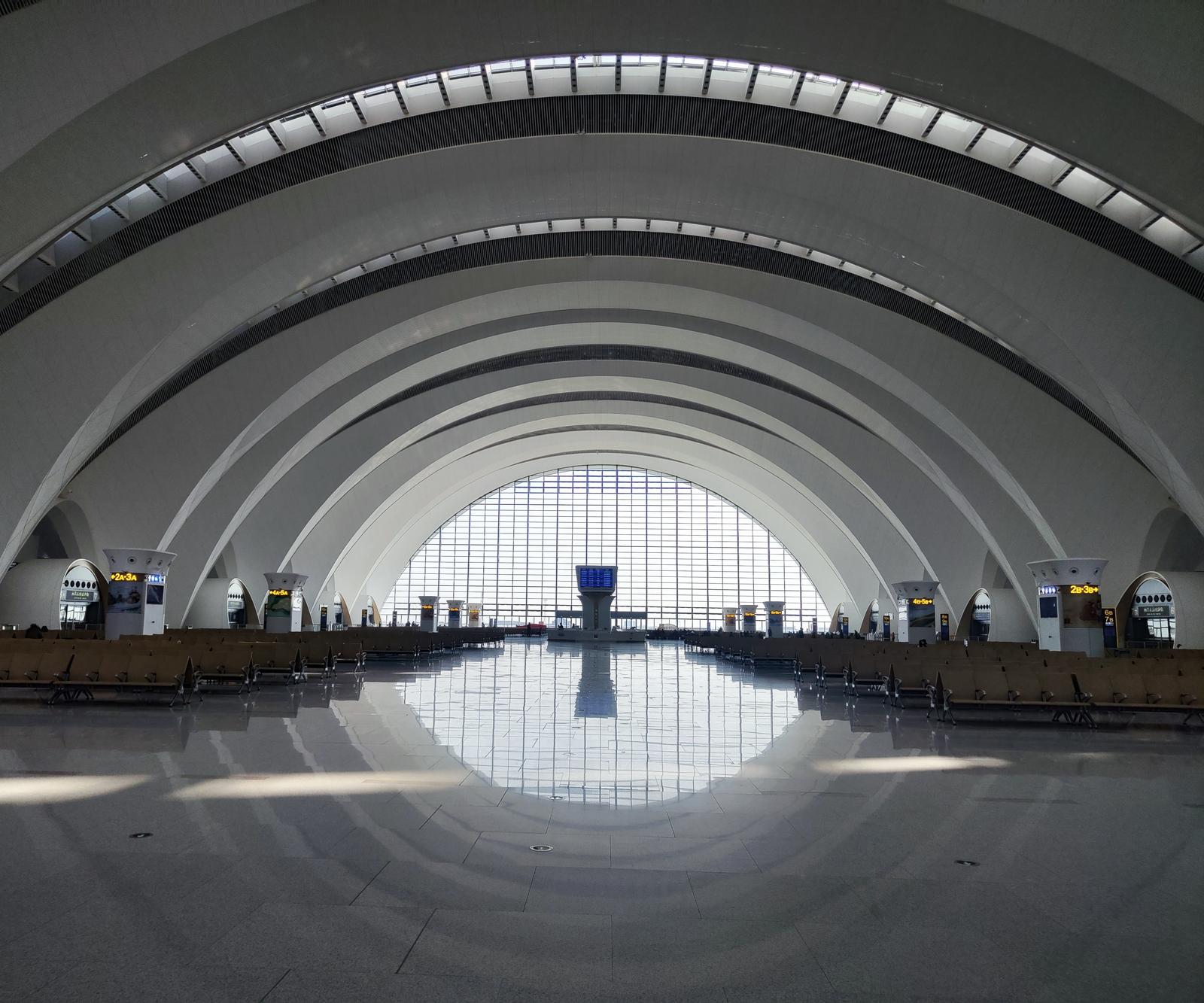
Nanchang East — where the fast trains to Jingdezhen leave from, and the far edge of what a transit traveller is allowed to reach inside Jiangxi. Photo: Yuuki / Wikimedia Commons (CC BY 4.0).
The consolation is a good one. Jingdezhen, the thousand-year porcelain capital, is inside the line and is comfortably the best day out in the province: roughly 45 minutes each way on the high-speed train from Nanchang East, with fares recently sitting in the ¥85–95 band (Chinese rail fares now float, so treat that as a range). Come on a Friday, Saturday or Sunday and the Taoxichuan market fills a former state porcelain factory with several hundred stalls from around 4:30pm.
You are allowed to leave the province
This is the part of the 2024 reform that changes trip design. Within the permitted areas of the 24 participating provinces you may travel across provincial lines, and you may exit China from a different port than you entered. Shanghai Municipality, Zhejiang, Anhui, Fujian, Hunan and Hubei all appear in the table with whole-province or whole-municipality coverage, which puts a lot of eastern China within reach of a Nanchang arrival.
In practice that means high-speed rail. From Nanchang West, Shanghai is roughly three to four hours, Changsha about an hour and a half, Wuhan around two, Guangzhou about three and a half. Our guide to getting around Jiangxi by train covers the regional picture; for which of Nanchang's three stations you actually want, see the gateways guide. Before you cross a provincial line, check that province's own permitted-area entry — Jiangxi is proof that they are not all the whole province.
How the ten days are counted
The 240 hours begin at 00:00 Beijing time on the day after you enter, not at the moment your passport is stamped. Land at 22:40 on a Tuesday and Tuesday costs you nothing: the clock starts at midnight and runs ten full days from there. It is worth engineering a late arrival if the flight prices are similar — you gain most of a day for nothing.
What counts as a "third country"
Somewhere that is neither China nor your point of origin. Flying London to Nanchang and back to London does not qualify; London to Nanchang to Seoul does. Hong Kong, Macao and Taiwan are treated as third regions, which is the cheap way to satisfy the condition if your route is otherwise a round trip. The ticket must be booked, dated and seated before you reach the immigration desk — an itinerary you intend to buy later is not a ticket.
Arriving at Nanchang Changbei (KHN)
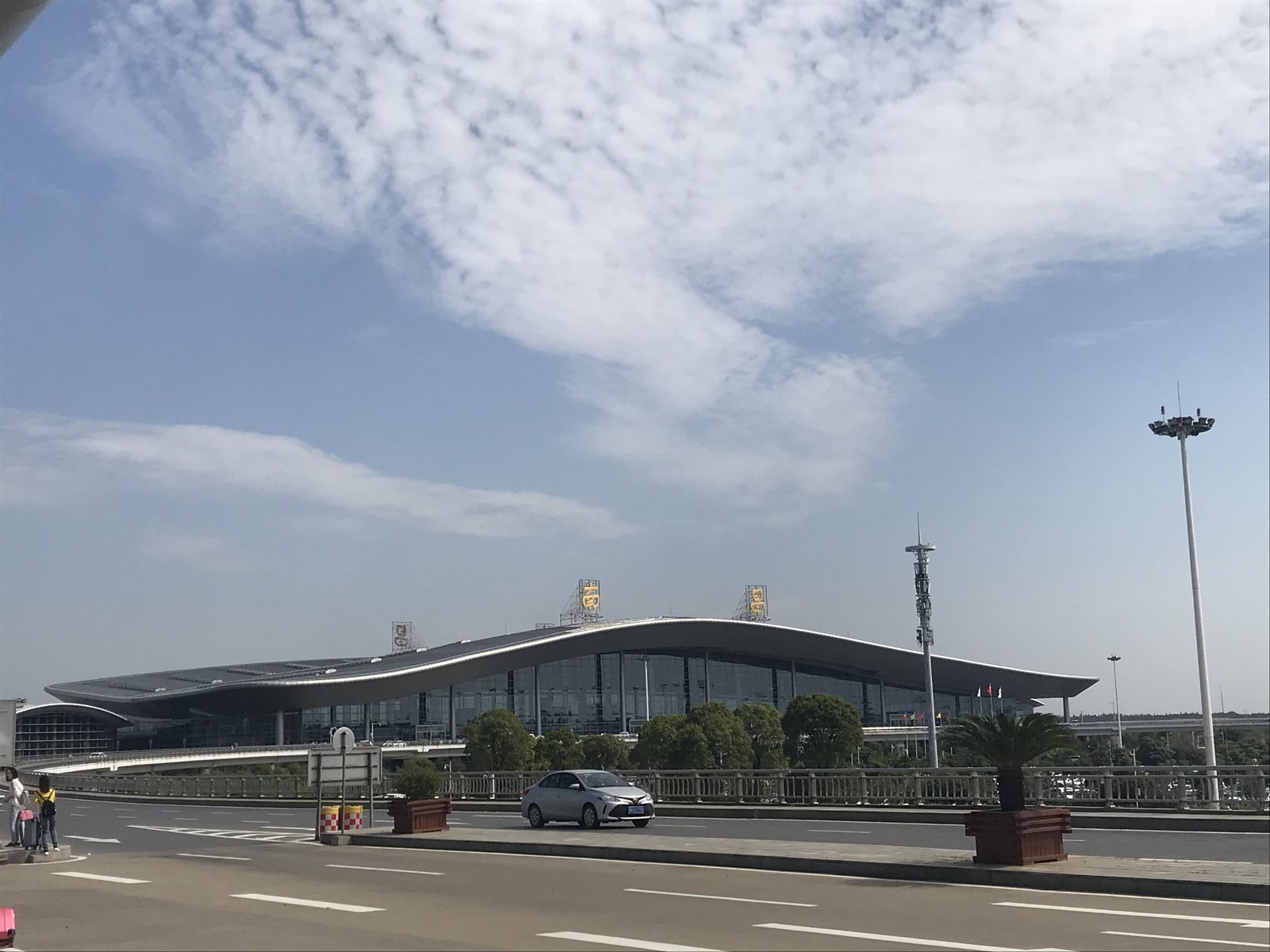
Changbei's Terminal 2 — international arrivals clear at the smaller T1, then most onward connections run from here. Photo: 丰泽一号 / Wikimedia Commons (CC BY-SA 4.0).
File the arrival card before you fly
Since 20 November 2025 China has run an online arrival card, and it has largely replaced the paper slip cabin crew used to hand out. You file it in the three days before you arrive — the window opens 72 hours before your entry date and the system rejects submissions made earlier — through the National Immigration Administration's website, the NIA 12367 app, or its WeChat and Alipay mini-programs. Paper forms and on-site kiosks still exist as a fallback, and a handful of categories are exempt — permanent residents, group-visa travellers, 24-hour transit passengers, cruise passengers, e-channel users and crew — but for everyone else, doing it on the sofa the night before beats doing it in the queue.
At the counter
Follow the signs for the visa-free channel and say plainly which policy you are using; the officer is deciding between different rulebooks and it speeds things up. Have these ready, on paper or on a screen that works offline:
- Passport with comfortable remaining validity — six months clear of your travel dates is the safe standard, whatever the minimum technically is.
- The onward ticket to a third country, showing date and seat. This is the document that ends trips. Screenshot it.
- Your first night's accommodation — a hotel booking is worth having even when nobody asks.
- Your arrival-card confirmation, if you filed online.
Fingerprints and a photograph are routine for most adult arrivals. Budget more time than the flight tracker suggests, particularly if you land alongside another wide-body.
Which terminal, and a realistic word about the flights
Terminal 1 handles international and regional flights, so that is where you will clear immigration; Terminal 2 is domestic and where onward connections and the metro live. Be realistic about Changbei's international network, though: it is a modest slate — Bangkok, Singapore, Kuala Lumpur, Osaka and Macau have all featured, and routes shift seasonally. Plenty of readers will find it easier to enter China at Shanghai, Guangzhou or Shenzhen and reach Nanchang by train, which the cross-province rules allow as long as both ports are listed and every place you stop is inside a permitted area.
Getting into the city
One correction worth making loudly, because older guides — including earlier versions of this page — get it wrong: the metro reaches the airport. Line 1 extended north to Changbei Airport station at Terminal 2 on 28 June 2025. Anything telling you the airport line is "under construction" is stale.
- Metro Line 1 — no interchange needed to reach Bayi Square (八一广场), the city's central crossroads. Fares roughly ¥2–7, a covered walkway of about 300 m from the terminal, service around 06:00–22:30. The catch is that it is a city line, not an express: allow an hour or a little more to the centre. Full detail in our Nanchang metro guide.
- Airport shuttle bus — a flat ¥15, about 45–60 minutes, boarding outside T2 Gate 7, paid by WeChat or Alipay, transit card or coins.
- Taxi or DiDi — fastest door to door at roughly 27–45 minutes, typically ¥90–120 to central districts, with surge pricing at peaks.
With luggage and a short stay, take the taxi. Arriving at rush hour or counting yuan, the metro is now a genuinely good answer.
Register where you sleep — within 24 hours
Every foreign visitor must have their accommodation registered with the local police within 24 hours of arrival, under Article 39 of China's Exit and Entry Administration Law. Nobody mentions this at the airport, and it is the rule short-stay visitors most often breach by accident.
In a hotel it is invisible: the passport scan at check-in is the registration. In a private home, a rented apartment or an unlicensed short-let, it is on you and your host to walk into the neighbourhood police station (派出所) and file it within 24 hours. (Rural districts have historically been given longer; do not plan around it.) Bring your passport with the entry stamp, and expect the host to need their household register (户口簿) and sometimes a lease or deed.
Ask a short-let host before you book whether they will register you at the local police station. A vague answer is an answer. Book a hotel instead — it takes them ninety seconds and you have the slip in your hand.
Keep the registration slip with your passport. If you change hotels mid-trip, the new one registers you again; that is normal, not a problem.
Four ways people get this wrong
- Overstaying. Visa-free stays cannot be extended from inside China. Article 78 of the Exit and Entry Administration Law provides for a warning, and in serious cases a fine of ¥500 per day capped at ¥10,000, or detention of five to fifteen days. A missed flight is not a defence — build a buffer day.
- Drifting outside the permitted area. The Lushan problem again. A transit traveller who takes a scenic detour is out of status however innocent the intention, and the registration at the next hotel is where it surfaces.
- An onward ticket that goes home. Round trips do not satisfy the third-country condition. Fix it with a cheap onward hop to Hong Kong, Macao, Seoul or Bangkok.
- Assuming your travel companion is on the same rules. Eligibility is per passport. An Irish–American couple can walk up to the same counter under two different policies, with the American on a ten-day clock and the Irish passport holder on thirty days.
A ten-day route that stays inside the rules
If you are using the transit exemption, here is a shape that uses the full window without crossing a line. Treat it as a template rather than a timetable.
- Arrival evening. Land at KHN, take a taxi in, check into a hotel so registration is handled. Your 240 hours start at midnight, so this evening is a bonus.
- Days 1–3, Nanchang. Tengwang Pavilion (滕王阁), Bayi Square, the Wanshou Palace (万寿宫) lanes and the river light show after dark. Our two-day Nanchang itinerary covers the core, and the Nanchang destination guide fills in the rest.
- Day 4, Jingdezhen. Out from Nanchang East, about 45 minutes each way. Overnight if you want the Friday-to-Sunday evening market at Taoxichuan without watching the clock.
- Days 5–8, east. Nanchang West to Shanghai in roughly three to four hours, or Hangzhou for less. Both are inside permitted areas — verify the current table before you commit.
- Day 9, buffer. Weather, delays, a train you did not book early enough. Leave one.
- Day 10, out. Fly to your third country from a listed port before your window closes. Do not cut this fine.
Want the version tuned to your own passport, dates and onward flight? That is exactly what our custom trip planning is for — we will build the days around the boundary rather than into it.
A ten-minute checklist before you fly
- Confirm your nationality's current route on the National Immigration Administration site or with your nearest Chinese embassy. Do this last, close to departure.
- Buy the onward third-country ticket before you fly, if you are using transit rules.
- File the digital arrival card in the 72 hours before you fly — the window does not open earlier, and it is not something you can do on landing.
- Book at least the first night in a hotel so registration happens automatically.
- Set up Alipay or WeChat Pay with your card, and sort an eSIM and VPN before you land — see our Plan Your Trip hub for the payment and connectivity setup.
- Screenshot the onward ticket, the hotel booking and the arrival-card confirmation so they work without data.
- Carry your passport in Nanchang. Hotels, train gates, museum entry and occasional street checks all want it.
One last piece of perspective. The direction of travel over the past two years has been steadily more open — longer stays, more ports, more countries, less paper. But every element of it is a policy rather than a right, and policies are amended quietly. Check the official sources in the week you fly, not the month you booked.
Last verified: 2026-08 — visa policies, country lists, permitted areas, fares and transport times change; confirm with the National Immigration Administration or your nearest Chinese embassy before you travel.
Frequently Asked Questions
How long can I stay in Nanchang without a visa?
Under the 240-hour visa-free transit policy that replaced the old 144-hour rule in December 2024, eligible travellers get up to 10 days — and the clock only starts at 00:00 Beijing time the day after you enter. If your passport is on China's separate 30-day visa-free list, you get 30 days per entry with no onward-ticket condition. Confirm which one applies to your nationality before you book.
Does China's 144-hour visa-free transit still exist?
No. From 17 December 2024 the National Immigration Administration replaced the 72-hour and 144-hour transit exemptions with a single 240-hour (10-day) policy, widened the list of entry ports and allowed travel across the permitted areas of 24 provinces. Any page still quoting 144 hours is out of date — and it is short-changing you by four days.
Can I visit Lushan or Wuyuan on the 240-hour transit exemption?
Not under transit rules. Jiangxi's permitted area for visa-free transit travellers is listed as Nanchang City and Jingdezhen City only — so Lushan, Wuyuan, Wugongshan, Sanqingshan, Jinggangshan and Longhushan sit outside it. To reach Jiangxi's mountains and villages you need a tourist visa, or a 30-day visa-free entry if your passport qualifies.
Do I still fill in a paper arrival card for China?
Usually not. Since 20 November 2025 most foreign arrivals file the China Digital Arrival Card online in the three days before you arrive — the system opens 72 hours out and rejects anything earlier — through the National Immigration Administration website, the NIA 12367 app, or its WeChat and Alipay mini-programs. Paper cards and on-site kiosks remain as a fallback at the border, but doing it before you fly is faster.
Do I need to register with the police in Nanchang?
Yes, within 24 hours of arrival. Hotels do it for you at check-in — that is what the passport scan is for. If you stay in a private home, an apartment or an unlicensed short-let, you or your host must report to the neighbourhood police station (派出所) yourselves, within the same 24 hours. Keep the registration slip with your passport.
View all travel info & transport tips · Plan a custom trip with us