Fenghuanggou: Nanchang Cherry Blossoms
A spring day-trip from Nanchang — cherry blossoms, tea gardens and farm country at Fenghuanggou, plus how to get there and when the flowers peak.
By Hello Nanchang · Last updated
Fenghuanggou, Huangma Township, Nanchang County, Jiangxi · Cherry blossoms typically bloom mid-March to mid-April each spring; evening illumination usually runs during bloom season
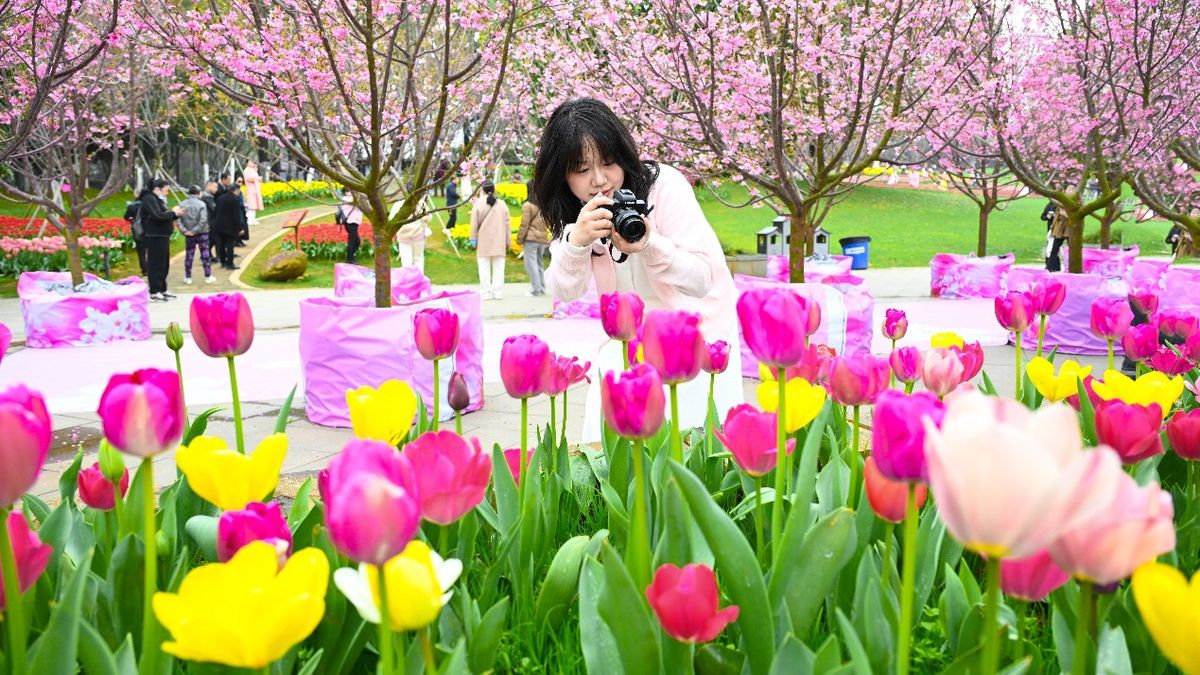
Where Nanchang goes to see the cherry blossoms
The first bus south leaves around six in the morning, and for a few weeks every spring it does not go out empty. By the time the gate opens at eight there is a queue of grandparents, tripods, prams and rented hanfu waiting to scan through — and then the crowd thins into the trees and the noise drops to shutter clicks and the occasional shout of a child who has found a petal drift worth lying down in.
This is Fenghuanggou (凤凰沟), and the first thing worth knowing about it is that nobody designed it to be a flower park. It is a working provincial farm — tea bushes, mulberry rows, fruit trees, research plots — that planted cherries along its lanes and then discovered a city would drive 35 kilometres to look at them. You're not walking through a set. You're walking through a farm in blossom, with the tea being picked in the next field.
What Fenghuanggou actually is
The park sits in Huangma (黄马), in Nanchang County (南昌县), roughly 35 km south of the city centre. The land belongs to the Jiangxi Institute of Sericulture and Tea (江西省蚕桑茶叶研究所), a provincial agricultural research station founded in 1958 to work on tea varieties and silkworms. Everything you see grew out of that brief: the park counts something like 2,150 mu of ecological tea gardens, demonstration mulberry plots, and an orchard block planted to fruit for as much of the year as the climate allows.
The cherry valley (樱花谷) is the famous part — official figures put it at close to 2,000 mu with something in the order of 100,000 trees across more than twenty varieties, from early Taiwanese and Japanese cherries through to late doubles. The Ministry of Agriculture named it one of China's "beautiful farmscapes", and the park holds a national 4A rating, which in practice means proper toilets, a visitor centre and paved paths rather than anything about the flowers.
The blossom festival itself has been running since the late 2000s. The 2022 season was billed as the fifteenth edition and the 2025 season as the eighteenth — count back and the first one lands around 2008, which makes this one of the older continuously running spring events in the province. A city ritual, in other words, not a marketing invention of the last few years.
When the blossom actually happens — and why you can't diary it
Cherry timing moves with the winter. Nobody, including the park, knows in October what March will do. What you can rely on is the shape of the season:
- Late February: the earliest varieties — the bell-flowered and early pink cherries — can open while it's still cold and grey. Thin, pretty, uncrowded.
- Early March: the park usually declares the season open. Recent years give you the range: the 2022 festival ran 12 March–4 April, 2025 ran 1 March–13 April, and 2026 was announced as 7 March–19 April.
- Mid-to-late March: peak, almost every year. This is when the tunnels close overhead and when the crowds are heaviest.
- Early-to-mid April: the late doubles carry the tail of the season while the early trees go to leaf.
So: plan for March, keep the dates loose, and check the week before you go. The park announces its opening and its peak on its official WeChat account (江西省凤凰沟景区), and there is a Chinese-language hotline, 400-9633-188. Both dates and the festival programme change annually — treat any specific date you read online, including the ones above, as history rather than forecast.
One more piece of timing that matters more than the calendar: go on a weekday, and go early. Spring Saturdays here are a genuine crush, and the gate opens around 8am. The first two hours are quiet, cool, and — if you care about photographs — the only time the light comes in low under the branches instead of straight down through them.
Getting there: three ways, and one trap
There is no metro to the gate, and there is no shortcut. Every route ends on a country road in Nanchang County, and the whole trip is 35 km each way.
1. Metro + bus (cheapest, ~2 hours door to door)
Ride Metro Line 3 south to Fuxing Avenue East (复兴大道东). Note the name carefully: this station was called Zhenxing Avenue (振兴大道) until it was renamed in March 2023, and half the blog posts and travel listings still use the old name. The road above it is still Zhenxing Avenue; the station is not. Line 3 is easy to reach from anywhere central — it meets Line 1 at Bayi Guan (八一馆) in the old town, Line 2 at Qingshan Lukou (青山路口), and Line 4 at Shengjinta (绳金塔), which is also the stop for the Shengjin Tower food street. From Bayi Guan it is nine stops south. If the metro is new to you, our Nanchang metro guide covers tickets and QR codes.
Come out at Exit 2 for Changnan Bus Station (昌南客运站), and pick up either bus 128 or bus C64, both of which run to the scenic-area gate. There is also a dedicated ¥5 shuttle line from the Changnan transport hub's north gate that runs out roughly 8:00–15:30 and back roughly 9:30–17:00, and which on the return also calls at Yinsanjiao North (银三角北), the southern terminus of Line 3 — useful, because it saves you the bus-station shuffle on the way home. Carry a few small notes; not every rural bus reader is friendly to a foreign phone.
2. DiDi or taxi (easiest, and what most visitors should do)
Reckon on 45 minutes to an hour from the centre depending on traffic and where you start. Get a live quote in the app before you commit — it's a long ride, and blossom-weekend surge pricing is real. The important part is the return: cars are scarce at the gate, especially once the day-trippers clear out. Either book your ride back before you lose signal in the valley, or ask your driver to wait (drivers will often agree for a fee, and on a busy Sunday it's money well spent).
3. Driving
About 45 minutes via the G60 expressway to the Huangma exit, then roughly 2 km to the gate; or off National Route 320 onto Lanyuan Avenue and 2 km in. There is parking, and on peak weekends it fills. Note that a foreign driving licence is not valid to self-drive in China, so for most overseas visitors this means a hired car with a driver — the same solution that works for the rest of the countryside around Nanchang.
The trap: public transport out here keeps farm hours. The shuttle line's last run back is mid-to-late afternoon, and listings for bus 128 vary between a mid-afternoon and an early-evening final departure. If you're relying on buses, ask at the gate what time the last one leaves the moment you arrive, and build your day backwards from that. And if you want the evening blossom session — during festival weeks the park has recently opened again around 18:00–21:00, with lit trees and a rotating cast of shows — assume you're getting home by car.
A half-day route through the park
Fenghuanggou covers roughly 6 square kilometres. You won't walk all of it, and you shouldn't try. Signage is Chinese-only, so photograph the map board at the gate before you set off. This loop takes about three to four hours at a civilised pace.
- Start at the North Gate (北门), before 9am. This is the visitor centre and the main ticket hall, and local advice is consistent that it queues less than the smaller gates. You can buy on the park's WeChat account in advance and scan straight through.
- Buy a shuttle-cart ticket at the same time. The electric carts loop the park with stops at the cherry valley, the tea maze, the tea sea and the orchard — recent listings put it around ¥20–25 per person. If you'd rather pedal, bike hire has run at roughly ¥8 an hour for a single and ¥15–16 for a tandem. Either beats walking the connecting roads, which are dull.
- Go straight to the cherry valley (樱花谷). Do this first, before the 10am wave. It's the densest planting, and the reason you came.
- Walk the tunnels. The park counts eight of them, running west from the "cherry blossom love" square (樱为爱情广场) to the zodiac garden (十二生肖园) across a couple of kilometres, and in recent seasons it has strung one long stretch with ribbons and wind chimes. Walk at least one tunnel end to end rather than photographing the entrance and turning back — this is the thing Fenghuanggou has that no other park in Jiangxi does.
- Climb the Sakura Pavilion (樱花阁). A recent addition, built for the view down over the canopy — the only way to see the pink as a mass rather than as branches.
- Cross to the tea sea (茶海) and the maze (茶海迷宫). This is the part visitors skip and shouldn't. The tea rows run over the hills in dark-green corduroy, and the maze — about 10 mu, laid out on the eight-trigram bagua pattern with clipped tea hedges as walls — is a genuinely odd and lovely thing to find in a farm park. From roughly mid-March the pickers are out here in wide hats, working the rows while visitors photograph the blossom fifty metres away: the spring flush has to come off before Qingming whether there's a festival on or not. Some seasons the park sells a hands-on picking session — ask at the gate.
- Finish at the orchard (百果园) and the silk museum. The Jiangxi Sericulture and Silk Eco-Museum (江西蚕桑丝绸生态博物馆), opened in 2012, runs through the whole arc of silk — hall by hall, from history to how the thread actually comes off a cocoon. Captions are Chinese, so bring a translation app. It's twenty quiet minutes, and it's the thing that explains the rest of the park.
- Eat, then leave before the buses do. See below.
Where to point the camera
Three shots are worth planning for. The tunnel interior, taken low and early, when the sun is still under the canopy and the light comes through the petals rather than off them. The tea rows against blossom — the green-and-pink contrast is the picture that says Fenghuanggou rather than "some cherry trees", and you can only get it where the plantings meet. And the elevated view from the Sakura Pavilion, best in the last hour of light. In recent seasons the park has also planted a tulip field as a piece of land art below the trees; if it's in, it's the easiest colour on site.
Two honest warnings. Everyone else is also taking photographs, and by late morning the prettiest tunnel entrances have a queue for the middle of the path. And if this is your only photography day in the region, weigh it against what else is around — our guide to Nanchang's best photo spots ranks the city's own options, most of which are free and reachable by metro.
What to eat
The food here is farm-canteen good, not destination good — but it has one genuine speciality you won't find in the city, because the institute grows the raw material. Mulberry, in everything.
- Mulberry-leaf steamed buns (桑叶馒头) — pale green mantou, faintly grassy, slightly sweet. The park has run a dedicated bun counter during recent blossom seasons; prices aren't published anywhere, so treat it as snack money and check the board. The easy first-timer pick, and good picnic fuel.
- Mulberry-leaf noodles (桑叶面) — the same green worked into a wheat noodle, springy and mild. A lunch, not a snack. Not spicy, which makes it the safe order if Jiangxi's chilli habit has caught you out.
- Cold-dressed mulberry leaves (凉拌桑叶) — a starter, served chilled with garlic and vinegar. More local, more of an acquired texture; order it if you like Chinese cold vegetable dishes.
- Old duck soup with mulberry branches (桑枝老鸭汤) — a clear, medicinal-tasting stock, the kind of dish Jiangxi families order for the table rather than for one person. Lunch, shared, and worth it in cold March weather.
- Mulberry juice and mulberry-fruit cakes (桑果汁 / 桑果糕) — sold at the museum shop alongside mulberry-leaf tea and silk. The juice is dark, tart and genuinely good; it also happens to be the best souvenir on site.
The sit-down option inside the park has for years been the Bailang Lake resort restaurant (白浪湖), out by the water, where the mulberry menu is done properly — ask for the "tea and mulberry" (茶海桑田) dishes. Park catering does get reshuffled between seasons, so confirm at the gate that it's open before you walk out there, and note there are simpler farmhouse kitchens nearer the tea sea. On a peak-season Saturday all of them are slammed at noon: either eat at 11:30 or bring a picnic. The lawns are made for it, and half the local families turn up with mats and thermoses.
Honest verdict: nobody comes to Fenghuanggou for dinner. Eat lightly here and save your appetite for the city — a proper bowl of Nanchang rice noodles back in town is a better meal than anything at the gate.
Is it worth it outside blossom season?
Straight answer: for a visitor with three days in Nanchang, no. For anyone living here, often yes.
The park runs on a four-season pitch its own signage sums up as "tea in spring, mulberry in summer, fruit in autumn, feasting in winter." That plays out as strawberry picking from around December through to May, mulberries and summer flower plantings — sunflowers and lavender among them — through the hot months, an orchard that carries peaches, kiwi, persimmon, loquat and pomelo across the second half of the year, and autumn colour into the early winter. It's a green, roomy way to spend a Sunday, and Nanchang families treat it as exactly that.
But it is the better part of an hour each way by car and closer to two by bus, and the flowers are what lift it above "nice big park". If you're here in spring and the cherries aren't out, the better use of the same day is the Anyi ancient villages and the rapeseed fields northwest of the city, or — if you have a full two days to spend — the terraced version of the same landscape at Wuyuan, which is the trip people actually cross provinces for.
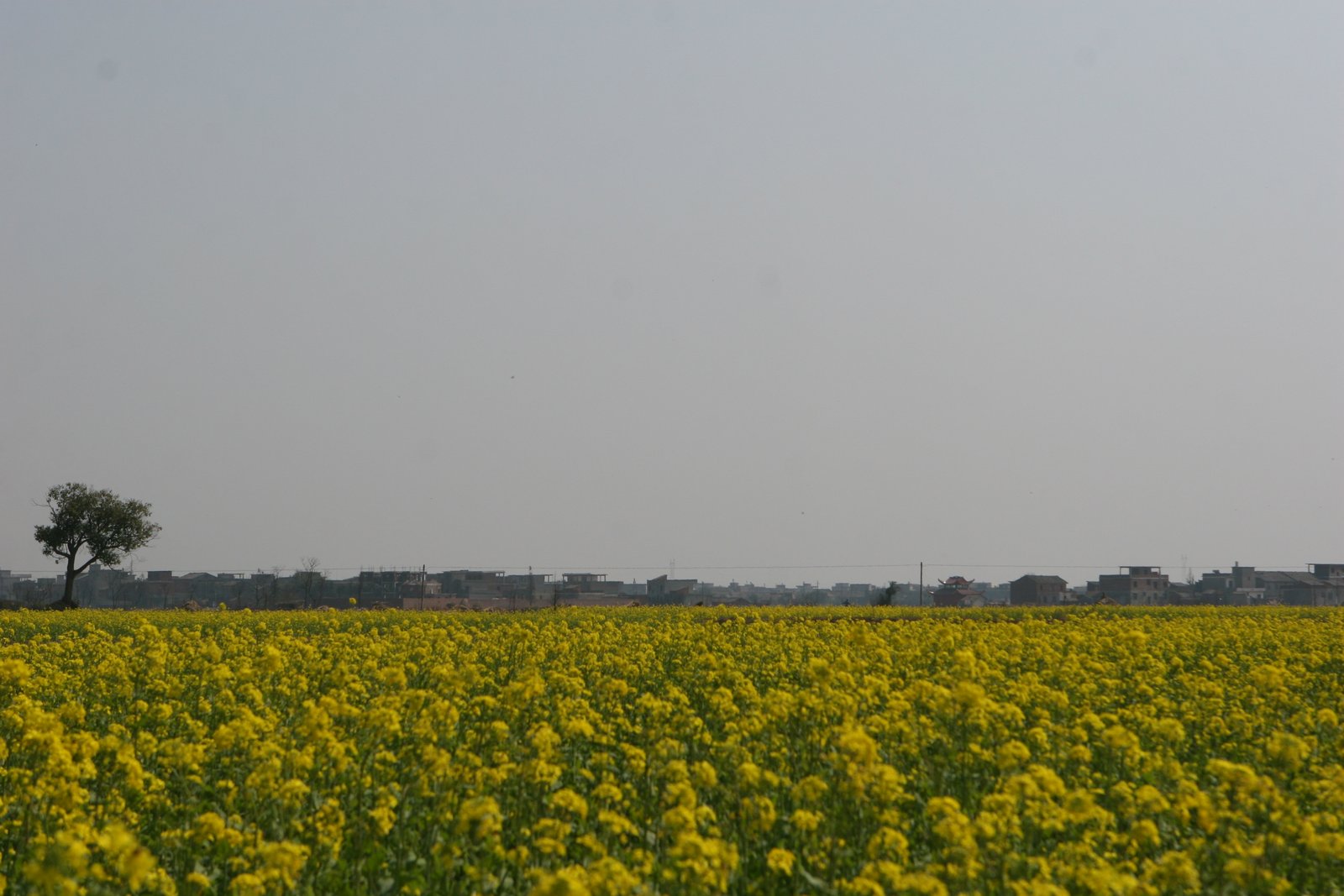
Nanchang's other spring: rapeseed comes into flower across the county at much the same time as the cherries, and pairs well with a Fenghuanggou morning. Photo: 张元柏 / Wikimedia Commons (CC BY-SA 3.0).
Practical info
- Where: Fenghuanggou Scenic Area, Huangma, Nanchang County, Jiangxi (江西省南昌市南昌县黄马乡凤凰沟风景区) — about 35 km south of central Nanchang. Save the Chinese name on your phone to show a driver.
- Getting there: Metro Line 3 to Fuxing Avenue East (复兴大道东), Exit 2 for Changnan Bus Station, then bus 128 or C64 to the gate; or the ¥5 shuttle line from the Changnan hub north gate. DiDi from the centre takes about 45–60 minutes.
- Hours: generally around 08:00–17:00, with ticket sales stopping at closing. During blossom-festival weeks the park has recently added an evening session around 18:00–21:00. Confirm both before travelling.
- Tickets: roughly ¥45–50 for adults depending on whether you buy in advance or at the gate; about ¥25 for full-time students and children 120–140 cm; free for children under 120 cm and visitors aged 65 and over. Prices and festival-season pricing change — check the park's WeChat account (江西省凤凰沟景区) or call 400-9633-188.
- Inside the park: shuttle carts around ¥20–25 per person; bike hire from roughly ¥8 an hour. Both are worth it given the distances.
- How long: three to four hours for the loop above; a full day if you add lunch, the museum and fruit picking.
- Pay and language: Alipay and WeChat Pay everywhere; carry ¥50–100 in small notes for buses and rural stalls. Signage and museum captions are Chinese-only — bring an offline translation app.
- Good for: families with small children, photographers in March, anyone who wants a day of open sky after a few days of city. Less good for: travellers on a tight two-day schedule, anyone who dislikes crowds on a spring weekend, and anyone hoping for English-language interpretation.
What to skip, and what to do if you only have three hours
Skip the add-on amusements. The park sells a rotating layer of paid extras around the flowers — costume rental, kiddie rides, animal-feeding pens, seasonal evening shows — and the line-up changes year to year. None of it is the reason to come, and on a peak Saturday all of it has a queue.
If you have three hours: North Gate, shuttle cart straight to the cherry valley, walk one tunnel end to end, cart to the tea sea for twenty minutes among the rows, back out. That's the whole of it, and on a clear March morning it's more than enough. Everything else — museum, orchard, lake, lunch — is the long version.
And if you'd rather someone else worked out the timings, the driver and the last bus, we can build the day into a Nanchang trip — Fenghuanggou slots neatly onto the front of a Nanchang weekend, with the city's riverfront and street food for the evening.
FAQ
When do the cherry blossoms bloom at Fenghuanggou?
The earliest varieties can open in late February, the park normally declares its season open in the first ten days of March, and peak is usually mid-to-late March, with late doubles running into April. Recent festivals have run 12 March–4 April (2022), 1 March–13 April (2025) and 7 March–19 April (2026), which tells you how much the window moves. Check the park's WeChat announcement the week before you travel.
How do I get to Fenghuanggou from Nanchang?
It's about 35 km south, with no metro to the gate. Cheapest: Metro Line 3 to Fuxing Avenue East (复兴大道东) — formerly named Zhenxing Avenue — Exit 2 for Changnan Bus Station, then bus 128 or C64, or the ¥5 shuttle line from the Changnan hub. Easiest: a DiDi, 45–60 minutes, with your return ride booked before you go into the valley.
How much does Fenghuanggou cost?
Adult entry has recently run around ¥45–50, with roughly ¥25 for students and children 120–140 cm and free entry under 120 cm and for over-65s. Budget another ¥20–25 if you want the shuttle cart. Prices change, so confirm on the park's WeChat account before you go.
Is Fenghuanggou worth visiting outside cherry-blossom season?
For residents, yes — it's a big, green, easy day out with strawberry picking in winter and spring, summer flower plantings, and an orchard that fruits through autumn. For a traveller with only a few days in Nanchang, no: it's the better part of an hour each way by car and closer to two by bus, and without the blossom it doesn't beat what's inside the city.
Is Fenghuanggou good for children?
It's one of the better family days near Nanchang — flat paths, wide lawns, shuttle carts, fruit picking and a silkworm museum that children tend to like more than their parents expect. Bring a picnic mat, go on a weekday, and be realistic about distances: the park is around 6 square kilometres, so use the cart.
Last verified: 2026-08 — bloom dates, festival programming, ticket prices, bus timetables and opening hours change every year; please check the park's official announcements before you travel.